
Why analyze sales performance: guide for European tech leaders
Only 47% of European SaaS sales reps hit quota in 2025, a stark reminder that gut feel and hope don’t scale. For tech sales leaders across Europe, analyzing sales performance isn’t just a reporting exercise. It’s the foundation for operational efficiency, revenue predictability, and competitive advantage. This guide unpacks why performance analysis matters, what metrics to track, common pitfalls to avoid, and how AI-driven revenue intelligence can transform your sales operations from reactive firefighting to proactive growth.
| Point | Details |
|---|---|
| Revenue intelligence boosts predictability | Revenue intelligence can transform sales operations from reactive firefighting to proactive growth and improve revenue predictability. |
| Data quality and GDPR impact | Data quality and GDPR compliance shape which tools you can deploy and how you analyze customer data in Europe. |
| Benchmarking identifies gaps | Benchmarking helps identify performance gaps by comparing quota attainment and win rates against European SaaS benchmarks. |
| Shift to proactive metrics | Shifting from reactive metrics to proactive measures enables better forecasting and resource planning. |
| Tailored AI for Europe | Using tailored AI tools designed for Europe helps address multilingual markets and data protection requirements. |
Sales performance analysis starts with knowing which numbers matter. Quota attainment measures the percentage of reps hitting their targets, a fundamental health check for any sales organization. Win rate tracks how many opportunities convert to closed deals, revealing the effectiveness of your sales process and messaging. Sales cycle length shows how long it takes to move prospects from first contact to signature, directly impacting cash flow and resource planning. Pipeline coverage compares the value of active opportunities to your revenue target, typically requiring a 3x to 5x multiple to account for natural deal slippage.
Recent 2025-2026 SaaS sales benchmarks paint a sobering picture for European tech companies. The median quota attainment sits at just 47%, meaning more than half of sales reps miss their targets. Average win rates hover around 20% for new business and 30% for expansion deals, while sales cycles stretch 3 to 6 months for mid-market SaaS deals. Pipeline coverage ratios vary widely, but high-performing teams maintain 4x to 5x coverage to buffer against inevitable deal losses.
These empirical sales performance benchmarks serve as reality checks for sales leaders setting targets. If your win rate is 15% and industry standard is 20%, you’ve identified a coaching opportunity or a qualification problem. If your sales cycle is 8 months when peers close in 4, you’re likely losing deals to faster competitors or struggling with internal approval processes. Understanding where you stand relative to European SaaS metrics helps you diagnose problems before they crater your quarter.
Pro Tip: Don’t use benchmarks as rigid targets. Your product complexity, deal size, and market maturity all influence what’s realistic. Use benchmarks to identify outliers and investigate why certain reps or segments perform differently, then replicate what works.
European tech sales leaders face unique hurdles when analyzing performance. GDPR compliance restricts which tools you can deploy and how you handle customer data, ruling out many US-centric platforms that lack adequate data protection safeguards. Multilingual markets add complexity, as sales conversations happen in German, French, Spanish, and a dozen other languages, making conversation intelligence and sentiment analysis more difficult. Data quality issues plague most organizations, with incomplete CRM records, inconsistent stage definitions, and missing close dates undermining any analysis you attempt.

Poor CRM hygiene is the silent killer of accurate forecasting. Why sales forecasts keep missing reveals that forecast errors stem from reps failing to update deal stages, logging inflated deal values to look busy, and neglecting to record lost deals promptly. When your CRM reflects wishful thinking instead of reality, any performance analysis built on that data is worthless. Over-reliance on vanity metrics compounds the problem. Revenue booked, total pipeline value, and activity counts look impressive in dashboards but tell you nothing about deal health or likelihood of closing.
Pipeline weighting based on deal stage probabilities offers a more honest view. Assigning a 10% probability to early stage opportunities, 25% to qualified leads, 50% to proposals, and 75% to verbal commitments creates a weighted pipeline value that accounts for natural attrition. Without probability weighting, a pipeline stuffed with stale opportunities gives false confidence until deals slip or disappear, leaving you scrambling at quarter end. This approach to improving forecast accuracy requires discipline but pays dividends in predictability.
“The biggest mistake sales leaders make is tracking lagging indicators like closed revenue without monitoring leading indicators like discovery call quality, demo-to-proposal conversion, and proposal-to-close rates. By the time revenue misses, it’s too late to fix the problem.”
Pro Tip: Audit your CRM data quality monthly. Spot-check 20 random opportunities to verify stage accuracy, completeness of contact information, and realistic close dates. Hold reps accountable for hygiene as part of their performance review, not just closed deals.
Artificial intelligence is shifting sales performance analysis from backward-looking reports to forward-looking insights. Revenue intelligence platforms ingest data from CRM, email, calendar, and conversation recordings to identify patterns invisible to human analysts. They flag at-risk deals based on engagement drop-offs, predict which opportunities will close based on historical win signals, and surface coaching moments where reps deviate from proven talk tracks. For European tech companies, the key is choosing GDPR-compliant tools that respect data sovereignty and privacy regulations.
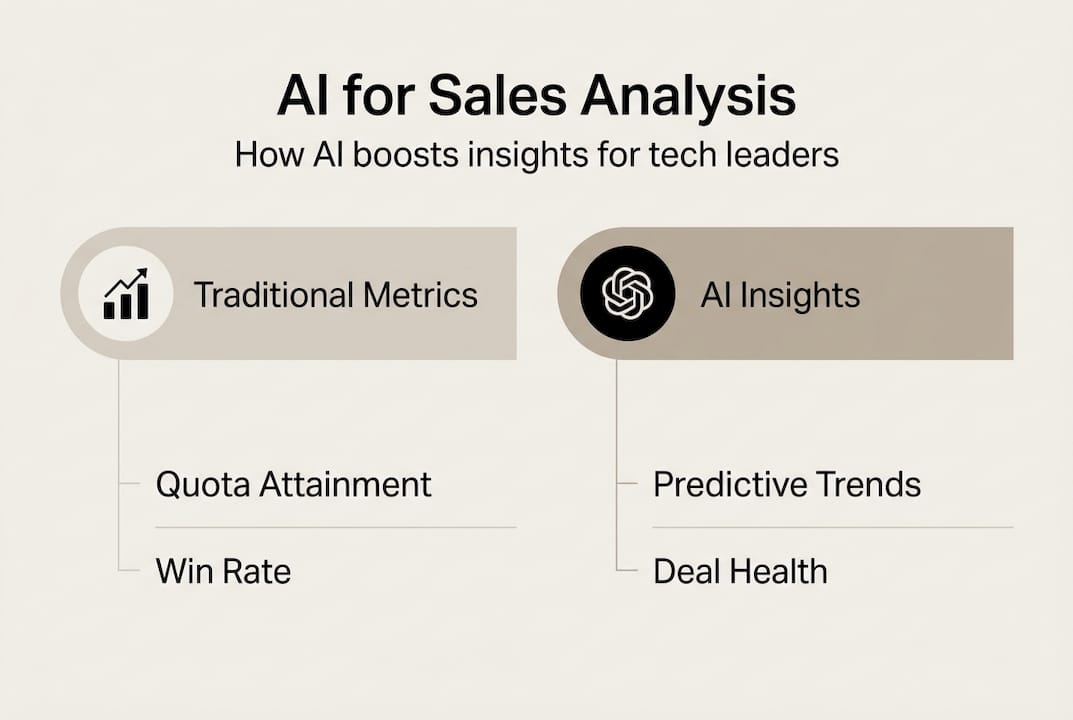
Kickscale, a European revenue intelligence platform, demonstrates the tangible benefits of AI-driven analysis. Kickscale AI sales intelligence platform expansion shows that companies using the platform see closing rates increase by 24% and save 40 hours per month on administrative tasks like data entry and report generation. The platform analyzes sales conversations, scores deal health, and recommends next best actions, all while keeping data within EU borders and adhering to strict privacy standards. These gains come from moving beyond static dashboards to dynamic, prescriptive guidance.
Implementing AI for sales analysis requires a structured approach. Start by defining clear objectives, whether improving forecast accuracy, shortening sales cycles, or increasing win rates. Choose tools designed for European markets that integrate with your existing tech stack and comply with GDPR. Train your team on how to interpret AI recommendations, emphasizing that technology augments human judgment rather than replacing it. Monitor adoption and iterate based on feedback, adjusting configurations to match your unique sales process.
To maximize value from AI tools for sales analysis, integrate metrics across three tiers. Track activity metrics like calls made and emails sent to ensure sufficient pipeline generation. Monitor conversion metrics like demo-to-proposal and proposal-to-close rates to identify process bottlenecks. Measure outcome metrics like quota attainment and customer acquisition cost to evaluate overall sales effectiveness. AI platforms excel at connecting these tiers, showing how changes in activity drive conversion improvements that ultimately boost outcomes.
| AI Capability | Impact on Analysis | European Consideration |
|---|---|---|
| Conversation intelligence | Identifies winning talk tracks and objection handling | Requires multilingual NLP models |
| Deal scoring | Predicts close probability based on engagement signals | Must account for longer European sales cycles |
| Automated data capture | Eliminates manual CRM updates | GDPR compliance for email and calendar access |
| Forecasting algorithms | Improves accuracy by 20-30% over manual methods | Needs training data from European markets |
Pro Tip: Start small with AI adoption. Pilot with a single team or use case, measure results, and expand once you’ve proven ROI. Trying to transform your entire sales operation overnight leads to resistance and failed implementations.
Executing effective sales performance analysis requires a systematic approach. First, gather relevant data from your CRM, marketing automation platform, customer success tools, and financial systems. Define the KPIs that align with your strategic goals, whether that’s increasing average deal size, shortening sales cycles, or improving customer retention. Avoid the trap of tracking everything and focus on the 5 to 7 metrics that truly drive your business.
Second, identify patterns and gaps in your performance data. Segment analysis by rep, region, product line, and customer segment to uncover where you’re winning and where you’re struggling. Look for leading indicators of trouble, such as declining demo-to-proposal conversion rates or increasing time between proposal and close. Compare your metrics against sales analysis 5-step process benchmarks to contextualize your performance and spot areas for improvement.
Third, create actionable plans based on your findings. If win rates are low in a specific segment, investigate whether it’s a product-market fit issue, a pricing problem, or a skills gap in your sales team. If sales cycles are lengthening, map your buyer journey to identify friction points and streamline approvals. Translate insights into concrete initiatives with owners, timelines, and success metrics. Analysis without action is just interesting trivia.
Fourth, implement integrated revenue platforms that connect marketing, sales, and customer success data. Siloed systems create blind spots and make it impossible to track the full customer journey. Modern revenue operations platforms provide a single source of truth, enabling you to see how marketing qualified leads progress through the sales funnel and into customer success. This end-to-end visibility is essential for identifying bottlenecks and optimizing the entire revenue engine.
Fifth, avoid relying on Excel spreadsheets for large-scale analysis. Spreadsheets work for small teams but become unmanageable as data volume grows. They’re prone to formula errors, version control nightmares, and lack real-time updates. Purpose-built sales analytics tools offer automation, visualization, and collaboration features that spreadsheets can’t match. Investing in proper infrastructure pays for itself through time savings and better decision making.
Common pitfalls to avoid in your sales performance review process include:
Analyzing sales performance is just the first step. Translating insights into sustained improvement requires robust sales enablement that equips your team with the skills, content, and processes to execute consistently. Sales Label Consulting specializes in helping European tech companies build predictable revenue engines through tailored enablement programs. Our approach combines sales audits to diagnose current state, enablement strategies to address gaps, and demand generation tactics to keep your pipeline full.
Whether you’re looking to implement a structured sales enablement step by step predictable revenue framework, adopt proven sales enablement best practices from high-growth tech companies, or measure impact through sales enablement metrics that tie to business outcomes, we bring the entrepreneurial tech experience to guide you confidently through complex challenges. Contact us to explore how we can help your sales organization move from reactive to proactive performance management.
Quota attainment, win rate, and pipeline coverage are the foundational metrics every tech sales leader must monitor. Quota attainment reveals whether targets are realistic and reps are capable, while win rate indicates sales process effectiveness and competitive positioning. Pipeline coverage shows whether you have enough opportunities to hit revenue goals, typically requiring 4x to 5x coverage. Beyond these basics, track sales cycle length to identify process inefficiencies and customer acquisition cost to ensure unit economics make sense.
GDPR restricts which sales intelligence and conversation analytics tools European companies can legally deploy. Many US-centric platforms store data outside the EU and lack adequate privacy safeguards, creating compliance risk. European tech sales leaders must choose GDPR-compliant alternatives like Kickscale that keep data within EU borders and provide transparent data handling practices. This regulatory constraint actually drives better vendor selection, as compliant tools tend to have stronger security and privacy features overall.
Poor CRM hygiene is the most pervasive pitfall, with incomplete or inaccurate data rendering analysis useless. Relying on vanity metrics like total pipeline value without probability weighting creates false confidence that evaporates at quarter end. Over-dependence on Excel spreadsheets for large data sets leads to errors, version control problems, and lack of real-time visibility. Finally, analyzing performance quarterly instead of continuously means you discover problems too late to course correct, missing early warning signals that deals are slipping.
AI enables proactive revenue intelligence by analyzing patterns across thousands of deals to predict outcomes and recommend actions. Conversation intelligence identifies which talk tracks and objection handling techniques correlate with wins, allowing you to coach reps on proven approaches. Deal scoring algorithms flag at-risk opportunities based on engagement signals, giving you time to intervene before they’re lost. Automated data capture eliminates manual CRM updates, saving 40 hours monthly while improving data quality. For European tech firms, GDPR-compliant AI tools like Kickscale deliver these benefits while respecting privacy regulations, increasing closing rates by 24% through smarter, faster decision making.
Subscribe to our Insights: Expert productivity tips in your inbox
You'll receive 1-3 emails per month. Your data stays private, always.

CRO & Co-Founder with Sales Label Consulting

Watch our Sales Mates Podcast
October 15, 2026 - 9 min read
Read article Read articleOctober 14, 2026 - 7 min read
Read article Read articleOctober 13, 2026 - 10 min read
Read article Read articleOctober 12, 2026 - 11 min read
Read article Read article