
Sales Enablement Best Practices for Scaling Revenue
Sales leaders in Western European IT firms know the pressure of shifting customer demands and rising competition. Coordinating efforts across departments can feel like a constant challenge when the sales process keeps evolving. Focusing on sales enablement as a holistic framework empowers teams to bridge gaps between marketing, sales, and operations while staying aligned with customer needs. Discover practical strategies and tools that move your team from siloed effort to unified, customer-driven performance.
| Point | Details |
|---|---|
| Sales Enablement Defined | Sales enablement is a strategic function that aligns various departments to optimize sales processes and enhance revenue generation. |
| Technology Integration | A cohesive technology stack, including AI analytics and content management, is essential for effective sales enablement. |
| Cross-Functional Collaboration | Breaking down departmental silos through collaboration improves communication and aligns efforts toward shared objectives. |
| Continuous Learning and Measurement | Ongoing, tailored training programs and robust metrics tracking are vital for adapting to market dynamics and improving sales performance. |
In the rapidly evolving world of technology-driven sales, sales enablement has emerged as a critical strategic function designed to align organizational efforts toward revenue generation. Sales enablement represents a holistic framework that integrates multiple departments to optimize the entire sales ecosystem.
At its core, sales enablement is about creating a synchronized approach that empowers sales representatives with the right tools, knowledge, and resources to engage customers effectively. This comprehensive strategy goes beyond traditional sales training by addressing the complex intersection of technology, process, and human performance.
Key components of modern sales enablement include:
The primary objective is transforming sales from a transactional process to a strategic, customer-centric approach. By breaking down departmental silos and fostering collaborative environments, organizations can create more responsive and agile sales mechanisms that adapt quickly to changing market dynamics.
Pro tip: Invest in cross-functional training programs that help sales teams understand the broader organizational ecosystem and customer journey.
The modern sales enablement landscape is characterized by sophisticated technology ecosystems that transform how organizations approach revenue generation. Advanced sales enablement technologies have become critical for creating intelligent, data-driven sales strategies that adapt to rapidly changing market conditions.

Today’s most effective sales technology stacks typically comprise several interconnected platforms designed to streamline and optimize sales performance. These technologies go beyond simple customer relationship management (CRM) systems, integrating multiple advanced capabilities that support the entire sales workflow.
Key components of a comprehensive sales enablement technology stack include:
Successful implementation requires more than just acquiring these tools. Organizations must create a cohesive technology strategy that aligns these platforms, ensuring seamless data flow and providing sales teams with intuitive, integrated experiences that actually enhance their productivity.
Here’s how key sales enablement tools drive business impact:
| Tool Type | Primary Function | Business Impact |
|---|---|---|
| Content Management System | Centralizes and shares sales materials | Boosts efficiency, reduces redundancy |
| AI Analytics Platform | Provides performance insights | Enables data-driven strategy adjustments |
| Sales Engagement Platform | Tracks customer communication | Increases personalized selling, higher win rates |
| Training Environment | Offers skill development sessions | Accelerates ramp-up, improves skill retention |
Effective sales enablement technology is not about having the most tools, but about having the right tools that work together strategically.
Pro tip: Conduct a thorough audit of your current technology stack to identify integration opportunities and potential performance gaps before investing in new sales enablement tools.
Successful sales enablement demands more than individual talent. Cross-functional collaboration strategies are fundamental in creating a unified approach that breaks down traditional departmental barriers and drives organizational performance.
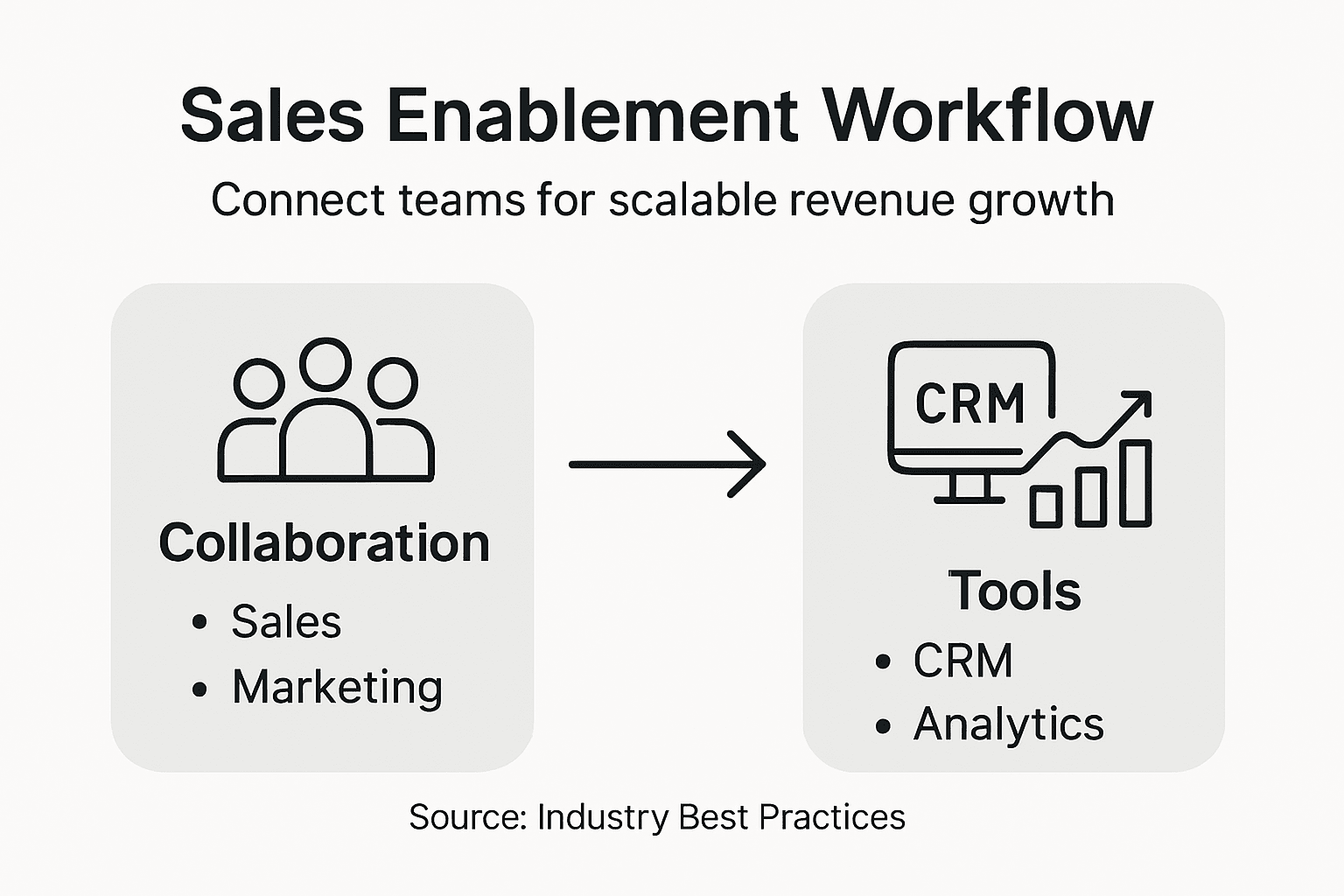
Modern sales teams require sophisticated coordination mechanisms that ensure seamless communication and shared accountability across marketing, product, and sales departments. This integrated workflow approach transforms siloed operations into a holistic, customer-focused ecosystem where information flows smoothly and strategic objectives are consistently aligned.
Key elements of effective workflow integration include:
Technology plays a critical role in enabling these collaborative workflows. Advanced platforms now provide real-time insights, shared dashboards, and integrated communication channels that allow different teams to work together more efficiently and strategically.
Effective collaboration is not about eliminating departmental boundaries, but about creating transparent, flexible connections that enhance collective performance.
Pro tip: Schedule monthly cross-functional meetings with representatives from sales, marketing, and product teams to maintain alignment and identify potential workflow optimization opportunities.
Sales enablement requires a strategic approach to training and content development that goes beyond traditional learning methods. Data-driven training approaches have become critical for transforming sales team performance and driving consistent revenue growth.
Modern sales training must be dynamic, personalized, and continuously adaptive to meet the evolving challenges of complex sales environments. This means moving away from one-size-fits-all training programs toward tailored learning experiences that address individual skill gaps, leverage technology, and align closely with specific organizational objectives.
Key components of an effective training and content strategy include:
Successful content strategies require a deep understanding of buyer personas, sales team capabilities, and the specific value propositions that drive customer engagement. Organizations must create content that not only educates but also empowers sales representatives to have more meaningful, consultative conversations.
Effective sales enablement content is not about volume, but about providing precisely targeted insights that help sales professionals solve customer problems.
Pro tip: Conduct quarterly skills assessments and create personalized learning paths that address individual performance gaps and emerging market trends.
Sales enablement metrics represent the critical measurement framework that transforms intuitive strategies into quantifiable results. Data-driven sales effectiveness metrics enable organizations to track, analyze, and continuously improve their revenue generation capabilities.
Comprehensive measurement goes beyond traditional performance indicators, requiring a holistic approach that captures both quantitative and qualitative dimensions of sales team performance. This multifaceted evaluation helps leaders understand the true impact of enablement initiatives and make informed strategic decisions.
Key performance indicators (KPIs) for measuring sales enablement impact include:
Successful measurement requires sophisticated analytics platforms that can integrate data from multiple sources, providing a nuanced view of sales team performance. Organizations must develop robust tracking mechanisms that offer real-time insights and predictive capabilities.
Effective metrics are not just about collecting data, but about transforming raw information into actionable strategic intelligence.
Pro tip: Implement a quarterly review process that combines quantitative metrics with qualitative feedback to create comprehensive performance assessments.
Sales enablement programs often fail due to systemic issues that undermine their potential effectiveness. Strategic optimization approaches are critical for transforming potential pitfalls into opportunities for meaningful organizational improvement.
Many organizations struggle with fragmented enablement strategies that lack cohesive alignment between technology, training, and business objectives. These disconnected approaches create inefficiencies that prevent sales teams from achieving their full potential, resulting in wasted resources and diminished revenue generation capabilities.
Common mistakes in sales enablement implementation include:
Successful optimization requires a holistic approach that integrates technology, data, and human-centric design principles. Organizations must develop agile enablement strategies that can quickly adapt to changing market dynamics and individual sales representative needs.
Here’s a summary of common sales enablement mistakes vs. proven optimization solutions:
| Mistake | Negative Effect | Optimization Solution |
|---|---|---|
| Siloed training events | Inconsistent sales performance | Implement ongoing, tailored learning |
| Generic content | Low buyer engagement | Focus on buyer-centric messaging |
| Ignoring metrics | Poor insight into effectiveness | Track KPIs and conduct regular reviews |
| Weak cross-team links | Slow market response | Foster regular collaborative meetings |
Effective sales enablement is not about implementing perfect systems, but about creating flexible frameworks that continuously learn and improve.
Pro tip: Conduct monthly cross-functional retrospectives to identify enablement program gaps and develop iterative improvement strategies.
Scaling revenue requires more than just isolated efforts It demands a unified sales enablement strategy that breaks down silos integrates advanced technology and fosters continuous skill development Sales Label Consulting understands the challenges you face such as fragmented training low buyer engagement and lack of cross-team collaboration that limit your sales potential Our tailored consulting services in Sales Enablement and Sales Audit help RevOps Heads of Sales and VPs of Sales build flexible frameworks that deliver predictable and error-free results by aligning technology people and processes for maximum impact
Ready to transform your sales team?s performance and achieve sustainable revenue acceleration Start your journey with Sales Label Consulting where our entrepreneurial tech expertise powers intelligent strategies that adapt and improve continuously Don?t let missed opportunities hold your organization back Visit Sales Label Consulting today to book a consultation and unlock the full potential of your sales enablement program
Sales enablement is a strategic function that aligns multiple departments to optimize the sales process, empowering sales representatives with tools, knowledge, and resources to engage customers effectively.
Technology improves sales enablement by integrating various platforms that streamline communication, provide data-driven insights, and enhance training and coaching, thereby improving overall sales team performance.
Key metrics include sales velocity, win rates, content engagement, training effectiveness scores, and productivity benchmarks, which help organizations evaluate and enhance their sales enablement strategies.
Common mistakes include treating enablement as a one-time training event, neglecting personalization in learning experiences, underutilizing technology, and failing to foster cross-functional collaboration.
Subscribe to our Insights: Expert productivity tips in your inbox
You'll receive 1-3 emails per month. Your data stays private, always.

CRO & Co-Founder with Sales Label Consulting

Book a free consultation call
October 23, 2026 - 10 min read
Read article Read articleOctober 22, 2026 - 9 min read
Read article Read articleOctober 21, 2026 - 9 min read
Read article Read articleOctober 20, 2026 - 9 min read
Read article Read article