
Defining sales engagement: A practical guide for tech sales leaders
TL;DR:
- Sales engagement is a structured operating discipline encompassing all buyer interactions across the sales cycle to achieve revenue goals. Most teams confuse it with tools or cadence, risking lost opportunities; defining clear sequences, ownership, and measurable outcomes enhances performance. Effective engagement relies on deliberate, multi-channel sequencing, continuous measurement, and organizational clarity, not just automation or scripts.
Sales engagement gets thrown around in board decks, tool demos, and hiring briefs like it means something obvious. It doesn’t. Most sales leaders we speak with use it interchangeably with sales enablement, cadence, or CRM activity, and that confusion is quietly costing them pipeline. Sales engagement is the structured approach to plan, execute, and manage seller to buyer interactions across the sales cycle so touchpoints are intentional, timely, and aligned to revenue goals. Get the definition right first. Everything else follows.
| Point | Details |
|---|---|
| Sales engagement defined | It’s the intentional, sequenced process of seller-buyer interactions that drives measurable pipeline outcomes. |
| Focus on operationalization | The difference between leaders and laggards is how engagement is structured, executed, and measured. |
| Avoid concept confusion | Keep enablement, cadence, and engagement distinct so sales teams don’t fall into execution traps. |
| Process beats theory | Top teams design engagement as daily discipline, not a one-off campaign, and win more as a result. |
Let’s clear the air. Sales engagement is not a tool category, a buzzword, or a synonym for “sending more emails.” It’s an operating discipline. And treating it as anything less is where most teams start losing deals they should have won.
Sales engagement covers all interactions between sales reps and buyers, making it a broader concept than narrower terms like “cadence” or “enablement.” Think of it as the full architecture of how your team shows up to buyers at every stage of the sales cycle. That includes calls, emails, LinkedIn messages, demos, follow-ups, and every touchpoint in between. It’s not one thing. It’s the whole system.
For European tech sales leaders especially, this definition needs to be operational. As Highspot frames it, sales engagement should be defined as a governed, multi-channel interaction sequence tied to measurable outcomes like response rate, meeting conversion, and stage progression. Not just a collection of scripts your SDRs rotate through on autopilot.
Real talk: If your team can’t tell you which touchpoint in which sequence is driving the most meetings, you don’t have a sales engagement strategy. You have a collection of habits.
Here’s what a mature engagement discipline actually covers:
You can get a sharper view of how this connects to the broader revenue picture by reading about measuring sales effectiveness. Because until you instrument your engagement, you’re flying blind.
Pro Tip: Start by auditing your current touchpoints without judgment. Map out every interaction your reps have with prospects in a typical deal. That map is your baseline. Everything you improve from here becomes measurable.
This is where most teams get tangled. The terms sound similar, they overlap at the edges, and leaders often blur them when building their go-to-market stack. That blurring creates execution risk. So let’s draw hard lines.
Engagement definitions blur with adjacent concepts like enablement, sales strategy, playbooks, cadences, and CRM workflows. That’s the problem. Leaders should separate “what you operationalize” (the touchpoint sequence) from “what you equip” (enablement) and from “how you build strategy.” Three different layers. Three different owners. Three different conversations.
Here’s a simple way to keep them straight:
| Concept | What it means | Who owns it | Key output |
|---|---|---|---|
| Sales engagement | What reps do with buyers | Sales ops or RevOps | Executed touchpoint sequences |
| Sales enablement | What reps are given to succeed | Enablement or marketing | Content, training, tools |
| Sales cadence | A specific sequence of touches | Usually sales ops | Structured contact plan |
| Sales strategy | The why and target segments | VP Sales or CRO | ICP, positioning, go-to-market |
| CRM workflows | Automation of admin tasks | RevOps | Data accuracy, process triggers |
Each of these serves a purpose. The mistake is treating them as one thing. When an SDR skips follow-ups because “we have cadences in the tool,” but there’s no governance over which cadences run when, you’re looking at an engagement failure masquerading as a technology problem.
Sales engagement operationalizes the sales strategy into a repeatable sequence of touchpoints, stages, actions, and workflows that moves a prospect from first contact to closed-won. That’s the mechanics definition. Cadence is a subset of that. Enablement feeds it. Strategy shapes it.
A few practical distinctions that matter when you’re building your operating model:
Getting this right is directly tied to understanding sales KPIs and knowing which numbers actually signal engagement health versus vanity activity. And if you’re unsure where consulting fits into this, the short answer is: we help you draw these lines and own them operationally.
Now we’re getting into the engine room. Theory is useful. But world-class sales teams win because they operationalize engagement into repeatable, trackable, coachable sequences. Here’s how it actually works in practice.

Sales engagement platforms are used to plan, track, execute, and optimize multi-channel interactions rather than relying on rep memory and ad hoc follow-up. This matters enormously at scale. When you have 15 reps managing 40 active prospects each, no one can hold all of that in their head. Structure replaces heroics.
A typical high-performing engagement sequence for B2B tech might look like this:
This is not revolutionary. What’s revolutionary is actually running it consistently across your entire team, tracking every touchpoint, and iterating based on what the data tells you.
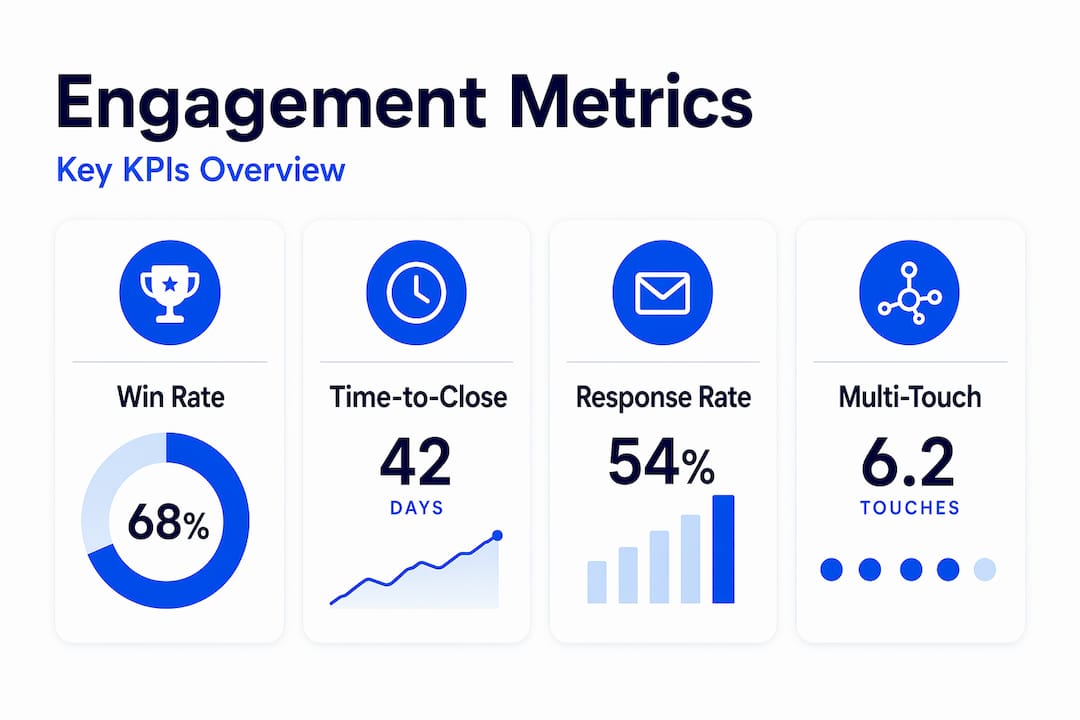
Engagement performance benchmarks are tied to metrics like win rate, time-to-close, and multi-touch dynamics. The data consistently shows that structured, multi-touch sequences outperform ad hoc outreach in both response rate and deal velocity. That’s not an opinion. That’s pattern recognition from thousands of sales cycles.
| Engagement metric | What it measures | Why it matters |
|---|---|---|
| Response rate per sequence step | Which touchpoint generates replies | Optimize sequence order and messaging |
| Meeting conversion rate | Outreach to booked meeting ratio | Pipeline generation efficiency |
| Time-to-first response | Speed of buyer engagement | Signals interest and urgency |
| Stage progression rate | Deals moving forward per week | Reflects engagement quality, not just volume |
| Win rate by sequence type | Which sequences close more deals | Guides future playbook decisions |
For deeper context on which metrics to prioritize for your European tech org, the guide on EU sales metrics is worth a close read.
Pro Tip: Don’t just measure activity (emails sent, calls made). Measure outcomes per touchpoint (replies per email, meetings per call). That’s where you find the leverage. One high-performing step in a sequence is worth more than five low-performing ones.
One more thing: you don’t need a $50,000 platform to start. You need a defined sequence, clear ownership, a way to track execution, and a rhythm for reviewing performance. Learn more about sales automation benefits and how to use technology purposefully rather than just adding tools to your stack. The best place to start optimizing is by reviewing your tech sales outreach approach from the ground up.
Even well-structured engagement plans trip up in reality. Here’s what often goes wrong, and how to avoid it.
Real talk: Most engagement breakdowns aren’t strategy failures. They’re execution failures. The playbook existed. The tools were in place. No one owned the sequence end-to-end.
Sales engagement often fails in practice when teams lack real-time visibility and coordinated workflows, even when strategy and playbooks exist. You can have a beautiful engagement framework and still lose deals if your reps can’t see where each prospect is in the sequence, what’s overdue, or what the next best action is.
Here are the most common failure modes we see with European tech sales teams:
Because “sales engagement” is an umbrella term for all interactions, there’s a real risk that leaders implement tooling or training without fully specifying the sequence, ownership, measurement, and stage-specific needs, which leads to inconsistent outcomes across the team.
The fix isn’t always more technology or more training. Often it’s tighter definition. Who owns each step? What does a “completed touchpoint” mean? What triggers the next action? These questions sound operational because they are. And they’re exactly the questions you have to answer before you scale anything.
For teams navigating longer deal timelines, the dynamics around managing long sales cycles are especially relevant to keeping engagement consistent without burning out your reps.
Here’s our honest take, earned from working with tech sales teams across Europe.
Most leaders treat sales engagement as a project. They map sequences, buy a tool, run training, and declare victory. Then six months later they’re asking why conversion rates haven’t moved. The real problem? Engagement is an operating discipline, not a one-time initiative. It requires obsessive measurement, clear ownership, and continuous adaptation.
The leaders who get it right do three things differently.
First, they operationalize sequences before they automate them. Before any platform goes live, they’ve defined exactly which touchpoints exist, in what order, triggered by what, owned by whom, and measured by what metric. Automation then amplifies something that already works. Not the other way around.
Second, they tie every touchpoint to a KPI. Not “this email is part of the nurture sequence.” But “this email’s job is to generate a reply within 72 hours, and if it doesn’t, we know the message needs to change.” Tying each step to a clear KPI measurement transforms engagement from activity into data.
Third, they build organizational clarity around engagement. Who owns the sequence design? Who coaches reps on execution? Who reviews performance weekly? Structure beats heroics every single time. One rep who owns their sequence end-to-end will consistently outperform three reps running ad hoc outreach, no matter how talented those three reps are.
The uncomfortable truth? Most “engagement problems” are actually clarity problems. Define it tightly, own it operationally, and measure it relentlessly. That’s the formula.
Understanding sales engagement at this level is already an advantage. Most of your competitors are still treating it as a buzzword. But understanding and operationalizing are two different things.
If you’re ready to move from framework to execution, Sales Label Consulting helps RevOps leaders, Heads of Sales, and VPs of Sales turn engagement principles into predictable, measurable revenue. Start with a deep read on step-by-step sales enablement to understand how engagement and enablement work together in practice. Or use a sales audit for revenue growth to identify exactly where your current engagement model is leaking pipeline. We work with European tech companies to build engagement disciplines that are defined, owned, and built to scale.
Sales engagement is what your reps do in interactions with buyers, while enablement is what you provide reps to succeed. Leaders should separate the two to avoid blending execution with preparation, which creates accountability gaps.
Key engagement metrics include win rate, time-to-close, response rate per touchpoint, and multi-touch interaction counts. These reveal whether your sequences are driving outcomes, not just activity.
Not immediately, but platforms help teams plan, track, and optimize multi-channel interactions at scale rather than relying on rep memory. Start with a defined sequence; add technology once the process logic is solid.
Define clear sequences with step-by-step ownership and real-time visibility into execution. Teams fail at engagement when playbooks exist but no one is accountable for following through at each stage, so tightening governance solves more than adding new tools does.
Subscribe to our Insights: Expert productivity tips in your inbox
You'll receive 1-3 emails per month. Your data stays private, always.

CRO & Co-Founder with Sales Label Consulting

Watch our Sales Mates Podcast
October 25, 2026 - 9 min read
Read article Read articleOctober 24, 2026 - 8 min read
Read article Read articleOctober 23, 2026 - 10 min read
Read article Read articleOctober 22, 2026 - 9 min read
Read article Read article