
How to optimize remote sales teams for peak results
TL;DR:
- Remote sales teams outperform fully remote setups by 28% when structured properly and supported with effective coaching. Building trust, structured onboarding, and outcome-focused management are crucial for maximizing performance and retention in distributed European sales organizations. Successful teams treat results as the key metric, leveraging hybrid models and deliberate development to sustain growth and engagement.
Remote sales teams have become the backbone of modern tech sales organizations across Europe, yet most companies are still operating with playbooks built for the office. Here’s what should get your attention: hybrid teams outperform fully remote setups by 28% in likelihood of better outcomes, and experienced teammates sitting near new hires boost productivity by 12.2%. That single data point challenges everything you thought you knew about “remote-first.” In this guide, we break down why remote sales teams need more than Slack and a CRM, and what it actually takes to build a structure where reps close deals, stay engaged, and grow their numbers quarter after quarter.
| Point | Details |
|---|---|
| Hybrid outperforms remote | Hybrid sales teams are 28 percent more likely to excel than fully remote ones according to recent research. |
| Coaching drives remote engagement | Short, consistent coaching plus immediate feedback is crucial for high-performing remote sales teams. |
| Trust and autonomy matter | Screening for autonomy and building trust are key to preventing silos and productivity issues. |
| Structure beats micromanagement | Regular check-ins and clear expectations help remote teams thrive without feeling controlled. |
Remote selling is not new, but the pandemic compressed a decade of adoption into 18 months. What changed is not just where reps work. It’s what buyers expect, how deals move, and what skills a quota-carrying rep needs to survive.
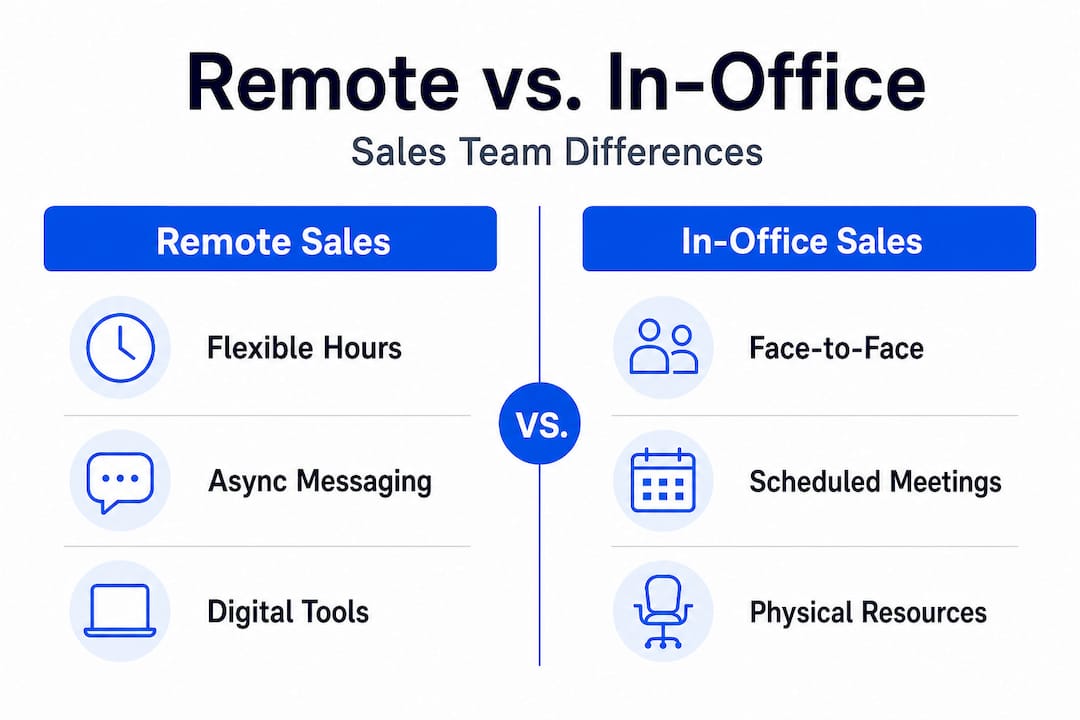
Before 2020, remote sales was largely a perk reserved for senior enterprise reps with established books of business. Today, SDRs, AEs, and even sales managers operate entirely distributed across time zones, working Europe-wide or globally from day one. The role has shifted from presence-based to performance-based, and that is not always a smooth transition.
Remote versus in-office sales teams: key differences
| Dimension | In-office teams | Remote sales teams |
|---|---|---|
| Communication | Real-time, face-to-face | Async-first, video-heavy |
| Productivity patterns | Fixed hours, visible activity | Outcome-driven, flexible |
| Coaching | Shoulder-to-shoulder, spontaneous | Structured, scheduled, intentional |
| Culture building | Organic, incidental | Deliberate, engineered |
| Onboarding speed | Faster peer learning | Slower without structured pairing |
| Risk factors | Groupthink, office politics | Silos, isolation, low retention |
The research backs this up with some nuance. Remote sales setups can drive higher activity rates and revenue per rep, but they also carry real risks: team silos, isolation, and lower retention when structure is absent. The data is clear that results over presence is the right north star, but you have to build the architecture that makes results possible.
New competencies now matter more than ever for remote reps:
If you’re building a high-performance sales team, these competencies should sit right at the top of your hiring scorecard, not buried under “nice to have.”
Here’s the hard truth: most sales coaching was designed for the hallway conversation, the ride-along, or the post-call debrief over coffee. Drop that model into a remote environment and it stops working almost immediately. Sessions get skipped. Feedback lands flat. Reps feel invisible.
Coaching remote vs. in-person: what changes
| Element | In-person coaching | Remote coaching |
|---|---|---|
| Session length | 45 to 60 minutes | 20 to 30 minutes, focused |
| Feedback style | Informal, frequent, immediate | Structured, recorded, specific |
| Tools used | Whiteboard, call shadowing | Call recording platforms, video review |
| Frequency | As-needed, opportunistic | Scheduled, consistent cadence |
| Engagement signals | Body language, energy | Camera presence, participation rate |
| Risk | Favoritism, inconsistency | Reps feeling unseen or forgotten |
Forbes research on coaching remote teams is direct: short, consistent sessions with role-play elements, immediate specific feedback, and regular check-ins are the levers that actually move engagement. Not annual performance reviews. Not long quarterly syncs.
Here are 5 steps for effective virtual coaching:
Pro Tip: Make the goal for your remote reps to feel seen, not watched. There’s a world of difference between a manager who checks in because they care about growth versus one who monitors screen time. If your reps associate your name with surveillance, your coaching has already failed before it starts.
“The best remote coaching creates a space where reps feel challenged, supported, and trusted. When feedback arrives with empathy and specificity, it sticks. Without those two elements, it just creates friction.”
Reviewing sales coaching techniques built specifically for pipeline impact and understanding sales coaching’s impact on tech team success can help you shape a program that actually translates to ARR growth. And if you want a practical starting framework, our sales team coaching tips are built around getting to predictable results, not just activity.
Let’s talk about what actually goes wrong. Because plenty does, and most of it is avoidable once you know what to look for.
The trust gap is the first and most damaging issue. Only 54% of managers say they trust their remote team’s productivity. That number is alarming. If you don’t trust your reps, you’ll micromanage. Micromanagement kills autonomy. And autonomy, as we’ve established, is a core competency for remote sales success. It becomes a self-defeating cycle.
Time zone fragmentation is another real operational problem, especially for European sales teams covering CET, GMT, and beyond. When your SDR in Warsaw can’t sync with your AE in Lisbon in real time, deals stall. Async communication disciplines need to be engineered, not hoped for.
Top 5 remote management pitfalls
Pro Tip: Screen for autonomy and accountability during hiring, before someone joins your team. Ask candidates about a time they managed a long sales cycle solo, or how they structure their own day without external accountability. The answers reveal more than any personality test. Pairing this with the right sales team motivation framework helps you keep the right people engaged after they’re hired.
The high-ticket close also deserves a specific mention here. Deals over six figures require trust-building that is harder to accelerate through video. Virtual persuasion is a skill that must be trained, not assumed. Your senior reps may have built relationships in person for years and now need a conscious reset of how they convey authority and empathy through a camera.
Awareness of the challenges is the starting point. Execution is where the distance gets made up. Here’s what the highest-performing remote sales organizations in European tech are doing differently.
Six action steps to align, engage, and measure remote teams:
For tactical execution, reviewing sales strategy examples built around team performance and implementing step-by-step sales training programs designed for tech sales teams will dramatically compress your ramp timeline.
Structure beats heroics. Every time. The remote sales teams that win aren’t doing it through hustle alone. They’re operating inside a repeatable system where every rep knows what’s expected, how they’re supported, and what success looks like.

Real talk: most articles about remote sales teams focus almost entirely on tools and processes. Better CRM hygiene. Another Slack integration. A fancier dashboard. And while those things matter at the margin, they are not what actually separates high-performing remote sales teams from struggling ones.
The uncomfortable truth is that many sales leaders over-index on control and chronically under-invest in development. They buy software to track activity but won’t budget for two extra coaching hours per rep per month. They monitor pipeline updates in real time but haven’t had a genuine career development conversation with their team leads in six months. That’s a leadership gap, not a technology gap.
Here’s the counterintuitive insight we share with clients regularly: hybrid is often a stepping stone, not the destination. Leaders see hybrid as the compromise position between full office and full remote. We’d argue that for many tech sales teams in Europe, hybrid is actually the developmental stage where your culture and processes get strong enough to eventually support a higher-performing distributed model. Done right, you use the hybrid phase to build the coaching infrastructure, async communication discipline, and outcome-based management habits that then scale into a strong remote organization. Rush past that phase without building the foundation, and you’ll feel it in your retention numbers within 18 months.
The most successful remote teams we’ve worked with share one defining characteristic: they treat outcomes as the primary currency, and activity as context, not the goal. If a rep hits 130% of quota by working unconventional hours and having a quirky prospecting process, that’s not a problem to fix. That’s a model to understand, document, and replicate. When leaders start managing people as humans optimizing for results, rather than workers optimizing for visibility, everything shifts. Trust goes up. Autonomy increases. And yes, results follow.
The advanced coaching methods we use with clients are built on exactly this principle: develop the person, trust the process, and measure what actually matters.
Reading this is a great start. Implementing it across a distributed team with real pipeline pressure, competing priorities, and evolving quotas? That’s where most organizations need an outside perspective.

At Sales Label Consulting, we work directly with RevOps leaders, Heads of Sales, and VPs of Sales at European tech companies to audit your current setup, identify the friction points, and build a sales enablement structure that works for a remote or hybrid team. Our approach covers sales enablement best practices, step-by-step enablement frameworks designed for predictable revenue, and the kind of deep consulting support in sales that turns strategy into repeatable execution. If the ideas in this article resonate, let’s have a direct conversation about where your team stands and what it takes to move the needle.
Effective remote sales teams combine autonomy, regular coaching, and clear performance metrics. Short, consistent sessions with immediate specific feedback and regular check-ins are what sustain engagement and drive results over time.
Yes. Hybrid teams are 28% more likely to outperform fully remote setups, with experienced teammates also lifting new hire productivity by a measurable 12.2%.
Pair new hires with experienced teammates from day one and schedule structured weekly check-ins during the first 90 days. Experienced teammates significantly boost new hire productivity, especially in the critical ramp period.
Low trust and team silos are the most damaging risks when structure is absent. Remote setups can create isolation and lower retention if intentional engagement frameworks aren’t built into the operating model from the start.
Weekly is the standard for high-performing remote teams. Consistent, short coaching sessions of 20 to 30 minutes each, combined with structured role-play and immediate feedback, outperform longer but infrequent sessions by a significant margin.
Subscribe to our Insights: Expert productivity tips in your inbox
You'll receive 1-3 emails per month. Your data stays private, always.

CRO & Co-Founder with Sales Label Consulting

Watch our Sales Mates Podcast
September 21, 2026 - 8 min read
Read article Read articleSeptember 20, 2026 - 13 min read
Read article Read articleSeptember 19, 2026 - 13 min read
Read article Read articleSeptember 18, 2026 - 10 min read
Read article Read article