
Sales team onboarding: frameworks for faster ramp and ROI
Most new sales reps take longer to close their first deal than their managers expect. Without a structured process, 40-70% faster productivity stays a missed opportunity rather than a measurable outcome. In European IT companies especially, where sales cycles are complex and product knowledge runs deep, unstructured onboarding doesn’t just slow ramp time. It bleeds revenue, burns out managers, and pushes good hires out the door before they ever hit quota. This guide gives you the frameworks, checklists, and sequencing logic to fix that.
| Point | Details |
|---|---|
| Faster ramp matters | Structured onboarding can halve ramp time and deliver quick productivity gains. |
| 90-day framework works | A phased 90-day plan supports effective knowledge transfer and measurable milestones. |
| Preparation sets success | IT setup, access, and clear early goals are critical before day one. |
| Custom-fit onboarding | Tailor the process for different roles and experience levels to avoid overload. |
| Enablement drives results | Sales enablement, not HR, should own quota-impact training and ongoing coaching. |
Before we get into actionable steps, let’s clarify why sharpening your onboarding process truly moves the needle for your team and bottom line.
The numbers are hard to ignore. Companies with structured onboarding achieve 40-70% faster ramp, 25-50% higher retention, and 10-20% better quota attainment. Those aren’t marginal gains. For a team of ten reps, that gap between structured and unstructured onboarding can represent hundreds of thousands in missed pipeline annually.
Real-world cases reinforce this. A Fortune 500 telecom saw a 20% quota increase after redesigning its sales onboarding program. Furza, a sales training firm, cut ramp time in half for clients using structured onboarding sequences. PropTech firm Granlund reported faster productivity gains after implementing milestone-based onboarding for its sales team.
The most common complaints from sales leaders without a structured process are predictable: reps take too long to book their first meeting, managers spend too much time hand-holding, and attrition spikes in the first 90 days. These aren’t talent problems. They’re process problems.
“Structured onboarding doesn’t just accelerate ramp time. It creates a repeatable system that scales with your team, regardless of how fast you hire.”
If you’re building or scaling an IT sales team, the onboarding process is the single highest-leverage investment you can make in your first 90 days with a new hire.
Key business outcomes of structured onboarding:
With the high stakes clear, here’s how leading sales orgs in technology map the path from new hire to quota crusher.
Structured 90-day frameworks with clear milestones are standard in top-performing sales organizations. The logic is simple: break the ramp into phases, assign specific goals to each phase, and measure progress before moving forward. Here’s how the phases break down:
| Phase | Timeframe | Focus | Key outcome |
|---|---|---|---|
| Pre-boarding | Before day 1 | Tech setup, welcome comms, admin | Rep arrives ready to work |
| Foundation | Days 1-30 | Company, product, process, tools | Core knowledge locked in |
| Shadowing | Days 31-60 | Observe top performers, join calls | Real-world context built |
| Independent execution | Days 61-90 | Self-led outreach, first deals | Quota activity begins |
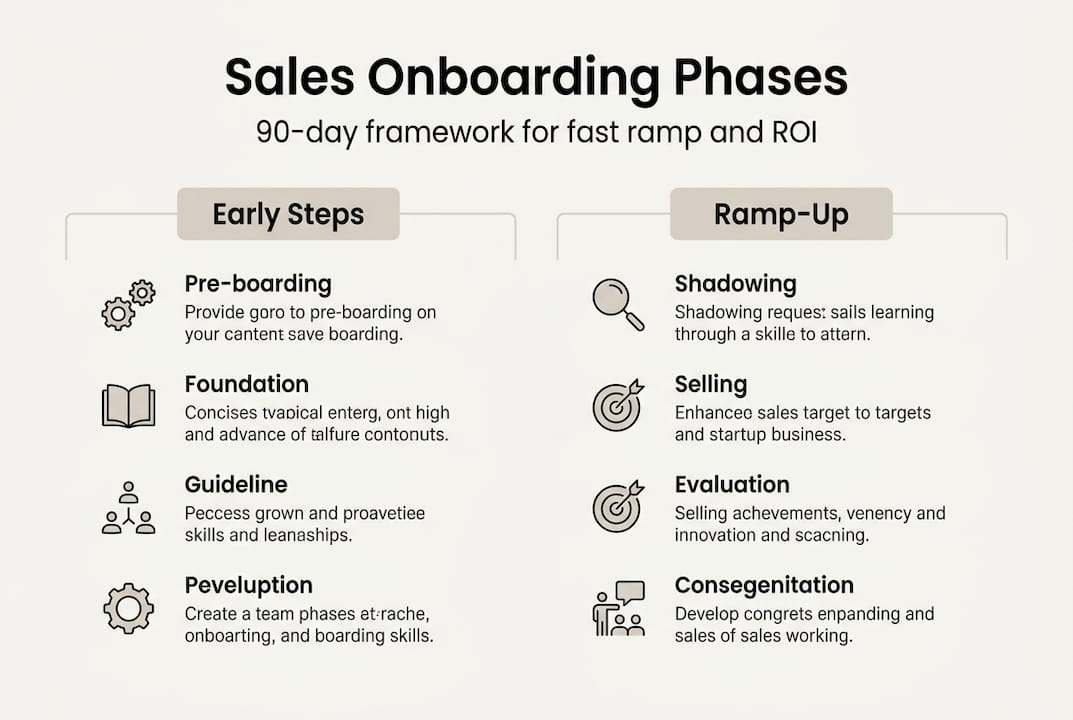
Each phase builds on the last. Skipping or rushing any one of them creates gaps that show up later as inconsistent behavior, missed targets, or early churn.
For IT and SaaS companies, the foundation phase often needs extra time. Products are complex, buyer personas are technical, and the sales process involves multiple stakeholders. Factor that into your timeline rather than forcing a generic 30-day knowledge sprint.
Here’s what sales enablement should cover at each stage:
If you want to see how this maps to broader sales frameworks, the sequencing logic applies across most B2B tech environments.
Understanding the framework is crucial, but execution starts the moment you offer the job. Here’s how to ensure every new hire lands running.
Key onboarding elements include pre-boarding, a structured welcome email, CRM access on day one, a product deep-dive schedule, and clear KPI expectations from the start. Most companies get the HR side right and completely drop the ball on the sales-specific setup.
| Prepare before day 1 | Assign by day 30 |
|---|---|
| Laptop, email, CRM login | CRM workflow certification |
| Welcome email with schedule | First outreach sequence built |
| Slack/Teams access | ICP and persona quiz passed |
| Compliance training assigned | Shadow call debrief completed |
| First-week agenda shared | Initial pipeline targets set |
The core training elements your new hire needs aren’t complicated, but they do need to be sequenced. Context before content. Company story before product specs. Process before tools.
Common pre-boarding mistakes to avoid:
Pro Tip: Don’t overload new hires with product knowledge in the first week. A rep who understands why your buyers care about your solution will outperform a rep who can recite every feature but can’t connect it to a business problem.
With the foundation set, execution is about sequencing skills, tools, and real-world learning. Here’s how world-class onboarding gets it right.

Foundational onboarding steps include company and product training, a full sales process walkthrough, CRM and tools setup, shadowing top performers, and goal setting with clear milestones. The sequence matters as much as the content.
Here’s the training sequence that consistently produces faster ramp in IT sales teams:
Role-specific coaching at each milestone is what separates good onboarding from great onboarding. A junior rep needs more scaffolding on process. A senior hire needs context on your specific buyers and internal tools, not a lecture on how to run a discovery call.
Pro Tip: Track early activity metrics like calls made, emails sent, and demos booked before you focus on quota. Activity predicts pipeline. Pipeline predicts revenue. If the activity numbers are healthy in month two, quota attainment in month four takes care of itself.
For a detailed breakdown of how to structure step-by-step sales training for tech teams, the sequencing logic above maps directly to what works in European IT environments. You can also review how sales process setup connects to onboarding milestones for a tighter execution plan.
Not all onboarding should look the same. Here’s how experts tailor success for every seat on your sales team.
Ramp time and milestones should be customized by sales role, product complexity, and rep experience to avoid information overload. A one-size-fits-all program is one of the most common reasons onboarding fails in growing IT companies.
Here are the most common adaptive factors and how to adjust:
The goal isn’t to make onboarding easier. It’s to make it relevant. A senior enterprise rep sitting through a basic CRM tutorial on day five is already mentally checking out. A new grad thrown into independent outreach on day 30 is set up to fail.
For more on how to adapt your sales management approaches across different team structures, the same principles apply whether you’re running a startup sales floor or a scaled corporate team.
Finally, it’s critical to draw a clear line between what HR delivers on day one and what your sales enablement team must own.
Separating HR orientation from sales enablement onboarding is one of the most important structural decisions a sales leader can make. HR sets the context: policies, benefits, compliance, and company culture. Sales enablement drives quota skills: process, personas, playbooks, and pipeline methodology. Mixing the two dilutes both.
“When HR owns the entire onboarding experience, sales reps arrive at their first customer call knowing the vacation policy but not the ICP. That’s a structural failure, not a training problem.”
Common onboarding pitfalls that happen when these two functions blur:
The fix is a clear ownership model. HR owns days one through three. Sales enablement owns everything from day four onward. Both teams align on the schedule before the hire’s first day.
Review sales enablement best practices to see how leading IT sales orgs structure this handoff. The sales enablement essentials checklist is a practical starting point for defining what your enablement team should own from day four.
If your onboarding process still relies on ad hoc manager knowledge and a shared Google Drive folder, you’re leaving measurable revenue on the table. The frameworks in this guide work, but implementation is where most teams stall.
At Sales Label Consulting, we work directly with RevOps leaders, Heads of Sales, and VPs of Sales in European IT companies to build onboarding programs that produce predictable ramp times and consistent quota attainment. From structured sales enablement frameworks to hands-on program design, we bring the operational depth that turns good intentions into repeatable results. Explore our best practices for scaling your sales enablement function and see how a structured approach changes what’s possible for your team.
With structured onboarding, most tech sales reps ramp in 3-6 months. Without it, average ramp in tech runs 4.5 months for general tech roles and up to 9-12 months for enterprise SaaS, with structured programs cutting that by 34-50%.
It’s a phased plan that divides onboarding into pre-boarding, foundation, shadowing, and independent selling, each with clear milestones and measurable outcomes before the rep advances to the next stage.
Track ramp time, early activity metrics like calls and demos, 90-day retention, and the percentage of reps hitting quota. Companies with structured programs see 40-70% faster ramp and 10-20% higher quota attainment.
HR covers orientation, but sales enablement must lead job-specific training. Separating the two prevents compliance content from crowding out the process and persona training that actually drives quota performance.
Sequence information by priority, start with context before content, and track leading metrics like calls and demos before focusing on quota. Tailor the pace to the rep’s role and prior experience.
Subscribe to our Insights: Expert productivity tips in your inbox
You'll receive 1-3 emails per month. Your data stays private, always.

CRO & Co-Founder with Sales Label Consulting

Watch our Sales Mates Podcast
October 11, 2026 - 7 min read
Read article Read articleOctober 10, 2026 - 8 min read
Read article Read articleOctober 9, 2026 - 7 min read
Read article Read articleOctober 8, 2026 - 10 min read
Read article Read article