
Sales Enablement Step by Step for Predictable Revenue
Every Sales leader knows the frustration of setting ambitious revenue targets only to fall short because enablement objectives lack clarity and bite. Aligning measurable goals with corporate strategies is more than a box-ticking exercise—it shapes how your European tech company drives consistent results. This article uncovers how actionable and quantifiable metrics anchor sales enablement for predictable growth, guiding you toward practical steps that tackle operational hurdles and empower your team.
| Key Insight | Explanation |
|---|---|
| 1. Set Clear Enablement Objectives | Define specific and measurable goals that align with business performance for effective sales enablement. |
| 2. Assess Current Sales Processes | Conduct a thorough evaluation of existing workflows to identify inefficiencies and improvement opportunities. |
| 3. Tailor Enablement Tools and Content | Develop customized, interactive resources that fit your sales team’s unique needs and learning styles. |
| 4. Implement Structured Training | Roll out comprehensive training programs that support continuous skill development and performance improvement. |
| 5. Continuously Verify and Optimize | Regularly assess the effectiveness of your strategies using metrics and feedback to ensure ongoing improvements. |
Defining clear sales enablement objectives is the foundation for building a predictable revenue machine. In this critical phase, you’ll establish measurable goals that align your sales enablement strategy directly with overall business performance.
Successful enablement requires a strategic approach to setting objectives that go beyond generic targets. Start by identifying your specific business challenges and mapping enablement goals that address those precise needs. This means creating actionable and quantifiable metrics that provide genuine insight into sales team performance.
To create robust enablement objectives, consider these key components:
Your objectives should cover multiple dimensions, including:
When developing these metrics, focus on establishing meaningful performance benchmarks that provide actionable insights. This approach transforms enablement from a theoretical exercise into a strategic revenue acceleration tool.
Here’s a summary of key enablement objective types and their business impact:
| Objective Type | Example Metric | Business Impact |
|---|---|---|
| Skill Development | Training hours completed | Higher sales effectiveness |
| Knowledge Retention | Assessment pass rates | Improved product expertise |
| Content Utilization | Resources accessed per rep | Greater message consistency |
| Productivity Improvements | Deals closed per quarter | Increased revenue predictability |
The most effective enablement objectives are specific, measurable, and directly tied to revenue generation outcomes.
Pro tip: Create a dashboard that tracks your enablement metrics in real-time, allowing immediate visibility into progress and potential areas of improvement.
Understanding and evaluating your existing sales processes is crucial for developing a strategic roadmap toward improved revenue generation. In this step, you’ll conduct a comprehensive examination of your current sales ecosystem to pinpoint inefficiencies and potential areas of improvement.

To effectively assess your sales processes, leverage systematic gap analysis techniques that provide structured insights into performance bottlenecks. These diagnostic approaches help you move beyond surface-level observations and uncover deep-rooted operational challenges. Begin by mapping out your entire sales workflow, documenting each stage from lead generation to deal closure.
Key areas to scrutinize during your assessment include:
When performing your gap analysis, consider these critical evaluation methods:
The most effective gap assessments reveal not just problems, but transformative opportunities for sales process optimization.
Pro tip: Involve sales representatives directly in the assessment process to gain ground-level insights and ensure comprehensive analysis.
Successful sales enablement demands creating precise, targeted learning experiences that transform your team’s performance. In this critical phase, you’ll develop customized tools and content that speak directly to your sales team’s unique needs and learning styles.
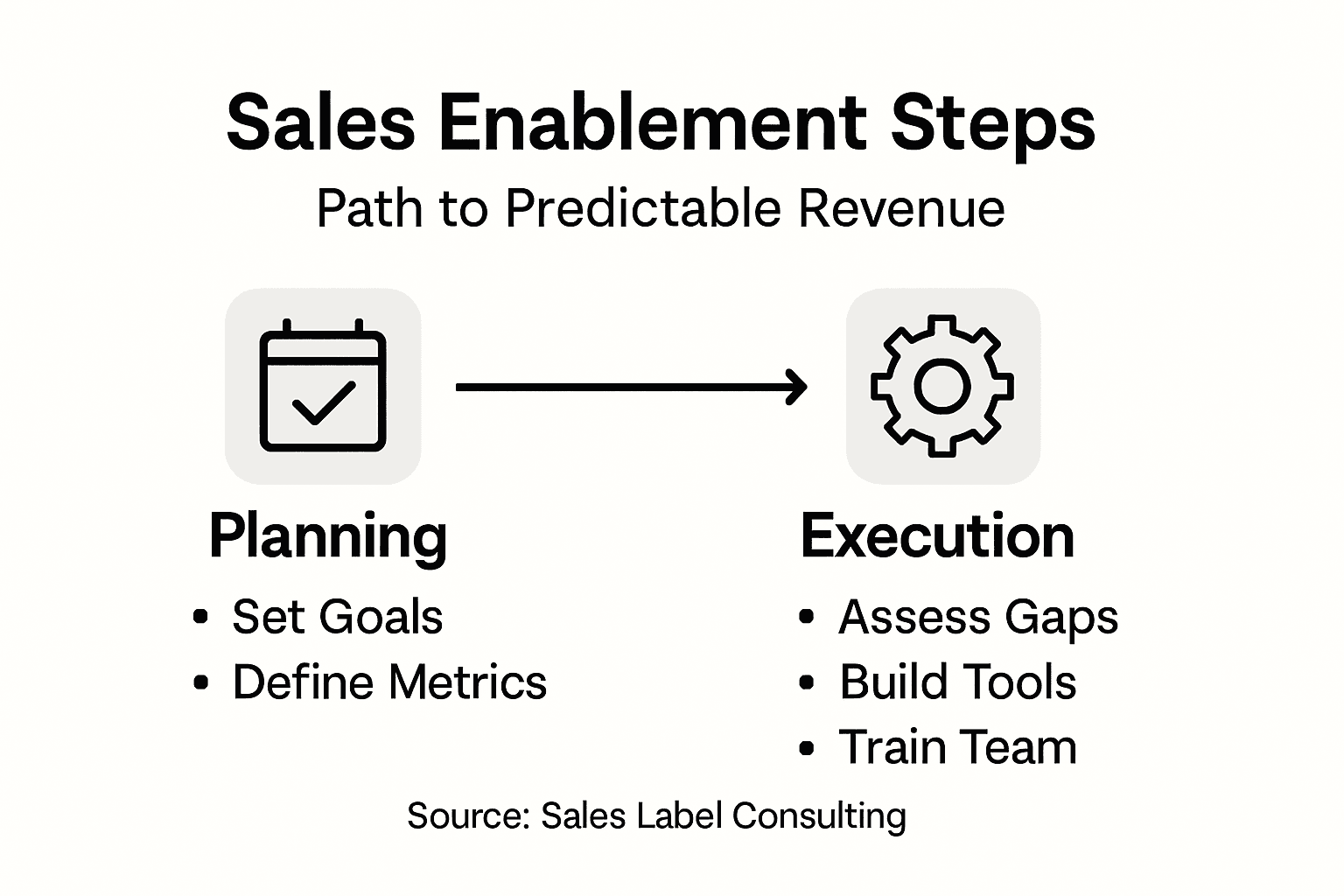
To craft truly effective enablement resources, design a learning experience that goes beyond generic training materials. This means developing multimedia-rich, interactive content that adapts to individual learning preferences and skill levels. Your goal is to create tools that are not just informative, but engaging and immediately applicable to real-world sales scenarios.
Key components of your enablement toolkit should include:
When designing your enablement content, follow these strategic development steps:
This comparison highlights traditional vs. tailored sales enablement resources:
| Resource Approach | Traditional Enablement | Tailored Enablement |
|---|---|---|
| Content Format | Generic presentations | Interactive, role-specific modules |
| Engagement Level | Passive learning | Active, adaptive experiences |
| Measurement | Limited tracking | Real-time performance dashboards |
| Customization | One-size-fits-all | Personalized for team needs |
Effective sales enablement tools are not one-size-fits-all, but precision-engineered solutions tailored to your team’s unique dynamics.
Pro tip: Prototype your enablement tools with a small sales team segment and iterate based on their direct feedback to ensure maximum relevance and impact.
Implementing a robust sales enablement training program transforms your team’s performance from sporadic to systematic. In this critical phase, you’ll roll out comprehensive learning experiences that equip your sales professionals with the skills and tools necessary for consistent revenue generation.
To maximize impact, design structured sales enablement training that blends multiple learning approaches. This means creating a dynamic ecosystem of resources that support continuous skill development and real-time performance improvement. Your implementation strategy should encompass formal instruction, self-paced learning, and ongoing coaching mechanisms.
Key components of your training implementation include:
When rolling out your enablement training, follow these strategic implementation steps:
Successful sales enablement training is not about information transfer, but transformation of sales team capabilities.
Pro tip: Create a dedicated internal communication channel where sales representatives can share insights, ask questions, and collaborate on learning experiences in real-time.
Evaluating the effectiveness of your sales enablement program is crucial for continuous improvement and sustained revenue growth. In this final phase, you’ll systematically assess performance, identify areas of opportunity, and refine your strategies to drive predictable sales outcomes.
To ensure meaningful optimization, continuously evaluate enablement performance through comprehensive metrics and targeted feedback mechanisms. This means moving beyond surface-level assessments and diving deep into data-driven insights that reveal your program’s true impact on sales productivity and revenue generation.
Key components of your verification and optimization process include:
When verifying and optimizing your enablement strategies, follow these critical steps:
Optimization is not a one-time event, but a continuous journey of strategic refinement and performance enhancement.
Pro tip: Create a quarterly review dashboard that automatically highlights performance deltas and provides actionable recommendations for enablement strategy improvements.
Building predictable revenue starts by addressing common challenges like unclear sales objectives, process gaps, and ineffective training and content design. This article highlights the need for measurable enablement objectives, thorough sales process assessments, tailored training tools, and ongoing optimization. If you are a RevOps leader or Head of Sales striving to transform these goals into confident, error-free outcomes, expert guidance can make all the difference.
At Sales Label Consulting, we specialize in partnering with sales leaders to navigate complex enablement challenges using proven strategies and entrepreneurial tech experience. Whether you need to optimize your sales enablement framework, conduct a comprehensive Sales Audit, or drive demand generation efforts that boost consistent revenue, we bring tailored solutions that turn strategic concepts into actionable results.
Ready to stop trial and error and start accelerating revenue predictability now?
Take the first step with us.
Explore how our consulting expertise can elevate your sales team’s performance and unlock measurable growth. Visit Sales Label Consulting to learn more and get started today.
The key objectives of sales enablement include aligning your enablement goals with overall business performance, ensuring measurable outcomes, and enhancing sales team skills. Start by defining specific goals, such as increasing close rates or improving product knowledge, within 30–60 days.
To assess your current sales processes, map out your entire sales workflow and document performance metrics at each stage. Analyze lead qualification, team productivity, and technology utilization to prioritize improvement areas based on potential revenue impact.
Create tailored tools such as interactive training videos, role-specific simulations, and real-time performance tracking dashboards. Focus on developing multimedia-rich resources that adapt to your sales team’s unique learning needs and preferences for optimal engagement.
Implement a structured training program that blends formal instruction, self-paced learning, and coaching. Begin with onboarding modules, followed by targeted skill workshops, and utilize digital platforms to provide on-demand resources for continuous skill development.
To verify outcomes, track performance metrics, collect feedback from your sales team, and perform comparative analyses against industry benchmarks. Establish continuous improvement protocols to refine your enabling resources and strategies systematically, aiming for quarterly reviews to assess progress.
Subscribe to our Insights: Expert productivity tips in your inbox
You'll receive 1-3 emails per month. Your data stays private, always.

CEO & Co-Founder with Sales Label Consulting

Lets book a free consultation
October 15, 2026 - 9 min read
Read article Read articleOctober 14, 2026 - 7 min read
Read article Read articleOctober 13, 2026 - 10 min read
Read article Read articleOctober 12, 2026 - 11 min read
Read article Read article