
Outbound sales drives strategic revenue growth in the EU
TL;DR:
- Outbound sales in the EU remains a powerful and compliant growth channel when executed with proper strategy and legal safeguards.
- Most sales leaders overestimate GDPR risks, but with legitimate interest, opt-outs, and documentation, outbound can generate predictable revenue.
Outbound sales has a reputation problem in Europe. Between GDPR headlines, overcrowded inboxes, and the endless “cold email is dead” posts on LinkedIn, plenty of sales leaders have quietly dialed back their outbound programs, or abandoned them entirely. That’s a costly mistake. The reality is that outbound, when executed with the right strategy, targeting, and compliance framework, remains one of the most powerful levers for predictable pipeline growth in the EU market. This guide cuts through the noise and gives you a clear, actionable picture of how to make outbound work legally, strategically, and profitably.
| Point | Details |
|---|---|
| Outbound is not illegal | Outbound sales in the EU is allowed if executed with the right legal basis and compliance safeguards. |
| Compliance is ongoing | Treat GDPR requirements as part of daily sales operations, not just a legal hurdle. |
| Outbound drives growth | Well-run outbound programs capture new revenue streams that inbound alone can’t reach. |
| Strategy over volume | Modern outbound success relies on targeting, personalization, and compliance—not just sending more emails. |
Let’s clear the air on what’s actually true about outbound sales in the EU. Most sales leaders we speak with dramatically overestimate the legal risk. They hear “GDPR” and picture massive fines and cease-and-desist letters. That fear is understandable, but it’s not accurate.
The real talk: cold outreach isn’t automatically illegal under GDPR. You can conduct B2B cold outreach if you have a valid legal basis, most commonly legitimate interest, and if you include proper safeguards like an opt-out mechanism and compliance documentation. That’s a very workable framework for most mid to large companies with a focused ICP (Ideal Customer Profile).
“In the EU, outbound via cold email/cold outreach is not automatically illegal under GDPR; it must have a valid legal basis and include safeguards such as an opt-out mechanism and compliance documentation.” — Is Cold Email Legal?
Here are the most common myths and what’s actually true:
Myth: Cold email is banned in the EU under GDPR.
Reality: It’s permitted with legitimate interest and appropriate safeguards. Millions of compliant outbound programs run across the EU every day.
Myth: Only companies with consent-based lists can do outreach.
Reality: Consent is one legal basis. Legitimate interest is another, and it’s the most commonly used for B2B outbound.
Myth: GDPR compliance is too complex for a lean sales team.
Reality: The compliance requirements are concrete and repeatable. Once your process is built, it’s operational, not overwhelming.
Myth: Outbound isn’t worth the risk when inbound works.
Reality: Inbound alone rarely fills pipeline gaps for enterprise targets. Outbound is the proactive engine your strategy needs.
If you’re serious about building a healthy pipeline, learning how to optimize sales outreach in 2026 is non-negotiable. The leaders doing this well aren’t cutting corners. They’re building compliant, systematic outbound machines that generate consistent results quarter after quarter.
Now that the legal foundation is clearer, let’s talk strategy. Some people argue that outbound is “dead” or degrading when executed with outdated channels or low-quality processes. That’s a fair critique of bad execution. It’s not a critique of outbound itself. Strategy, targeting, and compliance are the real differentiators, not volume alone.
Here’s the honest comparison between your main lead generation channels:
| Channel | Speed to pipeline | Control | Scalability | Cost per lead |
|---|---|---|---|---|
| Outbound | Fast | High | High | Medium |
| Inbound | Slow | Low | Medium | Low (long-term) |
| Referral | Medium | Low | Low | Very low |
Outbound wins on speed and control. That matters enormously when you’re trying to hit a quarterly number, enter a new market segment, or target a specific vertical that doesn’t read your content. Understanding the full picture of outbound vs. inbound for lead generation helps you allocate resources intelligently instead of betting everything on one channel.
Here are five revenue-driving advantages of outbound sales for EU companies:
Direct access to target accounts. You choose exactly who you reach. No waiting for the algorithm to surface your content to the CFO at the company you’ve been chasing for six months.
Predictable pipeline modeling. Outbound activity is measurable. You can model activity ratios from outreach volume to meetings booked to deals closed, which is exactly what RevOps teams need to build reliable forecasts.
Faster market feedback. Speaking directly to prospects tells you what resonates, what objections they raise, and what messaging needs adjustment. Inbound gives you data in months. Outbound gives it to you in days.
Fills gaps inbound can’t cover. High-value enterprise accounts rarely arrive through a blog post. Outbound reaches the people who won’t stumble into your funnel on their own.
Enables expansion into new segments. When you’re entering a new geography or vertical, you don’t have the brand equity to generate inbound demand yet. Outbound is how you kick-start that engine.
You can explore the full range of types of lead generation to understand where outbound fits within a broader demand generation strategy.
Pro Tip: Don’t chase volume. The sales teams we’ve seen burn out or burn bridges are the ones sending 500 generic emails per week. The ones winning are sending 80 highly targeted, personalized messages with clean data and a clear value proposition. Message quality and data hygiene beat sheer volume every single time.
Here’s where most outbound programs fail in the EU. Not because they’re doing anything malicious, but because compliance is treated as a legal checkbox rather than an operational discipline. Assigned to a lawyer at the start of the project, then promptly forgotten. That’s a recipe for risk.

The legitimate interest framework requires documented rationale through a Legitimate Interest Assessment, plus fast handling of opt-outs and a clear record-keeping process. Treat it like you treat your pipeline metrics: track it, update it, and own it.
Here’s a practical GDPR compliance checklist for outbound sales:
| Compliance step | What it means | Who owns it |
|---|---|---|
| Legitimate Interest Assessment (LIA) | Written justification of why outreach is lawful | Legal + RevOps |
| Opt-out mechanism | Clear unsubscribe option in every outreach | Sales Ops |
| Fast opt-out processing | Remove within 30 days (ideally faster) | Sales Ops / CRM Admin |
| Data minimization | Only collect and use data you genuinely need | RevOps |
| Record keeping | Log outreach activities, consent status, opt-outs | CRM / Sales Ops |
| Third-party data vendor review | Verify data sources are GDPR-compliant | Procurement / Legal |
Four operational steps to build compliance into your outbound program:
Draft your LIA before launching any campaign. Document why your product or service is relevant to your target audience, how you’ve balanced their interests against your commercial ones, and what safeguards exist. This isn’t a lengthy document. It’s a structured, honest assessment.
Build opt-out workflows into your CRM from day one. Every outreach, whether email or LinkedIn message, needs a clear and easy opt-out. Map the workflow so that opt-outs are flagged, processed, and synced across your outreach tools within 48 hours.
Audit your data sources. If you’re buying lists or using enrichment tools, verify that the provider is GDPR-compliant. Check their privacy policy, data sourcing methodology, and whether they honor data subject requests. This protects you.
Assign compliance ownership. One person or team needs to own the compliance process, run quarterly LIA reviews, and update documentation when your targeting or messaging strategy changes. Treat LIA updates like a sales metric, schedule them, track them, and report on them.
If you want to go deeper on the technical execution side, this guide on GDPR-compliant cold outreach covers deliverability and compliance in practical detail.
Pro Tip: Assign a named compliance owner within your revenue team, not just in legal. That person should sit in your weekly sales ops meetings, review campaign setups before launch, and act as the bridge between your legal team’s requirements and your reps’ day-to-day activity. This single structural change reduces your exposure dramatically.
With compliance locked in, let’s build the actual program. Here’s a five-step framework you can adapt and launch immediately.
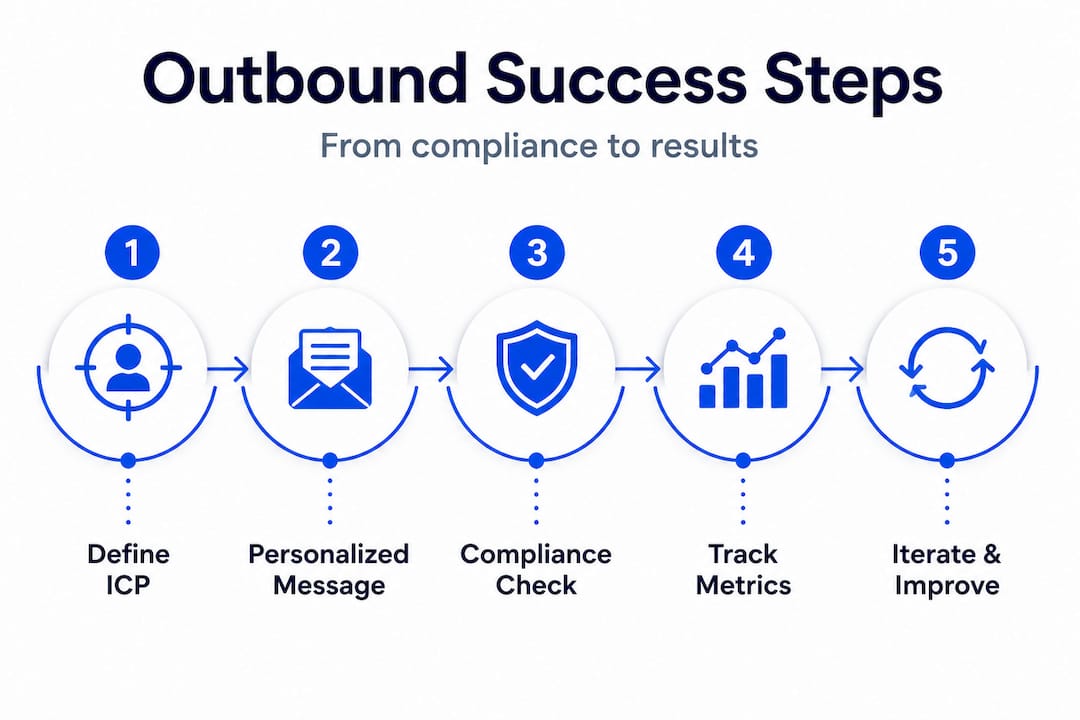
1. Define your ICP with precision.
“Everyone who might buy” is not an ICP. Go narrow. Industry, company size, revenue range, tech stack, geography, and specific trigger events like recent funding, hiring surges, or leadership changes. The tighter your ICP, the more relevant your messaging, and the better your conversion rates.
2. Build personalized, value-led messaging.
Your first outreach should do one thing: create genuine curiosity. Reference something specific about the prospect’s business. Lead with a problem you solve, not a product you sell. Sequences should be 4 to 6 touches across multiple channels (email, LinkedIn, phone), spread over 10 to 15 business days, with each touch adding context rather than just following up.
3. Integrate compliance checks before every campaign launch.
Review your LIA against the specific ICP segment you’re targeting. Confirm your opt-out mechanism is active in every outreach template. Verify that your data source for this specific list is compliant. This cold email compliance framework reinforces why these pre-launch checks are non-negotiable. This step takes 30 minutes and eliminates most of your regulatory risk.
4. Measure with a clear activity-to-revenue model.
Track every stage: emails sent, open rates, reply rates, positive reply rates, meetings booked, opportunities created, deals closed. Map conversion ratios between each stage. This is how you build a predictable pipeline model and identify exactly where your program is leaking. RevOps should own this dashboard.
5. Iterate based on data, not gut feel.
Run A/B tests on subject lines, opening lines, and CTAs. Review performance weekly, not quarterly. Kill underperforming sequences fast. Double down on what converts. The fastest-improving outbound teams treat each campaign as an experiment with a hypothesis and a clear success metric.
Here are the key tools you’ll need:
Getting your sales process set up with these components from the start saves you months of painful retrofitting later.
Real talk: we’ve heard the “outbound is dead” argument hundreds of times. And every single time, we trace it back to the same root cause. Someone ran a high-volume, low-quality outbound program, got terrible results, and concluded that the channel was broken. The channel wasn’t broken. The strategy was.
Some practitioners argue outbound is failing when executed with outdated channels and low-quality processes. We agree. But that’s an argument for better execution, not abandonment.
Here’s what we consistently see with EU companies that get outbound right. They start with ideal customer selection that’s almost uncomfortably narrow. They invest in understanding the specific business problems their ICP faces. They write messaging that sounds like it came from a person who actually read the prospect’s annual report, not from a template generator. And they embed compliance into every stage of their workflow rather than bolting it on at the end.
The companies that abandon outbound are often the same ones that never fixed classic outbound pitfalls in their process. They confuse the failure of a tactic with the failure of a strategy. Volume-based spray-and-pray outbound is dead. Intelligent, targeted, compliance-first outbound is very much alive and producing strong results for companies across the EU.
The winners in 2026 and beyond are the ones who adapt their process, integrate compliance as a competitive advantage (not a burden), and invest in relevance over reach. Structure beats heroics. A well-built outbound engine running at 70% capacity consistently outperforms an aggressive but undisciplined team swinging for home runs.
If this guide has clarified the strategic case for outbound and given you a sharper view of the compliance landscape, the next step is execution. Knowing the framework is one thing. Building a program that generates predictable outbound revenue quarter after quarter is where the real work happens.
At Sales Label Consulting, we work directly with RevOps leaders, Heads of Sales, and VPs of Sales at mid to large EU companies to design, audit, and scale outbound programs that are compliant, targeted, and built for consistent results. Whether you need a full demand generation build or a focused audit of your current outbound motion, we bring the entrepreneurial tech experience to get it done right. Explore our outbound sales best practices and see how we help sales teams move from insight to execution without the guesswork.
Yes, outbound cold outreach is legal when you use a valid legal basis like legitimate interest and provide opt-out rights backed by robust compliance documentation. It requires proper setup, not avoidance.
Treating compliance as a one-time legal review instead of an ongoing operational process. Legitimate interest requires documented rationale through a formal LIA, plus fast opt-out handling that’s tracked and enforced throughout your outreach program.
Outbound enables direct, targeted outreach to high-value accounts that inbound content never reaches, filling pipeline gaps and accelerating sales cycles for companies that can’t afford to wait for prospects to come to them.
You need a documented Legitimate Interest Assessment as well as records of outreach activity, opt-out requests, and data handling procedures. These should be living documents updated whenever your targeting or messaging strategy changes.
Subscribe to our Insights: Expert productivity tips in your inbox
You'll receive 1-3 emails per month. Your data stays private, always.

CRO & Co-Founder with Sales Label Consulting

Watch our Sales Mates Podcast
July 19, 2026 - 9 min read
Read article Read articleJuly 16, 2026 - 9 min read
Read article Read article