
Why sales operations matter for EU tech leaders in 2026
Many sales leaders view sales operations as a back-office function, a necessary administrative layer that supports the real work of closing deals. This misconception costs EU tech companies millions in lost revenue and missed opportunities. Sales operations is the strategic engine that transforms raw sales activity into predictable, scalable revenue generation. It ensures your forecasts are accurate, your processes are optimized, and your team operates with maximum efficiency. For tech sales leaders navigating complex European markets in 2026, understanding and leveraging sales operations is no longer optional, it’s essential for competitive advantage and sustainable growth.
| Point | Details |
|---|---|
| Revenue precision | Sales operations ensures accurate forecasting and data-driven decision making for predictable revenue growth. |
| Process optimization | Streamlined sales workflows and standardized processes boost team efficiency and increase win rates significantly. |
| Strategic integration | Effective sales ops connects CRM tools, analytics platforms, and cross-functional teams for unified revenue operations. |
| Scalability foundation | Strong sales operations infrastructure supports sustainable growth without proportional increases in overhead costs. |
| Measurable ROI | Investing in sales ops delivers quantifiable improvements in pipeline velocity, forecast accuracy, and revenue per rep. |
Sales operations encompasses the strategic planning, process design, and data management activities that enable sales teams to perform at peak efficiency. Unlike sales management, which focuses on coaching reps and driving individual performance, sales operations builds the infrastructure that makes high performance possible across the entire revenue organization. Think of it as the difference between teaching someone to drive versus engineering the roads, traffic systems, and vehicle maintenance protocols that make safe, efficient transportation possible at scale.
In tech sales environments, where deal complexity and sales cycles span multiple stakeholders and months of engagement, sales operations becomes even more critical. The function manages your CRM architecture, ensures data quality across systems, designs territory and quota structures, and provides the analytics that inform strategic decisions. Without this foundation, sales leaders make decisions based on gut feeling rather than reliable data, teams waste time on manual processes instead of selling, and revenue forecasting becomes educated guesswork rather than predictive science.
Core sales operations activities include data management and hygiene, sales process documentation and optimization, tool selection and integration, performance analytics and reporting, territory and compensation planning, and sales enablement coordination. These aren’t administrative tasks, they’re strategic initiatives that directly impact your ability to scale revenue efficiently. When executed well, sales ops transforms your sales organization from a collection of individual contributors into a coordinated revenue engine with predictable output and continuous improvement cycles.
Pro Tip: If your sales team spends more than 30% of their time on non-selling activities like data entry, report generation, or tool troubleshooting, you have a sales operations gap that’s costing you revenue every quarter.
The distinction between sales operations and sales management often confuses tech leaders new to scaling their revenue functions. Sales managers focus on people: coaching, motivation, pipeline reviews, and deal strategy. Sales operations focuses on systems: process efficiency, data accuracy, tool effectiveness, and organizational design. Both are essential, but they require different skill sets and serve different strategic purposes. The best performing sales organizations recognize this distinction and invest appropriately in both functions, creating a balanced approach where great systems enable great people to achieve exceptional results.
Streamlined sales processes eliminate friction at every stage of the buyer journey, allowing your team to move opportunities through the pipeline faster and with higher conversion rates. When sales operations optimizes your sales process, they identify bottlenecks, standardize best practices, and remove unnecessary steps that slow deals down. Research shows that process optimization raises win rates up to 20% by ensuring reps focus their energy on high-value activities and follow proven methodologies rather than reinventing approaches for each deal.

Accurate data forms the foundation of reliable revenue forecasting and intelligent quota setting. Sales operations establishes data governance policies, implements validation rules in your CRM, and creates dashboards that surface insights rather than just numbers. When your forecast accuracy improves from 60% to 85%, you gain the confidence to make strategic investments in headcount, marketing, and product development without the constant fear of missing targets. This precision also enables better cash flow management, more accurate guidance to investors or leadership, and the ability to identify problems early enough to course correct.
| Metric | Without Sales Ops | With Sales Ops | Impact |
|---|---|---|---|
| Forecast accuracy | 55-65% | 80-90% | Improved planning and resource allocation |
| Time spent selling | 35-40% | 55-65% | More revenue per rep without hiring |
| Sales cycle length | Baseline | 15-25% shorter | Faster revenue realization |
| Win rate | Baseline | 15-20% higher | More revenue from same pipeline |
| Data quality score | 60-70% | 90-95% | Better decisions and analytics |
The tools and metrics sales operations implements create visibility into revenue generation that was previously impossible. Pipeline velocity metrics show you not just how much is in your pipeline, but how fast opportunities move through each stage. Conversion rate analysis by rep, region, or product line reveals where coaching or process changes will have the biggest impact. Activity metrics correlated with outcomes help you understand which behaviors actually drive results versus which just keep people busy. This analytical rigor transforms sales from an art into a science, where you can predict outcomes, diagnose problems, and optimize performance systematically.
Continuous process audits and enablement training ensure your sales operations infrastructure doesn’t become stale or disconnected from market realities. As your product evolves, competitors emerge, and buyer preferences shift, your sales processes must adapt accordingly. Sales operations conducts regular reviews of win/loss patterns, gathers feedback from reps and customers, and implements iterative improvements that keep your go-to-market approach fresh and effective. This commitment to continuous improvement, supported by sales enablement metrics, creates a learning organization that gets better over time rather than calcifying around outdated practices.
Pro Tip: Start measuring pipeline velocity (deal value divided by sales cycle length) by stage and rep. This single metric reveals more about sales health than traditional pipeline coverage ratios and highlights exactly where to focus improvement efforts.
Building a world-class sales operations function requires deliberate planning and phased implementation. Start by auditing your current state across five key dimensions: data quality and CRM utilization, process documentation and adherence, tool stack integration and adoption, reporting and analytics capabilities, and cross-functional alignment between sales, marketing, and finance. This assessment reveals your biggest gaps and highest-impact opportunities, allowing you to prioritize initiatives that deliver quick wins while building toward long-term excellence.
Optimizing your CRM and data management practices forms the foundation of effective sales operations. Implement these critical steps in order:
This systematic approach to sales operation activities ensures your technology investment actually delivers value rather than becoming another underutilized tool that frustrates users and produces unreliable insights.
Establishing clear roles and workflows prevents the confusion and duplication that plague many growing sales organizations. Document who owns each stage of the sales process, what handoffs occur between teams, and what triggers movement from one stage to the next. Create RACI matrices (Responsible, Accountable, Consulted, Informed) for key processes like lead routing, opportunity qualification, proposal approval, and deal closing. This clarity eliminates the gaps where opportunities fall through cracks and the overlaps where multiple people waste time on the same task without coordination.
Collaboration between sales, marketing, and finance becomes exponentially more important as your tech company scales. Sales operations serves as the connective tissue between these functions, ensuring lead definitions align, pipeline metrics reconcile across systems, and revenue recognition follows consistent rules. Regular cross-functional meetings focused on pipeline health, forecast accuracy, and process improvements create shared accountability for revenue outcomes rather than siloed optimization that suboptimizes the overall business.
Common pitfalls to avoid when scaling sales operations include:
By anticipating these challenges and designing your sales operations function with both current needs and future growth in mind, you build a foundation that supports sustainable scaling rather than requiring constant rebuilding as you grow.
Demonstrating the value of sales operations requires tracking the right metrics and connecting operational improvements to business outcomes. Start with forecast accuracy, measuring the variance between predicted and actual revenue at weekly, monthly, and quarterly intervals. As your sales ops function matures, you should see this variance decrease consistently, giving leadership confidence in the numbers and enabling better strategic planning. Track this metric by rep, by region, and by product line to identify where your forecasting process is strongest and where it needs refinement.
Sales cycle length provides another critical indicator of sales operations effectiveness. Measure the average time from opportunity creation to closed won, then segment this analysis by deal size, product type, and sales rep. As you optimize processes, remove bottlenecks, and improve enablement, you should see cycle times compress without sacrificing win rates. Shorter cycles mean faster revenue realization, better cash flow, and the ability to close more deals with the same sized team. A 20% reduction in sales cycle length effectively increases your sales capacity by 20% without adding headcount.
| KPI | What It Measures | Target Benchmark | How Sales Ops Improves It |
|---|---|---|---|
| Forecast accuracy | Predictability of revenue | 85%+ within 10% | Data quality, process consistency, analytics |
| Pipeline velocity | Speed of revenue generation | Industry dependent | Process optimization, bottleneck removal |
| Win rate | Efficiency of pipeline conversion | 25-35% for enterprise | Qualification, enablement, competitive intelligence |
| Quota attainment | Team performance consistency | 70%+ of reps at 90%+ | Territory design, realistic goal setting |
| Time to productivity | New rep ramp speed | Under 6 months | Onboarding programs, training, tools |
Pipeline velocity combines deal size, win rate, and sales cycle length into a single metric that captures overall sales efficiency. Calculate it by multiplying your average deal value by your win rate, then dividing by your average sales cycle length in days. This metric increases when you close bigger deals, win more often, or move faster, making it an excellent composite measure of sales operations impact. Track this metric alongside traditional pipeline coverage to get a complete picture of sales health.
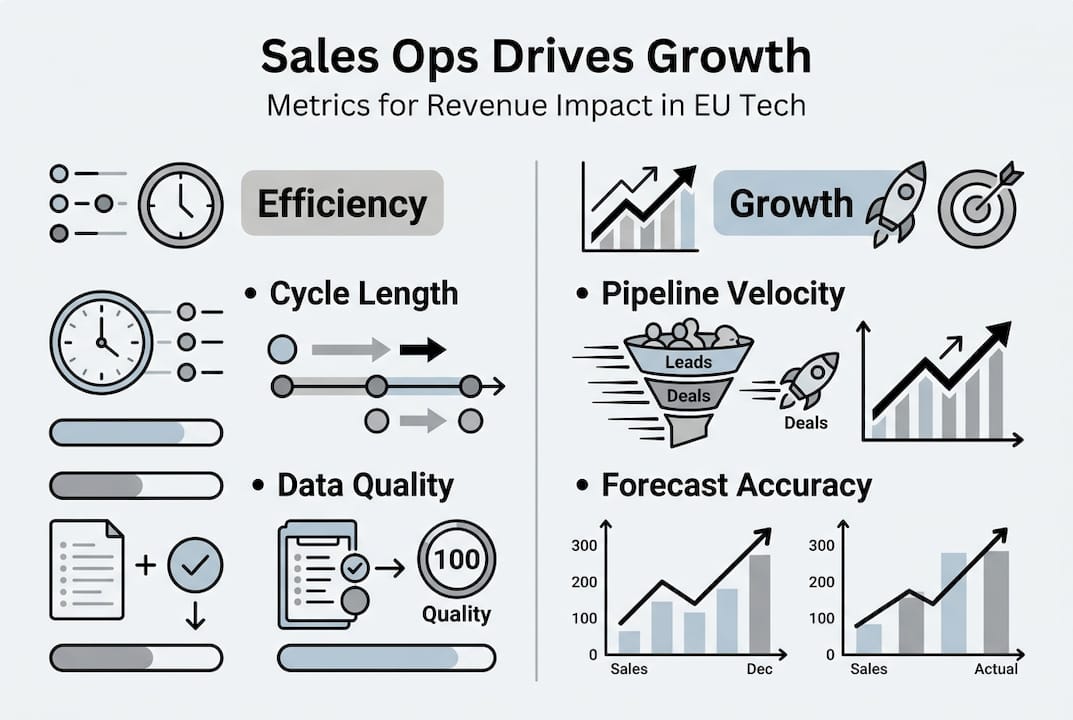
Using dashboards and analytics for continuous improvement requires discipline and focus. Build a tiered dashboard structure with executive views showing high-level trends and outcomes, manager views showing team and individual performance against goals, and rep views showing personal metrics and next actions. Update these dashboards automatically from your CRM and other systems, eliminating manual report generation that wastes time and introduces errors. Review dashboard insights in regular cadence meetings, using data to drive objective conversations about performance and priorities rather than relying on anecdotes and opinions.
Aligning sales ops metrics with business growth targets ensures your operational improvements translate into strategic value. If your company targets 40% year-over-year revenue growth, work backward to determine the required improvements in rep productivity, win rates, and deal sizes needed to hit that goal with realistic hiring plans. This alignment helps you prioritize which sales operations initiatives will have the biggest impact on your specific growth objectives, rather than pursuing generic best practices that may not address your unique challenges and opportunities.
Building world-class sales operations requires both strategic thinking and tactical execution. Sales Label Consulting helps EU tech companies design and implement revenue operations that drive predictable growth and operational excellence. Our step-by-step sales enablement approach provides the frameworks and tools you need to transform your sales organization from reactive to proactive, from inconsistent to reliable.
Whether you’re establishing your first sales operations function or optimizing an existing team, our sales enablement best practices guide you through proven methodologies that work specifically for European tech companies. We help you identify the operational activities that will have the biggest impact on your revenue goals, then support implementation with hands-on consulting that ensures lasting change. Let’s build the sales operations foundation that powers your next phase of growth.
Sales operations focuses on the infrastructure, processes, data management, and systems that make selling efficient and predictable. Sales enablement concentrates on training, content, coaching, and resources that help individual reps sell more effectively. While distinct, they work together closely, with sales ops providing the platforms and insights that enablement uses to develop targeted training and support programs.
Sales operations improves forecast accuracy by maintaining clean CRM data, standardizing stage definitions and progression criteria, implementing consistent reporting methodologies, and analyzing historical patterns to identify leading indicators. This systematic approach replaces guesswork with data-driven projections. Regular pipeline reviews using standardized metrics help sales leaders spot risks early and adjust strategies before they impact results.
Begin by assessing your current sales processes, identifying pain points, and documenting where reps waste time or where deals stall unnecessarily. Next, hire or designate someone to own CRM administration, data quality, and process improvement as their primary focus rather than a side responsibility. Start with quick wins like cleaning your database, building essential dashboards, and documenting your sales process before tackling larger initiatives like territory redesign or compensation restructuring.
Sales operations creates repeatable processes, documented playbooks, and automated workflows that allow new reps to become productive faster and existing reps to handle more opportunities without proportional increases in support resources. By standardizing how work gets done and providing self-service tools for common tasks, sales ops enables growth without creating chaos. This infrastructure means you can double your team size without doubling your management overhead or sacrificing quality.
Companies typically see 15-25% improvements in sales productivity, 10-20% increases in win rates, and 20-30% reductions in sales cycle length within the first year of implementing structured sales operations. These improvements translate directly to revenue growth and margin expansion. The exact ROI depends on your starting point and the specific initiatives you prioritize, but most tech companies find that sales operations pays for itself many times over through efficiency gains and revenue acceleration.
Subscribe to our Insights: Expert productivity tips in your inbox
You'll receive 1-3 emails per month. Your data stays private, always.

CRO & Co-Founder with Sales Label Consulting

Watch our Sales Mates Podcast
October 15, 2026 - 9 min read
Read article Read articleOctober 14, 2026 - 7 min read
Read article Read articleOctober 13, 2026 - 10 min read
Read article Read articleOctober 12, 2026 - 11 min read
Read article Read article