
What is a sales pipeline? 2026 guide for EU tech leaders
Most sales leaders believe a pipeline is just a visual chart tracking deals. That’s wrong. Your pipeline is a dynamic revenue engine that requires constant tuning, objective criteria, and alignment with how buyers actually make decisions. Without this clarity, forecasts crumble and revenue becomes unpredictable. This guide shows you how to build and optimize a sales pipeline that delivers consistent, measurable results for tech companies in the EU market.
| Point | Details |
|——-|———||
| Objective criteria matter | Each pipeline stage requires clear entry and exit rules based on buyer actions, not internal opinions. |
| Mirror buyer behavior | Your pipeline must reflect the customer’s decision journey, not your internal sales process. |
| Pipeline drives forecasting | Proper pipeline management enables accurate revenue predictions and smarter resource allocation. |
| Common mistakes kill results | Vague stage definitions and ignoring deal velocity lead to inflated forecasts and missed targets. |
A sales pipeline is not just a visual representation but a dynamic system requiring constant adjustment. Think of it as an assembly line for revenue where each stage represents a specific milestone in your buyer’s decision process. Deals move from one stage to the next based on verifiable actions, not guesswork or wishful thinking.
Many tech sales leaders confuse pipelines with sales funnels. A funnel measures volume drop off at each stage, showing how many prospects you lose along the way. Your pipeline, however, focuses on where individual deals stand right now and what needs to happen next. Both tools serve different purposes, but your pipeline is your operational map for managing active opportunities and predicting when revenue will land.
For EU tech companies, effective sales pipeline management becomes critical when dealing with longer sales cycles and multiple decision makers. Your pipeline tells you where bottlenecks form, which stages need more support, and how to allocate resources. Without this clarity, you’re flying blind.
A properly designed pipeline delivers three core benefits:
Your pipeline is not a set and forget tool. Market conditions shift, buyer behaviors evolve, and your internal processes improve. Regular pipeline reviews and adjustments keep your revenue engine running smoothly and your forecasts reliable.
Lack of objective criteria for stage entry and exit leads to misleading pipeline values and poor closing results. When reps can move deals forward based on gut feel rather than concrete buyer actions, your pipeline becomes fiction. Deals sit in advanced stages that should still be in early qualification, inflating your forecast and setting up disappointment at quarter end.
Here’s what goes wrong when stage definitions lack rigor:
Many sales leaders obsess over close rates while ignoring deal velocity and early stage conversion. You might celebrate a 25% close rate, but if deals take twice as long to close and 60% of opportunities die in early stages, you have a broken pipeline. Fixing these classic sales pipeline mistakes requires looking at the entire flow, not just the final conversion number.
Think of your pipeline like a manufacturing production line. Quality control happens at every step, not just final inspection. If defective parts make it through early stages, the whole line suffers.
“Pipeline should be managed like a production line with quality control at each step. Enforce strict entry and exit criteria, measure flow rates between stages, and identify bottlenecks before they crater your quarter.”
Another critical error is modeling your pipeline around internal processes instead of buyer behavior. Your stages might reflect what your sales team does, but buyers don’t care about your internal workflow. They move through their own decision journey, and your pipeline must mirror that reality to deliver accurate predictions.

Creating pipelines that reflect internal processes rather than buyers’ journeys causes inaccurate forecasts and weak sales strategies. Your buyer doesn’t think about discovery calls or proposal reviews. They think about problem recognition, solution evaluation, vendor comparison, and purchase approval. Your pipeline stages should map to these buyer milestones.
Here’s how to build buyer aligned pipeline stages:
For tech sales cycle stages, buyer alignment might look like this. Stage one is problem awareness, triggered when a prospect acknowledges a specific business problem and agrees to explore solutions. Stage two is active evaluation, entered when the buyer requests detailed product information or agrees to a demo. Stage three is vendor selection, marked by formal proposal requests or stakeholder presentations.
Objective signals prevent pipeline inflation. Instead of a rep deciding a deal is qualified, you require evidence like a signed mutual action plan or commitment to a specific evaluation timeline. These concrete markers eliminate guesswork and improve forecast accuracy by 40% or more in well managed teams.
Pro Tip: Map your top 10 closed won deals backward through their actual buyer journey. Identify the specific actions prospects took at each decision point. Use these patterns to define your stage criteria and train reps on what real progress looks like versus busy work.
When your pipeline mirrors buyer behavior, marketing and sales alignment improves dramatically. Marketing can create content for specific buyer stages, and sales knows exactly what resources to deploy when. Forecasting becomes simpler because stage probabilities reflect actual buyer commitment levels, not sales optimism.
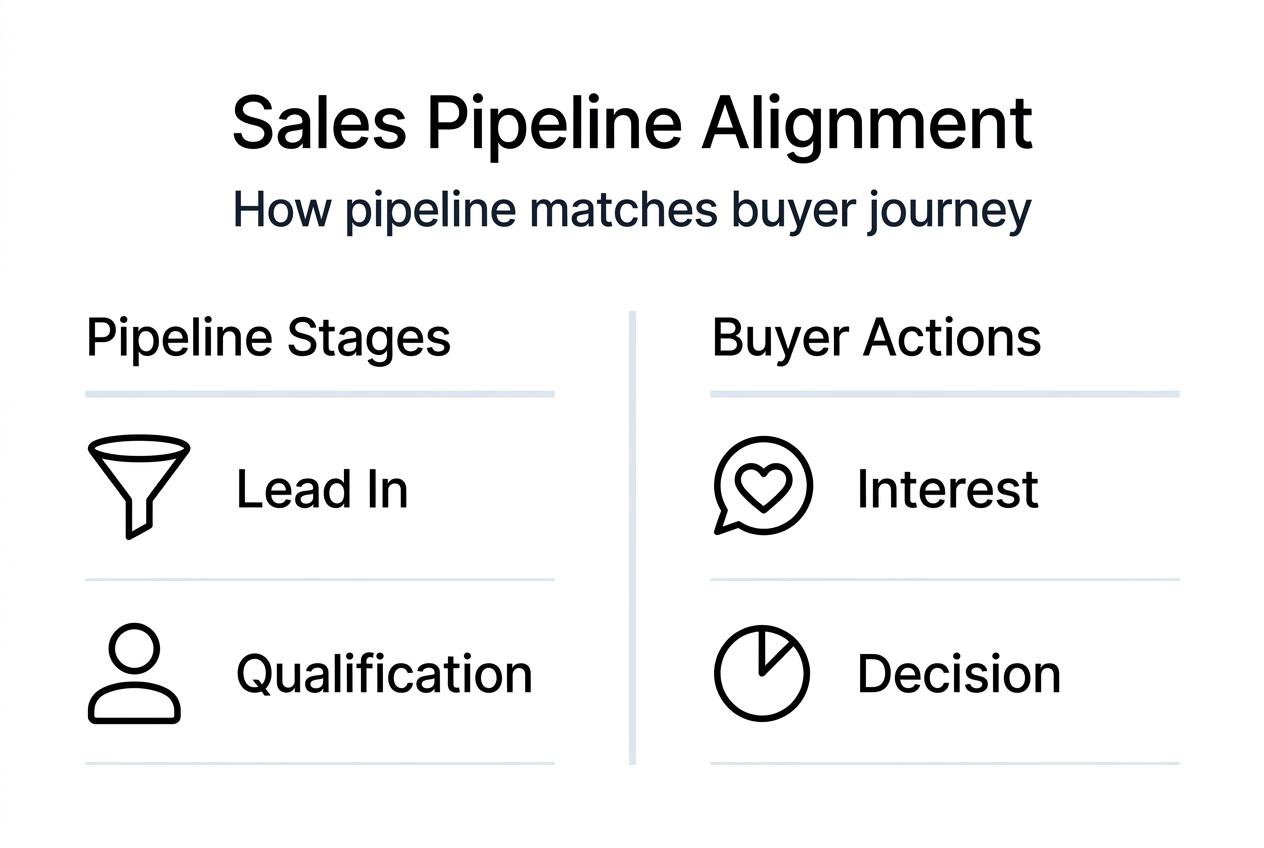
Expert sales leaders focus on pipeline flow and rules as a revenue assembly line, ensuring quality control at every step. Implementation starts with defining clear stage criteria, then building monitoring systems to track pipeline health and identify problems before they damage revenue.
Follow these implementation steps:
Your pipeline metrics tell different stories about sales health. This comparison helps you diagnose specific problems:
| Metric | What It Reveals | Action Required |
|---|---|---|
| Stage conversion rates | Where deals die in your process | Fix messaging or qualification at weak stages |
| Average deal velocity | How long revenue takes to materialize | Identify and remove friction points |
| Pipeline coverage ratio | Whether you have enough deals to hit targets | Increase top of funnel activity or improve conversion |
| Stage duration variance | Consistency of your sales process | Standardize approach or improve rep training |
Pro Tip: Track where deals enter your pipeline, not just where they exit. If 70% of wins come from deals that entered at stage two, you’re wasting resources on stage one activities. Redirect marketing spend and sales effort to channels and tactics that bring in higher quality opportunities.
Optimization never stops. Run quarterly pipeline audits where you examine lost deals, interview buyers, and refine your stage definitions. Market conditions change, buyer behaviors evolve, and competitors adjust their approaches. Your pipeline must adapt to stay accurate and useful.
For ongoing pipeline optimization strategies, focus on three areas. First, monitor and improve stage conversion rates by identifying why deals stall or die. Second, reduce deal cycle time by removing unnecessary steps and accelerating buyer decision making. Third, increase pipeline quality by tightening qualification criteria so only real opportunities consume sales resources.
Many EU tech companies see sustainable sales growth when they treat pipeline management as a continuous improvement discipline rather than a one time setup task. Build feedback loops, test refinements, and measure impact on forecast accuracy and revenue predictability.
Building a disciplined, buyer aligned pipeline requires more than good intentions. It demands structured processes, ongoing training, and expert guidance to maintain rigor as your team grows. Sales Label Consulting specializes in helping EU tech companies transform pipeline chaos into predictable revenue engines.
Our sales enablement programs give your team the frameworks and tools to implement pipeline discipline that sticks. We’ve helped RevOps leaders and VPs of Sales build best practice enablement systems that align sales and marketing, improve forecast accuracy, and accelerate deal velocity. Whether you need a comprehensive sales audit or targeted pipeline optimization support, we bring decades of entrepreneurial tech experience to solve your specific challenges.
A pipeline tracks where individual deals currently sit and what actions move them forward through buyer decision stages. A funnel measures volume reduction at each stage, showing how many prospects drop off during the sales process. Pipelines focus on deal management and forecasting, while funnels analyze conversion efficiency and identify where you lose the most opportunities.
Base your criteria on verifiable buyer actions like document requests, stakeholder meetings, or signed agreements rather than sales rep opinions. Require concrete evidence before allowing stage advancement, such as meeting notes, email confirmations, or completed evaluation forms. Define clear stage requirements that your team can observe and validate, eliminating subjective judgment calls that inflate pipeline values.
Never let deals advance without meeting objective stage criteria, as this creates false forecasts and masks real pipeline problems. Don’t focus exclusively on close rates while ignoring deal velocity and early stage conversion, since slow moving pipelines and poor qualification waste resources even with decent final conversion. Avoid these classic mistakes by enforcing pipeline discipline, monitoring flow metrics, and regularly auditing deal quality at every stage.
Conduct quarterly pipeline audits to assess whether your stages still match buyer behavior and market conditions. Review stage conversion rates and deal velocity monthly to identify emerging problems before they impact revenue. Update stage definitions whenever you notice systematic forecast misses or when buyer feedback reveals changes in decision processes.
Stage conversion rates show the probability of deals advancing, which drives weighted forecast calculations. Deal velocity reveals when revenue will actually land, not just if it will close. Pipeline coverage ratio indicates whether you have sufficient opportunities to hit targets. Track all three together to build reliable forecasts and identify risks early enough to take corrective action.
Subscribe to our Insights: Expert productivity tips in your inbox
You'll receive 1-3 emails per month. Your data stays private, always.

CRO & Co-Founder with Sales Label Consulting

Watch our Sales Mates Podcast
October 11, 2026 - 7 min read
Read article Read articleOctober 10, 2026 - 8 min read
Read article Read articleOctober 9, 2026 - 7 min read
Read article Read articleOctober 8, 2026 - 10 min read
Read article Read article