
Sales Enablement Metrics: Boosting Tech Firm ROI
What makes sales enablement truly powerful is not just about content or training, but the way it unites diverse teams behind shared business goals. For sales enablement leaders in European technology firms, understanding cross-functional alignment is key to dispelling common myths and unlocking the real value of measurement. This article gives practical insights into defining the right metrics, helping you establish ongoing, data-driven programs that drive real sales performance and maximize ROI.
| Point | Details |
|---|---|
| Sales Enablement is Strategic | Effective sales enablement goes beyond content distribution; it integrates training, technology, and performance coaching for holistic organizational alignment. |
| Continuous Measurement is Essential | Organizations must view sales enablement as an ongoing initiative, utilizing metrics to assess and adapt strategies continually for sustained success. |
| Focus on Key Metrics | Metrics should be categorized into performance, proficiency, and productivity to provide valuable insights into team effectiveness and efficiency. |
| Avoid Common Pitfalls | Organizations should not treat sales enablement as a one-time effort and must ensure alignment with business objectives to enhance team performance effectively. |
Sales enablement has emerged as a critical strategic function within modern technology organizations, moving far beyond traditional sales support roles. Strategic cross-functional alignment represents the core of effective sales enablement, challenging simplistic misconceptions about its purpose and scope.
Most organizations misunderstand sales enablement as merely a tactical content distribution mechanism. However, authentic sales enablement encompasses a comprehensive approach that integrates multiple organizational elements:
The primary objectives of sales enablement extend well beyond traditional sales support. These include:
Many enterprises mistakenly view sales enablement as a one-time implementation rather than an ongoing, data-driven initiative. Performance-focused strategic programs demonstrate that continuous measurement and adaptation are crucial for sustainable success.
Pro Tip: Develop a quarterly review process to reassess and recalibrate your sales enablement metrics, ensuring alignment with evolving business objectives.
Sales enablement metrics represent a sophisticated framework for understanding and optimizing organizational performance. Comprehensive analytics categories provide technology firms with strategic insights into their sales ecosystem’s effectiveness and potential areas of improvement.
The core categories of sales enablement metrics can be systematically broken down into three primary dimensions:
Performance Metrics focus on tangible business results and include:
Proficiency Metrics dive deeper into the qualitative aspects of sales team capabilities:
Technology stack utilization represents a critical emerging metric category that bridges technological investment with sales performance. By analyzing how sales teams leverage technological tools, organizations can optimize their enablement strategies and identify potential training or integration gaps.

Pro Tip: Create a dashboard that integrates metrics across all three categories, providing a holistic view of your sales enablement ecosystem.
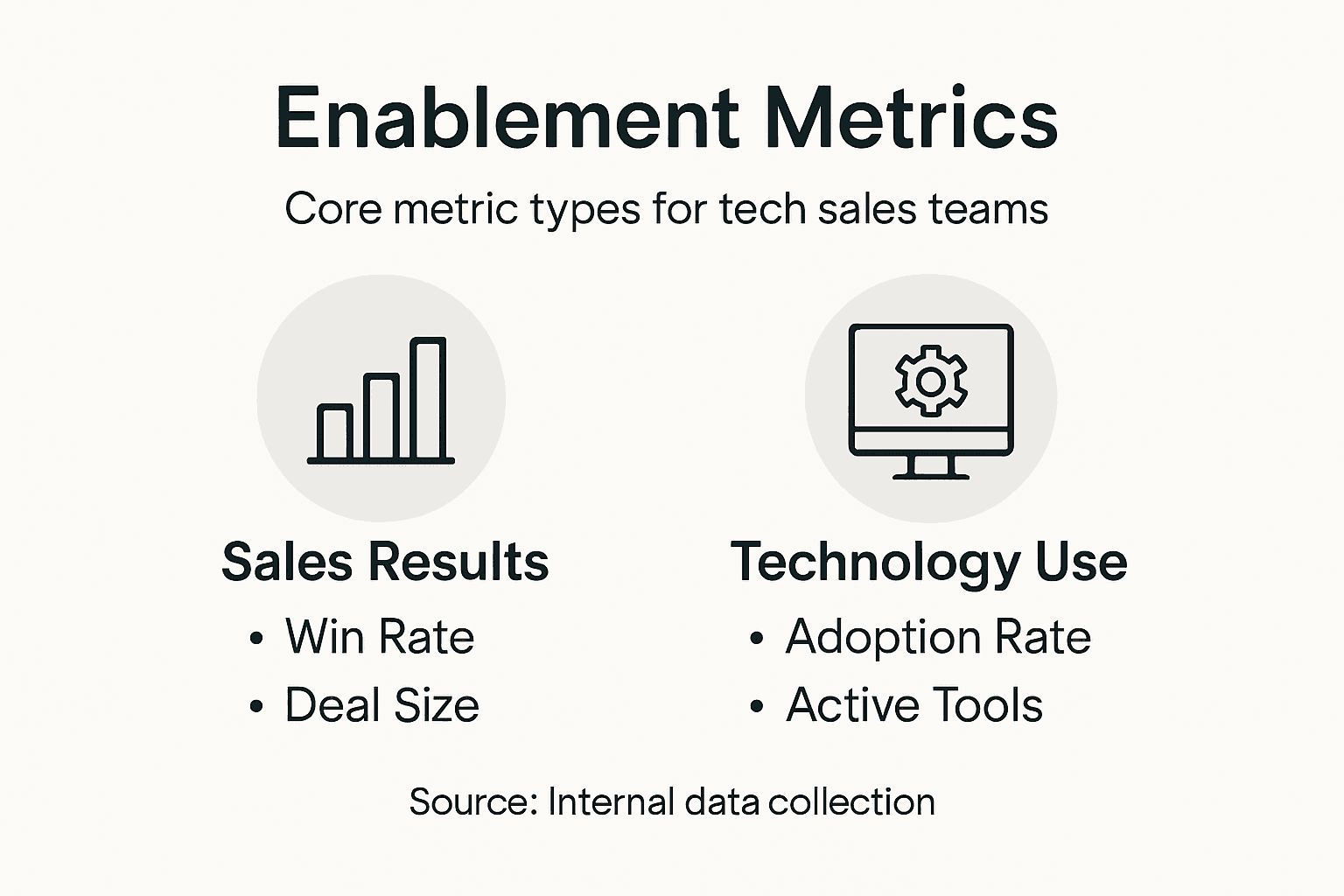
Here’s a consolidated view of the main sales enablement metric categories and their organizational benefits:
| Metric Category | What It Measures | Business Impact |
|---|---|---|
| Performance Metrics | Sales results and pipeline flow | Drives revenue and deal success |
| Proficiency Metrics | Team skills and learning | Improves onboarding and expertise |
| Productivity Metrics | Sales process efficiency | Enhances resource utilization |
| Tech Utilization | Adoption of enablement tools | Maximizes ROI on technology spend |
Effective measurement frameworks transform sales performance by providing actionable insights into organizational capabilities. These metrics serve as strategic diagnostic tools that reveal critical strengths and potential improvement areas within sales teams.
The impact of sales enablement metrics manifests through several key dimensions:
Predictive Performance Indicators play a crucial role in understanding potential sales outcomes before they materialize. These metrics help organizations:
Behavioral Tracking Metrics provide deeper insights into sales team dynamics by monitoring:
Sales enablement analytics demonstrate that systematic measurement directly correlates with improved sales efficiency. By transforming raw data into strategic intelligence, organizations can create targeted interventions that dramatically enhance overall team performance.
Pro Tip: Implement a quarterly metric review process that connects individual performance data with broader organizational goals, creating a continuous improvement cycle.
Sales enablement measurement requires a sophisticated approach integrating multiple technological and analytical tools. Advanced tracking systems transform raw data into actionable intelligence, providing comprehensive insights into sales team performance and potential optimization strategies.
The core measurement tools can be categorized into several key technological platforms:
Key Measurement Techniques involve collecting and analyzing data through multiple approaches:
CRM Analytics represent the foundational measurement technique, offering comprehensive insights by tracking:
Modern Sales Intelligence Platforms integrate multiple data sources to provide holistic performance perspectives. These advanced systems correlate individual and team metrics, creating nuanced understanding of sales team dynamics and potential improvement opportunities.
Pro Tip: Implement a cross-functional measurement strategy that connects sales performance data with broader organizational objectives, ensuring comprehensive and meaningful insights.
Sales enablement misconceptions can derail even the most well-intentioned organizational strategies. Understanding these potential pitfalls is crucial for developing a robust, effective sales enablement approach that delivers tangible business results.
The most critical mistakes organizations frequently make include:
Common Strategic Mistakes that undermine sales enablement effectiveness:
Measurement and Tracking Pitfalls can significantly compromise enablement efforts:
Successful sales enablement requires a holistic, integrated approach that breaks down organizational silos. Technology, training, and strategic alignment must work together seamlessly to create a comprehensive ecosystem supporting sales team performance.
This table highlights major sales enablement mistakes and explains how they can hurt business outcomes:
| Mistake | Why It Occurs | Impact on Organization |
|---|---|---|
| Treating enablement as one-off | Lack of ongoing commitment | Stagnant team performance |
| Poor measurement framework | Failure to set benchmarks | Misguided strategy decisions |
| Ignoring rep learning styles | Generic training approaches | Lower engagement, weaker skills |
| Fragmented tool integration | Disconnected systems | Data loss and inefficiency |
Pro Tip: Conduct a quarterly cross-functional audit of your sales enablement strategy, identifying potential gaps and opportunities for integrated improvement.
Sales Enablement Metrics are powerful tools for boosting sales team performance and driving ROI in technology firms. If you face challenges like fragmented measurement, inconsistent data, or unclear alignment between sales activities and business goals, it is time to transform your approach. Our team at Sales Label Consulting specializes in overcoming these exact obstacles by providing expert consulting in Sales Enablement, Sales Audit, and Demand Generation. We help RevOps, Heads of Sales, and VPs of Sales develop strategic, data-driven enablement programs that ensure continuous improvement and measurable impact.
Explore how our entrepreneurial experience and tailored strategies can help you enhance pipeline velocity, refine proficiency metrics, and maximize technology utilization. Don’t let sales enablement myths or poor measurement frameworks slow your growth. Take action now and partner with Sales Label Consulting to align your sales team with clear, actionable insights and predictable, error-free results. Visit us today at Sales Label Consulting to start your journey toward amplified revenue performance.
Sales enablement effectiveness can be measured through performance metrics (like pipeline velocity and conversion rates), proficiency metrics (such as training completion rates), and productivity metrics (including sales process efficiency).
By systematically measuring and analyzing sales enablement metrics, tech firms can identify areas of improvement, boost sales efficiency, and optimize resource allocation, ultimately driving higher revenue and better ROI.
Continuous measurement ensures that sales enablement strategies remain aligned with evolving business objectives and allows organizations to adapt and recalibrate their tactics based on performance data and market changes.
Common mistakes include treating sales enablement as a one-time event, failing to align it with strategic business objectives, and overlooking the importance of continuous measurement and cross-functional collaboration.
Subscribe to our Insights: Expert productivity tips in your inbox
You'll receive 1-3 emails per month. Your data stays private, always.

CRO & Co-Founder with Sales Label Consulting

Book a call to talk with Anton
October 15, 2026 - 9 min read
Read article Read articleOctober 14, 2026 - 7 min read
Read article Read articleOctober 13, 2026 - 10 min read
Read article Read articleOctober 12, 2026 - 11 min read
Read article Read article