
Why sales performance metrics matter for tech leaders
Sales leaders in Europe face an overwhelming challenge: which metrics actually drive revenue growth? While 90% of teams track KPIs, only 28% see higher quota attainment from their efforts. The difference isn’t in tracking more data, it’s in focusing on the right metrics and applying them consistently. This guide reveals which sales performance metrics truly matter for tech sales teams, backed by transformation examples from leading European companies, and shows you how to avoid common pitfalls that turn metric tracking into busywork instead of business impact.
| Point | Details |
|---|---|
| Focus beats volume | Teams tracking fewer, well-chosen KPIs achieve 28% higher quota attainment than those drowning in data |
| Experimentation isn’t transformation | 90% ChatGPT usage without strategic focus doesn’t improve sales outcomes |
| Tool optimization saves hours | Account managers reclaim 2.5 hours daily when sales systems align with actual workflows |
| Cross-functional alignment wins | Working groups spanning data, RevOps, and business teams drive sustainable metric adoption |
Sales performance metrics are quantifiable measures that track how effectively your sales team converts opportunities into revenue. For European tech companies, these KPIs provide the foundation for predictable growth and informed decision making. The right metrics illuminate pipeline health, rep productivity, and customer acquisition efficiency.
Recent research shows teams that track the right KPIs consistently see 28% higher quota attainment compared to those that don’t. This isn’t about tracking everything, it’s about tracking what matters. Many sales leaders fall into the trap of believing more metrics equal better insights. The reality? Metric overload paralyzes decision making and dilutes focus from revenue-generating activities.
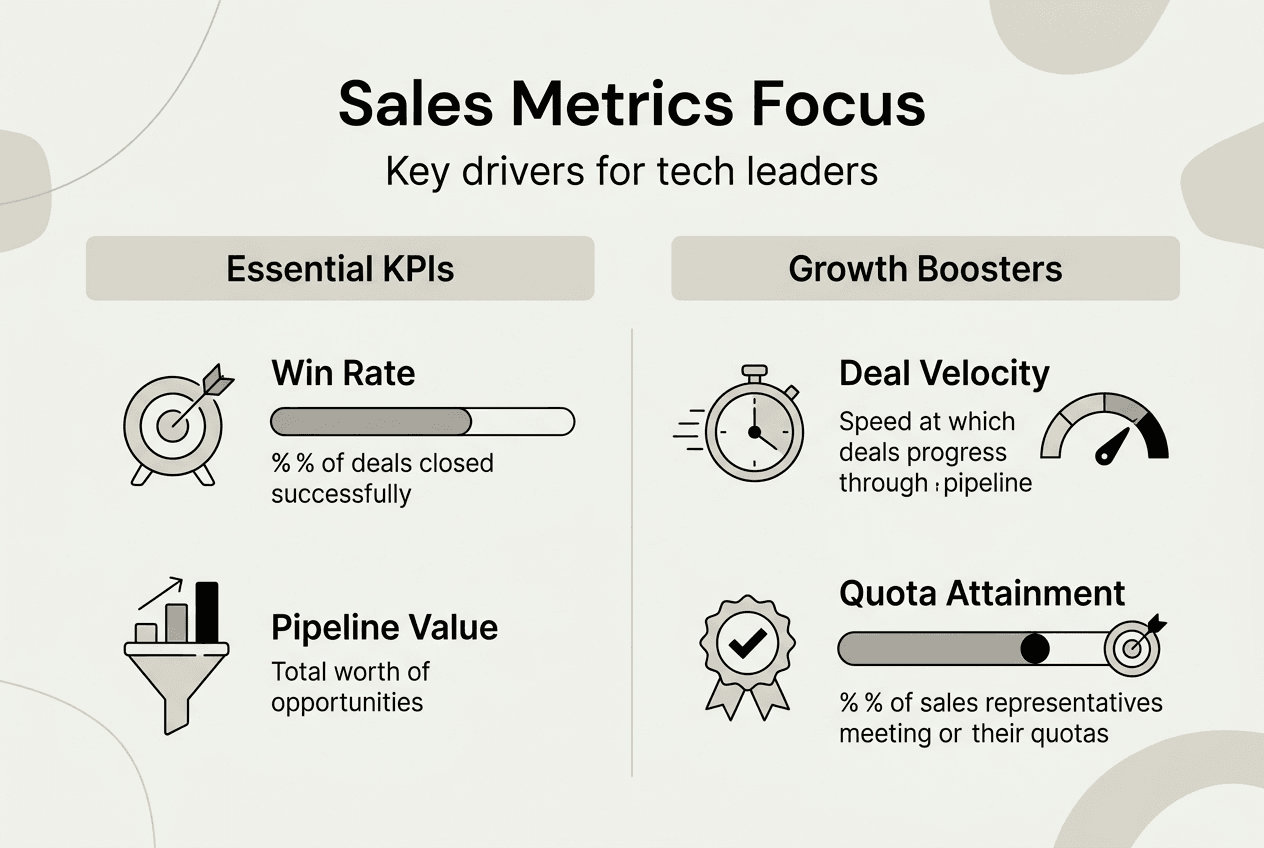
The most impactful metrics for tech sales teams include:
These metrics directly correlate with revenue outcomes because they measure conversion efficiency, not just activity volume. When you optimize sales pipeline optimization, you’re actually improving the underlying behaviors these metrics track.
The best sales leaders don’t ask their teams to track more. They ask them to track smarter.
Understanding which metrics drive your specific business model is crucial. A SaaS company selling to enterprise clients needs different KPIs than one focused on product-led growth with SMB customers. Your metrics should reflect your go-to-market strategy, sales cycle complexity, and revenue model.

Even experienced sales leaders stumble when implementing metric-driven strategies. The most damaging mistake? Confusing experimentation with transformation. Personio discovered 90% weekly ChatGPT usage was not transformation but experimentation at scale. Their teams were trying new tools without strategic direction, creating activity without impact.
The real transformation required answering questions about time dedication and tool commitment. This insight reveals a critical truth: metrics only drive results when embedded in a focused strategy, not scattered across disconnected experiments.
Here are five common pitfalls that undermine metric effectiveness:
The solution isn’t abandoning metrics. It’s ruthless prioritization. Select three to five KPIs that directly influence your revenue model and commit to them for at least two quarters. This timeframe allows patterns to emerge and enables you to test interventions against baseline performance.
Successful sales transformation strategy starts with clarity about what you’re optimizing for. Are you trying to shorten sales cycles, increase deal sizes, or improve win rates? Each goal requires different metrics and different interventions.
Pro Tip: Form a cross-functional working group with representatives from sales, RevOps, and data teams to validate which metrics truly correlate with revenue in your business. This group should meet monthly to review metric performance and adjust focus based on what’s actually moving the needle.
The rise of AI reshaping sales tech adds another layer of complexity. New tools promise better insights, but without strategic focus, they just add noise. Your metric framework should guide tool adoption, not the other way around.
Inefficient tools destroy sales productivity and corrupt the metrics you’re trying to improve. Account Managers lost 2.5 hours daily on one activity working across seven to eight systems. This fragmentation doesn’t just waste time, it creates data silos that make accurate metric tracking impossible.
Here’s what Personio’s transformation revealed about tool optimization:
| Metric | Before AI Assistant | After AI Assistant | Time Saved |
|---|---|---|---|
| Daily hours on system navigation | 2.5 hours | 0.5 hours | 2 hours |
| Number of systems accessed | 7 to 8 | 2 to 3 | 5 systems |
| Data entry accuracy | 73% | 94% | 21% improvement |
| Time to update CRM post-call | 15 minutes | 3 minutes | 12 minutes |
These improvements didn’t come from buying more software. They came from understanding the actual jobs sales reps needed to accomplish and building workflows around those needs. When tools align with real work patterns, metric tracking becomes a byproduct of normal activity instead of additional overhead.
Practical steps to optimize your sales tech stack for better metrics:
The goal is making good behavior easy and bad behavior hard. If updating your CRM requires navigating five screens, reps won’t do it consistently. If deal updates happen automatically from email and calendar activity, your pipeline data stays current without extra effort.
Pro Tip: Shadow three sales reps for a full day each to understand their actual workflow versus your assumed workflow. You’ll discover hidden inefficiencies and identify which AI sales workflows could genuinely save time versus adding complexity.
Effective sales operations in tech companies means building systems that capture accurate data as a natural consequence of selling, not as a separate administrative task. When you achieve this, your metrics become reliable leading indicators instead of lagging reports of what already happened.
Building a sustainable metric-driven culture requires more than selecting the right KPIs. It demands organizational alignment, consistent processes, and ongoing reinforcement. Personio built a 15-person working group spanning data, revenue operations, and business to drive their sales motion. This cross-functional approach ensures metrics reflect business reality, not departmental silos.
Here’s how traditional sales approaches compare to metric-driven strategies:
| Approach | Traditional Sales | Metric-Driven Strategy |
|---|---|---|
| Decision basis | Gut feel and experience | Data patterns and trends |
| Performance reviews | Subjective assessments | Objective KPI analysis |
| Coaching focus | Generic best practices | Specific metric gaps |
| Resource allocation | Equal distribution | Targeted at highest ROI activities |
| Strategy adjustments | Annual planning cycles | Quarterly metric reviews |
The metric-driven approach doesn’t eliminate experience and intuition. It augments them with objective evidence, creating a feedback loop that improves decision quality over time.
Six steps to embed sales metrics in daily operations:
The key is making metrics visible and relevant to daily decisions. When reps see how their activities influence KPIs and how KPIs predict commission checks, they engage with the data naturally.
Prioritization matters enormously. Personio’s working group didn’t try to fix everything at once. They identified the top three initiatives that would move their most important metrics and focused exclusively on those for six months. This disciplined approach delivered measurable results instead of diffused effort.
Your sales team structure should support metric visibility. RevOps teams play a crucial role in maintaining data quality, building dashboards, and translating metrics into actionable insights for sales leadership.
Implementing sales enablement best practices means equipping reps with the knowledge and tools to improve their personal metrics. When enablement content directly addresses common metric gaps, adoption increases because the value is obvious.
Sustained success requires treating your metric framework as a living system. Review it quarterly to ensure you’re still measuring what matters as your business evolves. Markets change, products mature, and competitive dynamics shift. Your metrics should adapt accordingly.
Implementing a metric-driven sales strategy sounds straightforward until you face the reality of organizational change, tool integration, and behavior modification. Sales Label Consulting specializes in helping European tech companies navigate exactly these challenges. We’ve guided sales leaders through complete transformations, from selecting the right KPIs to embedding them in daily operations.

Our approach combines deep sales expertise with practical implementation support. We don’t just recommend metrics, we help you build the systems, processes, and team capabilities to use them effectively. Whether you need a comprehensive sales enablement step by step roadmap or targeted support for specific challenges, our consulting adapts to your needs.
We work with Heads of Sales and VPs in tech companies to create predictable revenue growth through better sales performance metrics. Our sales enablement best practices guide shows proven frameworks from successful transformations. Ready to move from metric confusion to revenue clarity? Explore our consulting services to discover how we can accelerate your sales performance.
Focus on metrics that directly predict revenue: win rate by deal size, pipeline velocity, average contract value, and customer acquisition cost. These KPIs reveal conversion efficiency and growth sustainability better than activity metrics like calls made or emails sent.
Metrics identify exactly where deals stall in your pipeline and which rep behaviors correlate with wins. When you know your average sales cycle is 90 days but deals at 120 days close at half the rate, you can intervene earlier. Teams using this approach see 28% higher quota attainment.
Avoid tracking too many KPIs, changing metrics too frequently, and measuring activity instead of outcomes. The biggest mistake is confusing experimentation with transformation, like Personio’s initial 90% ChatGPT usage that didn’t improve results. Focus on three to five metrics that truly drive your revenue model.
The right tools eliminate manual data entry, consolidate reporting, and make metrics visible in real-time dashboards. When consultative selling techniques are supported by tools that track conversation quality and buyer engagement, reps get immediate feedback that improves performance.
Cross-functional working groups ensure metrics reflect business reality and maintain organizational alignment. Personio’s 15-person group spanning data, RevOps, and business teams drove their successful transformation by validating which metrics mattered and building consensus around priorities. These groups prevent metric frameworks from becoming disconnected from actual sales challenges.
Subscribe to our Insights: Expert productivity tips in your inbox
You'll receive 1-3 emails per month. Your data stays private, always.

CRO & Co-Founder with Sales Label Consulting

Watch our Sales Mates Podcast
October 11, 2026 - 7 min read
Read article Read articleOctober 10, 2026 - 8 min read
Read article Read articleOctober 9, 2026 - 7 min read
Read article Read articleOctober 8, 2026 - 10 min read
Read article Read article