
The Role of Buyer Enablement for B2B Sales Leaders
TL;DR:
- Buyer enablement simplifies complex enterprise buying by providing tools to help stakeholders complete their tasks independently. It reduces stalls, builds buyer confidence, and enables more predictable revenue in multi-stakeholder deals. Proper system engineering with role-specific assets, CRM integration, and measurement creates a durable competitive advantage.
Buyer enablement’s core role is to make the jobs of buying easier, giving purchasing teams the right resources to complete evaluations, build internal consensus, and move forward with confidence. If you want one immediate action: pick your most stalled enterprise deal, identify the specific buying task that’s stuck, and build one job-completion asset for it this week. Here’s the real talk on why this matters:
B2B buying has structurally changed. Buyers arrive informed, committees have grown, and the average enterprise deal now involves multiple stakeholders who each need to reach their own conclusion before anyone signs. Your reps can run a perfect discovery call and still lose the deal three weeks later because the CFO never got a clear ROI model, or the CISO couldn’t find a security brief to share with her team.
The vendor-time finding from Gartner is the metric that should reset your GTM priorities: buyers spend only about 17% of their total buying time meeting with vendors; the remaining 83% is self-directed. Your job is to be useful during that 83%, not just polished during the 17%. That’s the strategic case for buyer enablement in one sentence.
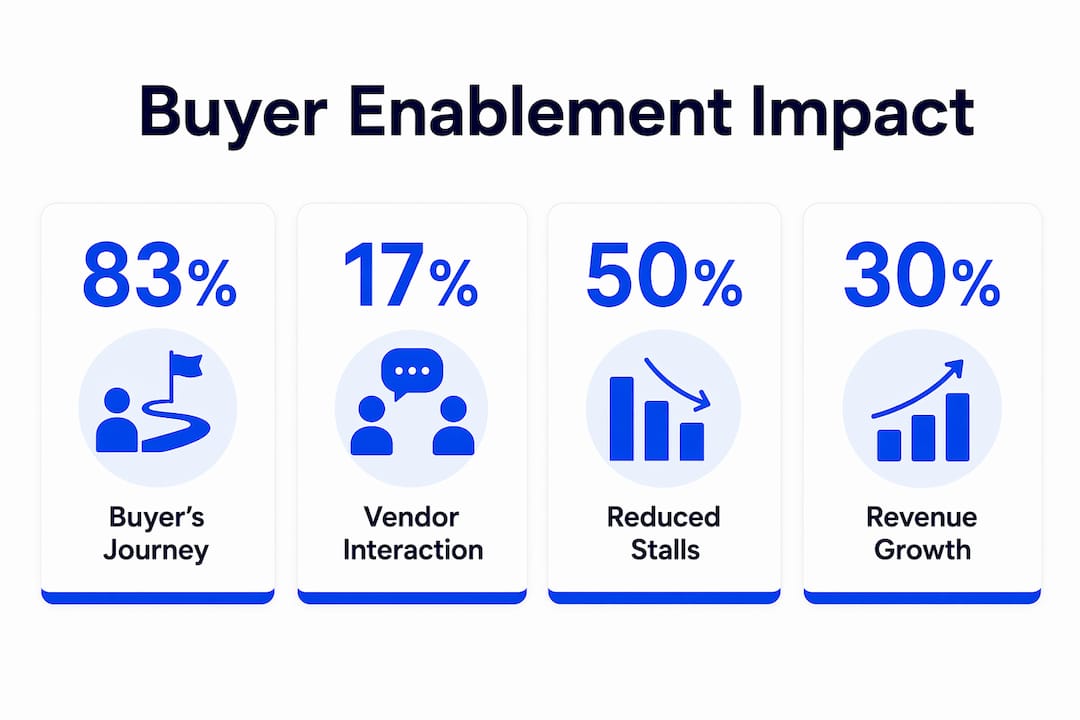
Three outcomes drive the business case:
Fewer late-stage stalls. Most deals don’t die because the buyer chose a competitor. They stall because someone on the buying committee couldn’t get a question answered, couldn’t build the internal business case, or couldn’t get procurement aligned. Job-completion assets directly address those friction points.
Higher buyer confidence and value clarity. A buyer’s clear understanding of how your solution affects their specific role outcomes is the practical lever that improves deal quality. When a champion can walk into an internal meeting with a ready-made ROI model and an executive one-pager, they close the deal internally so you don’t have to.
More predictable revenue. Enterprise buyers complete a substantial portion of their evaluation independently, and deals with multiple stakeholders are especially vulnerable to stalls. Buyer enablement produces the biggest ROI in complex, multi-stakeholder deals where the buying committee is large and the evaluation period is long. That’s exactly where most B2B tech revenue lives.
Forrester and adjacent analyst work have flagged high stall rates and buyer dissatisfaction as strategic risks, validating buyer enablement as a board-level priority, not just a sales ops project.
Sales enablement equips sellers. Buyer enablement equips buyers. Both are necessary, and neither replaces the other, but conflating them is one of the most common mistakes revenue teams make.
Sales enablement focuses inward: training, playbooks, talk tracks, and CRM hygiene so reps execute the seller motion consistently. Buyer enablement focuses outward: giving buying teams the tools, content, and governed expertise they need to complete the specific jobs of buying after the rep leaves the call.

| Dimension | Sales enablement | Buyer enablement |
|---|---|---|
| Primary focus | Equipping sellers to execute the sales motion | Equipping buyers to complete buying tasks |
| Who benefits | Sales reps and managers | Buying committee members |
| When it operates | Before and during seller-led interactions | Between seller interactions (the 83%) |
| Success signals | Rep activity metrics, pipeline velocity | Buyer advancement, stakeholder engagement, time-to-decision |
Ownership and handoffs matter. Here’s a practical breakdown:
Cross-functional governance is required. Without it, buyer enablement becomes ad-hoc content sharing with no consistency and no signal capture.
Pro Tip: Wire job-completion asset delivery directly into your CRM deal stages. When a deal moves to “Supplier Selection,” an automated task should prompt the rep to share the comparison worksheet and security brief. Don’t leave it to memory or heroics.
Buyer enablement centers on specific buying jobs: discrete tasks a buying committee must complete to move a purchase forward. Gartner’s buying-jobs framework identifies six of them, and each one maps to a specific asset type.
| Buying job | Buyer task | Job-completion asset | Who delivers it |
|---|---|---|---|
| Problem identification | Define the pain and quantify it | Problem framing one-pager, benchmark data | Marketing / AE |
| Solution exploration | Evaluate approaches and categories | Category comparison guide, demo summary | AE / SE |
| Requirements building | Build internal specs and criteria | Requirements checklist, RFP template | AE / Solutions |
| Supplier selection | Narrow to shortlist and justify | Comparison worksheet, reference brief | AE / Marketing |
| Validation | Confirm technical and security fit | Security brief, architecture overview | SE / Solutions |
| Consensus creation | Align stakeholders internally | Executive summary, ROI model, FAQ doc | AE / Marketing |
The two jobs where deals stall most often are requirements building and supplier selection. A rep who shows up to a call without a pre-built requirements checklist is asking the buyer to do extra work. Most won’t. They’ll slow down, loop in more people, and eventually the deal goes quiet.
Role-specific content is non-optional in multi-stakeholder deals. The CFO needs an ROI model. The CISO needs a security brief. IT needs an architecture overview. Procurement needs a comparison worksheet. Your champion needs an executive summary they can forward without rewriting. Build assets that travel well on their own.
Two brief examples illustrate the point. In one deal, a mid-market SaaS company had a six-figure contract stalled for eight weeks at the validation stage. The blocker wasn’t price. The CISO had unanswered security questions and no one had given her a structured brief to review. One two-page security FAQ, delivered through the AE, cleared the stage in four days. In another deal, a requirements checklist handed to the champion during solution exploration became the internal document the buying committee used to evaluate all three shortlisted vendors. The vendor who wrote the checklist won.
Tailoring assets by role:
Structure beats heroics. Buyer enablement fails when it depends on one motivated rep who happens to share the right content at the right time. You need a governance model.
| Activity | Sales | Marketing | Enablement | RevOps |
|---|---|---|---|---|
| Asset creation | Input on gaps | Accountable | Reviews for field fit | — |
| Asset governance | — | Accountable | Consulted | — |
| Delivery wiring (CRM) | Executes | — | Consulted | Accountable |
| Analytics and tracking | — | Informed | Informed | Accountable |
| Stakeholder-specific content | Requests | Accountable | Reviews | — |
| Pilot measurement | Informed | Informed | Consulted | Accountable |

Sales owns the moment of delivery and the feedback loop. Marketing owns the asset library and version control. Enablement owns rep training and the content-to-field feedback cycle. RevOps owns the measurement infrastructure and the wiring of assets into deal-stage workflows.
The role of the enablement manager is especially important here: they sit at the intersection of field feedback and content production, and they’re the ones who catch when an asset is outdated or missing for a specific buying job.
Pro Tip: Run a monthly enablement sprint with reps, marketing, and RevOps. Agenda: which assets got shared last month, which ones moved deals, which jobs still have no asset. Keep a shared content SLA so marketing knows the turnaround time reps expect. A single source of truth for approved assets prevents reps from improvising with outdated decks.
The biggest barrier to starting isn’t tooling. It’s intentionality. Most teams already have content. What they lack is a deliberate system for mapping it to buying jobs and delivering it consistently.
The framework: Discover → Design → Pilot → Iterate → Scale
Discover (Days 1–15). Interview reps on the three deals that stalled or lost in the last quarter. For each, identify which buying job was incomplete when the deal went quiet. Map your existing content to the six buying jobs. Find the gaps.
Design (Days 16–30). For the two or three buying jobs with the biggest gaps, commission or create one job-completion asset each. Prioritize requirements building and supplier selection first. Define the delivery trigger for each asset in your CRM (which deal stage, which role, which signal).
Pilot (Days 31–60). Run the program across five to ten active deals. Reps deliver assets at the wired trigger points. RevOps tracks asset opens, stakeholder shares, and time-to-next-stage. Marketing monitors which assets get forwarded internally.
Iterate (Days 61–75). Review pilot data. Which assets moved deals? Which buying jobs still have friction? Update or replace underperforming assets. Adjust delivery triggers based on what reps report from the field.
Scale (Days 76–90). Expand to the full pipeline. Formalize the content SLA. Add automation where it reduces rep effort without reducing personalization. Brief the broader team on the governance model.
Pilot success criteria to set upfront:
Resourcing reality: You don’t need a dedicated team to start. Borrow a content writer from marketing, assign one RevOps analyst to tracking, and have the enablement manager run the sprint cadence. The minimum viable toolset is your existing CRM plus one content hub or digital sales room for tracking. Add AI-assisted content personalization and revenue intelligence when the pilot proves the model.
Measure buyer advancement, not rep activity. A rep who logged five calls and sent twelve emails hasn’t necessarily moved the buyer forward. A buyer who opened the ROI model, shared it with two colleagues, and scheduled a follow-up call has.
| KPI | Why it matters | How to measure |
|---|---|---|
| Asset engagement rate | Shows whether buyers are actually using what you send | Content hub or DSR open/view tracking |
| Stakeholder share rate | Indicates champion is distributing content internally | DSR link tracking, email forwarding signals |
| Time-to-next-stage | Measures whether assets reduce buying friction | CRM stage timestamps, before/after comparison |
| Stall rate by buying job | Identifies which jobs still lack effective assets | CRM stage data, rep-reported blockers |
| Deal quality score | Tracks whether enabled deals close at higher value | CRM opportunity data, win/loss analysis |
| Late-stage attrition rate | Measures whether consensus creation assets reduce drop-off | CRM lost-deal tagging by stage |
Digital sales rooms are particularly useful here because they give buyers a single, shareable destination and give your team real-time engagement signals: who opened what, when, and how many times. That’s buyer position data, not rep activity data.
Pro Tip: The most common attribution mistake is crediting asset delivery to the rep’s activity log rather than tracking whether the buyer actually engaged. A rep who “sent the ROI model” and a buyer who “opened the ROI model three times and shared it with the CFO” are two very different signals. Build your measurement around the latter. Use revenue intelligence tools to surface buyer-side engagement, not just seller-side task completion.
A sample measurement plan for a 90-day pilot: baseline your stall rate by buying job in month one, track asset engagement and stage velocity in months two and three, then compare late-stage attrition before and after. That’s enough signal to make a production decision.
Start with intentionality, not tooling. That said, the right tools make buyer enablement measurable and scalable. Here’s what each category actually solves:
Functional requirements for tool evaluation:
| Requirement | Why it matters |
|---|---|
| CRM integration | Asset delivery and tracking must live in the seller workflow |
| Buyer-side engagement tracking | You need to measure buyer behavior, not just rep sends |
| Role-based content personalization | One-size content doesn’t serve a six-person buying committee |
| Content governance and version control | Reps must always share the current, approved version |
| Security and access controls | Sensitive deal content needs permission management |
| Analytics and reporting | Pilot measurement requires clean, exportable data |
For a pilot, you need a CRM and one content hub or DSR. That’s it. Add revenue intelligence and AI personalization when you’re scaling a proven model, not before.
At Saleslabelconsulting, the framework we use with B2B tech clients follows four stages: Map, Build, Wire, Measure.
Map: We start by auditing two or three recent stalled or lost deals to identify which buying jobs were incomplete. This surfaces the specific gaps in the client’s current asset library and delivery motion.
Build: We design job-completion assets for the highest-priority gaps, typically starting with a requirements checklist, an executive one-pager, and an ROI model. Assets are built to be role-specific and shareable without rep involvement.
Wire: We integrate asset delivery into the client’s CRM deal stages so reps receive automated prompts at the right moment. This is where sales enablement for IT firms becomes a system rather than a set of good intentions.
Measure: We set up a lightweight measurement plan tracking asset engagement, stakeholder share rate, and time-to-next-stage. RevOps owns the dashboard; the enablement manager owns the sprint cadence.
A typical engagement produces three to five job-completion assets, a delivery-wired CRM workflow, and a 90-day measurement plan. Clients see the first signal within the pilot period, usually a reduction in stall time at the buying jobs we targeted.
When does it make sense to bring in external help? When your team has the content but no system for delivering it consistently. When your CRM shows deals stalling at the same stage repeatedly and you can’t diagnose why. When you’re scaling a sales team and need the buyer enablement motion to be repeatable from day one, not something each rep invents for themselves.
Antony and the Saleslabelconsulting team work with B2B tech revenue leaders who need a structured, measurable approach to buyer enablement, not a content dump.
Buyer enablement works because it addresses the 83% of the buying journey that happens without your rep in the room. Gartner research shows buyers spend only about 17% of their total buying time meeting with vendors, leaving 83% self-directed; buyer enablement gives buyers the specific tools they need to complete evaluations and build internal consensus.
| Point | Details |
|---|---|
| Map buying jobs first | Identify which of the six buying jobs stalls your deals before building any content. |
| Build role-specific assets | CFOs, CISOs, and IT leads each need different content; one deck doesn’t serve all six stakeholders. |
| Wire delivery into CRM | Assets delivered randomly don’t produce consistent results; trigger delivery from deal-stage logic. |
| Measure buyer advancement | Track asset engagement and stakeholder share rate, not just rep activity, to prove program impact. |
| Saleslabelconsulting accelerates the build | Saleslabelconsulting designs the job map, builds pilot assets, and wires delivery into your CRM in a structured engagement. |
Most sales teams treat buyer enablement as a content problem. Build more decks, write better one-pagers, and hope the champion shares them. That framing misses the point entirely.
The teams that win consistently in complex B2B deals have engineered the buying experience. They’ve mapped the jobs, built assets that travel without a rep attached, and wired delivery into a system that works whether the AE is a five-year veteran or a six-month hire. Structure beats heroics every time.
What gets underestimated is the consensus creation job. Sales leaders obsess over the champion relationship and forget that the champion has to sell internally to four or five people who’ve never met your rep. If your champion doesn’t have a ready-made executive summary, an ROI model, and a pre-written FAQ for procurement, you’re asking them to do your job for you. Most won’t. The deal goes quiet.
Buyer enablement delivers the highest ROI in complex, multi-stakeholder deals with long evaluation cycles, which is exactly the profile of most enterprise B2B tech sales. For transactional deals with a single decision-maker, the investment is lighter, but the principle holds: make the job of buying easier and you win more.
If your pipeline has deals stalling at the same stages repeatedly, the fix usually isn’t more outreach. It’s giving your buyers what they need to move forward on their own.
Saleslabelconsulting designs buyer enablement programs for B2B tech revenue teams: job mapping, asset creation, CRM delivery wiring, and a measurement setup that ties content use to deal outcomes. A typical engagement runs 60–90 days and produces a working pilot you can scale.
A standard engagement includes:
The result is a repeatable system, not a one-time content drop. If you want to see what this looks like for your specific pipeline, start with a structured audit of your current sales process. Or if you’d prefer to benchmark your enablement gaps first, the sales audit checklist is a practical starting point.
What Is Buyer Enablement? (Foundational) — The clearest primary definition of buyer enablement and the buying-jobs framework, including the Gartner 17% vendor-time finding. Start here if you’re new to the discipline.
Buyer Enablement in Practice: Four Approaches That Work — Practical implementation guidance emphasizing that intentionality, not tooling, is the main barrier. Useful for teams designing their first pilot.
Buyer Enablement Strategy for B2B Growth — Covers buyer behavior trends, the deal-quality finding for self-navigating buyers, and digital sales room capabilities. Good for building the business case internally.
Buyer Enablement: Enable the Buyer, Not the Seller — Explains Gartner’s buying-jobs framework in practical terms and the logic behind job-completion assets. Useful for enablement managers designing asset libraries.
What Is Buyer Enablement? The Complete B2B Guide — Detailed guidance on role-specific content design and shareability. Practical for marketing teams building assets for multi-stakeholder deals.
Gartner: A Guide to Buyer Enablement — Gartner’s own framework and recommendations for sales organizations. High-authority reference for executive conversations.
Saleslabelconsulting: Sales Enablement Step by Step — Saleslabelconsulting’s practical guide to building a predictable enablement system, including buyer-facing components. Useful next step for teams ready to implement.
Saleslabelconsulting: Sales Enablement Trends 2026 — Market context on how enablement is evolving in 2026 and where buyer enablement fits in the broader GTM shift.
Subscribe to our Insights: Expert productivity tips in your inbox
You'll receive 1-3 emails per month. Your data stays private, always.

CRO & Co-Founder with Sales Label Consulting

Watch our Sales Mates Podcast
August 26, 2026 - 9 min read
Read article Read articleAugust 25, 2026 - 8 min read
Read article Read articleAugust 24, 2026 - 8 min read
Read article Read articleAugust 23, 2026 - 11 min read
Read article Read article