
Multi Threading in Sales: A Playbook for Bigger Deals
Multithreading in sales means running deliberate, role-tailored conversations with multiple stakeholders in an account so the deal survives if your champion quits, gets reassigned, or goes quiet. It’s the difference between a deal that lives or dies with one relationship and a deal with real structural support underneath it.
The payoff shows up directly in your win rate. Deals that engage five or more stakeholders close at roughly 30%, compared to about 5% for single-threaded deals, a six-fold gap that no amount of rep charisma closes on its own.
Pro Tip: If you can only fix one habit this quarter, fix this: stop calling a deal “in progress” when only one person on the buying committee has ever replied to you.
Multithreading works because engaging multiple role-tailored stakeholders in parallel protects deals from single points of failure and directly lifts win rates.
| Point | Details |
|---|---|
| Definition | Multithreading means running individually tailored conversations with multiple stakeholders instead of relying on one contact. |
| Win-rate impact | Deals with five or more stakeholders close at roughly 30% versus 5% for single-threaded deals. |
| Cadence floor | Use the 2-2-2 rule as a minimum, scaling up for enterprise accounts. |
| CRM discipline | Tag every stakeholder’s role, owner, and last-contact date so thread health is measurable, not assumed. |
| Deal-size fit | Match threading intensity to deal complexity: two to three contacts for small deals, ten or more for enterprise. |
Single-threading is running your whole deal through one contact. You email them, they loop in whoever they need to internally, and you trust that relay to hold. It’s fast and it’s fine for low-stakes, low-ACV deals where one buyer genuinely owns the decision.
Multithreading in sales replaces that relay with direct, parallel relationships. You’re not asking your champion to sell internally on your behalf. You’re building your own connection with the economic buyer, the technical evaluator, and the end user, each with a message built for their specific stake in the outcome.
Here’s the quick decision rule we use with clients:
A $2,000 SaaS seat doesn’t need five stakeholders. A $150,000 platform deal does.
The stakeholder-count data isn’t a marginal improvement story. It’s the difference between a deal that closes and one that quietly dies in someone’s inbox. Sales analyses of won versus lost deals show won deals typically involve more buyer contacts than lost deals, and strategic, enterprise-tier deals commonly involve multiple people before signature.
That gap matters most in the outcome sellers fear more than losing to a competitor: no decision at all. Forrester’s research on business buying documents that buying committees have grown, and internal consensus-building has become one of the biggest sources of friction in the purchase process. A single-threaded deal has no defense when that friction hits. If your one contact can’t build internal consensus alone, and you’ve given them no help, the deal stalls with nobody accountable for reviving it.
So how many stakeholders is enough? Use these as working thresholds, not hard rules:
Gartner explicitly recommends multithreaded engagement as a way to reduce stalls and accelerate revenue growth precisely because buying committees have gotten larger and harder to align.
This is the operational sequence we walk clients through when we rebuild their outbound motion from scratch.
Pro Tip: Never let your champion be the only person who has heard your value proposition. If they’re hit by a bus, or just a reorg, your deal should survive.
The 2-2-2 rule is the minimum cadence for a healthy thread: contact two stakeholders, at least twice each, across two different channels, before you consider a thread “active.” ZoomInfo’s guidance on multithreaded selling treats this as a floor, not a target. Enterprise deals often need broader, sustained threading with weekly value touches across five or more contacts, not just two.
Timing matters as much as volume. Introducing an executive sponsor around your third touchpoint, after you’ve built some context and credibility with the champion, tends to land better than either a cold executive email on day one or waiting until late in the cycle when the deal already needs saving.
Track thread health the way you’d track pipeline hygiene:
When a thread goes cold, don’t wait for your champion to fix it. Re-approach directly, reference the last shared context, and offer something new (a case study, a technical answer) rather than a generic check-in. For longer enterprise cycles, our guide on maintaining momentum across long B2B sales cycles covers this in more depth.
Every role in the buying committee is solving a different problem, and your message should reflect that instead of repeating the same pitch five times.
Pro Tip: Match message length to seniority. A VP gets three sentences. A technical evaluator gets three paragraphs. Send it backwards and you’ll lose both of them.
Multithreading breaks down fast without discipline, and the discipline lives in your CRM, not in your memory. Every contact record needs a role tag (economic buyer, champion, technical evaluator, user, blocker, procurement), a named internal owner, and a last-contact date that updates in real time. ZoomInfo’s framework for multithreaded selling treats this categorization as the backbone of the entire motion, not an optional nicety.

On tooling, you don’t need a dozen platforms. You need four categories covered: account intelligence to identify likely stakeholders you haven’t found yet, intent data to flag which accounts are actively researching, sequencing tools to manage multi-channel cadence without manual tracking, and conversation intelligence to capture and summarize calls.
That last category earns its keep in a specific way: a tight TL;DR summary after every call, sent to stakeholders who weren’t on it, keeps absent decision-makers current without asking your champion to relay a 45-minute conversation from memory.
Most failed multithreading attempts trace back to a handful of repeatable errors.
This framework comes from Antony, a consultant at Saleslabelconsulting specializing in sales enablement design and revenue operations audits for B2B tech companies.
Conflicting agendas aren’t a sign your deal is broken. They’re a sign you’ve mapped enough stakeholders to see the real politics of the account, which is progress most single-threaded reps never get to see.
Start by naming the conflict out loud rather than trying to quietly satisfy everyone. If your technical evaluator wants a deeper integration and your economic buyer wants a faster rollout, that’s a real trade-off the buying committee needs to resolve internally, not something you can paper over with vague language in two separate emails.
Your job is to surface the trade-off to the person with actual authority to make the call, usually the economic buyer or your champion, and let them own the resolution. Don’t take sides between stakeholders yourself. You’ll burn trust with whichever side you didn’t back, and you’ll look like you’re managing internal politics rather than solving their problem.
Keep a running note in your CRM on where each stakeholder stands and what they’ve pushed back on. This does two things: it prevents you from accidentally promising the technical evaluator one thing and the economic buyer another, and it gives you a paper trail if the deal stalls and someone asks what happened.
One underused move: ask your champion directly which stakeholder’s opinion carries the most internal weight on this specific decision. Champions usually know exactly whose objection will actually kill the deal versus whose objection is noise, and most reps never think to ask.
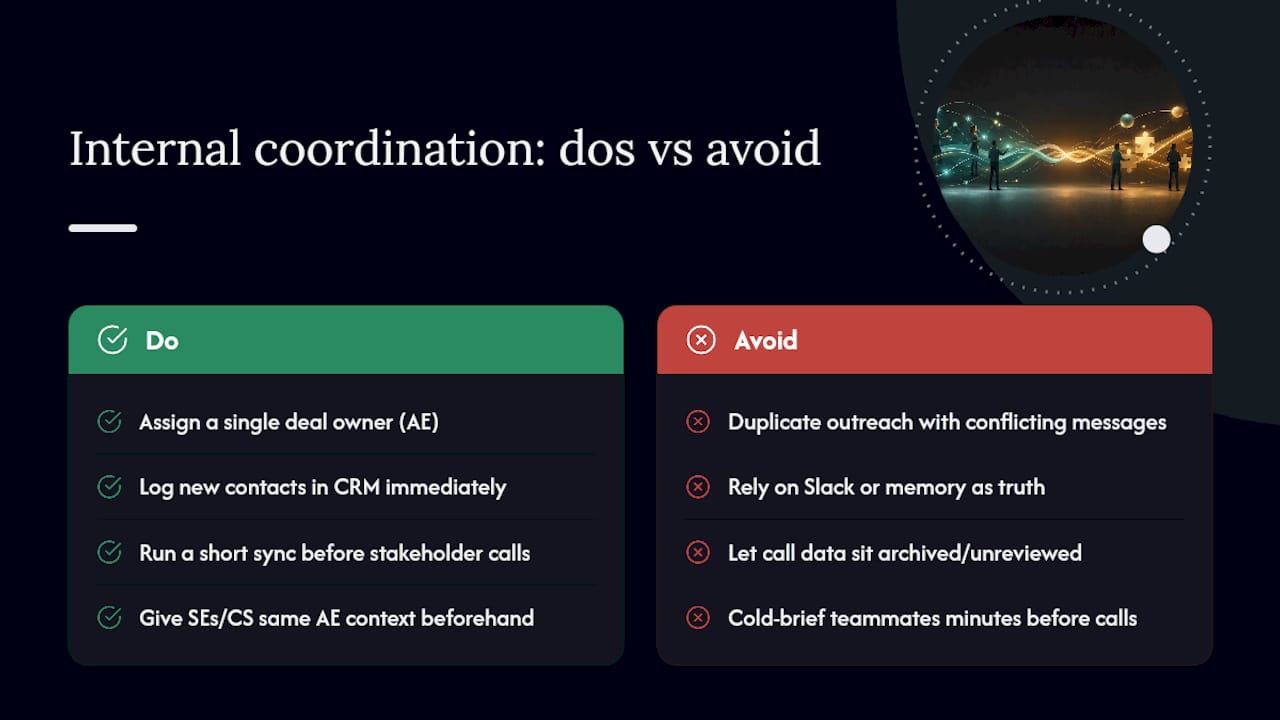
Multithreading falls apart internally before it ever fails externally. The most common failure isn’t a stakeholder going cold, it’s two people on your own team unknowingly contacting the same person with conflicting messages.
Assign a single deal owner, typically the AE, who has final say on sequencing and messaging across the account. If an SDR is doing top-of-funnel outreach to additional stakeholders, they report new contacts into the CRM immediately, with role tags, before sending anything.
Run a short internal sync, even five minutes, before any multi-stakeholder call or milestone. Everyone touching the account should know who’s been contacted, what’s been promised, and what the next move is. This is especially important when a sales engineer or customer success lead gets pulled in for a technical conversation. They need the same context your AE has, not a cold briefing five minutes before the call.
Use your CRM as the single source of truth, not Slack threads or memory. If the account intelligence and conversation summary tools mentioned earlier are logging calls automatically, make sure that data actually gets reviewed, not just archived. Our breakdown of B2B sales methodology and governance covers how to build this kind of internal accountability into a repeatable process rather than relying on team habit.
For SDR-AE pairs specifically, define handoff rules ahead of time: which contacts the SDR owns through qualification, and at what point ownership shifts fully to the AE for expansion into the rest of the committee.
Multithreading scales with deal size and complexity, and applying the same intensity to every deal wastes rep time on small accounts while under-resourcing the ones that actually need it.
For smaller deals, typically under a few thousand dollars in annual value with a short sales cycle, two to three stakeholders is often enough. A champion and an economic buyer, contacted with the 2-2-2 rule as your baseline, cover most of the risk. Over-threading a small deal just slows it down with unnecessary internal coordination.
Mid-market deals, where budget sign-off usually requires more than one signature and the cycle runs several weeks, call for the full role map: champion, economic buyer, technical evaluator, and end user at minimum. This is where the 3 to 5 stakeholder floor mentioned earlier applies most directly.
Enterprise deals need a different operating model, not just more contacts. Expect procurement, legal, and multiple technical evaluators alongside the standard roles, often ten or more people before signature on strategic accounts. At this scale, you need a documented account plan, not just a mental map, weekly internal syncs on thread health, and often a named executive sponsor on your own side to match seniority with the buyer’s leadership.
The mistake we see most often isn’t under-threading enterprise deals. It’s over-threading small ones, burning rep hours mapping a five-person committee for a deal that never needed more than two solid relationships.
Most advice on multithreading treats it like a networking tactic: meet more people, look more thorough. That misses the point entirely. The data on win rates and stakeholder counts isn’t describing a nice-to-have habit, it’s describing risk management. A single-threaded deal isn’t just slower to close, it’s structurally fragile in a way no amount of rep skill fixes.
The conventional wisdom oversells the exec-outreach part and undersells the CRM part. Reps love the idea of getting a VP on the phone. Almost nobody enjoys tagging roles and logging last-contact dates. But the second habit is what actually determines whether your threading effort produces a measurable pattern you can manage, or just a longer contact list that feels productive without changing your win rate.
If you take one thing from this, prioritize the mapping and tagging discipline before you worry about cadence sophistication. A well-tagged, honestly assessed three-person thread beats a sloppy, untracked seven-person one every time.
What is multithreading in sales, in one sentence?
It’s the practice of building direct, role-specific relationships with multiple stakeholders in a buying account instead of relying on a single point of contact to carry the deal internally.
How many stakeholders should I be threading on a typical B2B deal?
Use three to five as a floor for mid-market deals, and five or more for enterprise deals, while making sure each contact gets a tailored message rather than a generic one.
What is the 2-2-2 rule in sales?
Contact two stakeholders, at least twice each, across two different channels, as the minimum cadence for a thread to count as active, then scale up for larger deals.
When should I bring in an executive sponsor on my side?
Around the third touchpoint with the account tends to work best, after you’ve established enough context that the conversation doesn’t feel cold or premature.
Is multithreading necessary for small deals?
Not always. Low-ACV, short-cycle deals with one clear decision-maker can stay single-threaded without added risk, but anything involving multiple departments or longer approval chains benefits from threading early.
Teams ready to build this into a repeatable process can start with Sales Enablement Step by Step for Predictable Revenue.
Subscribe to our Insights: Expert productivity tips in your inbox
You'll receive 1-3 emails per month. Your data stays private, always.

CRO & Co-Founder with Sales Label Consulting

Watch our Sales Mates Podcast
August 24, 2026 - 8 min read
Read article Read articleAugust 22, 2026 - 8 min read
Read article Read articleAugust 21, 2026 - 7 min read
Read article Read articleAugust 20, 2026 - 9 min read
Read article Read article