
Benefits of Error-Free Sales for B2B RevOps Leaders
A repeatable, low-error sales process produces predictable revenue, faster rep ramp, and less pipeline leakage than any amount of hero selling ever will. That’s the whole thesis, and everything below is the mechanics behind it.
Here’s what a documented, CRM-embedded process actually buys you:
Stick around for the five-step roadmap and the exact KPIs to put on your dashboard.
A repeatable, low-error sales process with defined exit criteria and CRM enforcement is what converts unpredictable revenue into a forecastable, scalable system.
| Point | Details |
|---|---|
| Define exit criteria first | Write objective stage-advancement rules before buying or configuring any tool. |
| Gate commit on hygiene | Block deals with stale fields or missing next steps from counting toward forecast commit. |
| Track five core KPIs | Monitor forecast variance, stage conversion, stage velocity, ramp time, and revenue leakage weekly. |
| Fix handoffs to stop leakage | Standardize marketing-to-sales and sales-to-CS handoffs with named owners and SLAs. |
| Work with Saleslabelconsulting | Sales audits and enablement rollouts from Saleslabelconsulting help B2B tech teams embed this process into their CRM in weeks, not quarters. |
For a B2B tech RevOps leader, error-free sales isn’t about typo-free invoices or flawless order forms. It’s a predictable, repeatable sales process, backed by a RevOps setup, that minimizes execution errors: accurate forecasting, consistent qualification, and reliable deal execution from first touch to close.
That system needs six things to function:
The advantages of error-free transactions in your pipeline show up as line items your board will recognize. Let’s walk through each one.
Predictable revenue. When every rep runs the same stages with the same exit criteria, pipeline reviews stop being a debate about feelings and start being a conversation about facts. That’s the core promise of a documented sales process: it turns selling into a repeatable system instead of reactive guesswork, and higher forecast accuracy is the direct result.
Faster onboarding. A new AE who inherits a written playbook, with clear stage definitions and exit criteria baked into the CRM, doesn’t have to reverse-engineer what “qualified” means from watching senior reps. Ramp time drops because the system carries the knowledge, not any one person’s memory.
Scalable growth. Add ten reps to a process that lives in three people’s heads and you get inconsistency at best, churn at worst. Add ten reps to a documented, CRM-embedded process and you get more of the same predictable output. That’s the difference between growth and just… more headcount.
Reduced revenue leakage. Process friction and undefined handoffs between marketing, sales, and customer success is one of the most common places revenue quietly disappears. Standardizing those handoffs and locking in exit criteria closes that gap.
Data-driven optimization. You can’t improve a stage you haven’t defined. Once every deal moves through the same funnel, you can measure conversion rate by stage, spot where deals stall, and run targeted experiments instead of vague “let’s try harder” initiatives.
Tie each one to a number your executive team already tracks: forecast variance, ramp time in days, pipeline conversion rate, stage velocity, and a leakage estimate pulled from stalled or lost-without-reason deals.
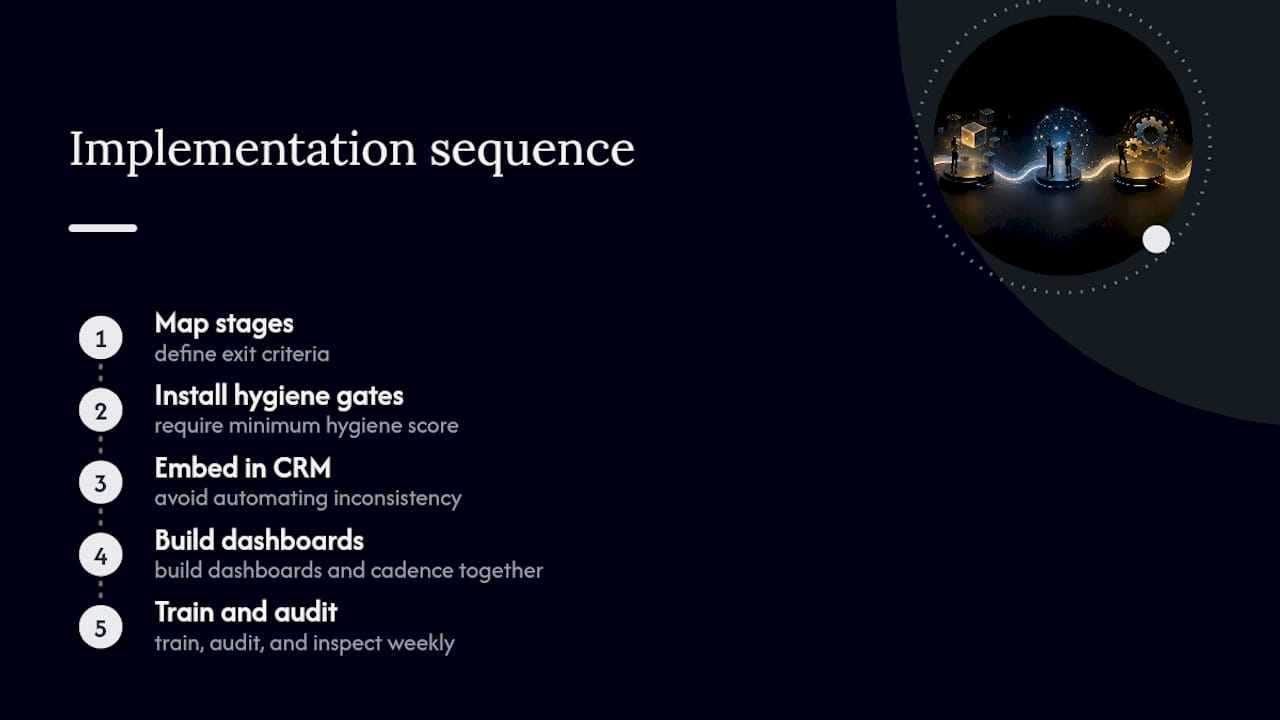
Here’s the compact version. This is the same sequence we run with clients, compressed into something you can start executing this quarter.
Pro Tip: Gate your commit roll-up on a hygiene score, not just a rep’s confidence rating. This single rule fixes more forecast pain than any new tool you’ll buy this year.
If you want the fuller version of steps two and three, we cover the automation and workflow specifics in our error-free process breakdown.
You need a short list of metrics that actually predict health, not a wall of vanity charts nobody opens. The core set: forecast variance (team commit versus actual), forecast accuracy band, stage conversion rate, stage velocity, ramp time, pipeline velocity, and revenue leakage rate.
Different roles should own different views. RevOps owns the hygiene scorecard. Sales managers own the Monday pipeline pass. The CRO owns a manager bias scorecard that tracks whether specific managers consistently over or under-call their forecasts.
| KPI | What it measures | How to calculate | Owner |
|---|---|---|---|
| Forecast variance | Gap between committed and closed revenue | (Actual minus committed) / committed | CRO |
| Stage conversion rate | Deal survival rate between stages | Deals advancing / deals entering stage | RevOps |
| Stage velocity | Speed of movement through the funnel | Average days per stage | Sales manager |
| Ramp time | Time to full quota productivity | Days from hire to first full quota month | Sales enablement |
| Revenue leakage rate | Qualified pipeline lost without clear reason | Lost-without-reason value / total pipeline value | RevOps |
Daily metrics (hygiene, at-risk flags) feed the weekly inspection. Ramp time and leakage are better suited to a quarterly retro where you’re looking for trend, not noise.
Most rollouts don’t fail because the strategy is wrong. They fail on execution details that are easy to overlook.
Red flags to watch in your first 30 days: CRM fields going stale within a week, deals sitting in one stage far longer than your historical average, and repeated forecast misses in the same direction (always high, never low). Run a quick audit: pull last quarter’s closed-lost deals and check how many had incomplete fields at the time they died. That number alone tells you how much of your leakage is process, not market.
You have a hygiene problem, and it’s fixable in weeks, not quarters.*
A messy internal process doesn’t stay internal. Prospects feel it. When your qualification is inconsistent, buyers get asked the same discovery questions twice by two different reps. When handoffs are undefined, the customer success team inherits a deal with no context, and the buyer has to re-explain their own use case during onboarding, right when they should be feeling confident about the purchase.

An error-free sales process fixes this from the buyer’s side, not just yours. Clear exit criteria mean a prospect only advances to a proposal once there’s genuine mutual understanding of scope, timeline, and value, so the proposal actually matches what they asked for. Standardized handoffs mean the account executive’s notes travel with the deal, so the implementation team isn’t starting from zero.
The compounding effect matters more than any single interaction. Buyers who experience a clean, well-paced sales cycle tend to expect and get a similarly clean onboarding experience, because it’s usually run by the same operational discipline. That consistency is part of why documented processes protect institutional knowledge even when a top rep leaves. The customer never has to know a departure happened, because the process, not the person, was carrying the relationship.
Fewer internal errors also mean fewer awkward corrections mid-deal, no re-quoting, no re-explaining terms, no promises made in the sales cycle that operations can’t actually deliver. That reliability is a retention lever, not just a sales metric.
Picture a mid-sized B2B software company adding fifteen SDRs and AEs in a single year. Without a documented process, that kind of growth usually produces wildly inconsistent forecasts, because each new rep interprets “qualified” differently and managers have no shared baseline to coach against.
The fix follows the same five-step sequence outlined earlier: map stages, install hygiene gates, embed the process in the CRM, build dashboards, then train and audit. The order matters. Companies that buy sales tools before defining exit criteria tend to end up automating the same inconsistency they started with, just faster.
Where this plays out well, the pattern is consistent: forecast variance narrows within a quarter or two once hygiene gates are enforced and commit roll-ups require a minimum hygiene score. Ramp time for new reps drops noticeably once onboarding is built around a documented playbook instead of shadowing whoever happens to be free that week, a pattern we’ve detailed in our onboarding framework guidance. Stage velocity becomes something managers can coach against directly, instead of a vague sense that “deals feel slow this quarter.”
The common thread across teams that get this right: they build the dashboard and the cadence at the same time as the process, not after. A process without weekly inspection just decays back into whatever reps were doing before.
Hero reps feel great until they leave, get promoted, or have an off quarter, and then your forecast leaves with them. Process-first teams win because the system is coachable in a way individual talent never is. You can inspect a stage. You can’t inspect a gut feeling.
The real unlock isn’t the documentation itself. It’s pairing that documentation with CRM enforcement and a weekly cadence, so the process is what the team actually runs, not a slide deck from an old kickoff. That combination is what makes hiring predictable too: you’re ramping people into a system, not hoping they reverse-engineer tribal knowledge from a senior rep who’s too busy to mentor.
If you’ve read this far, you already know the roadmap. What most RevOps leaders lack isn’t the theory, it’s the bandwidth to map stages, rebuild the CRM, and train the team while still hitting this quarter’s number. That’s the gap Saleslabelconsulting closes: we run sales audits, sales enablement rollouts, and RevOps implementations designed to get you from documented process to CRM-enforced discipline without pulling your team off the phones for months.
Engagements typically start with a diagnostic to find where your current process leaks revenue, then move into a structured build using the same five-step sequence covered above. Clients who’ve gone through this tend to see faster forecast stabilization and shorter rep ramp within the first two quarters. If you want the step-by-step version of this roadmap applied to your team, start with the Sales Enablement Step by Step for Predictable Revenue engagement, or book a diagnostic conversation to see where your current process is leaking the most revenue.
What are the benefits of error-free sales for a B2B tech company?
The main benefits are predictable revenue, faster rep ramp, scalable growth without added chaos, reduced revenue leakage, and forecasts your board can actually trust.
How is error-free sales different from operational accuracy in fulfillment?
This concept refers to a predictable, low-error sales process, accurate forecasting, consistent qualification, reliable deal execution, not invoice or order accuracy.
How long does it take to see results from a more accurate sales process?
Hygiene gates and a weekly cadence often tighten forecast variance within one to two quarters; ramp time improvements usually follow once onboarding is rebuilt around the documented playbook.
What’s the fastest way to start improving sales accuracy?
Start with exit criteria and hygiene gates before touching automation. A clean, enforced definition of “qualified” fixes more forecast pain than any new tool.
Do we need new software to build an error-free sales process?
Not necessarily. Most CRMs already support the stages, required fields, and automation needed. The bigger constraint is usually a documented process, not a missing tool.
Subscribe to our Insights: Expert productivity tips in your inbox
You'll receive 1-3 emails per month. Your data stays private, always.

CRO & Co-Founder with Sales Label Consulting

Watch our Sales Mates Podcast
September 22, 2026 - 11 min read
Read article Read articleSeptember 21, 2026 - 8 min read
Read article Read articleSeptember 20, 2026 - 13 min read
Read article Read articleSeptember 19, 2026 - 13 min read
Read article Read article