
30 Minute Pipeline Review for Sales Leaders: 5 Deal Questions
Run weekly 30-minute, evidence-first pipeline review meetings that focus on just 3 priority deals per rep. That single change, done consistently, improves deal visibility, forecasting accuracy, and coaching quality faster than any dashboard rebuild. The rest of this guide gives you the exact agenda, the prep checklists, the five deal questions, and the metrics that make the format work.
TL;DR:
- Weekly 30-minute pipeline reviews should focus on only three priority deals with recent activity, not the entire pipeline, to maximize decision-making efficiency.
- Differentiate pipeline reviews from forecast reviews by examining deal health and progress inwardly, separate from rolling up numbers for leadership.
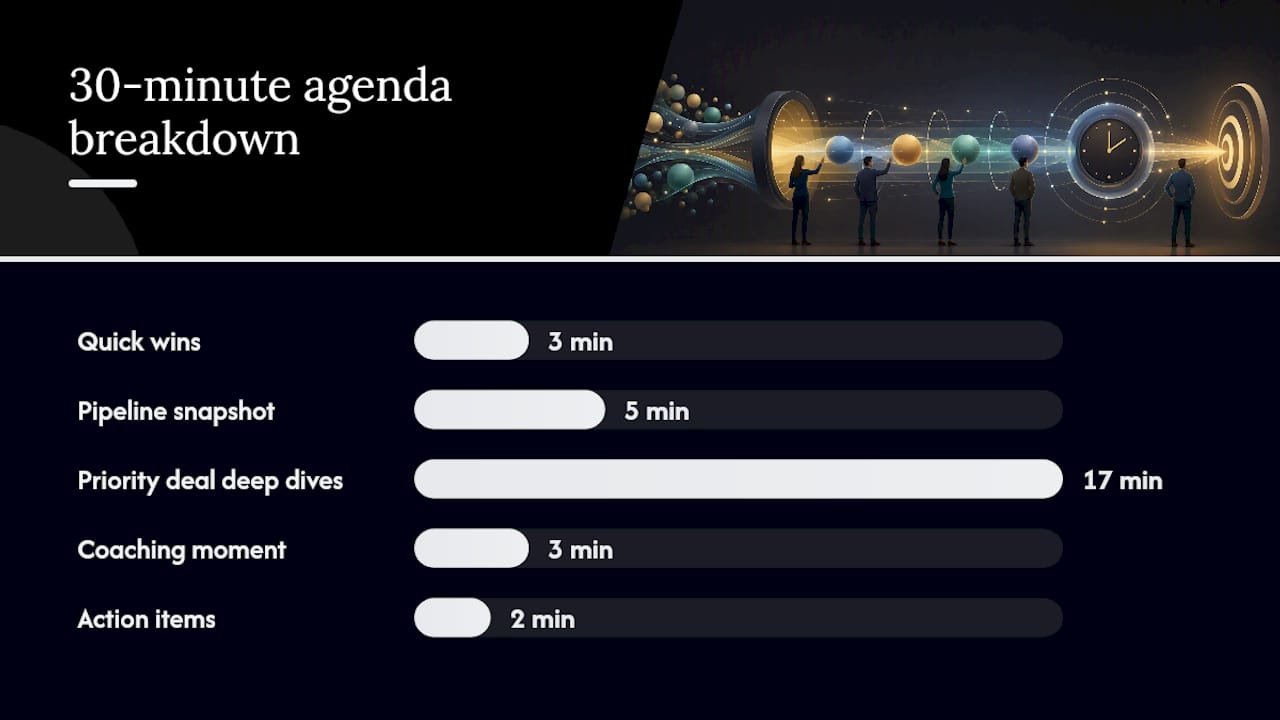
- Use a consistent agenda structure emphasizing momentum, open pipeline snapshot, deep dives on key deals, a coaching moment, and actionable next steps with clear CRM recording.
- Prepare deals and reps thoroughly before meetings with updated data, flagging specific deals and questions to avoid status narration and stale information.
- Focus on evidence-based questions about recent actions, champion involvement, deal risks, and stage progression to accurately categorize forecast potential.
A pipeline review meeting is a recurring, structured conversation where a manager and a rep (or a manager and the team) inspect specific deals to confirm they’re real, moving, and dated accurately. It’s not a status update. It’s a stress test.
This is where most managers get confused: a pipeline review meeting is not the same thing as a forecast review. A forecast review looks backward and upward, rolling numbers into a commit for leadership. A pipeline review meeting looks forward and inward, asking whether the deals feeding that number will actually close. Run them separately, or you’ll spend forecast conversations relitigating deal health and pipeline time defending a number nobody asked you to defend yet.
Two formats dominate:
The weekly 1:1 is where deals get saved or killed. The monthly team session is where you spot patterns across reps.
The direct payoff is deal visibility: you catch stalled deals before they die quietly on next quarter’s forecast. A rep who’s been “following up” for three weeks with no reply usually knows the deal is dead. A structured review forces that admission out loud, in week one, not week twelve.
Three outcomes show up almost immediately once reviews get consistent:
There’s a secondary benefit leaders underrate: CRM hygiene. When a rep knows the manager will ask about a specific field, that field gets updated. Revenue Grid’s analysis of pipeline meetings found that most reviews fail not because the meeting is badly run, but because the data feeding it is stale and self-reported before anyone walks in the room.
Pro Tip: Track three numbers over eight weeks: coverage ratio, week-over-week pipeline delta, and count of deals with an overdue next step. If none of them move after two months of weekly reviews, the meeting format is the problem, not the reps.
Here’s the template. Multiple practitioner frameworks converge on this exact shape because it forces decisions instead of narration, and Salesforce’s own guidance on pipeline reviews makes the same case for timeboxing every segment tightly.
That’s 30 minutes. Not 45. Not “we ran long again.”
Rules for picking your 3 priority deals:
Recording actions so they stick:
Every action item needs three parts, written into the CRM before anyone leaves the call: an owner, a specific next action (not “follow up”), and a hard deadline. “Sarah, send updated pricing to the champion, by Thursday” is trackable. “Sarah will follow up” is not, and it’s the single most common way action items evaporate between meetings. Next week’s review opens by checking last week’s action items were actually done, which is what makes the format self-enforcing rather than a weekly ritual nobody takes seriously. A practical playbook for pipeline management walks through how to structure that recurring check without it feeling like a compliance exercise.
Preparation is where most pipeline review meetings quietly fail before they even start. If the rep walks in and starts narrating from memory, you’ve already lost the 30 minutes.
Rep checklist, due before the meeting starts:
Manager checklist, done the morning of:
Automation earns its keep here. A saved CRM view that auto-filters to deals with no activity in 10 days, or a dashboard pulling coverage ratio automatically, saves real prep minutes every single week. Collaborative board tools can help teams visualize deal status ahead of time too, though the reviews on tools like MURAL suggest they work best as a supplement to CRM data, not a replacement for it. A 12-step sales onboarding checklist is worth borrowing from if newer reps consistently show up underprepared, since the root cause is often a gap in how they were trained to update records in the first place.
Skip “where does this stand?” It invites a story. Ask these five instead, and the answers tell you whether the deal is real.
Run those five questions against every priority deal, and you’ll walk out with a forecast category that reflects reality: commit, best case, or pipeline, not “whatever the rep felt optimistic about on Tuesday.” Any deal that can’t produce real evidence for its close date drops a category immediately, no exceptions, no “let’s give it one more week” without a specific reason logged.
Weekly 1:1s for individual deal health, monthly team sessions for pattern spotting across the roster, that’s the cadence that holds up across most B2B sales organizations. Anything less frequent than weekly and deals go stale between check-ins without anyone noticing.
The math that matters most is coverage ratio: total open pipeline value divided by remaining quota. A widely used starting benchmark is 3x coverage, meaning $3 of open pipeline for every $1 of quota left to hit. Thinner than that, and you likely don’t have enough deals in motion to hit the number even if everything closes on schedule.
Three numbers to glance at before every review:
Check the pipeline coverage benchmark against your own quota structure before you assume 3x is the right target for your deal size and sales cycle.
The single biggest failure mode is letting the meeting become a narrated status update instead of a decision-forcing session. Here’s what causes that, and the fix for each.
Keep every review anchored on what changed since last week. If a deal’s status, evidence, or date hasn’t moved, spend fifteen seconds on it and move to something that has.
The coaching value of a pipeline review meeting comes from specificity, not encouragement. One skill, tied to one real deal, delivered in under a minute, beats a general “keep pushing” every time. If a rep keeps losing momentum after the first call, the coaching moment that week is about multithreading into a second stakeholder, not a vague note to “build more urgency.”
Pro Tip: Keep a running list of every coaching note you give each rep across a quarter. Patterns that repeat three times or more point to a real skill gap worth a dedicated training session, not another 90-second reminder in a pipeline review.
You don’t need to build these from scratch. A deal review checklist built around the five evidence questions above works as a shared doc reps fill in before every 1:1, cutting prep time and stopping status-dump behavior before it starts.
Coverage math, worked through quickly: if a rep has $60,000 left on quota this quarter and $190,000 in open pipeline, that’s roughly 3.2x coverage, healthy by the common benchmark. Drop below 3x and it’s worth asking whether prospecting time has quietly slipped in favor of closing activity.
Field notes and case examples referenced throughout this guide come from practitioner-level work with B2B sales teams implementing this exact structure.
Most managers already know their pipeline review meetings aren’t working. What surprises people is how small the fix usually is. Teams that switch from open-ended status meetings to a strict 3-deal, evidence-first format tend to see close-date accuracy improve within a single quarter, not because the deals changed, but because the conversation stopped accepting hope as data.
The uncomfortable part: this format is harder on managers than the old one. It requires you to actually push back on a rep’s story instead of nodding along. Do it consistently, and the discipline compounds.
— Antony
Running a great pipeline review meeting for a few weeks is easy. Keeping it disciplined for a year, across a growing team, with CRM data that stays clean and coaching that actually compounds, is where most sales organizations quietly slip back into status dumps. This approach builds the pipeline system, the exit criteria, and the review cadence into revenue operations so the discipline survives beyond your best week.
If your reviews have drifted into narration, a Sales Workflow Audit pinpoints exactly where the structure broke down, whether that’s stage definitions with no exit criteria, a CRM nobody trusts, or a review cadence nobody enforces. For teams scaling past their first sales hires, our Sales Team Setup work builds the role structure and reporting rhythm that make pipeline reviews meaningful in the first place. Start with a diagnostic conversation about where your pipeline governance stands today.
A pipeline review means inspecting specific open deals to verify they’re real, actively moving, and accurately dated, using evidence rather than a rep’s summary. It’s distinct from a forecast review, which rolls numbers up for leadership rather than examining individual deal health.
A pipeline meeting is the recurring session, often weekly, where a manager and rep (or manager and team) walk through priority deals to catch risk early and assign concrete next steps. The most effective version is a 30-minute weekly 1:1 focused on 3 priority deals with actions logged in the CRM.
The purpose is to catch stalled or overstaged deals before they quietly disappear from the forecast, and to create a specific coaching moment tied to a real deal. A well-run review also improves close-date accuracy, since dates get challenged against evidence rather than accepted as reported.
Pipeline stages vary by company, but a common structure runs prospecting, qualification, proposal or demo, negotiation, and closed (won or lost). Each stage should have defined exit criteria, evidence a deal must show before it advances, which is exactly what a pipeline review meeting is designed to verify.
Pricing depends on the scope of the engagement, whether that’s a Sales Workflow Audit, a full Revenue System Design, or ongoing advisory work. Current pricing details are available directly on the services page.
Subscribe to our Insights: Expert productivity tips in your inbox
You'll receive 1-3 emails per month. Your data stays private, always.

CRO & Co-Founder with Sales Label Consulting

Watch our Sales Mates Podcast
September 21, 2026 - 8 min read
Read article Read articleSeptember 20, 2026 - 13 min read
Read article Read articleSeptember 19, 2026 - 13 min read
Read article Read articleSeptember 18, 2026 - 10 min read
Read article Read article