
Ship Quick Wins in 90 Days: RevOps Roadmap for Leaders
A RevOps roadmap is a sequenced, outcome-driven plan that turns audit findings into prioritized initiatives that produce measurable revenue improvement. The plan runs 6 to 24 months and always follows the same sequencing rule: fix your data first, standardize process second, unify reporting third, then layer in advanced capabilities like predictive scoring or AI-assisted forecasting. Success looks like fewer surprises in the pipeline and a forecast leadership actually trusts.
TL;DR:
- A successful RevOps roadmap prioritizes fixing data quality first and focusing on measurable business outcomes rather than tool requests.
- An audit across data, process, technology, reporting, and team capability identifies the lowest-scoring areas to address upfront.
- Building impact versus effort matrices and dependency maps helps sequence initiatives effectively, starting with quick wins that deliver immediate value.
- A 30/60/90-day plan centers on CRM cleanup, process documentation, and dashboard deployment, with full quarterly cycles expanding into advanced capabilities.
- Continuous governance and feedback loops, including regular reviews and cross-functional alignment, are essential to keep the roadmap relevant and actionable.
A real RevOps roadmap is a phased plan, not a wish list. It stretches anywhere from 6 months for a lean startup to 24 months for a multi-product enterprise, and it names an owner, a timeline, and a metric for every initiative on it.
Ownership usually sits with a Head of RevOps or VP of Sales Operations, but the roadmap only works if Sales, Marketing, Customer Success, and Finance all have a seat at the table when it gets built. Leave Finance out, and you’ll fight about attribution later. Leave Customer Success out, and you’ll optimize acquisition while retention quietly bleeds.
Here’s the part most people get wrong: they pitch initiatives as tool requests (“we need a new CPQ”) instead of business outcomes. Executives fund outcomes, not features. Roadmaps that frame initiatives as “improve forecast accuracy by a measurable margin” get funded far more often than lists of software asks, according to AccountAim’s guidance on structuring fundable roadmaps. Frame every line item that way from day one, and half your executive-alignment problem disappears before the meeting starts.
You can’t sequence a roadmap you haven’t diagnosed. Every credible RevOps roadmap starts with a structured audit across five dimensions, scored honestly rather than aspirationally.
Run this scoring pass before you write a single roadmap item:
Whatever scores lowest becomes an early priority, not a “someday” item. A sales audit built around a five-step checklist gives you a repeatable way to run this without reinventing the wheel each quarter.
Your audit should produce three concrete deliverables:
Gartner has flagged data alignment as the single most critical factor in RevOps success, which is why your data score deserves the harshest scrutiny of the five, according to Gartner’s revenue operations research.
Once the audit is done, you’re staring at a list of 15 to 30 potential fixes. Most teams either try to do all of it at once (chaos) or pick the loudest stakeholder’s pet project first (politics). Neither works.
Build an impact versus effort matrix instead. Plot every initiative from the gap register on two axes: revenue or efficiency impact, and effort or cost to implement. The initiatives in the high-impact, low-effort quadrant are your quick wins, and they should be first on the calendar regardless of how “strategic” they feel.
Dependency mapping matters just as much as impact scoring. Sequencing failures, not lack of effort, are the most common cause of roadmap delays, according to ORM-Tech’s research on roadmap structure. You cannot build attribution reporting on top of dirty lead-source data. You cannot automate lead routing before your territory definitions are settled. Sequence data work before process work, and process work before reporting.
To communicate priorities to executives without a 40-slide deck, use a single initiative card per project:
Pro Tip: Put the initiative card in front of Finance before you present it to the full leadership team. If the metric and cost don’t survive that conversation, it won’t survive the boardroom either.
Concrete timelines beat vague ambition every time. Here’s a build sequence that works whether you’re at a 40-person startup or a 400-person scale-up.
The 30/60/90 window:
A 90-day build sequence centered on CRM cleanup, territory review, and comp model work reliably produces an operational baseline within three months, based on SalesRoadmaps’ analysis of the 90-day build sequence.
The four-quarter sequence beyond day 90:
Each phase builds on the last, which is exactly why skipping ahead to Q4 capabilities while your Q1 data is still messy produces dashboards nobody trusts, per ORM-Tech’s four-quarter framework.
A roadmap without a cadence is a slide deck that dies in a shared drive. Build the operating rhythm before you launch the first initiative, not after things start slipping.
The cadence that keeps roadmaps alive looks like this:
Roadmaps should function as living documents reviewed quarterly with an updated dependency map, not static plans set once a year and forgotten, according to ORM-Tech’s guidance on roadmap governance. Build a simple stakeholder map: who approves scope changes, who approves budget, and who gets notified but doesn’t need to sign off.
Pro Tip: Write your change-control rule down before you need it: any initiative shifting more than two weeks or 20% of budget needs sign-off at the quarterly review, not a hallway conversation. Without that rule, your roadmap turns into whatever the loudest voice wants that week.
A roadmap without measurable outcomes is a project list wearing a strategy costume. Every initiative needs a KPI attached before it launches, not after.
The core metrics worth tracking across a RevOps roadmap:
Forecast accuracy below 80 to 85% is a signal you need foundational data and process fixes before investing in predictive analytics, based on SalesRoadmaps’ forecast accuracy benchmarks. Attach one primary KPI to each initiative card, review it at the weekly forecast call, and roll all of it into a single executive dashboard. Two competing dashboards showing two different pipeline numbers is how trust in RevOps dies.
Your roadmap document should fit on one page, or executives won’t read past the first slide. Include six fields per initiative: name, owner, target quarter, dependency, metric, and budget range.
For the kickoff meeting, keep the agenda tight:
Store the roadmap in a shared, version-controlled doc, not a slide deck buried in someone’s inbox, and log every re-prioritization decision with a date and reason.
Sales Label Consulting’s 90-Day Playbook runs this exact sequence in the field: CRM audit, routing automation cleanup, a working executive dashboard, and two or three quick wins delivered inside the first month to build momentum. Owners get named per initiative, and every win is tied back to a metric leadership already cares about, like forecast accuracy or pipeline velocity.
Pro Tip: When presenting early wins to leadership, lead with the metric movement, not the activity. “Forecast accuracy improved 12 points” lands harder than “we cleaned up the CRM.”
Most roadmaps don’t fail from lack of ambition. They fail from a handful of predictable, repeatable mistakes.
The biggest one is skipping the audit and jumping straight to tool selection. Teams buy a new forecasting platform before fixing the data feeding it, then wonder why the new tool produces the same bad numbers faster. Second is scope creep without change control: a roadmap that started with 8 initiatives balloons to 22 because nobody said no, and nothing ships on time.
Third, and this one is sneaky, is treating the roadmap as a Sales-only document. If Customer Success and Marketing weren’t in the room when priorities got set, they won’t show up for execution either, and cross-functional initiatives stall at the handoff every time.
Fourth is measuring activity instead of outcomes. “We implemented lead scoring” is not a result. “Lead scoring lifted qualified conversion by a measurable margin” is. Roadmaps that report the former lose executive attention by the second quarterly review.
Last, teams underestimate change management. A perfectly sequenced roadmap still fails if reps don’t adopt the new process, because nobody built enablement and training into the timeline. Building a sales enablement program alongside the roadmap is what actually gets adoption past the finish line, not just the technical rollout.
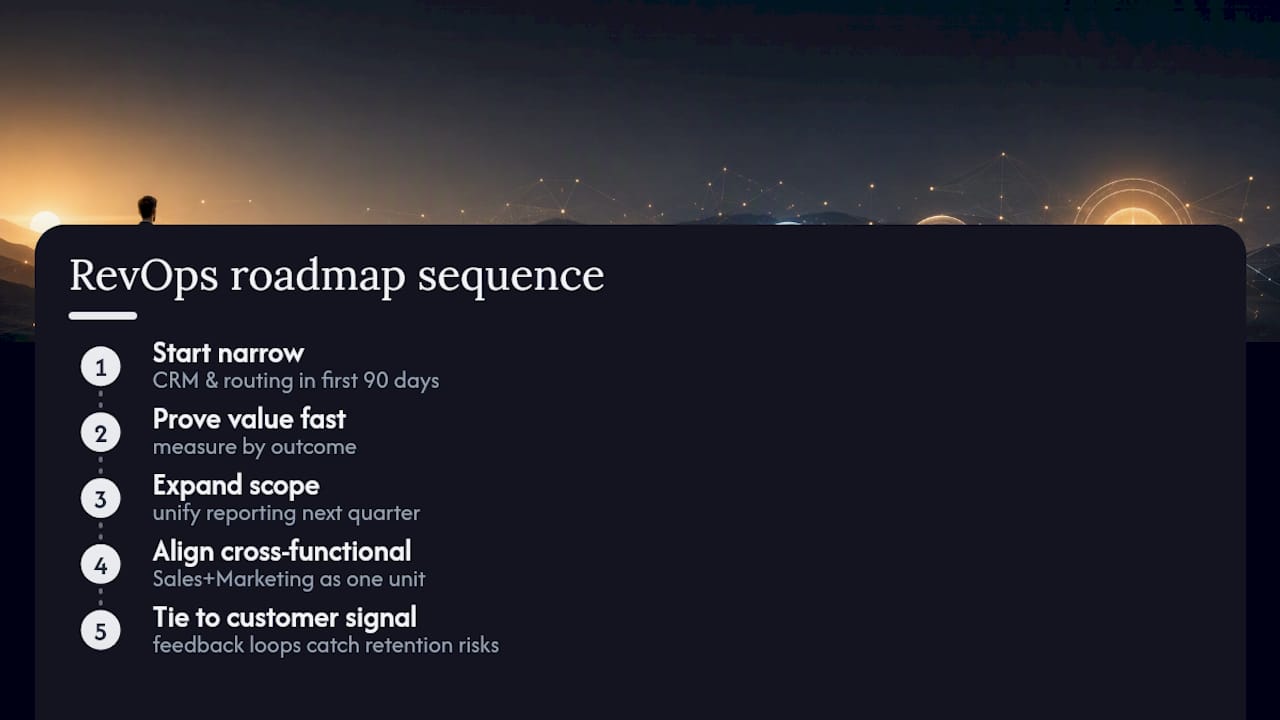
The pattern across effective RevOps programs is consistent: they start narrow, prove value fast, and expand scope only after the early wins land. A company tightening its CRM data and routing rules in the first 90 days, then unifying reporting in the following quarter, avoids the trap of trying to fix everything simultaneously.
Cross-functional alignment shows up repeatedly as the differentiator between roadmaps that stick and ones that quietly die. Companies that treat Sales and Marketing as one operating unit rather than two departments with separate scorecards see measurably stronger results, and research on sales and marketing alignment shows revenue growth as high as 208% when that alignment is done well. That number isn’t a fluke. It reflects what happens when handoffs stop leaking pipeline between teams that used to work in silos.
Another consistent best practice: tying roadmap initiatives to customer signal, not just internal process gaps. Teams that build feedback loops from customer interactions into their prioritization process catch retention risks earlier, and customer feedback has been linked to substantial revenue growth when it’s systematically fed back into GTM decisions rather than collected and ignored.
The through-line across every strong example is the same: sequence by dependency, measure by outcome, and never let the roadmap outrun what the data and process can actually support yet.
You don’t need enterprise software to run a roadmap well, but you do need something more durable than a spreadsheet that only one person understands. Project and roadmap visualization tools that support Gantt-style quarterly views work well for the planning horizon layer, since they let you show dependency chains visually rather than describing them in a meeting.
For the CRM and pipeline layer, the tool matters less than the discipline behind it. A clean CRM with rigorous field governance beats an expensive platform with messy data every time. What matters is whether your system of record can produce a single trusted pipeline number, feed your executive dashboard automatically, and flag data quality issues before they cascade into forecast errors.
For governance and decision logging, a shared, version-controlled document, whether that’s a wiki page or a structured project tracker, beats a slide deck that goes stale the week after the kickoff. The specific brand of tool is a secondary decision. The primary decision is whether your team actually updates it weekly, because a roadmap tool nobody opens is worse than no tool at all.
A roadmap set once a year and left untouched is already obsolete by month four. Build review points directly into the cadence you established earlier, and treat each quarterly strategic review as a re-scoring exercise, not a status update.
At each quarterly review, revisit your original impact versus effort matrix with fresh data. An initiative that looked high-impact in Q1 might drop in priority once early results come in, and one you deprioritized might resurface once a dependency clears. Bring actual KPI movement into that conversation. If forecast accuracy hasn’t moved after a full quarter of “process standardization,” something in the sequencing assumption was wrong, and the roadmap needs to say so honestly rather than quietly moving the goalposts.
Feedback shouldn’t only flow top-down from leadership review. Build a lightweight channel for reps and frontline managers to flag friction with new processes as they roll out, since they’ll spot adoption problems weeks before they show up in a dashboard. The dependency map from your original audit should get updated every quarter too. New gaps surface as old ones close, and a roadmap that doesn’t refresh that map is planning against outdated information within two quarters.
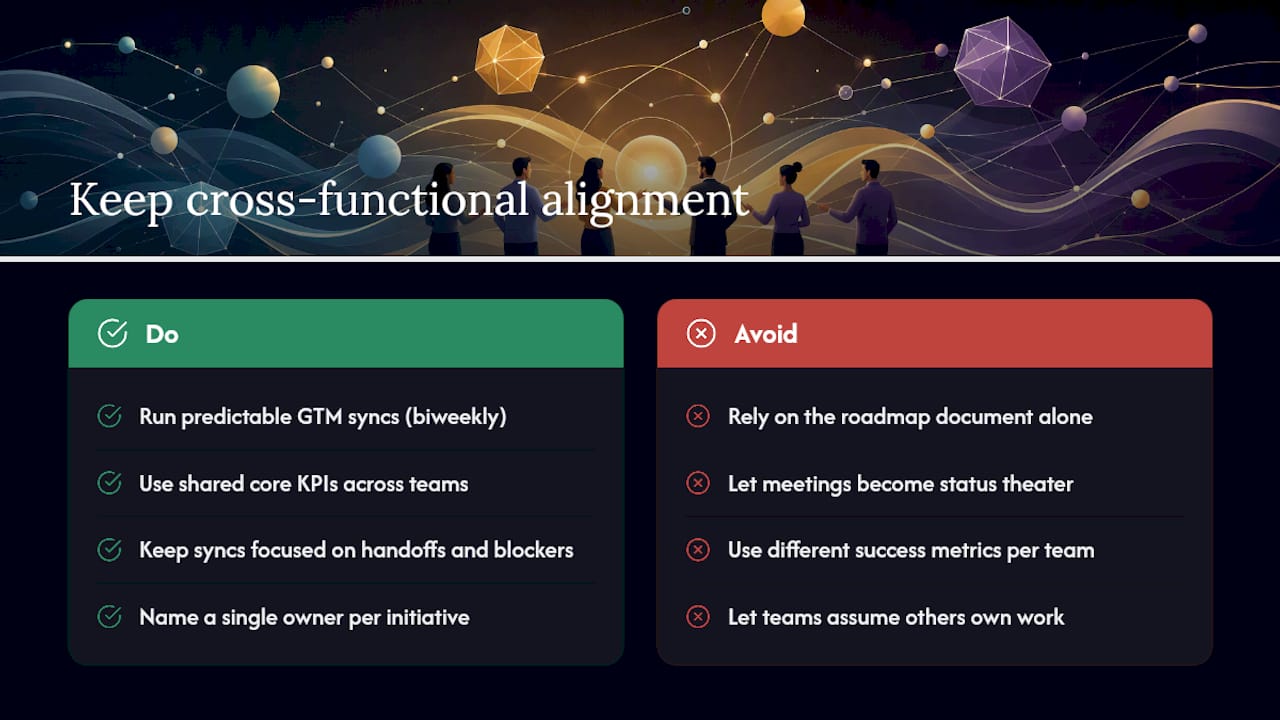
Alignment doesn’t happen because a roadmap document exists. It happens because the people executing it talk to each other on a predictable schedule, using shared language for what “done” and “success” mean.
Shared metrics are the foundation. If Sales measures success by bookings, Marketing measures it by leads, and Customer Success measures it by tickets closed, you have three departments optimizing for three different outcomes that may actually work against each other. Roadmap execution works better when all three groups report against the same core KPIs from the metrics section, even if their day-to-day work differs.
The biweekly GTM sync mentioned earlier is where this gets operationalized. Keep it focused on handoffs and blockers, not status theater. If a Marketing-sourced lead is stalling in Sales qualification, that’s the meeting where it gets surfaced and solved, not buried in a shared spreadsheet nobody checks. Naming a single owner per initiative, as covered in the initiative card format, also prevents the common failure mode where three teams each assume someone else is driving a cross-functional project forward.
Role clarity matters just as much as meeting cadence. Teams executing a roadmap need clearly defined ownership boundaries, and structuring your sales team around clear roles reduces the ambiguity that causes cross-functional initiatives to stall at exactly the handoff points a roadmap is supposed to smooth out.
Fix your data before you touch anything else. And tie every initiative to a number an executive already tracks. Skip either lesson, and your roadmap becomes a document nobody funds twice.
— Antony
Some consulting firms offer structured revenue system rebuilds grounded in real field execution, not just textbook frameworks. The phases mapped throughout this guide, audit, prioritization, sequencing, governance, correspond to the typical stages in revenue operations consulting engagements: diagnostics to run five-dimension audits, workflow audits to surface gap registers, and playbooks to execute initial quick wins with named owners and metrics attached to each one.

Clients typically engage for a fixed-scope diagnostic first, then move into ongoing advisory work as the roadmap progresses through its quarterly phases. The goal every time is the same one this guide has walked through: fewer forecast surprises, cleaner handoffs between Sales and Customer Success, and a roadmap leadership actually trusts enough to keep funding. If your current roadmap is stuck at the audit stage or stalled on executive buy-in, explore Sales Label Consulting’s services to see which engagement fits where you are right now.
A RevOps roadmap is a sequenced, phased plan, typically spanning 6 to 24 months, that turns audit findings into prioritized initiatives with named owners, timelines, and metrics. It follows a data-to-process-to-reporting-to-advanced-capabilities sequence so each phase builds on the last, as outlined in ORM-Tech’s roadmap framework.
The initial audit and first quick wins typically take 90 days, following a build sequence of CRM cleanup, territory review, and comp model work that produces an operational baseline within three months, according to SalesRoadmaps’ 90-day build sequence. Full roadmap execution across all phases usually runs a full four quarters or longer.
Frame every initiative as a measurable business outcome, like improved forecast accuracy, rather than a tool or software request. Roadmaps structured around outcomes, current-state gaps, and clear prioritization criteria secure funding more consistently, per AccountAim’s guidance on fundable roadmap structure.
Core metrics include forecast accuracy, pipeline velocity, stage conversion rates, time to value, and net revenue retention. Forecast accuracy below roughly 80 to 85% signals a need for foundational data and process fixes before investing in advanced analytics.
Yes. Sales Label Consulting offers Revenue System Diagnostics, Sales Workflow Audits, and a 90-Day Playbook that map directly to the audit, prioritization, and execution phases described in this guide. Current pricing for these engagements is available on the services page.
Subscribe to our Insights: Expert productivity tips in your inbox
You'll receive 1-3 emails per month. Your data stays private, always.

CRO & Co-Founder with Sales Label Consulting

Watch our Sales Mates Podcast
September 20, 2026 - 13 min read
Read article Read articleSeptember 18, 2026 - 10 min read
Read article Read articleSeptember 17, 2026 - 16 min read
Read article Read articleSeptember 16, 2026 - 14 min read
Read article Read article