
Sales and marketing alignment drives 208% revenue growth
Misaligned sales and marketing teams are quietly bleeding revenue from your tech company. Companies with aligned sales and marketing teams generate over twice the revenue from their marketing efforts compared to those that don’t. For mid-sized tech firms across the EU, this misalignment manifests as poor lead quality, conversion challenges, and wasted resources. This guide reveals proven alignment frameworks, cultural fixes, technology roles, and success stories targeted to Sales and RevOps leaders ready to unlock predictable revenue growth.
| Point | Details |
|---|---|
| Revenue impact | Alignment boosts revenue by 208% and reduces lead waste by 20%. |
| Team structure | Maintaining distinct teams with collaboration outperforms merging departments. |
| Success metrics | Shared KPIs and SLAs improve conversion rates and quota attainment significantly. |
| RevOps role | RevOps reduces forecast errors by 30% through unified data and processes. |
Sales and marketing alignment means coordinated efforts between departments to share goals, data, and accountability. It’s not about merging teams or eliminating boundaries. Instead, alignment eliminates silos and improves predictable pipeline management by creating structured collaboration frameworks.
For mid-sized EU tech firms, alignment matters because it directly drives revenue growth by improving lead quality and sales efficiency. Your marketing team generates demand, your sales team converts it. When these functions operate independently with conflicting priorities, you waste resources and miss opportunities.
Symptoms of misalignment appear everywhere. You’ll notice inconsistent lead follow-up, conflicting goals between departments, and fragmented data that nobody trusts. Cultural complexities across EU markets and scaling challenges amplify these problems in growing tech companies.
Common misalignment symptoms include:
Recognizing these symptoms is the first step toward building a revenue engine that actually works.
The numbers don’t lie. Aligned companies see a 208% revenue increase and reduce revenue leakage by 10-15% compared to misaligned organizations. This isn’t theoretical. It’s measurable impact on your bottom line.
Companies with aligned sales and marketing teams generate over twice the revenue from their marketing efforts compared to those that don’t.
Alignment reduces lead waste by 20% because sales teams actually follow up on qualified prospects instead of ignoring them. Your marketing budget works harder when sales trusts the leads coming through. Sales cycles shorten because consistent messaging and coordinated touchpoints move prospects through the pipeline faster.
Here’s what alignment improves across key metrics:
| Metric | Impact of Alignment |
|---|---|
| Revenue growth | 208% increase |
| Revenue leakage | 10-15% reduction |
| Lead waste | 20% reduction |
| Sales cycle time | 22% improvement |
| Forecast accuracy | 30% improvement |
These improvements compound over time. A 22% shorter sales cycle means your team closes more deals per quarter. Better forecast accuracy lets you plan hiring and resource allocation confidently.
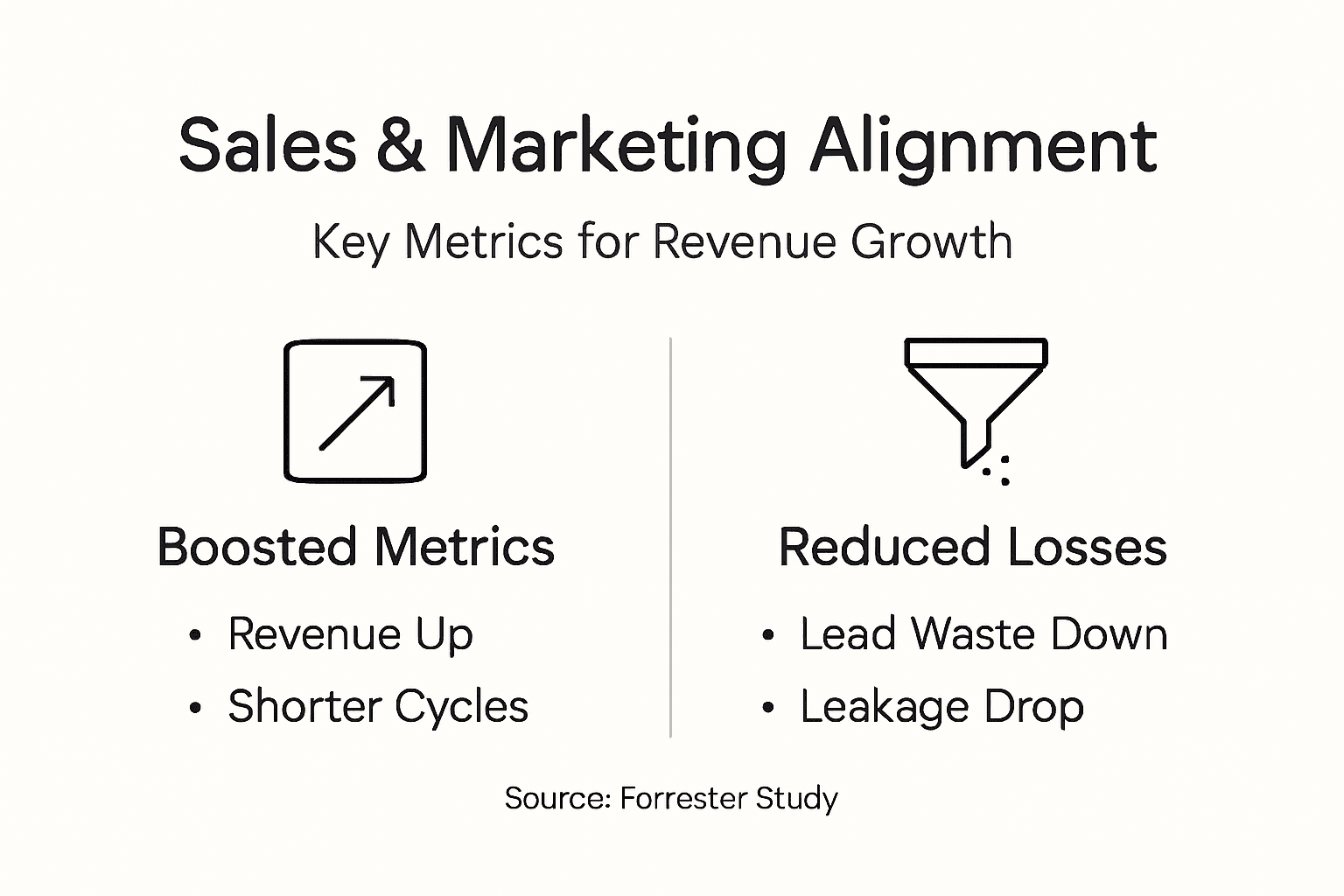
You can assess sales performance effectively to measure your current alignment maturity and identify gaps. The Forrester report on alignment metrics provides additional benchmarks to track your progress against industry standards.
Let’s clear up the myths blocking your alignment efforts. Misconception one: aligning means merging sales and marketing teams into a single department. Wrong. Maintaining distinct sales and marketing functions while fostering collaboration yields better outcomes than merging teams. You need specialized expertise in each function.
Misconception two: marketing is only responsible for lead generation, not nurturing or qualification. This outdated view creates handoff problems. Modern marketing owns the entire demand generation process, including nurturing prospects until they’re truly sales ready.
Misconception three: technology alone solves alignment without cultural or process changes. You can’t buy your way out of misalignment. CRM systems and marketing automation platforms enable alignment, but they don’t create it. You need cultural shifts and process discipline first.
Here are the key misconceptions about sales and marketing alignment corrected:
Pro Tip: Focus on clear role definitions with shared accountability. This avoids confusion and resistance from both teams. When everyone knows exactly what they’re responsible for and how success is measured jointly, alignment becomes achievable.
Shared KPIs create accountability that drives results. Marketing Qualified Leads (MQLs) measure marketing’s ability to generate interest. Sales Qualified Leads (SQLs) measure how well marketing understands what sales can actually close. Pipeline velocity tracks how fast deals move through stages. Quota attainment shows whether the entire system delivers revenue.
Shared KPIs like MQLs and SQLs, SLAs, and joint pipeline reviews improve sales outcomes significantly because both teams optimize for the same goals. No more finger pointing when numbers miss targets.
Service Level Agreements (SLAs) formalize commitments between teams. Marketing commits to delivering a specific number of qualified leads. Sales commits to contacting those leads within defined timeframes and providing feedback on quality. SLAs eliminate ambiguity about who’s responsible for what.
Joint pipeline and performance reviews foster continuous communication. Weekly alignment meetings keep teams synchronized on priorities. Monthly reviews identify trends and course corrections. Unified reporting dashboards give everyone real-time visibility into performance.
Here’s how different approaches compare:
| Approach | Pros | Cons | Best For |
|---|---|---|---|
| Merging teams | Single reporting structure | Role confusion, reduced morale | Rarely effective |
| Distinct teams, no coordination | Clear specialization | Silos, misalignment | Never recommended |
| Distinct teams with structured collaboration | Specialized expertise, clear accountability | Requires discipline | Mid-sized tech firms |
Key rituals that sustain alignment:
You can optimize sales processes for alignment by implementing these frameworks systematically. Forrester’s alignment frameworks provide detailed implementation guidance.
Pro Tip: Implement and review SLAs consistently to sustain alignment momentum. Monthly SLA reviews keep commitments visible and adjust targets based on actual performance data.
RevOps functions as the connective tissue between sales, marketing, and customer success. It unifies data, processes, and technology to create a single source of truth. RevOps reduces revenue forecast errors by 30% by eliminating conflicting data sources and standardizing definitions across teams.

CRM and marketing automation platform integration cuts sales cycles by 22% because information flows seamlessly. Sales reps see every marketing interaction before their first call. Marketing sees which campaigns generate closed revenue, not just leads. This transparency changes behavior on both sides.
Unified dashboards accessible to sales and marketing improve decision making. When everyone sees the same numbers, conversations shift from debating data accuracy to solving actual problems. You spend time optimizing conversion rates instead of arguing about whose leads are better.
Key RevOps and technology enablers include:
You can achieve RevOps success through team structure that bridges departmental silos. To understand Revenue Operations role fully, explore how it orchestrates alignment across your entire revenue organization.
These tools complement cultural and process changes rather than replace them. Technology enables transparency and automation, but humans still need to agree on goals, trust each other’s expertise, and communicate regularly. RevOps provides the infrastructure. Leadership provides the cultural foundation.
Mistrust over lead quality affects 60% of firms, causing blame and friction between departments. Sales complains that marketing leads are unqualified. Marketing insists sales doesn’t follow up properly. This cycle destroys collaboration and wastes everyone’s time.
Lack of shared language and goals creates silo mentality. Marketing celebrates MQL volume while sales cares only about closed revenue. Different definitions for “qualified lead” mean teams optimize for contradictory outcomes. The result: frustration on both sides and missed targets across the board.
Strategies to overcome these barriers:
Addressing culture alongside processes and technology is essential. You can implement perfect frameworks and world-class tools, but if teams don’t trust each other, nothing changes. Start with small wins that build confidence. Celebrate joint successes publicly. Address conflicts directly instead of letting resentment fester.
Formal accountability and shared metrics reduce political resistance. When compensation and performance reviews tie to joint outcomes, individual incentives align with organizational goals. Sales can’t succeed if marketing fails, and vice versa. This interdependence forces collaboration.
A mid-sized SaaS company in Germany improved lead-to-customer conversion rates by 27% within six months of implementing alignment strategies. They started with joint workshops defining MQL and SQL criteria both teams agreed upon. Marketing adjusted targeting to match sales’ ideal customer profile. Sales committed to contacting all SQLs within four hours.
The impact extended beyond conversion rates. Sales cycle duration dropped from 90 days to 68 days because messaging stayed consistent throughout the buyer journey. Pipeline predictability improved dramatically as forecast accuracy increased by 35%. The company scaled revenue without proportionally scaling headcount.
Another tech firm in the Netherlands saw similar results. They implemented weekly pipeline reviews where sales and marketing jointly analyzed stuck deals. Marketing created targeted content addressing specific objections sales encountered repeatedly. This collaboration closed deals that previously stalled indefinitely.
Key success factors from these cases:
These transformations didn’t happen overnight. Each company invested six months of disciplined execution before seeing major results. But the payoff justified the effort. Alignment creates compounding returns as trust builds and processes mature.
Ready to transform your revenue engine? Follow these steps to implement alignment systematically. Step one: audit current alignment maturity and identify gaps. Assess how well teams communicate, whether metrics are shared, and where friction points exist. Honest assessment reveals where to focus initial efforts.
Step two: create shared goals, KPIs, and SLAs between sales and marketing. Start with definitions everyone agrees upon. What makes a lead qualified? How quickly should sales contact new leads? What feedback should sales provide on lead quality? Document these agreements formally.
Step three: establish regular cross-functional meetings for communication and feedback. Weekly pipeline reviews keep teams synchronized. Monthly performance analysis identifies trends and improvement opportunities. Don’t skip these meetings when things get busy. Consistency builds the discipline that sustains alignment.
Step four: leverage RevOps and integrated technology for transparency and forecasting. Implement tools that share data bidirectionally between sales and marketing systems. Create dashboards showing real-time performance against shared metrics. Technology enables scale as your organization grows.
Here’s your implementation roadmap:
Pro Tip: Secure executive sponsorship early to maintain momentum and resource commitment. Alignment requires investment in time, tools, and potentially headcount. Executive support ensures you get what you need and that both teams prioritize alignment over competing demands.
Sales Label Consulting offers expert guidance tailored to mid-sized tech firms improving sales and marketing alignment for predictable revenue growth. We leverage extensive entrepreneurial tech experience to help RevOps, Heads of Sales, and VPs of Sales navigate complex alignment challenges confidently.
Our services include sales enablement implementation, best practices coaching, and RevOps team structuring designed specifically for growing European tech companies. We don’t provide generic advice. We work with your specific context, culture, and constraints to build frameworks that actually get adopted.
Dedicated support helps you execute alignment frameworks and technology adoption to realize measurable growth. Whether you need help with your initial audit, SLA creation, or ongoing optimization, we provide actionable guidance at every stage. Explore our sales enablement step-by-step guide, sales enablement best practices, and sales team structure and RevOps success resources for customized assistance that transforms alignment from concept to competitive advantage.
Inconsistent lead quality, frequent blame between teams, conflicting goals, and lack of shared metrics indicate misalignment. You’ll also notice poor conversion rates, fragmented data across systems, and marketing leads that sales never contacts. Recognizing these symptoms helps target corrective alignment efforts where they’ll have the biggest impact.
RevOps integrates data, processes, and technology to provide unified visibility and reduce forecast errors by 30%, improving alignment significantly. It creates a single source of truth that eliminates conflicting metrics and enables both teams to optimize for shared outcomes. To understand Revenue Operations role fully, explore how it orchestrates continuous collaboration across sales and marketing teams.
Key KPIs include Marketing Qualified Leads (MQLs), Sales Qualified Leads (SQLs), pipeline velocity, and sales quota attainment. Tracking these metrics jointly drives better accountability and results because both teams optimize for the same outcomes. Add conversion rates at each funnel stage and customer acquisition cost for comprehensive visibility.
Merging teams can cause role confusion and reduce morale, actually hindering collaboration rather than improving it. Maintaining distinct functions with formal coordination supports targeted expertise and clear accountability. Each team needs specialized skills, and blurring those lines typically creates more problems than it solves. Learn more about sales and marketing alignment misconceptions to avoid common implementation mistakes.
Subscribe to our Insights: Expert productivity tips in your inbox
You'll receive 1-3 emails per month. Your data stays private, always.

CRO & Co-Founder with Sales Label Consulting

Lets book a free call
October 11, 2026 - 7 min read
Read article Read articleOctober 10, 2026 - 8 min read
Read article Read articleOctober 9, 2026 - 7 min read
Read article Read articleOctober 8, 2026 - 10 min read
Read article Read article