
How to audit your sales process for predictable IT revenue
TL;DR:
- A sales process audit reveals revenue leaks, bottlenecks, and misalignments to create predictable growth.
- Combining operational checks with funnel diagnostics provides a comprehensive view of sales health.
- Regular, focused audits and continuous action are key to sustained sales improvement and revenue growth.
You’re hitting your activity targets, your reps are busy, and the pipeline looks full. Yet deals keep stalling, forecast accuracy is a mess, and revenue feels unpredictable. Sound familiar? For most European IT sales leaders, the problem isn’t effort. It’s invisible process gaps that quietly drain revenue quarter after quarter. A structured sales process audit changes that. It gives you a clear, honest picture of what’s working, what’s broken, and exactly where to focus to build the kind of predictable revenue engine your business needs to scale.
| Point | Details |
|---|---|
| Comprehensive audits win | Combining operational checks and B2B strategy uncovers more revenue opportunities than either alone. |
| Preparation is critical | Start your audit with complete data, clear KPIs, and buy-in from sales and operations for the best results. |
| Iterate for lasting change | Regular, smaller audits keep your team agile and enable continuous process improvements over time. |
| Fix and verify | Act on audit findings immediately, then measure and communicate progress to maintain team momentum. |
Let’s be direct: a sales audit isn’t just a compliance exercise. It’s a diagnostic tool that reveals where your revenue is leaking and why.
Most sales leaders think about audits in one of two ways. Some focus on operational checks, reviewing steps from initial quote to contract dispatch, ensuring process controls are followed. Others take a strategic lens, examining the full B2B customer funnel and diagnosing where prospects drop off. The real talk? Both approaches are needed for a truly comprehensive audit. Treating them as separate exercises leaves blind spots.
Here’s what a well-run audit actually delivers:
For European IT companies, this matters even more. B2B sales cycles in the tech sector are long, multi-stakeholder, and heavily influenced by procurement processes that vary across markets. Germany, the Netherlands, and the Nordics each have distinct buying cultures. A process that works in one market may stall in another. Your sales audit checklist needs to account for those nuances.
“Structure beats heroics. The best sales teams don’t win because their reps are superhuman. They win because the process is tight.”
Using a reliable revenue framework as your audit foundation helps you move from reactive firefighting to proactive pipeline management. And tracking the right sales performance metrics ensures you’re measuring what actually drives growth, not just what’s easy to count.
Pro Tip: Don’t run the audit with only leadership input. Involve frontline reps in the process. They see friction points that never make it into CRM notes or management reports.
Understanding the value of a sales audit sets a strong foundation for success. Next, we’ll outline exactly what you’ll need to begin your audit.
Having covered why an audit matters, let’s ensure you’re fully prepared with the right resources and people.
A rushed audit with incomplete data produces incomplete answers. Before you start, gather everything you need. Think of it like a surgeon prepping before an operation. You don’t improvise once you’re in the room.
Data you need to collect:
Tools required:
Team members to involve:
| Role | Contribution to audit |
|---|---|
| Head of Sales / VP of Sales | Sets scope, owns findings, drives changes |
| Sales Operations | Pulls CRM data, maps process steps |
| Finance | Validates revenue impact and deal economics |
| Selected sales reps | Provides frontline feedback and process reality check |
| Customer Success | Shares post-sale friction and handoff quality data |
Operational and B2B funnel diagnostics each require different data inputs. Operational audits lean on CRM logs, quote templates, and compliance checklists. Strategic funnel audits need conversion data, buyer journey maps, and customer interviews. Prepare for both.
Sample audit materials to gather:
Use your sales metrics for EU growth as a benchmark reference. Knowing what “good” looks like in your market segment makes it much easier to spot what’s underperforming. Combine that with process optimization essentials to set realistic improvement targets before you even begin the audit itself.
With your audit team and tools ready, let’s walk through the audit process step by step.
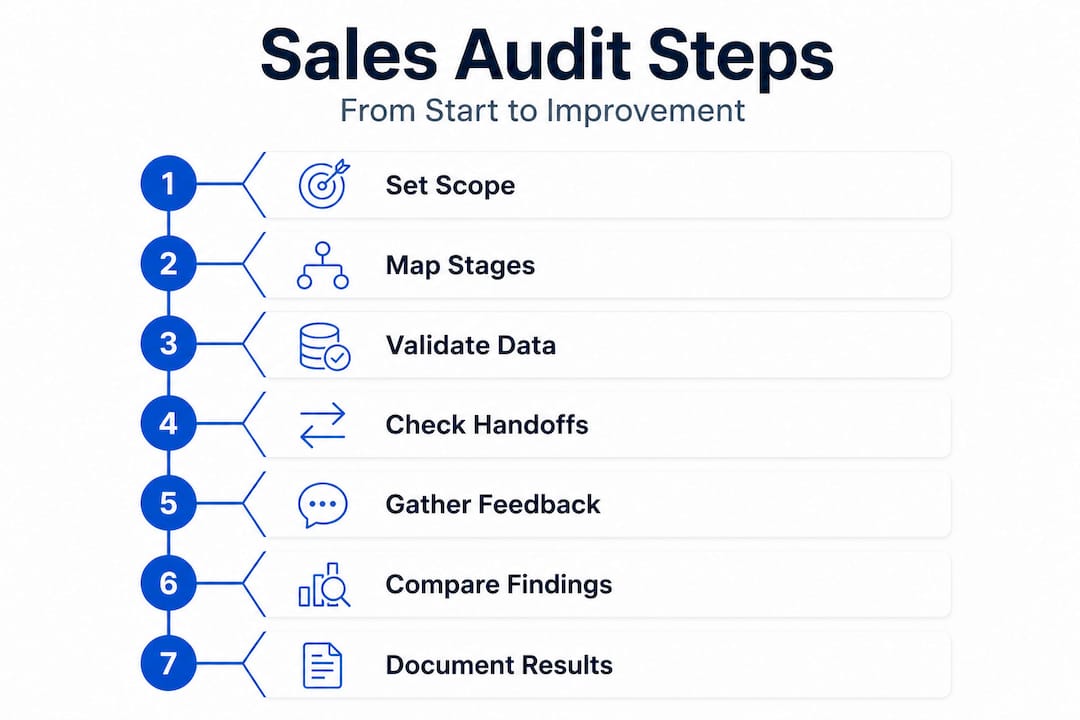
Step 1: Define your audit scope
Decide upfront: are you auditing the full funnel or a specific set of stages? Full-funnel audits are thorough but time-intensive. Focused audits on, say, the proposal-to-close stage can deliver faster wins. Be specific. “We’re auditing lead qualification through to demo completion” is a scope. “We’re auditing sales” is not.
Step 2: Map your current process visually
Draw out every step your sales process actually follows, not the ideal version in your playbook. What do reps actually do? Where do they skip steps? A visual process map often reveals unofficial workarounds that quietly undermine consistency. Use a whiteboard, Miro, or even a simple flowchart tool.

Step 3: Evaluate each stage
For every stage in your map, ask three questions:
Look at your CRM data to validate what you hear from reps. Numbers don’t lie, but they also don’t explain themselves. You need both.
Step 4: Check alignment across key handoffs
The most common revenue leaks happen at the seams: lead qualification to discovery, discovery to proposal, proposal to close, close to customer success onboarding. Audit each handoff specifically. Who owns it? What’s the SLA (service level agreement)? What gets lost in translation?
Step 5: Gather CRM data and overlay rep feedback
Pull your pipeline data and then sit down with reps to compare. Often you’ll find that what the CRM shows and what reps experience are two different realities. That gap is where your biggest process improvements live.
Step 6: Compare operational vs. funnel diagnostic findings
Integrating both audit approaches gives you the full picture. Use the operational lens to check quote accuracy, follow-up compliance, and documentation quality. Use the funnel diagnostic lens to assess buyer engagement, stage velocity, and conversion health. Neither alone is sufficient.
| Audit type | Best for | Key data sources |
|---|---|---|
| Operational audit | Process compliance, quote-to-close steps | CRM logs, templates, checklists |
| B2B funnel diagnostic | Conversion rates, buyer journey gaps | Pipeline data, call recordings, win/loss |
| Combined approach | Full revenue health check | All of the above |
Use funnel optimization steps to guide your stage-by-stage analysis. And when documenting findings, the step-by-step audit framework helps you structure outputs in a way that’s actionable, not just informational.
Pro Tip: Run at least a quarterly mini-audit focused on one or two key stages. Don’t wait for the annual review to catch problems that are already costing you deals.
A detailed audit is only effective if you avoid classic missteps. Here’s what to watch out for and how to fix each issue.
Mistake 1: Auditing compliance only, ignoring strategy
Focusing on just one audit type creates a partial picture. You might confirm that reps are sending follow-up emails on time while completely missing that those emails aren’t converting because the messaging is off. Fix: always pair compliance checks with funnel conversion analysis.
Mistake 2: Analyzing outcomes without examining process steps
Win/loss ratios are outcomes. They tell you what happened, not why. If you only look at win rates without examining the specific steps that led to those outcomes, you can’t fix the right things. Dig into the process, not just the scoreboard.
Mistake 3: Ignoring rep and customer feedback
Your CRM data is a lagging indicator. It reflects decisions already made. Sales rep feedback and customer input reveal the real-time friction that’s happening right now. Skip this and you’re flying blind on half the data that matters.
Mistake 4: Drowning in data instead of driving action
It’s tempting to track everything. Resist it. Choose three to five KPIs that directly reflect the health of your sales process and focus your audit findings around those. More metrics don’t mean more clarity. They often mean more paralysis.
“The goal of an audit isn’t a perfect report. It’s a shorter list of the right things to fix.”
Use a detailed sales audit checklist to keep your team focused on what matters. And track only the audit KPIs that connect directly to revenue outcomes.
Pro Tip: In the 48 hours right after your first audit session, document every quick win your team identifies. These are your low-hanging improvements. Act on them fast. Early momentum builds buy-in for the harder process changes ahead.
After completing your audit and fixes, it’s time to measure impact and build a habit of ongoing improvement.
An audit without follow-through is just a report. The real value comes from what you do next.
Choose clear post-audit KPIs:
Build a regular review rhythm:
Communicate changes clearly:
Don’t just fix things quietly. Tell your team what changed, why it changed, and what result you’re targeting. Reps who understand the “why” behind process changes adopt them far faster than those who receive a new playbook with no context.
Connect findings to sales enablement:
Comprehensive audits deliver reliable revenue only when findings feed back into training, coaching, and enablement programs. If your audit reveals that reps struggle with objection handling at the proposal stage, that insight should directly inform your next enablement sprint.
| Post-audit action | Expected impact | Timeline |
|---|---|---|
| Fix top 3 process gaps | Faster deal velocity | 30 days |
| Update qualification criteria | Higher-quality pipeline | 60 days |
| Revise proposal templates | Improved close rates | 45 days |
| Launch targeted coaching | Quota attainment improvement | 90 days |
Use your performance review checklist to track progress systematically. Verification isn’t a one-time step. It’s an ongoing loop that keeps your sales process sharp as markets, products, and buyer behaviors evolve.
Here’s the uncomfortable truth we’ve seen repeatedly working with European IT sales organizations: most audits fail not because the data is wrong or the team is lazy. They fail because the audit is treated as a one-time event rather than an ongoing practice.
Leadership schedules an audit, consultants or ops teams produce a 40-page report, and then… nothing. The report sits in a shared drive. Reps go back to doing what they’ve always done. Three months later, the same problems resurface.
The checkbox audit is the enemy of real improvement. When you audit to tick a box, you focus on surface-level compliance. Did reps log their calls? Are templates being used? Are stages updated in the CRM? These are fine questions, but they don’t tell you whether your process is actually winning deals.
The deeper failure is that operational checks and B2B funnel diagnostics are treated as separate exercises when they’re actually two sides of the same coin. Compliance without conversion analysis is incomplete. Conversion analysis without process compliance is equally blind. You need both, running in parallel, interpreted together.
What actually works? Quarterly pulse audits. Short, focused, and owned by the sales leader, not delegated to ops alone. These aren’t full-scale reviews. They’re 90-minute sessions where you look at one or two specific stages, pull the data, talk to two or three reps, and identify one concrete action. Done consistently, this builds a culture of continuous improvement that no annual audit can replicate.
We’ve seen this shift transform sales operations in IT companies across Germany, the UK, and the Nordics. The teams that win aren’t the ones with the most sophisticated audit frameworks. They’re the ones that audit regularly, act quickly, and communicate changes honestly. Structure beats heroics. Every time.
Running a sales process audit on your own is absolutely possible, and this guide gives you the foundation to start. But if you want to move faster, go deeper, and avoid the common traps that derail most audit efforts, having an experienced partner makes a real difference.
At Sales Label Consulting, we work specifically with European IT sales teams to design and run audits that go beyond surface-level compliance. We combine operational process reviews with strategic funnel diagnostics to give you a complete picture of your revenue health. Whether you need a structured audit process explained from scratch or a ready-to-use audit checklist for IT sales tailored to your market, we’ve got the frameworks and the experience to help you build predictable, scalable revenue. Let’s talk about what your sales process actually needs.
The primary goal is to uncover inefficiencies and missed revenue opportunities by assessing every step of your sales process, combining both operational and funnel diagnostics for a complete view.
Ideally, run a thorough full-funnel audit annually and conduct focused mini-audits quarterly to stay ahead of issues in fast-moving B2B tech markets.
Many teams focus only on compliance metrics or win/loss outcomes and skip integrating both audit types, which means they miss the practical, rep-level insights that drive real process improvement.
The core structure is similar across teams, but you should tailor audit scope, KPIs, and checklists to your specific market, deal size, and sales cycle complexity for accurate results.
Subscribe to our Insights: Expert productivity tips in your inbox
You'll receive 1-3 emails per month. Your data stays private, always.

CRO & Co-Founder with Sales Label Consulting

Watch our Sales Mates Podcast
Available
May 27, 2026 - 9 min read
Read article Read articleFix the System
Not Symptoms