
What Is Revenue Operations and Why It Matters
Watching revenue slip through the cracks is a familiar frustration for RevOps leaders across European tech companies. Complex processes, disconnected tools, and siloed teams often leave margin and conversion rates suffering. That is where the principles of Revenue Operations alignment come in, offering a unified framework for data, processes, and technology. This guide helps you pinpoint operational bottlenecks and build the structure that supports scalable growth and predictable revenue outcomes for every European market.
| Point | Details |
|---|---|
| Revenue Operations unifies departments | RevOps aligns marketing, sales, customer success, and finance to optimize revenue generation across the customer lifecycle. |
| Data and process standardization is essential | Clean data and defined processes reduce inefficiencies, enhance decision-making, and align team objectives. |
| Flexibility and adaptability in systems matter | RevOps must be agile, allowing for adjustments in processes and tools as business needs evolve. |
| Clear stakeholder involvement is crucial | Engage all relevant teams in the design and implementation of RevOps to ensure buy-in and effective execution. |
Revenue Operations is the operational function that aligns marketing, sales, customer success, and finance teams around shared revenue objectives. Rather than letting departments work in isolation, RevOps creates a unified system where decisions, data, and resources flow seamlessly across the entire customer lifecycle.
At its core, RevOps addresses siloed departmental efforts and the revenue leakage that comes with poor communication. Your teams might be hitting individual targets, but if they’re not aligned, you’re leaving significant money on the table.
RevOps operates across three interconnected dimensions:
The function isn’t about creating another bureaucratic layer. It’s about reducing friction. When your sales team spends time on administrative tasks instead of selling, that’s a RevOps problem. When marketing-qualified leads don’t match what sales actually needs, that’s a RevOps problem.
Revenue Operations combines integrated technology stacks, centralized data reporting, and shared goals into a unified model. When these elements work together, revenue becomes predictable and scalable.
Three principles separate effective RevOps from operational busy-work:
1. Predictability over heroics
You can’t scale on individual star performers. RevOps creates repeatable processes that generate consistent results regardless of who’s executing them. This matters enormously when you’re growing headcount and managing European expansion across multiple time zones.
2. Data as the foundation
Guesswork dies with RevOps. Every decision—pricing adjustments, territory assignments, campaign investments—stems from clean data. Poor data quality means poor decisions. RevOps ensures your systems are configured correctly and data flows accurately.

3. Cross-functional ownership
RevOps isn’t owned by one person or one team. Marketing owns lead quality, sales owns opportunity accuracy, customer success owns renewal data. RevOps coordinates and enforces these standards through shared accountability.
European tech companies face unique pressures. GDPR compliance, multi-currency pricing, regional compliance variations, and distributed teams across different markets create operational complexity that demands clear systems.
When you have fragmented processes and disconnected tools, scaling becomes chaotic. RevOps provides the operational backbone that lets you expand into new European markets without losing control of your revenue machine.
Pro tip: _Start by mapping where your current revenue leakage happens—lost leads, stalled opportunities, or customers who should have renewed. That’s your RevOps entry point.
RevOps structures aren’t one-size-fits-all. Your organization’s maturity, headcount, and revenue complexity determine which model makes sense. Understanding your options prevents you from building the wrong structure and wasting resources on overhead that doesn’t match your stage.
RevOps can be led by data-driven executives overseeing revenue forecasting, customer acquisition, and sales pipelines. The structure you choose depends on whether you’re a startup with five people or a scaling company with 200 across multiple markets.
Tech companies typically adopt one of three approaches:
1. In-house RevOps teams
Your organization builds and manages RevOps internally with dedicated staff. This model works when you have the budget and complexity to justify full-time headcount.
2. Hybrid approach
You maintain internal RevOps leadership but bring in external consultants for specific initiatives—system implementations, process design, or audit work. This balances cost with expertise and works well during transition periods.
3. Fully outsourced RevOps
Smaller tech companies often outsource RevOps entirely to a service provider. This model eliminates the cost of hiring specialists while providing scalability without long-term commitment.
Here’s a breakdown of the three main RevOps structural models for tech companies:
| Model Type | Typical Use Case | Main Advantages | Potential Drawbacks |
|---|---|---|---|
| In-house Team | Larger, complex organizations | Full control and role specialization | High ongoing salary investment |
| Hybrid Approach | Mid-sized or transitioning firms | Flexibility plus expert guidance | Consultancy costs add up |
| Fully Outsourced | Early-stage or small tech firms | Fast setup, access to expertise | Less internal knowledge retention |
RevOps structures vary from single-person generalists in startups to specialized teams with distinct roles in larger firms. Your choice determines execution speed and quality.
Startups typically start with a generalist model—one person juggling RevOps responsibilities alongside sales operations or customer success. This works until you hit approximately €2-3 million ARR.
Growing companies need specialized roles as complexity increases. Sales team structure optimization becomes critical when managing multiple regions, product lines, or go-to-market motions.
Scaling organizations benefit from centralized governance with clear role alignment. Multiple departments reporting into a RevOps leader prevents duplicate efforts and ensures consistent data standards across marketing, sales, and customer success.
In-house teams require significant investment. A RevOps manager in a European tech hub costs €80,000-120,000 annually. Add systems and data roles, and you’re looking at €250,000+ yearly.
Hybrid models cost less upfront but require ongoing consulting fees—typically €15,000-50,000 monthly depending on scope.
Outsourced models charge by scope: €5,000-15,000 monthly for small companies, scaling up for larger operations.
Choose the structure you can actually resource and support long-term. Understaffed RevOps creates more problems than it solves.
Pro tip: _Audit your current revenue bottlenecks before choosing a structure. If your main problem is data quality, you need systems expertise. If it’s process chaos, focus on a process specialist first.
RevOps doesn’t just create order—it unlocks money that’s currently stuck in broken processes. When marketing, sales, and customer success operate independently, deals slip through cracks and revenue potential disappears. RevOps fixes this by aligning teams around shared outcomes.
The optimization happens across three distinct areas: reducing revenue leakage, improving accuracy in critical processes, and identifying growth opportunities buried in your data.
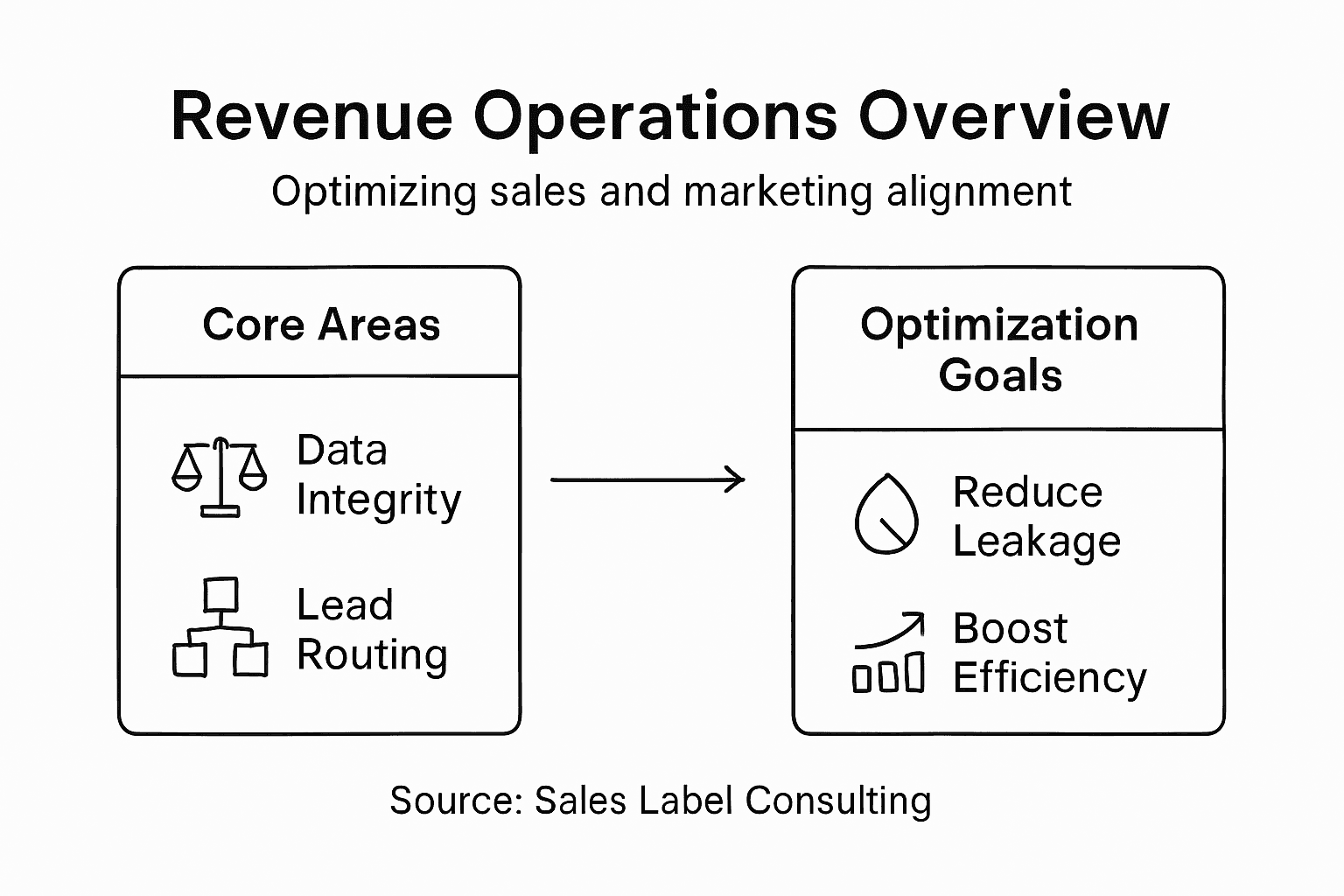
Revenue leakage is insidious. It’s not a single failure—it’s dozens of small inefficiencies that compound. You lose deals because handoffs between teams are messy. You lose deals because sales doesn’t know what marketing qualified them for. You lose deals because no one’s managing the pipeline consistently.
RevOps reduces leakage by standardizing how opportunities move through your funnel and ensuring nothing falls through gaps.
Common leakage points RevOps addresses:
RevOps breaks down silos and fosters collaboration, aligning team objectives and optimizing workflows. This directly translates to fewer lost deals and higher revenue capture.
When processes are consistent, results become predictable. Your team stops winging it. Instead, they follow proven sequences that win deals at higher rates.
RevOps improves conversion through:
Sales process optimization directly reduces time to close and improves deal quality across your entire organization.
Your customer data contains signals most organizations completely miss. RevOps centralizes that data and makes it actionable.
When you have clean data, you can answer critical questions:
These insights drive strategy. Without RevOps, this data stays scattered across systems and spreadsheets.
RevOps transforms operational burden into competitive advantage through visibility and consistency.
Pro tip: _Start by measuring your current revenue leakage. Track every lead that doesn’t convert and why. That baseline shows you exactly where RevOps will deliver the biggest impact.
RevOps teams aren’t sales ops with a new name. They operate at the intersection of multiple departments, which means the skill set is different. You need people who can think strategically about revenue while also executing operationally across systems, processes, and people.
The core challenge: RevOps roles require both technical depth and business acumen. You can’t hire pure technologists or pure strategists. You need people who understand how systems enable strategy.
Regardless of size, RevOps teams manage several critical functions:
Data integrity and governance
RevOps teams ensure data cleanliness and coordinate lead-to-account matching across systems. Bad data cascades into bad decisions everywhere. RevOps owns the quality standard and enforces it.
Lead routing and customer lifecycle optimization
How do leads flow from marketing to sales? What triggers next steps in customer success? RevOps designs these pathways and removes bottlenecks that slow deals or create hand-off chaos.
Process design and KPI alignment
What metrics matter? How do teams execute consistently? RevOps defines standard workflows and ensures everyone tracks toward the same outcomes—not competing goals that create friction.
Technology integration
Your CRM, marketing automation, billing, and analytics tools must talk to each other. RevOps architects these integrations and ensures data flows accurately across platforms.
RevOps reduces friction between departments and improves revenue growth through enhanced data accuracy, streamlined workflows, and measurable performance metrics. Clear role definitions drive alignment.
When hiring RevOps people, look for:
As you scale RevOps, you’ll hire specialists:
Revenue Operations Manager
Owns strategy, process design, and cross-functional alignment. Reports outcomes and drives continuous improvement.
Systems and Data Administrator
Manages CRM, marketing automation, integrations, and data quality. The technical backbone of RevOps.
Sales Enablement Specialist
Creates tools, content, and training that help reps execute the standardized process. Coaches and removes friction.
Analytics and Insights Specialist
Builds reporting, identifies trends in customer data, and surfaces growth opportunities to leadership.
Revenue operations success starts with clarity about who owns what. Ambiguity kills alignment.
Pro tip: _Hire your first RevOps person for data fluency and strategic thinking. Let them own multiple functions initially—they’ll tell you what role to fill next based on where they hit the ceiling.
RevOps implementations fail not because the concept is flawed, but because organizations make predictable mistakes. Most of these mistakes stem from either moving too fast without the right foundation or moving too slowly and losing momentum. Both kill RevOps adoption.
The difference between successful RevOps and failed RevOps often comes down to execution discipline and change management clarity.
Many teams jump straight into tool implementation without defining how people will actually work. You can’t automate chaos. Before touching your CRM or marketing automation platform, you need documented processes.
This means defining:
Without this clarity, RevOps becomes a collection of disconnected improvements rather than a unified system.
Start with process before tools. A great process with mediocre tools beats cutting-edge tools with broken processes.
Rigid permission controls and slow adaptability create bottlenecks that frustrate teams. Your RevOps system needs to flex when business conditions change.
Common rigidity mistakes:
RevOps should enable speed and agility, not constrain it. If your system feels like friction to the revenue teams using it, you’ve built the wrong thing.
This is the sneaky killer. Your process is sound. Your tools are configured correctly. But sales ignores the new system because nobody explained why it matters or how it helps them.
When roles change or new processes roll out, teams need:
Skip this, and your RevOps initiative sits unused while teams default to old habits.
Adoption fails silently. By the time you realize people aren’t using your new process, you’ve already wasted months of work.
RevOps isn’t about having fancy software. It’s about revenue results. Yet many teams get caught up in configuring systems and forget to measure whether anything actually improved.
Define success metrics before you start:
Then track relentlessly. If a process doesn’t move these metrics, simplify or abandon it.
RevOps fails when it’s owned by one person or one department without buy-in from sales, marketing, and finance. These teams need a voice in process design because they’ll execute it.
Involve stakeholders from day one. Their resistance often signals real operational problems you haven’t solved yet.
Pro tip: _Start small and measure. Implement one process improvement, track the results for 30 days, then expand. Small wins build momentum and prove RevOps value to skeptical teams.
Common RevOps pitfalls and their organizational consequences:
| Pitfall | Root Cause | Organizational Impact |
|---|---|---|
| No clear operating model | Process design skipped | Disjointed workflows, confusion |
| Overly rigid systems | Inflexible implementation | Bottlenecks, slow response to change |
| Poor change communication | Insufficient training | Low adoption, wasted investment |
| Tool-focus over outcomes | Metrics not defined upfront | Little measurable improvement |
| Siloed implementation | Lack of stakeholder input | Resistance, missed opportunities |
Understanding the critical role of Revenue Operations means recognizing how fragmented processes and poor data alignment can silently erode your tech company’s revenue potential. If you face challenges like revenue leakage, inconsistent sales methodologies, or difficulties coordinating marketing and sales teams across European markets, you are not alone. These pain points demand a strategic partner who combines deep entrepreneurial experience with practical Sales Enablement, Sales Audit, and Demand Generation expertise.

At Sales Label Consulting we empower Heads of Sales, VPs of Sales, and RevOps managers to break down silos and implement data-driven, scalable processes. Our tailored consulting services ensure you get the right structure, technology integration, and accountability that align with your unique growth stage. Don’t let operational complexity stall your expansion efforts. Start your journey toward predictable, error-free revenue by exploring how our Sales Enablement and Sales Audit services deliver measurable impact today.
Revenue Operations is an operational function that aligns marketing, sales, customer success, and finance teams around common revenue goals, creating a streamlined process that reduces silos and revenue leakage.
RevOps is crucial for tech companies as it addresses the complexities of fragmented processes and disjointed tools, enabling organizations to scale efficiently and maintain control over their revenue generation efforts.
The core principles of RevOps include predictability over heroics, utilizing data as the foundation for decision-making, and promoting cross-functional ownership to ensure accountability among teams.
RevOps reduces revenue leakage by standardizing customer workflows, improving data governance, and ensuring clarity of roles, which helps eliminate inefficiencies and ensures that leads and opportunities do not fall through the cracks.
Subscribe to our Insights: Expert productivity tips in your inbox
You'll receive 1-3 emails per month. Your data stays private, always.

CRO & Co-Founder with Sales Label Consulting

Book a free consultation call
October 11, 2026 - 7 min read
Read article Read articleOctober 10, 2026 - 8 min read
Read article Read articleOctober 9, 2026 - 7 min read
Read article Read articleOctober 8, 2026 - 10 min read
Read article Read article