
Improve sales forecasting: proven steps for greater accuracy
TL;DR:
- Accurate sales forecasting depends on diagnosing process shortcomings, solid data, and cross-team alignment.
- Cultivating a transparent culture that encourages honest reporting is crucial to forecast reliability.
- Ongoing monitoring and iterative adjustments enhance forecast precision and drive predictable revenue.
Missed revenue targets don’t just hurt quarterly numbers. They erode board confidence, distort hiring plans, and put your entire go-to-market strategy on shaky ground. For sales executives and RevOps leaders at EU-based tech companies, inaccurate forecasting is one of the most persistent and costly operational challenges. The good news? Forecasting is a skill, not a gift. With the right diagnostic process, cleaner data, structured models, and genuine cross-team alignment, you can move from frustrating misses to predictable, reliable revenue.
| Point | Details |
|---|---|
| Identify forecasting gaps | Diagnose weaknesses in your current process before making improvements. |
| Clean and unify data | Reliable, normalized sales data is essential for accurate forecasts. |
| Use structured methods | Applying proven models boosts forecasting reliability and stakeholder trust. |
| Involve multiple teams | Collaboration across sales and marketing drives greater accuracy. |
| Monitor and adapt | Continually review outcomes and refine your forecasting process. |
Once you’ve recognized the need for improvement and committed to change, the next step is to diagnose where your current process falls short. You can’t fix what you haven’t clearly identified.
Most forecasting problems trace back to three root causes: overoptimism in deal scoring, weak data discipline, and organizational misalignment. Sales reps shade numbers to look good. Managers accept those numbers without challenging assumptions. And finance builds plans on top of wishful thinking. The result is a forecast that feels confident but has no structural backbone.
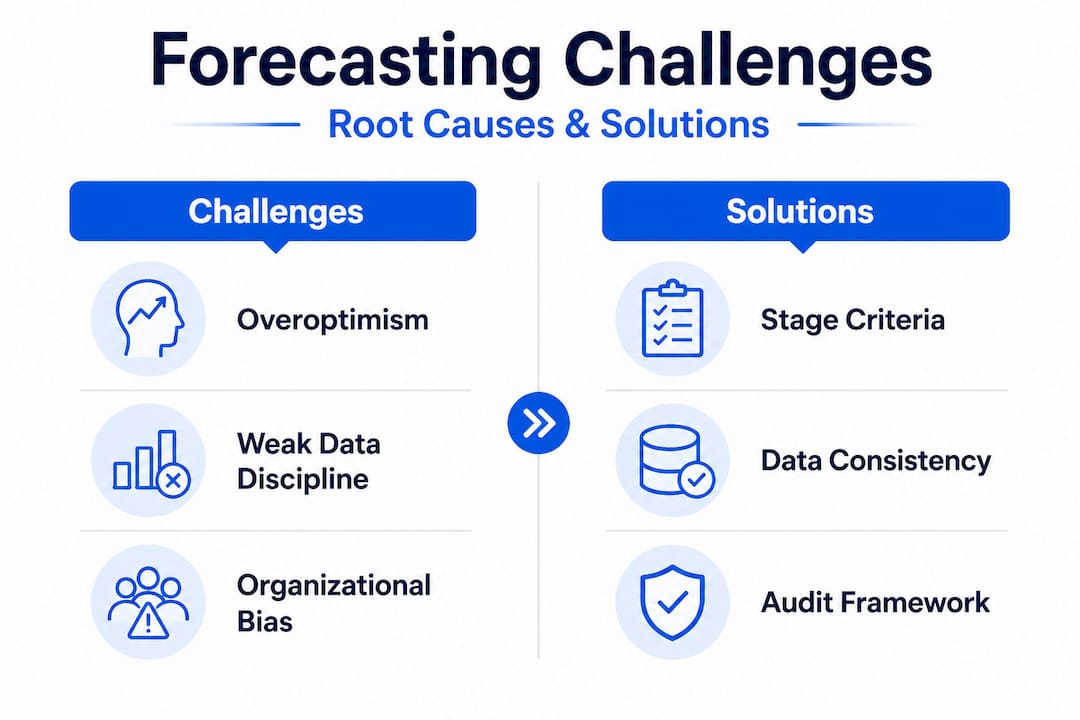
The unique obstacles faced by professional service organizations when predicting revenue are well documented, and many of these patterns repeat across EU-based tech teams regardless of company size or stage.
Key symptoms of an unreliable forecast:
| Common challenge | Practical solution |
|---|---|
| Overoptimistic deal scoring | Implement stage-exit criteria tied to buyer actions |
| No data discipline | Standardize CRM fields and enforce regular updates |
| Misalignment between teams | Create shared pipeline reviews with sales and marketing |
| No benchmark reference | Compare against industry benchmark surveys quarterly |
| Inconsistent deal definitions | Define and document what “qualified” means at each stage |
Pro Tip: Use a sales audit checklist to structure your diagnostic process. It gives you a repeatable framework to spot gaps without relying on anecdote or gut instinct.
Starting with an honest diagnostic is uncomfortable. But it’s the only way to build something better. Skipping this step means you’re just layering new tools on top of the same broken foundation.
With your diagnostic groundwork complete, focus on improving the data that feeds your forecasts. Garbage in, garbage out. It’s that simple.

Many EU tech sales teams operate with fragmented data spread across CRMs, spreadsheets, email threads, and disconnected analytics dashboards. This fragmentation creates blind spots. When your account executives are working from different versions of pipeline truth, you have no solid ground to forecast from.
Data analytics plays a central role in refining the forecasting process, especially for companies managing complex, multi-stakeholder sales cycles common in B2B tech.
Essential data sources you need feeding your forecast:
Consistency is everything here. If one rep defines “proposal sent” differently than another, your pipeline data becomes meaningless for statistical purposes. Document your stage definitions and train every rep on them. It sounds basic because it is. But most teams skip it entirely.
Analytics platforms that surface real-time pipeline health metrics give you a live view of where deals are stalling and what’s driving movement. Combine that with your historical close rates by stage, and you start to build genuine predictive power.
From our sales analytics work with EU enterprises, the teams that get this right share one habit: they treat their CRM like a source of truth, not an admin burden. That cultural shift is worth more than any software upgrade.
Pro Tip: Schedule a monthly data cleanse. Remove stale deals, update contact records, and recalibrate stage probabilities based on actual close data from the previous 90 days. One hour of hygiene saves hours of forecast chaos.
Now that you have reliable data inputs, it’s time to select and apply the right forecasting methodologies. There’s no single perfect model. Every method has tradeoffs, and the best teams blend approaches strategically.
| Method | How it works | Best for | Key limitation |
|---|---|---|---|
| Weighted pipeline | Assigns probability percentages to each deal stage | Companies with consistent deal cycles | Relies on accurate stage probabilities |
| Historical trend analysis | Projects future revenue based on past performance | Mature teams with 12+ months of data | Can miss market shifts or product changes |
| Intuitive forecasting | Reps and managers estimate based on experience | Early-stage or high-touch enterprise deals | Highly subjective, prone to bias |
Proven strategies for enhancing forecast accuracy in professional services and tech consistently show that blended methods outperform single-model approaches. When you layer weighted pipeline numbers over historical trend data, you get a model that captures both current pipeline reality and performance patterns.
Steps to implement a structured forecasting model:
Once your pipeline optimization strategy is running smoothly, evaluate your forecasting model every quarter. Markets shift. Win rates change. Rep teams turn over. A model calibrated six months ago may no longer reflect current reality.
Pro Tip: Blend weighted pipeline with historical trend analysis as your primary approach. Use intuitive rep-level forecasts as a secondary signal, not the primary driver. Structure beats heroics every time.
With forecasting models in place, maximize their effectiveness by embedding collaboration throughout the process. A great model fed by siloed data is still a broken model.
Forecasting isn’t a sales-only exercise. Marketing knows what’s coming into the top of funnel. Operations understands delivery capacity. Finance has visibility into cash flow constraints. When these teams work in isolation, the forecast reflects only one dimension of a much larger picture.
Key collaboration touchpoints that sharpen forecast accuracy:
The impact of internal collaboration on forecasting accuracy is significant. Consider this:
“Organizations that align their sales and marketing teams achieve 208% more revenue from their marketing efforts and see dramatically improved forecast reliability.”
That’s not a marginal improvement. That’s a structural advantage. And it comes from something most teams already have access to: their own people. They just need the process to pull it together.
Quick feedback loops matter just as much as formal reviews. When a deal status changes, it should trigger an immediate update in the forecast, not wait until the next weekly meeting. The faster your feedback loop, the more accurate your real-time pipeline view.
Effective teamwork across sales functions also reduces the political gaming that distorts forecasts. When reps know their numbers will be reviewed collaboratively rather than judged individually, they’re more likely to report honestly.
Collaboration sets a strong foundation, but regular monitoring and iterative improvements ensure lasting forecast accuracy. A forecast isn’t a document you write once. It’s a living process that needs constant calibration.
Key steps to ongoing forecast monitoring:
The role of data analytics in forecast refinement is backed by hard numbers. Teams that integrate ongoing analytics into their forecasting process see up to a 31% improvement in quota attainment. That’s the difference between hitting plan and missing it.
Recurring forecasting errors usually have patterns. One region consistently over-forecasts enterprise deals. A specific product line has a longer-than-expected sales cycle. One rep inflates early-stage probabilities. Once you surface these patterns through regular review, you can build corrections into the model before they become quarter-end surprises.
Schedule monthly quick reviews and full quarterly retrospectives. Make them structured, documented, and attended by RevOps, sales leadership, and finance. This turns forecasting from a guessing ritual into a managed, improvable process.
Sales team coaching plays a role here too. Reps who understand why accurate forecasting matters and how their inputs affect the model tend to update their CRM data more honestly and consistently. Transparency creates accountability.
Here’s our honest take after working across dozens of EU tech sales organizations: the tools and methods are rarely the real problem. Most teams know what good forecasting looks like. They’ve read the playbooks. They’ve invested in CRM platforms. They’ve attended the training.
What actually kills forecast accuracy is culture. Specifically, a culture where honest numbers feel dangerous.
When a VP of Sales knows the board expects 35% growth and current pipeline suggests 20%, there’s enormous pressure to close that gap in the forecast rather than in the business. Numbers get inflated. Stage probabilities get nudged upward. Deals that shouldn’t be in the forecast stay there because removing them feels like admitting failure.
This is the behavioral trap that classic sales mistakes often spring from. The underlying issue isn’t data or methodology. It’s the political environment around forecasting. When leaders punish honest reporting and reward confident optimism, reps learn quickly which game to play.
The fix starts at the top. Leaders have to model the behavior they want. That means saying “our forecast is 18 million and here’s what we know and don’t know” rather than rounding up to hit a narrative. It means celebrating forecast accuracy as a competency, not just revenue attainment as the only metric.
Hidden incentives also distort the picture. If reps get accelerated commissions for deals closed in Q4, they’ll push buyers toward Q4 regardless of whether the pipeline data supports it. If managers are measured purely on revenue booked, they’ll apply pressure that inflates close date accuracy. Structure your incentives so they reward data integrity, not just optimism.
Pro Tip: Challenge your core forecast assumptions monthly, not just at quarter-end. Ask yourself: “What would have to be true for this number to be wrong?” That simple question surfaces blind spots faster than any dashboard.
Real forecasting excellence is built on candid communication and psychological safety. When your team feels safe reporting what’s actually happening, you get the accurate signal you need to make better decisions.
You’ve walked through the full arc: diagnosing your current process, cleaning your data, applying structured models, building cross-team collaboration, and monitoring for ongoing improvement. That’s a solid foundation. Now it’s time to put it into motion.
At Sales Label Consulting, we work directly with RevOps leaders, Heads of Sales, and VP-level teams at EU-based tech companies to build forecasting processes that hold up under pressure. Whether you need a reliable sales audit to identify where your current system breaks down, a structured sales enablement program to build long-term forecasting capability, or a practical audit checklist for IT sales to run an internal review, we’ve got the tools and experience to help you get there. Predictable revenue starts with an honest look at where you are right now.
The most common mistakes include relying on gut feel over structured data, ignoring pipeline quality in favor of raw deal count, and never reviewing past forecast accuracy to learn from variance.
Sales data should be cleansed and updated at minimum once per month, with CRM activity records refreshed after every meaningful buyer interaction to maintain forecast integrity.
A blended approach that combines weighted pipeline analysis with historical trend analysis delivers the most reliable results for EU tech firms with multi-stakeholder, complex sales cycles.
Yes, significantly. Aligning sales and marketing teams creates shared pipeline visibility that directly improves accuracy and drives measurable revenue growth across the organization.
Comparing your win rates, deal velocity, and pipeline coverage ratios against benchmark surveys exposes performance gaps and helps leadership set more realistic, data-grounded forecast targets.
Subscribe to our Insights: Expert productivity tips in your inbox
You'll receive 1-3 emails per month. Your data stays private, always.

CRO & Co-Founder with Sales Label Consulting

Watch our Sales Mates Podcast
Available
May 2, 2026 - 9 min read
Read article Read articleMay 1, 2026 - 10 min read
Read article Read articleApril 30, 2026 - 10 min read
Read article Read articleApril 29, 2026 - 10 min read
Read article Read articleFix the System
Not Symptoms