
Unlock sales success through teamwork in 2026
Referral deals close at 3.8x faster velocity than traditional opportunities, yet most sales teams barely tap this potential. Meanwhile, poor collaboration wastes countless hours across tech organizations. The gap between what teamwork could achieve and what actually happens costs sales leaders revenue, momentum, and competitive edge. This guide reveals practical strategies to transform your sales team’s collaboration and unlock hidden performance gains.
| Point | Details |
|---|---|
| Collaboration drives velocity | Teams leveraging referrals and high-intent accounts close deals 3x faster than average performers. |
| Hybrid work needs structure | 36% of employees struggle with remote collaboration without proper digital tools and communication protocols. |
| Specialized expertise wins | Complex tech sales require team-based approaches where diverse specialists outperform solo generalists. |
| Quality over quantity matters | Strategic account planning focused on pipeline quality delivers superior conversion rates and faster revenue. |
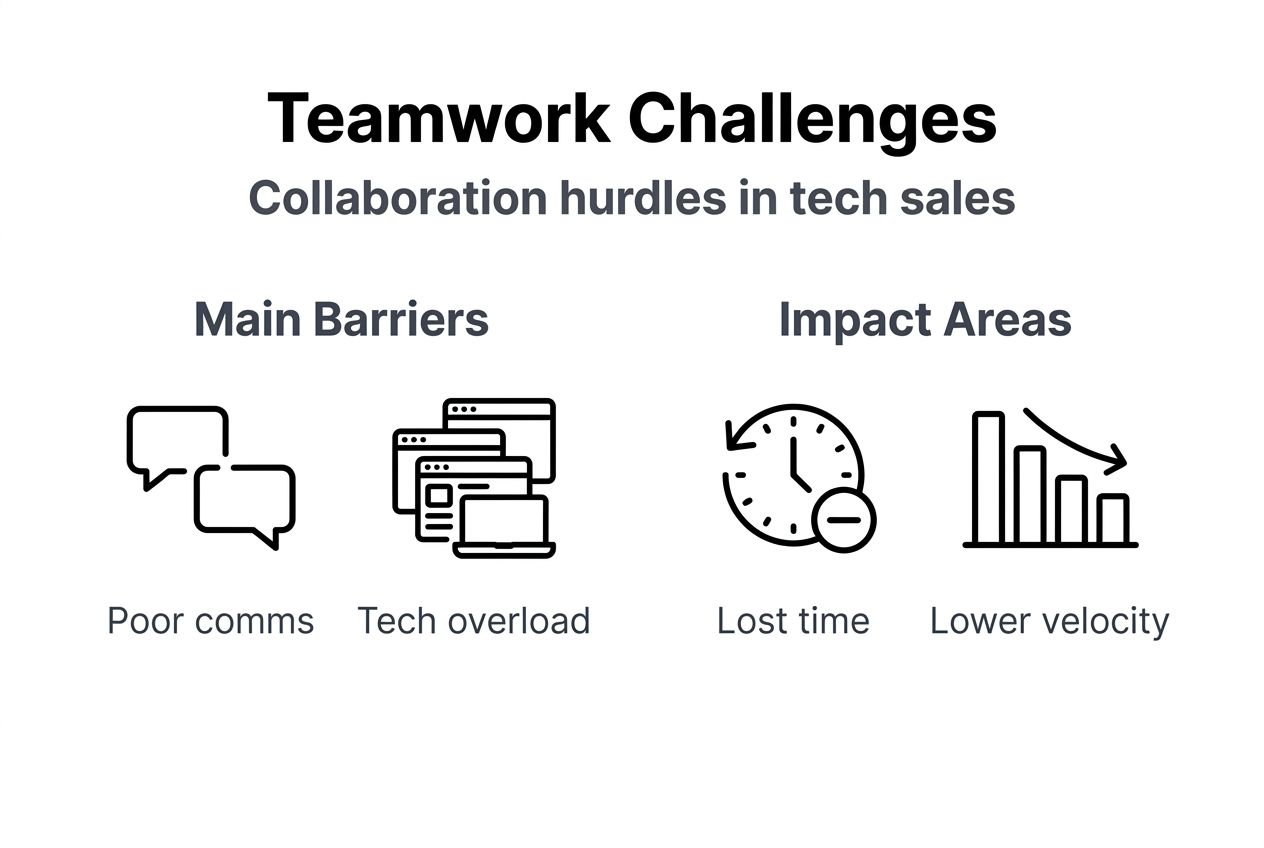
The numbers tell a harsh story. Communication problems waste employee time in 63% of organizations, draining productivity from already stretched sales teams. This isn’t just an HR problem. It directly impacts your pipeline, deal velocity, and revenue predictability.
Hybrid work adds another layer of complexity. While 71% of leaders report improved employee happiness from flexible arrangements, the collaboration picture gets murkier. About 36% of employees feel remote work harms teamwork, creating friction in sales processes that demand tight coordination.
Here’s what effective sales collaboration requires in 2026:
The technology landscape shift compounds these challenges. As AI reshapes sales tech, teams must coordinate not just with each other but also with new tools and workflows. Sales leaders who ignore collaboration fundamentals watch their teams fragment, duplicate efforts, and miss opportunities that competitors capture through better teamwork.
Pro Tip: Map your current collaboration touchpoints across a typical deal cycle. Identify where handoffs fail or information gets lost. These friction points are your highest-leverage opportunities for improvement.
The lone-wolf sales rep is dead, especially in complex B2B tech sales. Modern buyers demand specialized expertise at every stage, and no single person can credibly address all their concerns. Collaborative selling improves enterprise deal closure rates by bringing the right expert to each conversation.
Consider what happens when you shift from individual heroics to team-based approaches. Instead of one AE scrambling to answer technical questions, security concerns, and integration requirements, you deploy specialists who live and breathe their domains. The buyer gets confident answers. Your team builds trust faster. Deals progress with fewer stalls.
The data backs this up. Buyers increasingly reject generalist pitches in favor of consultations with domain experts. They want solutions, not products. They want partners who understand their specific challenges, not canned presentations.
“The shift from product-centric to solution-centric selling requires teams, not individuals. Complex deals demand specialized knowledge that no single rep can master across technical, financial, and operational dimensions.”
Here’s how collaborative selling transforms your results:
This approach particularly shines in enterprise software sales where buying committees span multiple departments. Your team mirrors their team, speaking directly to each stakeholder’s concerns. Want to learn how to structure these teams effectively? Check out our guide on building high-performance sales teams and explore proven commission models that drive collaboration.

Pro Tip: Create opportunity-based Slack channels or Teams spaces for complex deals. Bring in specialists early, even before the buyer asks. Proactive expertise signals competence and builds confidence.
Strategic teamwork starts with ruthless prioritization. Top performers don’t chase every lead. They focus team resources on high-intent accounts that convert 3.4x faster than average opportunities. This concentration strategy maximizes collaborative efforts where they matter most.
Referral opportunities deserve special attention. Referral deals close 3.8x faster yet remain systematically underutilized across the industry. Your team should treat referrals as priority-one opportunities, marshaling resources aggressively to capitalize on warm introductions and trusted relationships.
Here’s how to implement strategic account planning as a team sport:
| Account Tier | Team Resources | Review Cadence | Expected Velocity |
|---|---|---|---|
| Strategic (referral/high-intent) | Full specialist access | Weekly | 30-45 days |
| Target (qualified fit) | AE + technical as needed | Biweekly | 60-90 days |
| Opportunity (pipeline fill) | AE primary | Monthly | 90+ days |
Quality beats quantity every time. A focused pipeline of 20 strategically chosen accounts with full team support outperforms 100 scattered opportunities handled individually. The math is simple: your team’s time is finite, so invest it where conversion probability and deal velocity are highest.
Integrate these planning practices with your broader sales process by reviewing our sales process checklist for EU tech companies and sales enablement strategies for predictable revenue. These frameworks ensure your teamwork aligns with proven methodologies that drive consistent results. You can also explore detailed B2B benchmark data to see how top performers structure their approaches.
Pro Tip: Create a simple tier system for accounts and require team input before promoting opportunities to strategic status. This collective judgment prevents individual reps from chasing shiny objects while neglecting qualified buyers.
Hybrid work environments demand robust digital infrastructure. AI-powered collaboration tools are now essential for maintaining team cohesion and performance across distributed sales organizations. Without the right stack, your teamwork efforts will crumble under coordination overhead and information silos.
The communication advantage shows up in the data. Remote teams using modern collaboration platforms report 72% experience open two-way communication, significantly higher than poorly equipped teams. This transparency directly impacts sales effectiveness by ensuring everyone has the context they need when they need it.
Your collaboration technology should accomplish these core functions:
The tools matter less than the system. You could use Slack or Teams, Salesforce or HubSpot, Gong or Chorus. What counts is creating connected workflows where information flows automatically and team members can find what they need instantly. Learn more about how AI transforms sales workflows and discover practical AI applications that save hours weekly.
The biggest mistake is over-complicating your stack. Start with core platforms your team actually uses, then add specialized tools only when clear needs emerge. Every additional tool adds friction, so the bar for inclusion should be high. Explore comprehensive collaboration statistics and remote work communication research to understand what actually drives team effectiveness.
Implementation beats sophistication. A simple Slack channel with consistent usage patterns outperforms an elegant but ignored project management system. Focus on adoption, not features.

Transforming sales teamwork from concept to consistent practice requires more than good intentions. It demands structured enablement programs that equip your team with proven frameworks, clear processes, and ongoing support. That’s where Sales Label Consulting comes in.
Our sales enablement approach helps EU tech companies build collaborative, high-performance sales organizations through hands-on implementation support. We don’t just share best practices. We work alongside your team to embed collaboration into daily workflows, from account planning to deal execution. Explore our comprehensive sales enablement best practices and discover the types of sales enablement that boost team performance in modern B2B environments. Whether you need RevOps optimization, sales audits, or demand generation support, our entrepreneurial tech experience delivers predictable, measurable results that transform how your sales teams collaborate and win.
Teamwork brings specialized expertise to each stage of complex sales cycles, addressing buyer concerns with credible depth. Collaborative approaches increase close rates by matching specialists to stakeholder needs. This coordination reduces deal friction and accelerates velocity compared to generalist solo efforts.
Implement clear communication protocols and leverage AI-powered collaboration tools that maintain transparency across locations. Promote regular updates through structured check-ins and shared dashboards. Create trigger-based workflows that alert team members automatically when their expertise is needed on specific opportunities.
Track deal velocity improvements, pipeline conversion rate changes, and referral deal growth as primary indicators. Use collaborative opportunity reviews to correlate team engagement with win rates. Compare performance metrics between team-supported deals and individually managed opportunities to quantify collaboration value.
Referral deals close 3.8 times faster than cold opportunities and improve overall pipeline quality through warm introductions. They leverage existing customer relationships and trusted networks, reducing buyer skepticism. Teams that prioritize referrals maximize efficiency by focusing collaborative resources on highest-probability opportunities.
Subscribe to our Insights: Expert productivity tips in your inbox
You'll receive 1-3 emails per month. Your data stays private, always.

CRO & Co-Founder with Sales Label Consulting

Watch our Sales Mates Podcast
October 15, 2026 - 9 min read
Read article Read articleOctober 14, 2026 - 7 min read
Read article Read articleOctober 13, 2026 - 10 min read
Read article Read articleOctober 12, 2026 - 11 min read
Read article Read article