
Pipeline Management for Sales Managers: A Practical Playbook
Pipeline management is the active, day-to-day practice of moving, qualifying, and cleaning deals through defined stages so revenue becomes predictable. Not a dashboard you glance at on Fridays. Not a synonym for forecasting. A repeatable operational system that tells you, right now, which deals deserve your attention and which ones are quietly rotting.
Three things happen when you run it well:
Pipeline management is the operational core of Revenue Operations. It’s the shared language that lets managers identify bottlenecks, allocate coaching, and drive consistency across the team. The single most important action you can take this week: run a deal-by-deal review with hard stage gates and leave with a written action list.
Disciplined pipeline management is the single most reliable lever for making revenue predictable: enforce stage gates, run weekly reviews, and let buyer actions drive deal advancement.
| Point | Details |
|---|---|
| Pipeline management definition | Active, daily practice of moving and qualifying deals through defined stages to make revenue predictable. |
| Coverage benchmark | Maintain a 3x–4x pipeline coverage ratio relative to quota as a baseline health check. |
| Top two failure modes | Poor qualification discipline and stale deals are the root cause of most pipeline breakdowns. |
| Weekly review discipline | Run a structured 30–60 minute review weekly with written next actions per deal, not status updates. |
| Saleslabelconsulting | Delivers pipeline audits and playbooks for B2B tech teams to fix stage discipline and improve forecast accuracy. |
A pipeline that looks full but isn’t qualified is worse than a short, honest one. It produces forecasts nobody trusts, wastes coaching time on deals that will never close, and masks the real capacity problem until it’s too late to fix. Poor pipeline hygiene leads to forecasts no one trusts and wasted rep time, and that’s a leadership problem, not a data problem.
The business case for fixing this is direct. When managers enforce qualification gates and run structured weekly reviews, three operational benefits follow. First, you catch stalled deals before they age past the point of recovery. Second, you can allocate coaching to the reps and deals where it actually moves the needle. Third, capacity planning becomes grounded in real data: you know whether you have enough pipeline to hit next quarter’s number, or whether you need to accelerate demand generation now.
Here’s a concrete example of what that looks like in practice. A mid-market SaaS team running 60-day average cycles enforces a hard qualification gate at Stage 2: no deal advances without a confirmed budget conversation and a named decision-maker. Within one quarter, their win rate on qualified deals climbs and their average cycle shortens because reps stop carrying phantom opportunities. The pipeline health metrics that matter most, coverage ratio and days-in-stage, become reliable signals rather than noise.
Structure beats heroics. That’s the real talk here.
Most teams run 5–7 stages, and keeping pipelines short is a deliberate best practice: more stages create ambiguity, not precision. The goal is that every stage represents a buyer action, not a rep activity. A deal moves forward because the buyer did something, not because the rep sent a follow-up email.
The key discipline: exit criteria must be observable and verifiable. “Rep feels good about it” is not an exit criterion. “Prospect confirmed budget in writing” is.
Mid-market SaaS (30–60 day cycle):
Prospecting → Qualification (BANT gate) → Demo → Proposal → Negotiation → Closed. Six stages, no pilot stage, legal review folded into Negotiation.
Enterprise / Professional Services (90–180 day cycle):
Prospecting → Discovery → Technical Validation → Pilot / POC → Business Case → Legal / Procurement → Closed. Seven stages, with a formal pilot gate that requires a signed SOW before the deal advances. For tactics on keeping momentum in long cycles, the entry/exit discipline at the pilot stage is where most enterprise deals are won or lost.
The pipeline management definition from The Hackett Group frames this well: the process organizes, tracks, and optimizes opportunity flow from lead generation to close, and that optimization starts with stage design.
These three terms get used interchangeably, and that confusion costs managers real decision-making clarity. Here’s the clean separation:
Pipeline management is operational. It’s the active, deal-level practice of moving opportunities through defined stages, enforcing qualification, and running reviews. It’s an active practice distinct from forecasting, focused on what’s happening right now with live deals.
The sales funnel is a marketing-to-sales conversion view. It describes how a large pool of leads narrows as prospects move from awareness to purchase. It’s a volume and conversion model, useful for demand generation planning, not for managing individual deals.
Sales forecasting uses historical pipeline data and current stage probabilities to predict future revenue. It’s the output of a well-managed pipeline, not the practice itself.
Think of it this way: the funnel fills the pipeline, the pipeline is where deals live and get worked, and the forecast is what you read from the pipeline’s current state. If your forecast looks wrong, the first place to look is the pipeline, specifically pipeline coverage, stage accuracy, and stale deals. A forecast that diverges from target almost always traces back to one of three pipeline problems: not enough qualified deals (coverage), deals sitting in the wrong stage (accuracy), or deals that haven’t moved in 30+ days (hygiene).
Good pipeline management works at two layers: progressing each individual deal and watching portfolio-level signals like coverage, velocity, and hygiene. These metrics are how you do both simultaneously.
| Metric | Formula | Why it matters | Quick benchmark |
|---|---|---|---|
| Pipeline coverage | Total pipeline value ÷ Quota | Shows whether you have enough to hit target | 3x–4x quota is the common rule of thumb |
| Stage conversion rate | Deals advancing ÷ Deals entering stage | Reveals where deals stall or drop out | Varies by stage; track trends over time |
| Sales velocity | (Deals × Win rate × Avg deal size) ÷ Sales cycle length | Measures revenue generated per day | Higher is better; benchmark against prior quarters |
| Average deal size | Total closed revenue ÷ Number of deals closed | Flags if deal mix is shifting | Compare by segment and rep |
| Days in stage | Average days a deal spends in each stage | Identifies bottleneck stages | Set a threshold per stage; flag deals exceeding it |
| Win rate | Closed won ÷ Total closed (won + lost) | Overall pipeline efficiency | Track by rep, segment, and source |
| Stale deal count | Deals with no activity in 30+ days | Measures hygiene and data trust | Target: zero deals past your defined stale threshold |
Quick worked example for pipeline coverage: If your team’s quarterly quota is $1M and your current pipeline holds $3.2M in qualified deals, your coverage ratio is 3.2x. That’s within the healthy range. Drop below 3x and you need to either accelerate new pipeline creation or pull in deals from later stages.
Real talk: A 3x–4x coverage ratio is a rule of thumb, not a guarantee. If your win rate is 20%, you need 5x coverage. Know your own numbers before you trust the benchmark.
For a deeper look at how these metrics connect to pipeline health and forecasting accuracy, the relationship between days-in-stage and win rate is the signal most managers underuse.
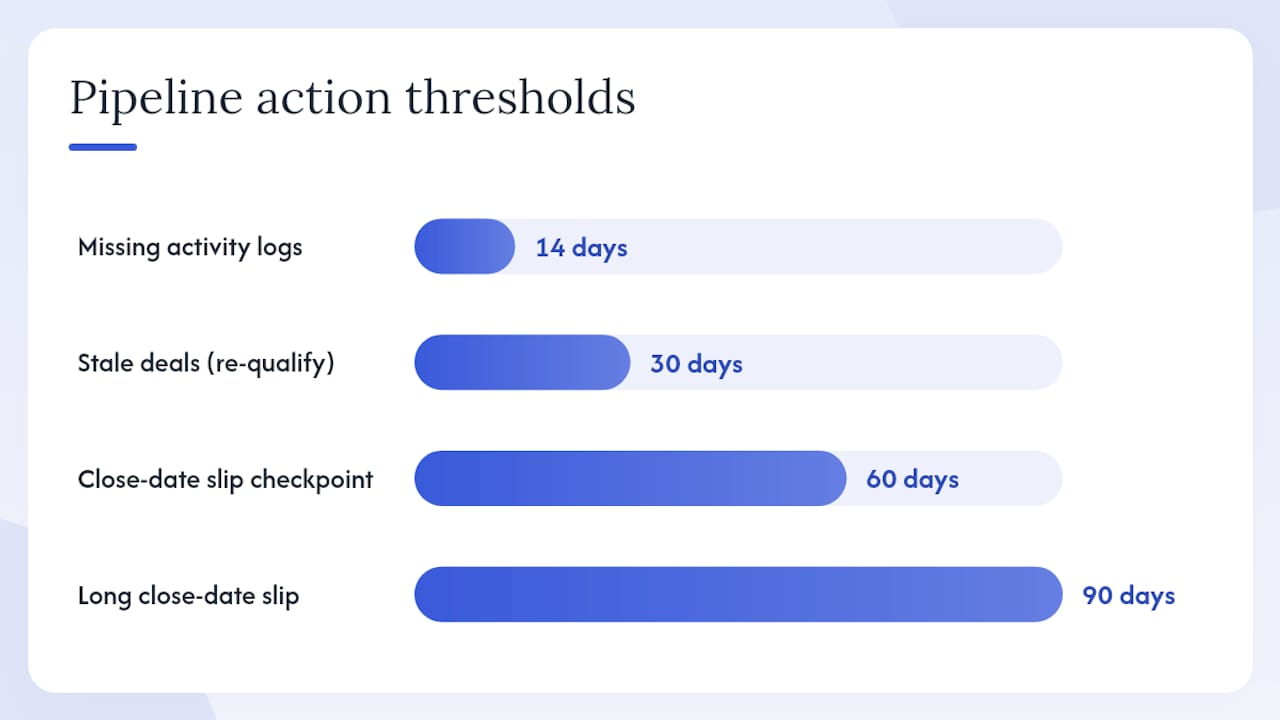
The most common causes of pipeline failure are poor qualification discipline and stale deals sitting unchallenged. Both are fixable this week if you know what to look for.
Poor qualification
Stale deals
Inflated deal values
Inaccurate close dates
Missing activity logs
For a full breakdown of common sales ops bottlenecks and their fixes, the diagnostic signal approach above maps directly to CRM-level rules you can configure today.
Quick-fix checklist for this week:
A CRM is only as useful as the rules you build into it. The pipeline CRM concept is straightforward: a system that visualizes stages, enforces criteria, and centralizes opportunity data so managers can act on signals rather than hunt for them. The features that matter most aren’t the flashiest ones.
Essential feature checklist:
Vendor callouts:
Salesforce is the enterprise standard for pipeline management. Its sales pipeline tools include customizable stage definitions, required field enforcement, Einstein deal scoring, and robust analytics. Best for teams with dedicated RevOps resources to configure and maintain it.
monday.com brings a visual, board-style pipeline view that works well for smaller or less complex sales teams. It’s easier to set up than Salesforce and supports custom stage columns, activity tracking, and automation rules. The tradeoff is less native CRM depth for enterprise-level deal scoring.
Mailchimp is primarily a marketing automation platform, but its CRM features support pipeline visibility for teams that run tightly integrated marketing-to-sales workflows. It’s most useful for managing the top-of-funnel handoff and tracking lead-to-opportunity conversion, rather than deep mid-funnel deal management.
Selection guidance: Small teams (under 10 reps) need stage definitions, activity alerts, and a basic dashboard. Enterprise RevOps teams need deal scoring, required field enforcement, integration with marketing automation, and custom reporting. Don’t buy enterprise complexity for a scrappy team that needs to move fast.
Process optimization strategies that work in operations apply directly here: standardize the process first, then automate it. Automating a broken pipeline process just produces bad data faster.
The weekly pipeline review is where pipeline management actually happens. Not in the CRM. Not in the dashboard. In the conversation between a manager and a rep about specific deals and specific next actions. Defining objective exit criteria and reviewing weekly is what separates a repeatable system from a status-update meeting.
Meeting setup: 30–45 minutes per rep, or 60–90 minutes for a team review. RevOps or the manager prepares a pre-filtered deal list before the meeting: deals in active stages, deals with no activity in 14+ days, deals with close dates in the next 30 days, and any deals that changed stage in the past week.
Agenda sequence:
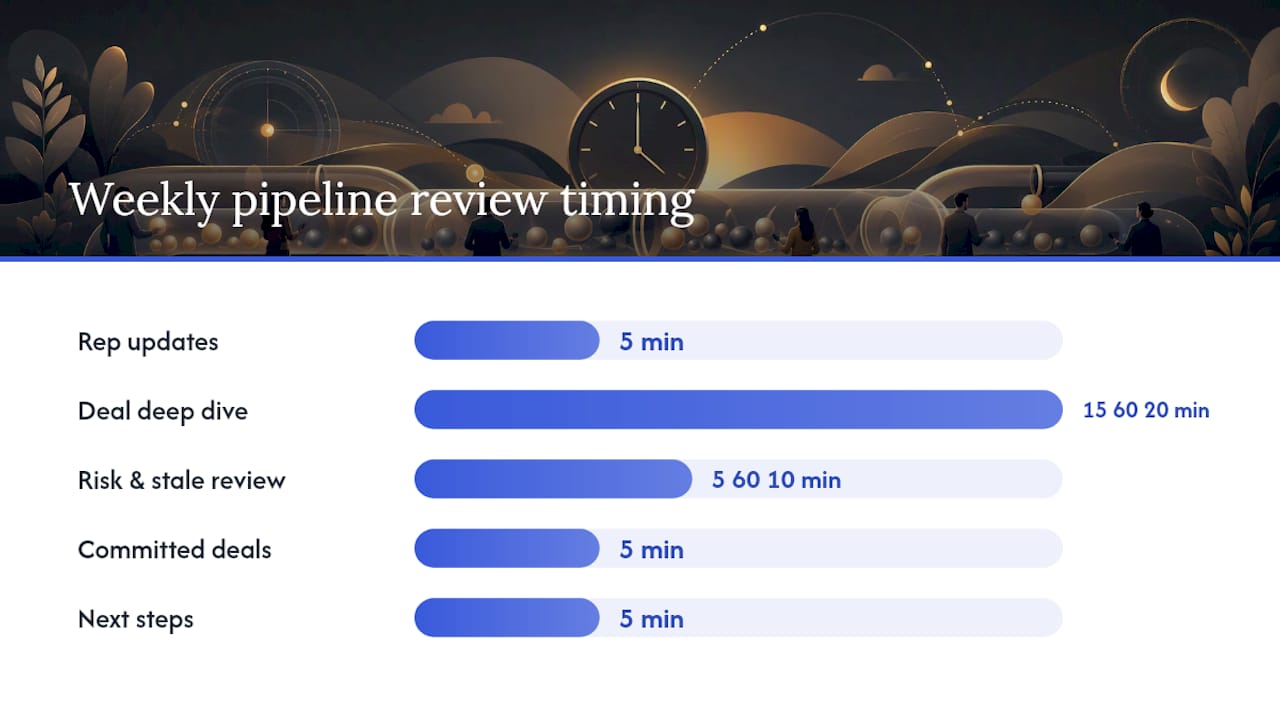
1. Rep updates (5 minutes): Each rep flags any deals that moved, stalled, or changed since the last review. No lengthy storytelling. One sentence per deal.
2. Deal-focused deep dive (15–20 minutes): Focus on the 3–5 deals closest to close and the 2–3 most at risk. For each deal, the manager asks:
3. Risk and stale deal review (5–10 minutes): Walk through any deal flagged as stale or with a slipping close date. Decision: re-qualify, escalate, or close out. No deal stays in limbo.
4. Committed deals (5 minutes): Confirm which deals are genuinely committed for the current period. “Committed” means the rep has a verbal or written agreement, not just a feeling.
5. Next steps and actions (5 minutes): Every deal discussed leaves the meeting with one named next action, one owner, and one deadline. If it doesn’t, the meeting didn’t work.
Pro Tip: Before the meeting, have RevOps pull a “deal health” flag report: any deal with no activity in 14 days, any deal with a close date in the next 30 days and no next step logged, and any deal that’s been in the same stage for longer than your defined threshold. Managers who walk in with this list run 30-minute reviews instead of 90-minute ones.
The manager’s job in this meeting is not to hear updates. It’s to challenge assumptions, remove blockers, and make decisions. That’s the difference between a pipeline review and a pipeline report.
Disciplined pipeline management comes down to a handful of practices that compound over time. None of them are complicated. Most teams just don’t enforce them consistently.
Operational best-practices checklist:
Three quick wins you can execute this week:
Quick Win 1: Purge stale deals. Pull every deal with no buyer-initiated activity in 30+ days. Re-qualify each one with a single question: “Is there a real next step with a buyer commitment?” If not, close it out. KPI that moves first: days-in-stage average drops, and your coverage ratio becomes more accurate.
Quick Win 2: Calendar your weekly review. Block 60 minutes every Monday or Tuesday morning for a structured pipeline review. Send the agenda template from the section above to your team before the first one. KPI that moves first: stale deal count decreases within two weeks.
Quick Win 3: Add one required CRM field. Pick the single most important qualification criterion your team skips (usually “Economic Buyer Name” or “Confirmed Budget”). Make it a required field before a deal advances past Stage 2. KPI that moves first: stage conversion rate at Stage 2 becomes a reliable signal rather than a vanity metric.
These three actions take less than two hours to set up and produce measurable pipeline data within one review cycle. That’s the scrappy, high-leverage approach that works before you need a full system overhaul.
When we work with B2B tech companies on pipeline systems, the same pattern shows up almost every time. The CRM has stages. The reps know the stages exist. But nobody enforces exit criteria, the weekly review is a status call, and the forecast is built on close-date hope rather than buyer evidence. The pipeline looks full. The quarter ends short.
The fix isn’t a new tool. It’s a process audit followed by a 30-day enforcement sprint: redefine two or three stage gates with observable criteria, run structured weekly reviews for four consecutive weeks, and purge every stale deal in the first session. Within one quarter, forecast accuracy improves because the data in the CRM finally reflects reality.
When to bring in outside help: Consider a consultant when you recognize any of these signals.
A good pipeline audit takes two to three weeks and delivers a stage map, a qualification playbook, a KPI dashboard, and a review agenda your team can run without a consultant in the room. That’s the outcome worth paying for.
If your pipeline reviews feel like status updates and your forecast keeps missing, the problem isn’t your reps. It’s the system they’re working in.
Saleslabelconsulting works with B2B tech companies to design and install the pipeline infrastructure that makes revenue predictable: a stage map with hard exit criteria, a qualification playbook your reps will actually use, a weekly review agenda that produces decisions, and a KPI dashboard your leadership team can trust. Engagements typically run as fixed-scope projects, and most clients see measurable improvement in forecast accuracy and deal velocity within the first quarter. The sales enablement step-by-step process we use is built around your existing team and CRM, not a wholesale replacement. Ready to find out where your pipeline is leaking? Request a pipeline audit and get a clear picture of what to fix first.
These resources back up the recommendations throughout this guide and are worth bookmarking for your team.
Subscribe to our Insights: Expert productivity tips in your inbox
You'll receive 1-3 emails per month. Your data stays private, always.

CRO & Co-Founder with Sales Label Consulting

Watch our Sales Mates Podcast
August 6, 2026 - 10 min read
Read article Read articleAugust 5, 2026 - 15 min read
Read article Read articleAugust 4, 2026 - 17 min read
Read article Read articleAugust 3, 2026 - 10 min read
Read article Read article