
Why demand generation drives B2B growth and revenue
TL;DR:
- Demand generation is a comprehensive system that spans the entire buyer journey and aligns sales and marketing.
- Focusing solely on lead generation leads to poor quality pipeline and unpredictable revenue, especially in EU markets.
- Building a demand generation system involves market-specific content, strong sales-marketing alignment, and compliance with EU regulations.
Most B2B sales leaders treat demand generation as a fancy term for lead gen. They run campaigns, collect contacts, and hand them off to sales. Then they wonder why pipeline quality is poor and revenue stays unpredictable. Real talk: demand generation is not a campaign. It’s a system. It spans every stage of the buyer’s journey, aligns sales and marketing around shared revenue goals, and builds the kind of trust that turns cold prospects into loyal customers. If you’re operating in the EU market, the stakes are even higher, because the complexity of buying cycles, regulatory requirements, and multi-stakeholder decisions makes a shallow approach genuinely costly.
| Point | Details |
|---|---|
| Demand gen drives growth | It underpins lead quality, conversions, and loyalty for B2B revenue. |
| Full-funnel nurturing needed | The long B2B cycle requires engagement across all buying stages. |
| Balance creation and capture | Combining demand creation with capture ensures sustained pipeline value. |
| EU requires tailored tactics | Localization, GDPR, and account-based methods are key for EU B2B success. |
Let’s be direct. Traditional lead generation is transactional. You run an ad, someone fills out a form, and a sales rep calls them. That model worked in 2010. Today’s B2B buyers are more informed, more skeptical, and more deliberate. They’ve done their research before they ever talk to your team.
Demand generation flips the script. Instead of chasing contacts, you build awareness, educate your market, and create genuine interest over time. The result? Improved lead quality and predictable pipeline, higher conversion rates, stronger customer loyalty, and a sales team that actually enjoys working the leads they receive.
Here’s how the two approaches compare:
| Dimension | Traditional lead gen | Demand generation |
|---|---|---|
| Primary goal | Collect contacts | Build qualified interest |
| Funnel focus | Bottom only | Full funnel |
| Sales handoff | Volume-based | Quality and intent-based |
| Customer loyalty | Low | High |
| Revenue predictability | Inconsistent | Structured and scalable |
| Measurement | MQL count | Pipeline velocity, ARR impact |
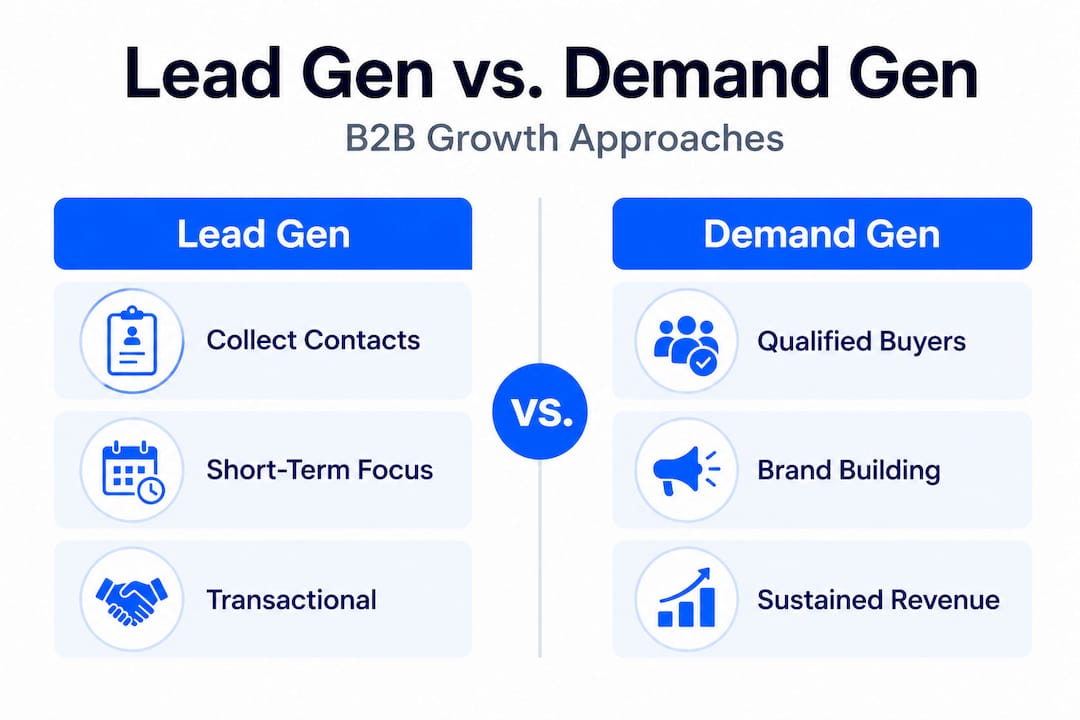
The shift from lead gen to demand gen is a strategic one. It requires buy-in from leadership, alignment between sales and marketing, and a willingness to invest in content and education before you see direct ROI.
Key benefits you can expect when you do this right:
For EU-based B2B organizations, pipeline optimization is not optional. It’s the foundation of sustainable revenue growth. Without it, you’re always firefighting instead of scaling.
Here’s a number that should change how you think about your go-to-market strategy. The average B2B buying cycle is 10.1 months. That’s almost a full year from first awareness to closed deal. And in the EU, particularly in DACH markets, that cycle can stretch even further because of consensus-driven decision-making cultures and additional regulatory due diligence.
What does this mean for your demand generation strategy? It means you cannot afford to only show up at the bottom of the funnel. If you’re only running retargeting ads and sending pricing emails, you’re missing the first nine months of the buyer’s journey.
“The companies that win in B2B are the ones that are present and helpful throughout the entire journey, not just when the buyer is ready to talk price.” This is not a nice-to-have. It’s the core logic of modern demand generation.
The typical B2B buying journey in the EU involves multiple stakeholders across different functions. A software purchase might involve IT, legal, finance, and the actual end users. Each of these stakeholders has different concerns, different objections, and different information needs.

Here’s how the funnel stages map to nurture priorities:
| Funnel stage | Buyer mindset | Nurture goal | Content type |
|---|---|---|---|
| Awareness (TOFU) | “I have a problem” | Educate and build trust | Blog posts, webinars, reports |
| Consideration (MOFU) | “What are my options?” | Differentiate your approach | Case studies, comparison guides |
| Decision (BOFU) | “Which vendor is right?” | Reduce risk, build confidence | Demos, ROI calculators, references |
| Post-sale | “Did I make the right call?” | Reinforce value, reduce churn | Onboarding content, success stories |
To build a nurture program that actually works, follow these steps:
Sales funnel optimization is the operational backbone that makes nurture programs scalable. Without it, you’re doing manual work that should be automated, and you’re losing deals to competitors who got there first.
This is where a lot of B2B marketers get it wrong. They either invest everything in brand awareness and thought leadership (demand creation) without converting that attention into pipeline, or they go all-in on intent-based targeting and paid search (demand capture) without building any brand equity.
Both approaches fail in isolation.
Demand creation is your TOFU play. It’s the content, events, podcasts, and educational resources that introduce your brand to people who don’t know they need you yet. It builds the market. It’s slower to show ROI, but it’s what fills your pipeline six to twelve months from now.
Demand capture is your BOFU play. It’s the SEO, paid search, review site presence, and retargeting that catches buyers who are actively searching for a solution. It drives near-term pipeline but only works if demand creation has already done its job.
The balance between creation and capture, integrated with RevOps, is what separates companies with predictable ARR from those stuck in feast-or-famine cycles.
Here’s what a balanced approach looks like in practice:
Pro Tip: If your sales team is complaining about lead quality, the problem is almost always in demand creation, not capture. Fix the top of the funnel before you optimize the bottom.
RevOps alignment is the connective tissue between demand creation and capture. When your revenue operations team has visibility across the full funnel, they can identify exactly where demand is leaking and fix it fast.
Let’s get into the harder stuff. If you’re running demand generation in the EU, you’re dealing with a set of challenges that most American playbooks completely ignore.
Account-based marketing (ABM) is powerful. But it’s also operationally complex. You need territory alignment between sales and marketing, clear ICP (ideal customer profile) definitions, and data infrastructure that can support personalized outreach at scale. When these elements are misaligned, ABM campaigns generate noise instead of pipeline.
“B2B has a coherence problem in Europe. The EU/DACH market demands localization, GDPR compliance, and substance over hype. Single-channel strategies fail multi-stakeholder journeys. Territory alignment in ABM is not optional.”
This is not just a marketing challenge. It’s a structural one. Here’s how to navigate it:
Check your lead generation checklist to make sure your EU campaigns are covering all the critical bases before launch.
Pro Tip: In DACH markets specifically, case studies from local or regional customers carry significantly more weight than global brand names. Invest in local social proof early.
Enough theory. Let’s talk about how you actually build this. Here’s a practical framework for operationalizing demand generation in your B2B organization:
The improved lead quality and predictable pipeline you’re after doesn’t happen overnight. But with the right framework, you’ll see measurable improvement within two to three quarters.
Measurement is where most teams fall short. Track these metrics consistently:
Review the sales growth adjustments framework to understand how leading B2B companies have operationalized these metrics in practice.
Pro Tip: Don’t wait for perfect data before you start. Build your measurement framework in parallel with your first campaigns. You’ll learn faster by doing than by planning.
Here’s our honest take. Most demand generation advice you’ll read in 2026 is still written for a US SaaS company with a massive content budget and a homogeneous market. It doesn’t account for the regulatory complexity of the EU, the cultural diversity of European buyers, or the consensus-driven decision-making that makes B2B sales cycles longer and more nuanced.
The uncomfortable truth is that cookie-cutter demand generation strategies are not just ineffective in the EU. They actively damage your brand. Buyers in Germany, the Netherlands, and France are sophisticated. They can tell when content is generic. They can tell when a campaign was designed for a different market and localized at the last minute. And they will not trust a vendor who doesn’t understand their context.
What actually works in 2026 is rigorous adaptation. It means investing in local market research before you build campaigns. It means building GDPR compliance into your demand gen infrastructure from day one, not as an afterthought. It means creating content that addresses the specific regulatory, technical, and business challenges your EU buyers face.
The companies winning in EU B2B right now are not running more campaigns. They’re running smarter ones. They have tight pipeline health monitoring, strong sales and marketing alignment, and a genuine commitment to educating their market rather than just harvesting it.
Structure beats heroics. A well-designed demand generation system with clear ownership, shared metrics, and consistent execution will outperform any one-off campaign blitz every single time. Stop chasing quick wins. Build the system.
If this article resonated, you’re probably already sensing the gap between where your demand generation is today and where it needs to be. That gap is exactly where we work.
At Sales Label Consulting, we help RevOps leaders, Heads of Sales, and VPs of Sales build demand generation systems that actually produce predictable revenue. We don’t hand you a generic playbook. We audit your current state, identify the leaks, and co-build a strategy that fits your market, your team, and your growth stage. Our step-by-step sales enablement approach ensures your sales team is equipped to convert the demand you generate. And our best practices for scaling give you the operational frameworks to grow without breaking what’s working. Ready to stop guessing and start building? Let’s talk.
Demand generation builds awareness and nurtures qualified interest throughout the entire buyer’s journey, while traditional lead generation focuses mainly on collecting contacts at the bottom of the funnel. The result is improved lead quality and predictable pipeline rather than a high volume of low-intent contacts.
B2B buying involves multiple stakeholders, compliance reviews, and risk analysis across departments, which is why the average B2B buying cycle runs 10.1 months. Each stakeholder has different concerns that must be addressed before consensus is reached.
GDPR requires explicit consent and careful data handling, while EU buyers expect messaging that reflects their specific market context. EU/DACH demand gen campaigns that ignore localization and compliance consistently underperform against those built with both as core requirements.
When sales and marketing align around shared pipeline metrics and revenue goals, the outcome is stronger customer loyalty and predictable pipeline because both teams are working from the same definition of a quality lead and a successful outcome.
Subscribe to our Insights: Expert productivity tips in your inbox
You'll receive 1-3 emails per month. Your data stays private, always.

CRO & Co-Founder with Sales Label Consulting

Watch our Sales Mates Podcast
September 7, 2026 - 9 min read
Read article Read articleSeptember 6, 2026 - 10 min read
Read article Read articleSeptember 5, 2026 - 8 min read
Read article Read articleSeptember 4, 2026 - 9 min read
Read article Read article