Sales Meeting Structure Guide for Sales Leaders
TL;DR:
- Most ineffective sales meetings stem from poor structure rather than people issues, with vague agendas and unprepared data. Implementing time-boxed segments, clear action items, and follow-up practices drives accountability and improves outcomes. Strict time management, role rotation, and frequent cadence reviews foster a culture of preparation, focus, and continuous improvement.
Most sales meetings fail before anyone says a word. The agenda is vague, the data isn’t ready, and the manager talks for 40 minutes while reps zone out. That’s not a people problem. That’s a structure problem. This sales meeting structure guide gives you a practical, field-tested framework to fix exactly that. You’ll learn how to prepare properly, run a time-boxed agenda that actually drives decisions, avoid the most common traps that kill meeting momentum, and build a follow-up system that holds people accountable long after everyone logs off.
| Point | Details |
|---|---|
| Preparation is non-negotiable | Send agendas 24 hours in advance and require pipeline data to be updated before the meeting starts. |
| Time-boxing protects everyone | Assign specific minutes to each agenda segment to prevent one topic from consuming the entire meeting. |
| Structure beats heroics | A consistent agenda format means reps come prepared and off-topic chatter drops significantly. |
| Action items need three things | Every action item requires a clear task, a single owner, and a specific due date to drive real follow-through. |
| Follow-up closes the loop | Recap emails sent within one hour of the meeting and status reviews at the next meeting turn commitments into results. |
Before you build the agenda, you need to get the fundamentals right. Poorly structured meetings are the root cause of ineffective sales meetings, not the concept of meetings themselves. That framing matters. It means the fix is in your hands.

Start by defining the meeting’s purpose. Is this a weekly pipeline review? A deal strategy session? A team learning call? Each type has a different goal, a different participant list, and a different format. Mixing them into one catch-all meeting is where things go wrong fast.
Here’s what to lock in before every meeting:
Pro Tip: Create a one-page meeting prep checklist and share it with your team at the start of each quarter. It removes ambiguity and signals that preparation is a shared responsibility, not just yours.
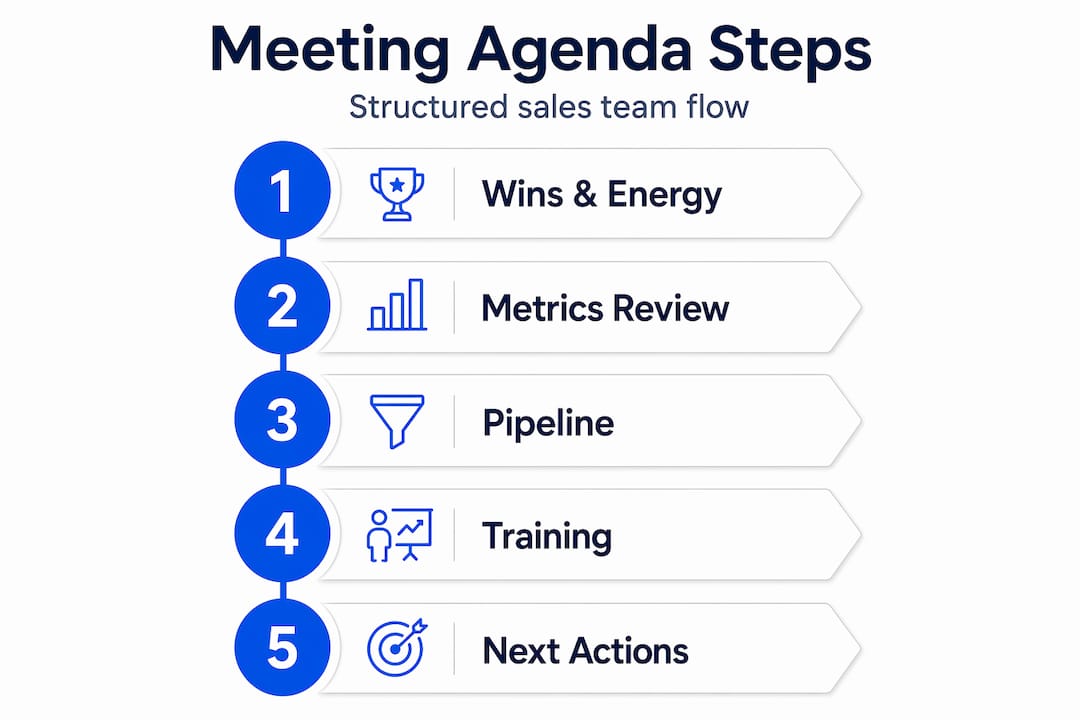
This is where the sales planning framework becomes real. A solid agenda isn’t a list of topics. It’s a sequence of time-boxed segments designed to generate momentum, decisions, and accountability. Here’s a proven structure for a 30 to 45-minute weekly sales team meeting.
Wins and energizer (5 minutes). Open with a rep sharing a recent win, a creative close, or a tough objection they handled well. This sets a positive, high-energy tone and models the behavior you want to see more of. Skip this and you’ve already lost the room.
Metrics review (5 to 7 minutes). Cover the numbers that matter: pipeline coverage, weekly activity, open deal count, conversion rates. Keep this factual and fast. The goal is alignment on current performance, not a deep-dive analysis.
Pipeline and deal discussion (10 to 15 minutes). This is the heart of the meeting. Treat it as a coaching and decision forum, not a live CRM scrub session. Managers who use this time for data entry are wasting everyone’s time. Focus on deals that need intervention, strategic input, or a decision.
Training or learning segment (5 to 7 minutes). A short skill-building moment. A quick role-play, a competitor objection handled, or a product update walkthrough. Over 52 weeks, these segments compound into a meaningfully more capable team.
Competitive intelligence (3 to 5 minutes). What are you hearing in the field? Any new objections tied to a competitor? This segment keeps the team sharp and makes your sales presentation tips land in real context, not a vacuum.
Action items and close (5 minutes). Read action items aloud before the meeting ends. This practice catches ambiguities on the spot and creates verbal commitment. Reading actions aloud before the meeting ends resolves ambiguity and drives follow-through.
Here’s how the timing breaks down across a 40-minute meeting:
| Segment | Time Allocated | Primary Purpose |
|---|---|---|
| Wins and energizer | 5 minutes | Build momentum and morale |
| Metrics review | 5 to 7 minutes | Team alignment on performance data |
| Pipeline discussion | 10 to 15 minutes | Coaching, decisions, deal intervention |
| Training segment | 5 to 7 minutes | Skill development and reinforcement |
| Competitive intelligence | 3 to 5 minutes | Field insights and positioning updates |
| Action items and close | 5 minutes | Accountability and commitment |
Pro Tip: Balance talk time intentionally. If your reps are silent for more than 60% of the meeting, you’re running a broadcast, not a team discussion. Engagement planning, as emphasized in the SCAAPID framework, keeps participants interactive and prevents the demoralizing “status-only” meeting trap.
Even with a solid sales meeting best practices framework in place, things break down. Here’s where it usually goes wrong and what to do about it.
Real talk: The biggest meeting killer isn’t a bad agenda. It’s tolerance. Every time you let a meeting run over, go off-topic, or end without clear owners on action items, you’re training your team that none of it matters. That’s a culture problem disguised as a scheduling problem.
Meeting sprawl. 35% of meetings are unproductive, largely because there are no hard stops on individual segments. When the pipeline discussion bleeds into the training slot, both suffer. Use a visible timer and enforce it. Hard stops aren’t rude. They’re respectful of everyone’s time.
No data readiness. If reps show up without their pipeline updated, the meeting becomes a data collection exercise. Solve this upstream. Make pre-meeting data hygiene a standing expectation tracked in your sales performance review process.
Vague action items. “Follow up with the prospect” is not an action item. It’s a hope. A proper action item names the task, assigns one owner, and sets a specific deadline. No exceptions.
Manager monologue. If you’re talking more than 40% of the time, you’re not running a meeting. You’re giving a presentation. Flip the dynamic. Ask reps to bring one deal they want coaching on. Let them lead the conversation.
No connection to strategy. Meetings that feel disconnected from the broader sales strategy lose rep buy-in fast. Every meeting segment should tie back to something the team is actively working toward.
Running a meeting is the easy part. Knowing whether it delivered value is where most teams drop the ball. Here’s a simple system to verify effectiveness and keep improving your team meeting structure over time.
Send a recap within one hour. Recap emails sent within one hour of the meeting maintain clarity and follow-through. The recap should include decisions made, action items with owners and due dates, unresolved items, and next meeting details. Delayed recaps lose their impact within hours.
Open every meeting by reviewing last week’s action items. Did the owner complete the task? If not, why not? This single habit transforms action items from suggestions into real commitments. It also signals that accountability is not optional.
Track a simple meeting quality score. Ask your team two questions at the end of every third meeting: “Was this meeting worth your time?” and “What would make it better?” You don’t need a complex survey. Two questions done consistently will surface patterns fast.
Review your meeting cadence quarterly. A structured meeting cadence correlates with 20 to 25% improved quota attainment. But cadence only works if the frequency matches the team’s actual needs. Check quarterly whether your meeting types and frequencies still fit.
Iterate the agenda based on data. If the training segment consistently gets cut, schedule it earlier. If pipeline discussion always runs long, give it more time or split it into a separate session. Let your meeting outcomes shape the agenda, not just your instincts.
Here’s a quick comparison of what unstructured versus structured meetings typically produce:
| Meeting Element | Unstructured Meeting | Structured Meeting |
|---|---|---|
| Agenda clarity | Vague or missing | Sent 24 hours in advance |
| Data readiness | Updated live during meeting | Prepared before meeting starts |
| Action item quality | Generic, no owner | Specific task, single owner, deadline |
| Talk time balance | Manager-dominant | Shared between reps and manager |
| Recap and follow-up | Inconsistent or absent | Sent within one hour, reviewed next meeting |
| Impact on quota | Unclear | 20 to 25% improvement correlated |
I’ve worked with enough sales teams to know that the real barrier to effective meetings isn’t knowledge. Most leaders have read the articles, attended the workshops, and know the theory. The gap is execution under pressure.
What I’ve found actually works is strict time-boxing. Not as a concept but as a physical practice. Put a visible countdown timer on the screen during every segment. It shifts the energy immediately. People stop rambling because the timer makes rambling visible. That one change alone cuts meeting time by 20 to 30% in most teams I’ve seen.
Rotating facilitation is the second move that consistently surprises leaders. When a rep facilitates the meeting, two things happen. First, they prepare differently because they’re responsible for the room. Second, they develop skills that make them better in front of customers. It’s free training embedded into your weekly rhythm.
The uncomfortable truth? Most meetings lack accountability not because leaders don’t care, but because they avoid the awkward moment of calling out incomplete action items. That moment is the whole point. Skipping it communicates that commitments are optional. Don’t skip it.
One more thing: don’t over-engineer the preparation load. If your pre-meeting checklist takes 45 minutes to complete for a 30-minute meeting, you’ve built a system no one will follow. Keep it scrappy. The best agenda for sales discussions is one your team actually uses, not the perfect one sitting in a Google Doc no one opens.
— Antony
At Saleslabelconsulting, we work directly with RevOps leaders, Heads of Sales, and VPs who are tired of meetings that consume time without moving the number. If the frameworks in this article resonate, we can help you build them into your team’s operating rhythm from day one.
Our sales enablement step by step approach is designed to give your team the structure, tools, and habits to run meetings that actually accelerate pipeline and predictable revenue. We also offer a dedicated sales audit service that evaluates where your current meeting cadence, preparation processes, and follow-up systems are costing you deals. If you want to know exactly where the gaps are before you build, start there. Real talk: structure is the foundation. We help you build it.
A sales meeting structure guide is a practical framework that outlines how to prepare, run, and follow up on sales meetings to drive consistent outcomes. It covers agenda design, role assignments, time-boxing, and accountability systems.
Weekly sales team meetings typically run 30 to 45 minutes with time-boxed segments covering wins, metrics, pipeline, training, and action items. Going over that window usually signals preparation gaps, not content needs.
Strong sales meeting agendas consistently include celebrating wins, reviewing metrics, pipeline status, a short learning segment, competitive intelligence, and clear action items with owners and deadlines.
Send a recap email within one hour, review last meeting’s action items at the start of each new meeting, and ask the team a simple two-question feedback check every few weeks. Structured meeting cadence correlates with 20 to 25% quota attainment improvement when followed consistently.
35% of meetings are unproductive largely due to missing agendas, no pre-meeting data preparation, vague action items, and lack of hard stops. Structure solves all four.
Subscribe to our Insights: Expert productivity tips in your inbox
You'll receive 1-3 emails per month. Your data stays private, always.

CRO & Co-Founder with Sales Label Consulting

Watch our Sales Mates Podcast
Available
June 20, 2026 - 8 min read
Read article Read articleJune 19, 2026 - 8 min read
Read article Read articleJune 18, 2026 - 9 min read
Read article Read articleFix the System
Not Symptoms