
Step by Step Lead Nurturing: A Practical Guide
TL;DR:
- Effective lead nurturing is a behavior-driven, multi-stage system that guides prospects from initial interest to sales readiness through targeted, automated sequences. It requires well-defined entry and exit criteria, segmentation, a scoring model, and relevant content mapped to buyer stages to prevent leakages and increase conversions. Proper automation, real-time sales alerts, and continuous model calibration are essential for building successful nurture programs that drive predictable revenue.
Lead nurturing is a behavior-driven, multi-stage engagement strategy that moves prospects from initial interest to purchase readiness through targeted, automated sequences. The industry term is “lead nurturing,” and the structured approach most sales and marketing teams need is a clear step by step lead nurturing process. This guide covers everything from entry and exit criteria to content mapping, scoring models, and sales handoff. Tools like HubSpot workflows, segmentation frameworks, and lead scoring models are central to making this work. If your pipeline leaks qualified leads before they ever reach a rep, this is where you fix it.
Before you write a single email, you need the right foundation. Skipping this step is the most common reason nurture programs fail inside 90 days.
Entry and exit criteria come first. Entry criteria define which leads enter a sequence and when. Exit criteria define when they leave. Exit logic includes handoff on MQL or score threshold, rep assignment, reply to email, unsubscribe, or sequence completion. Without both sides defined, you’re running a leaky pipe.
Segmentation is your second building block. Leads from different sources behave differently. A lead from a webinar registration needs different messaging than one from a pricing page visit. Segment by lifecycle stage, lead source, and behavior flags captured through forms or CRM properties.
Here’s what you need in place before building any sequence:
Pro Tip: Don’t build your nurture sequence until you have at least three content assets mapped to different buyer stages. One blog post and a demo request link is not a nurture program.
| Prerequisite | Why It Matters |
|---|---|
| Entry and exit criteria | Controls who enters and when they leave the sequence |
| Segmentation rules | Prevents irrelevant messaging that kills engagement |
| Marketing automation platform | Enables triggered, behavior-based delivery at scale |
| Lead scoring model | Identifies when a lead is ready for sales contact |
| Content asset library | Provides relevant material for each stage of the buyer journey |
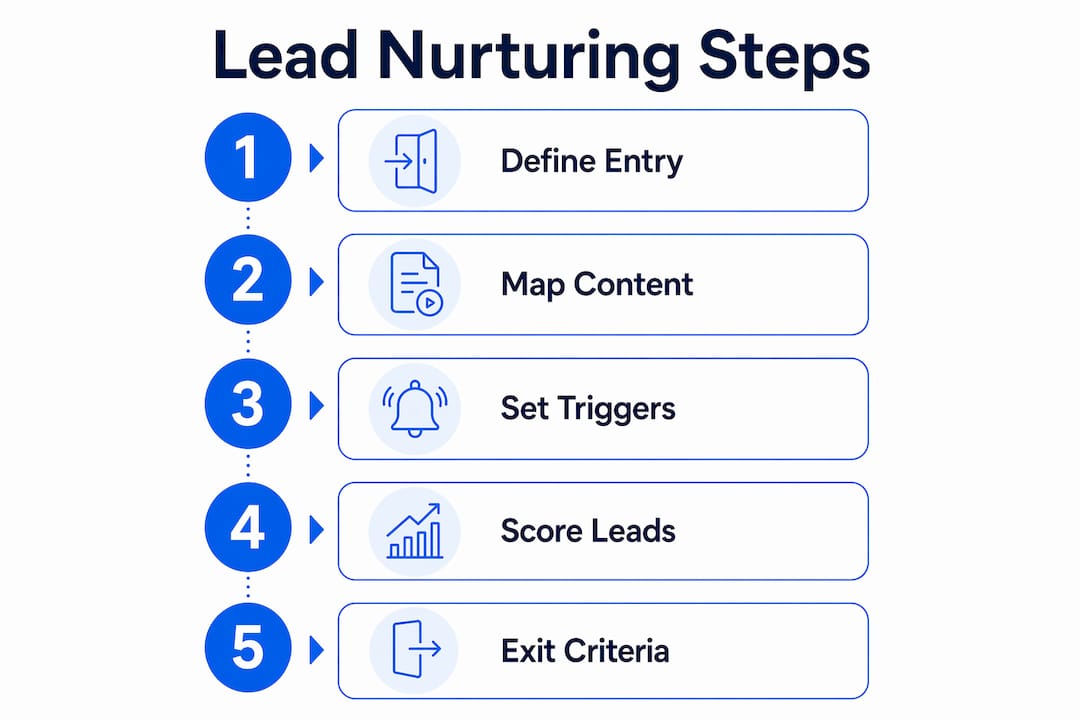
Effective nurture programs are multi-stage sequences with stages like capture/segment, welcome, educate, convert/handoff, and re-engage, each having distinct triggers and success metrics. Skipping stages causes lead leakage. The stages must connect logically with appropriate messaging at each transition.
Here’s how to structure a sequence that actually moves leads forward:
Pro Tip: Build your content map by starting at the purchase stage and working backward. Ask: what does a lead need to believe before they book a call? Then create content that builds each belief, stage by stage.
Here’s how the three core content stages compare:
| Stage | Content Type | Goal |
|---|---|---|
| Awareness | Blog posts, problem-framing guides | Make the lead recognize their problem |
| Evaluation | Case studies, comparison content, webinars | Show your solution fits their situation |
| Purchase | ROI calculators, demos, high-intent CTAs | Remove final objections and prompt action |

This is where most nurture programs either win or fall apart. HubSpot workflows use enrollment triggers, delays combined with branching based on engagement, goals for conversion tracking, and suppress re-enrollment for scalable nurture automation. Scoring and routing become automated when a lead crosses the MQL threshold, sending tasks and alerts to sales reps.
Behavioral triggers are the engine. Don’t send the same next email to every lead. Branching in nurture workflows should be based on specific engagement knowledge, such as which email was opened or which link was clicked, not just broad engagement categories. A lead who clicks a pricing link gets different follow-up than one who clicks a blog post link.
Here’s how to build a scoring model that works:
Exit conditions need to be explicit and fast. Missing exit conditions cause lead handoff failures and wasted nurturing. Timely routing to human sales action improves conversion rates and prevents email fatigue. Your exit triggers should include: lead replies to any email, lead books a meeting, lead reaches MQL score threshold, lead unsubscribes, or sequence completes without conversion.
Pro Tip: Set up a real-time Slack or email alert to the assigned sales rep the moment a lead hits MQL. A lead who just crossed your threshold is warm right now. Waiting 24 hours costs you the conversation.
| Trigger Type | Example | Action |
|---|---|---|
| Positive engagement | Clicked pricing page link | Branch to high-intent sequence |
| Score threshold reached | Lead hits MQL score | Exit nurture, notify sales rep, create CRM task |
| Disengagement | No opens after 4 emails | Move to re-engagement track |
| Unsubscribe | Lead opts out | Suppress from all active sequences immediately |
Real talk: most nurture programs fail not because of bad content, but because of bad architecture. The structure is wrong before the first email goes out.
Treating lead nurturing as a calendar of identical messages is ineffective. Best practice is stage-based, behavior-triggered sequences where cadence and content adjust based on lead actions. Personalizing follow-ups based on link clicks and page visits prevents generic fatigue. If every lead gets the same seven emails in the same order, you’re running a drip campaign, not a nurture program.
The second biggest mistake is building content maps based on your internal org chart instead of actual buyer pathways. Your product team’s favorite features are not what your leads care about in week one. Map content to the questions leads actually ask at each stage, not to the answers your team wants to give.
Real talk: A nurture sequence without clear exit criteria is not a system. It’s a spam machine. Leads who qualify and keep receiving marketing emails lose trust in your brand fast. Define your exits before you write your first subject line.
Three more mistakes worth calling out directly:
Test your branching logic every time you add a new trigger. One misconfigured branch can send your hottest leads down the wrong path for weeks before anyone notices.
Effective lead nurturing is a structured routing contract, not a drip campaign. It requires defined entry and exit criteria, behavior-driven branching, and a scoring model that triggers immediate sales action at the right moment.
| Point | Details |
|---|---|
| Define entry and exit criteria first | Set handoff triggers and suppression rules before writing any sequence content. |
| Use multi-stage sequencing | Connect capture, welcome, educate, convert, and re-engage stages with distinct triggers and metrics. |
| Build behavior-based branching | Route leads based on specific actions like pricing page visits or link clicks, not broad engagement. |
| Score and route in real time | Automate MQL alerts and CRM task creation so sales reps act while leads are warm. |
| Audit your scoring model quarterly | Recalibrate point thresholds based on actual close rate data to prevent scoring drift. |
Here’s my honest take after working with RevOps teams and Heads of Sales across B2B tech companies: most teams build nurture programs the wrong way around. They start with content. They should start with the exit.
The moment I shifted to designing nurture as a routing contract first, everything changed. Strong lead scoring models combined with real-time sales rep notifications dramatically increase conversion by ensuring timely human follow-up. That’s not theory. I’ve watched teams cut their lead response time from 48 hours to under 2 hours just by adding a Slack alert to their MQL trigger.
The other thing I’ll tell you directly: fewer, better content assets beat volume every time. I’ve seen companies with 40 nurture emails and a 3% click rate. I’ve seen others with 8 emails, tight behavioral branching, and a 22% meeting booking rate. The difference is specificity. When you use sales triggers that reflect actual buyer behavior, your messaging lands because it’s relevant, not because it’s frequent.
Cross-team communication is the piece nobody talks about enough. Marketing builds the sequence. Sales gets the handoff. But if sales doesn’t know what content the lead consumed before they got the notification, the first call feels cold. Share the nurture history with the rep. Make it part of the CRM task. That one change improves first-call conversion more than any subject line test.
— Antony
If this guide gave you clarity on the structure, the next step is execution. Building a behavior-driven nurture program from scratch takes more than a good platform. It takes the right architecture, the right content map, and a sales handoff process that actually works.
Saleslabelconsulting works with RevOps leaders, Heads of Sales, and VPs of Sales to design predictable revenue systems that include multi-stage nurture, scoring models, and clean sales handoff protocols. We’ve done this across B2B tech environments where pipeline predictability is non-negotiable. If you want a nurture program that routes the right leads to the right reps at the right time, let’s talk about what that looks like for your team.
Step by step lead nurturing is a structured, behavior-driven process that moves prospects through defined stages, from initial capture to sales handoff, using targeted content and automated triggers. Each stage has distinct entry criteria, content, and exit conditions.
Most effective sequences include five stages: capture and segment, welcome, educate, convert and hand off, and re-engage. Skipping stages causes lead leakage and reduces overall conversion rates.
A lead should exit when they reply to an email, book a meeting, reach the MQL score threshold, or unsubscribe. Missing exit conditions cause handoff failures and damage sender reputation through over-nurturing.
Assign positive points for high-intent actions like pricing page visits and demo requests, and subtract points for disqualifiers like wrong job title or competitor email domains. Review and recalibrate thresholds quarterly based on actual close rate data.
A drip campaign sends the same sequence of messages to every lead on a fixed schedule. Lead nurturing adapts content and timing based on actual lead behavior, such as which links were clicked or which pages were visited, making it significantly more relevant and effective.
Subscribe to our Insights: Expert productivity tips in your inbox
You'll receive 1-3 emails per month. Your data stays private, always.

CRO & Co-Founder with Sales Label Consulting

Watch our Sales Mates Podcast
Available
June 15, 2026 - 11 min read
Read article Read articleJune 13, 2026 - 8 min read
Read article Read articleFix the System
Not Symptoms