
Why Sales Audits Are Essential for Revenue Growth
TL;DR:
- A sales audit identifies revenue leaks, strategy gaps, and execution issues within a sales organization. Conducting regular, structured audits improves forecast accuracy, resource allocation, and team accountability. It is a strategic tool to enable growth, rather than simply fixing problems after failure.
A sales audit is a systematic diagnostic review of your sales process, pipeline health, seller output, and resources, designed to expose where revenue is leaking and where performance is falling short. Most sales leaders assume their teams are executing the plan. Most of the time, they’re not. Understanding why sales audits are essential starts with accepting that perception and reality inside a sales organization rarely match. The gap between what your CRM says and what your reps actually do in the field is where growth stalls and forecasts break down. This article gives you the evidence, the framework, and the practical steps to fix that.
The numbers make a hard case. 40% of organizations missed their annual revenue targets, which means nearly half of all sales teams are underperforming without a clear diagnosis of why. That’s not a motivation problem. That’s a systems and visibility problem.
Here’s what makes that statistic alarming: most of those organizations had CRM tools, sales playbooks, and quota-carrying reps in place. The infrastructure existed. The execution didn’t match it. A sales audit is the mechanism that closes that gap.
The financial upside is concrete. Recovering just 10% of leaked revenue through audit-driven process improvements significantly improves company valuation and growth trajectory. For a company doing $10M in ARR, that’s $1M in recovered revenue without a single new hire or additional marketing spend.
Consider this real-world example. A field sales audit at a consumer goods company revealed that 70% of field reps were focused on metro markets, despite the company’s stated strategy of prioritizing Tier-2 and Tier-3 regions. The strategy existed on paper. The field ignored it. Without the audit, leadership would have continued investing in a direction the team wasn’t actually moving.
Key findings from the evidence:
The importance of sales audits isn’t theoretical. It shows up in ARR recovery, forecast reliability, and the ability to make resource decisions based on facts rather than assumptions.
The most damaging problems in a sales organization are the ones nobody sees. A sales process that’s documented but not followed is more harmful than having no process at all. It creates false confidence. Leadership believes the playbook is running. Reps are doing something else entirely.
Audits verify reality against the playbook. They examine both policy and actual field behavior, which prevents the kind of unreliable forecasting that comes from unexecuted processes. When you combine CRM data review with rep interviews and pipeline analysis, you get a complete picture of where the breakdown happens.
Here’s a comparison of what you see without an audit versus what you find with one:
| Without an audit | With an audit |
|---|---|
| CRM data taken at face value | CRM data validated against actual activity |
| Pipeline reviewed by deal count | Pipeline reviewed by stage conversion and velocity |
| Seller performance judged by quota attainment | Seller capability assessed by skill, behavior, and process adherence |
| Territory coverage assumed complete | Territory gaps and duplicated efforts identified |
| Strategy assumed to be executing | Field compliance with strategy measured directly |
The audit also surfaces resource misallocation. Reps doubling up on the same accounts. Underused territories generating zero pipeline. Marketing-generated leads sitting unworked for weeks. These aren’t edge cases. They’re standard findings in almost every audit we’ve seen.
Pro Tip: Don’t rely solely on CRM reports to assess pipeline health. Pull a sample of deals and interview the reps who own them. You’ll find qualification gaps, stalled deals, and forecast inflation that the system never flags.
Aligning daily sales activities with corporate strategy is one of the core outputs of a well-run audit. Without that alignment check, wasted effort compounds quarter after quarter.
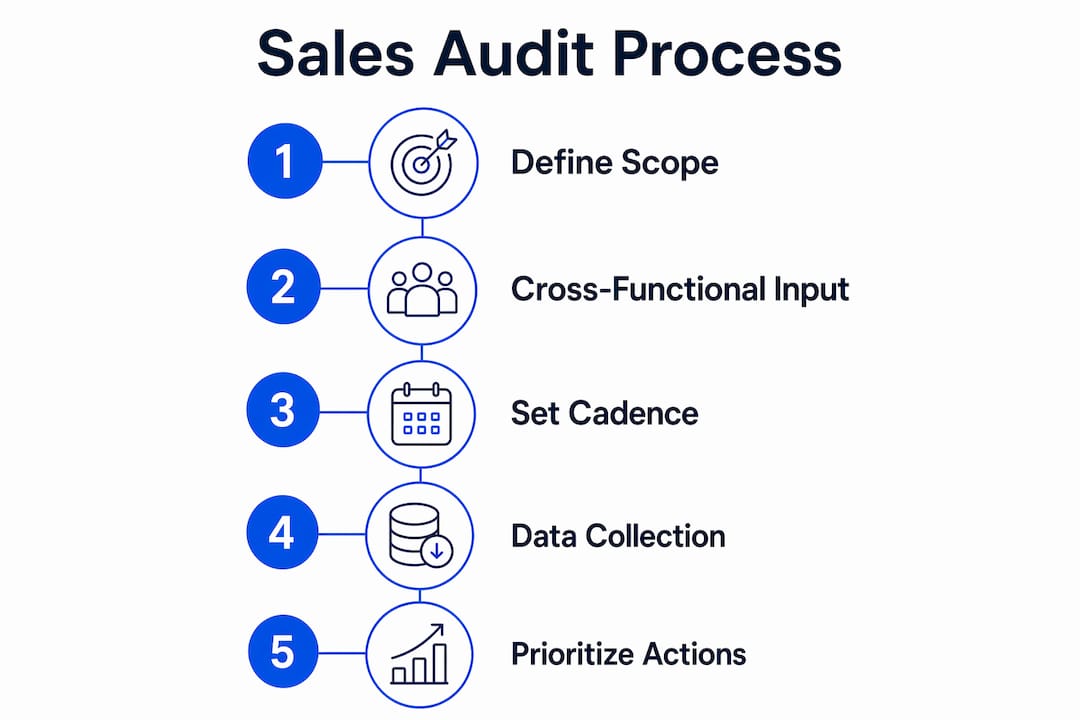
The benefits of sales auditing only materialize if the audit is structured correctly. Here’s how to conduct one that actually drives change.

1. Define the audit scope before you start. Cover five core areas: pipeline health, seller capability, process adherence, resource allocation, and data and tech quality. Skipping any one of these creates blind spots. Sales audits that examine pipeline issues, seller capability gaps, and CRM data problems together produce the most complete picture of where revenue is at risk.
2. Involve cross-functional input. Marketing needs a seat at the table. Lead quality, handoff timing, and MQL-to-SQL conversion rates are joint accountability items. An audit that only looks at the sales team misses half the story.
3. Set the right cadence. Quarterly audits catch emerging issues early. Annual audits are better suited for strategic realignment. Most organizations benefit from a lightweight quarterly review combined with a deeper annual assessment.
4. Combine quantitative and qualitative data. Pull conversion rates, deal velocity, and win/loss ratios from your CRM. Then interview reps, managers, and customers. Numbers tell you what happened. Conversations tell you why.
5. Prioritize findings before acting. Not every audit finding requires immediate action. Rank issues by revenue impact and effort to fix. Address the top three before moving to the rest.
Pro Tip: Before you hire another rep or buy a new sales tool, run the audit first. Investing in new technology before auditing only amplifies existing inefficiencies. The audit tells you what you actually need.
This is one of the most common and costly mistakes we see. A VP of Sales adds headcount because pipeline looks thin. The audit would have revealed that existing reps weren’t working their current territories. More reps doing the wrong things doesn’t fix the problem.
Use a structured sales audit checklist to make sure nothing gets skipped. Consistency across audits also makes it easier to track improvement over time.
A single audit is valuable. A culture of regular auditing is transformational. Here’s what changes when you make this a standard practice rather than a crisis response.
Forecast accuracy improves. Sales audits improve forecast accuracy by enforcing shared qualification frameworks and process discipline across the team. When every rep qualifies deals the same way, the numbers you report to the board actually mean something.
Deal stagnation drops. Audits force a review of every deal in the pipeline. Stalled opportunities get addressed or removed. The pipeline becomes a working tool rather than a wishlist.
Leadership visibility sharpens. Growth without audit-driven visibility is risk disguised as success. When revenue is growing but the underlying data is flawed, you’re flying without instruments. Audits convert raw sales data into trusted insights that executives can actually use.
Early warning becomes possible. Regular audits act like a smoke detector, flagging falling conversion rates and rising customer churn before they become crises. You stop reacting and start anticipating.
“Proactive audits identify revenue leaks before critical financial shortfalls occur. Reactive audits are damage control. The difference between the two is a quarter of missed targets.” — The B2B Sales Audit Process
The long-term payoff also shows up in team accountability. When reps know their pipeline and activity will be reviewed against the playbook, behavior changes. Not because of fear, but because clarity creates focus. Structure beats heroics every time.
You can track the improvement in sales forecasting accuracy over successive audit cycles to demonstrate ROI to your leadership team and board.
Sales audits are the most direct path from revenue uncertainty to predictable, data-backed growth, and skipping them is the single most common reason sales organizations underperform despite having the right tools and talent.
| Point | Details |
|---|---|
| Revenue leaks are recoverable | Recovering 10% of leaked revenue through audit findings significantly improves ARR and company valuation. |
| Strategy-execution gaps are invisible without audits | 70% of field reps in one case study ignored the company’s regional strategy until an audit revealed it. |
| Audit before you invest | Hiring or buying new tech before auditing amplifies inefficiencies rather than fixing root causes. |
| Forecast accuracy depends on process discipline | Shared qualification frameworks enforced through audits make pipeline data reliable and board-ready. |
| Routine audits build a culture of accountability | Regular reviews shift teams from reactive firefighting to proactive, data-driven decision making. |
Most executives I work with come to audits after something breaks. A missed quarter. A rep who’s been sandbagging for six months. A CRM that hasn’t been updated since the last QBR. That’s the wrong time to start.
The real talk is this: the audit isn’t a troubleshooting tool. It’s a leadership tool. The best sales leaders I’ve seen use it the way a CFO uses a financial review. Not because something is wrong, but because you can’t manage what you can’t measure.
I’ve watched companies pour budget into Salesforce customizations, Outreach sequences, and new SDR headcount, all before anyone asked whether the existing process was actually being followed. Every single time, the audit revealed the same thing: the problem wasn’t resources. It was adherence, alignment, and accountability.
The shift that matters most is moving from “we think our sales team is executing” to “we know exactly where execution breaks down and why.” That shift doesn’t come from a new tool. It comes from a structured, honest review of what’s actually happening in the field.
Make the audit a quarterly habit. Normalize it. When your team knows the process will be reviewed, they run the process. When leadership can see the data, they make better calls. That’s how you build a sales organization that grows predictably instead of one that sprints and crashes.
— Antony
If you’ve read this far and you’re thinking “we need to do this,” you’re right. The question is whether to build the audit methodology internally or bring in a team that’s done it dozens of times across B2B tech and services companies.

Saleslabelconsulting runs structured sales audits that cover pipeline health, seller capability, process adherence, and CRM data quality in a single engagement. You get a clear diagnostic report, a prioritized list of revenue recovery opportunities, and a roadmap your RevOps or Head of Sales can execute immediately. No guesswork. No generic recommendations. Start with our sales audit explained page to see exactly how the process works, or explore our predictable revenue framework to understand how audits connect to long-term sales enablement.
Growth without visibility is risk. Flawed qualification and forecasting data can make growth look healthier than it is, and an audit catches those cracks before they widen.
A lightweight quarterly review combined with a deeper annual audit gives most organizations the right balance of early warning and strategic realignment.
A complete audit covers pipeline health, seller capability, process adherence, territory and resource allocation, and CRM data quality. Skipping any area creates blind spots that cost revenue.
Audits enforce shared qualification frameworks across the team, which makes pipeline data consistent and forecast numbers reliable enough to present to a board or investors.
No. Adding headcount before auditing amplifies existing inefficiencies. The audit identifies whether the problem is capacity or execution, which determines the right fix.
Subscribe to our Insights: Expert productivity tips in your inbox
You'll receive 1-3 emails per month. Your data stays private, always.

CRO & Co-Founder with Sales Label Consulting

Watch our Sales Mates Podcast
October 25, 2026 - 9 min read
Read article Read articleOctober 24, 2026 - 8 min read
Read article Read articleOctober 23, 2026 - 10 min read
Read article Read articleOctober 22, 2026 - 9 min read
Read article Read article