
Why Document Sales Best Practices for Predictable Revenue
Documenting sales best practices is the fastest way to turn individual rep talent into consistent, team-level revenue. When your process lives in people’s heads, you’re one resignation away from losing it. Forbes Coaches Council research confirms that documentation creates a scaling mechanism driving consistency, faster onboarding, and targeted coaching. Harvard Business Review puts it plainly: process-driven teams outperform talent-dependent ones because greatness becomes a system, not a lottery.
Your immediate next steps:
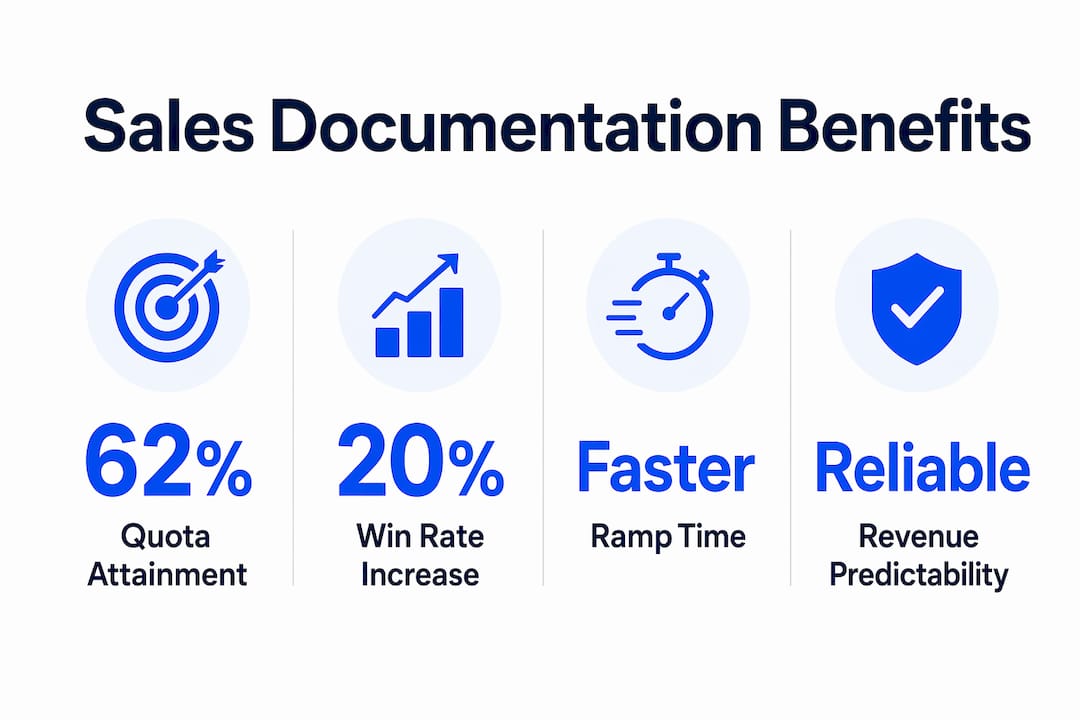
The business case is direct. Sales documentation creates a repository of playbooks, scripts, and case studies that delivers consistent buyer experiences and cuts onboarding time. The payoff shows up in four KPIs leaders actually track.
Consistency. Every rep delivers the same core message regardless of tenure. That matters for brand credibility and pipeline predictability. Brand consistency across touchpoints directly correlates with buyer trust and deal velocity.
Faster ramp time. New hires stop relying on shadowing and tribal knowledge when structured onboarding tracks exist. Structured documentation shortens ramp time and reduces the cost of every new hire.
Higher win rates. Teams that follow a documented process close more. According to the BrooksGroup/HubSpot 2025 Sales Leader Research Report, Organizations that consistently adhere to their sales process have a notably higher proportion of their sellers on track to hit quota. That’s not a marginal lift — it’s the difference between a team that hits plan and one that misses it every quarter.
Revenue predictability. For CROs, documented stage definitions and exit criteria make pipeline forecasts reliable. For RevOps, a written process is the only thing you can actually audit and improve.
Don’t try to document everything at once. Start with the minimum useful set that covers the moments where reps most often go off-script or get stuck.
| Document Type | Primary Owner | Immediate KPI Impact |
|---|---|---|
| Sales playbook | Head of Sales | Win rate, message consistency |
| ICP and qualification criteria | RevOps | Pipeline quality, cycle length |
| Outbound sequences | Sales Enablement | Reply rate, meeting booked rate |
| Call frameworks | Sales Manager | Discovery-to-demo conversion |
| Objection handlers | Sales Manager | Late-stage win rate |
| Stage definitions and exit criteria | RevOps | Forecast accuracy |
| Onboarding tracks | Enablement | Ramp time |
| Scorecards and metrics | RevOps | Quota attainment |
Short wins. Reps need skimmable guidance they can reference mid-call, not a 40-page PDF they’ll never open. The format rule is simple: if a rep can’t find the answer in 30 seconds, the doc failed.

Recommended formats: One-page playbook summaries, bulleted call frameworks, templated email sequences, and timestamped call recordings linked directly from the relevant doc. Checklists beat paragraphs for in-call use.
Storage decisions to make now:
[DocType]_[Stage]_[Version]_[ReviewDate] (e.g., Playbook_Discovery_v3_2026Q3).Pro Tip: Every doc should have a “last reviewed” date visible at the top. If it’s more than 90 days old without a review, treat it as expired. Stale docs erode rep trust faster than no docs at all.
Rollout fails when leadership announces a new playbook and then never mentions it again. Here’s a pilot plan that actually sticks.
Change management is where most documentation projects die. Assign a named owner for each document. Use manager coaching routines to reinforce the process in weekly call reviews. Peer sharing, where a top rep walks the team through how they used the playbook on a real call, drives adoption faster than any mandate.
Pro Tip: Build documentation review into your existing manager cadence. A five-minute “playbook check” in the weekly pipeline review is more effective than a quarterly all-hands training session.
Baseline first, always. Before the pilot starts, record your current ramp time, win rate, sales cycle length, and stage-by-stage conversion rates. Without a baseline, you’re measuring noise.
| Metric | Document It Tracks | Measurement Cadence |
|---|---|---|
| Ramp time (days to first close) | Onboarding track | Per cohort |
| Win rate | Playbook, call frameworks | Monthly |
| Sales cycle length | Stage definitions, exit criteria | Monthly |
| Reply rate on sequences | Outbound sequences | Weekly |
| Stage-to-stage conversion | Stage definitions | Weekly |
| Quota attainment rate | Scorecards and metrics | Monthly |
The BrooksGroup/HubSpot data showing 62% of process-adherent organizations exceed 60% quota attainment gives you a benchmark to compare against. Use data-driven measurement to validate which documents are driving the lift and which need revision. Sequence reply rates and win rates are your fastest feedback loops; ramp time takes a full hiring cohort to measure properly.
| Phase | Timeline | Milestones | Estimated Internal Hours |
|---|---|---|---|
| Audit | Days 1–30 | Process map, gap list, priority doc set | 20–40 hrs (manager + RevOps) |
| Document | Days 30–60 | V1 playbook, ICP, sequences, call frameworks | 40 hrs (enablement + SMEs) |
| Pilot | Days 61–90 | Four to six rep pilot, weekly coaching reviews | 10–20 hrs (manager) |
| Roll-out | — | Full team adoption, training sessions | 20–40 hrs (enablement) |
| Measurement | — | KPI review, doc iteration, version updates | 10–20 hrs (RevOps) |
External consultant engagements typically run as fixed-scope audit and playbook sprints (covering the first 60 days) or ongoing advisory arrangements covering pilot through measurement. The decision between internal and external support usually comes down to two factors: whether your team has the bandwidth to do the audit rigorously, and whether you have someone who has built playbooks before. If the answer to either is no, external help pays for itself in speed.
Start your audit by checking for these gaps in your current documentation:
One-page playbook template fields: Owner, objective, target ICP, key value props (three maximum), discovery questions (five to seven), common objections and responses, stage exit criteria, success metric, and review date. That’s it. Keep it to one page. Use sales enablement best practices to guide the structure.
For onboarding, a 30/60/90 gate list should include: first solo call completed (day 30), first qualified opportunity created (day 60), and first closed deal or pipeline target hit (day 90). Every gate needs a pass/fail criterion, not just a date.
Documentation is the system that converts individual rep performance into predictable, team-level revenue — and the teams that build it first scale faster with less chaos.
| Point | Details |
|---|---|
| Documentation is a scaling mechanism | Written processes let you replicate top-rep behavior across the whole team, not just hope for it. |
| Process adherence drives quota attainment | 62% of organizations consistently following their sales process have more than 60% of sellers on track to hit quota. |
| Start with the minimum useful set | Prioritize playbook, ICP, sequences, call frameworks, and stage definitions before anything else. |
| Measure baseline before the pilot | Record ramp time, win rate, and conversion rates before launch so you can prove the documentation drove the change. |
| Saleslabelconsulting accelerates the audit | Saleslabelconsulting runs structured sales audits and playbook sprints that compress the 30–60 day documentation phase into a faster, prioritized engagement. |
Here’s the real talk: the most common failure isn’t a bad playbook. It’s a good playbook that nobody uses. Four patterns kill documentation programs before they prove value.
Docs that are too long. A 30-page playbook is a research document, not a sales tool. Reps won’t open it mid-call. The fix is ruthless editing: one page per process, bullets over paragraphs, and a clear “use this when” label at the top.
No named owner. When everyone owns a document, nobody does. Within six months, it’s outdated and reps stop trusting it. Every doc needs one person whose name is on it and whose job includes keeping it current.
No version control. Reps using different versions of the same sequence is worse than no sequence at all. A simple naming convention and a single storage location solves this immediately.
Manager reinforcement missing. Documentation without coaching is shelf-ware. The teams that see a 20% higher win rate from documentation are the ones where managers reference the playbook in every call review, not just at launch. Consistent coaching reinforcement is what separates a documentation project from a documentation culture.
A consultant engagement fixes all four by running the audit, building the prioritized playbook, training managers on reinforcement routines, and setting the measurement plan before handing off. That’s the difference between a document and a system.
If your team is scaling and your process still lives in people’s heads, you’re leaving predictable revenue on the table. Saleslabelconsulting works with B2B tech sales teams to run structured sales audits, build prioritized playbooks, design onboarding tracks, and set up the coaching routines that make documentation stick. The result is a sales system your whole team can execute, not just your top two reps.
Typical engagements start with a focused audit that surfaces your highest-impact documentation gaps in the first 30 days. From there, a playbook sprint delivers V1 assets your team can pilot immediately. The step-by-step enablement framework Saleslabelconsulting uses is built specifically for B2B tech companies that need predictable pipeline, not another binder on a shelf. Book a discovery call this week and walk away with a prioritized gap list you can act on immediately.
Subscribe to our Insights: Expert productivity tips in your inbox
You'll receive 1-3 emails per month. Your data stays private, always.

CRO & Co-Founder with Sales Label Consulting

Watch our Sales Mates Podcast
July 26, 2026 - 13 min read
Read article Read articleJuly 25, 2026 - 8 min read
Read article Read articleJuly 24, 2026 - 11 min read
Read article Read articleJuly 23, 2026 - 17 min read
Read article Read article