
Demand Generation Tactics 2026: B2B Revenue Growth Guide
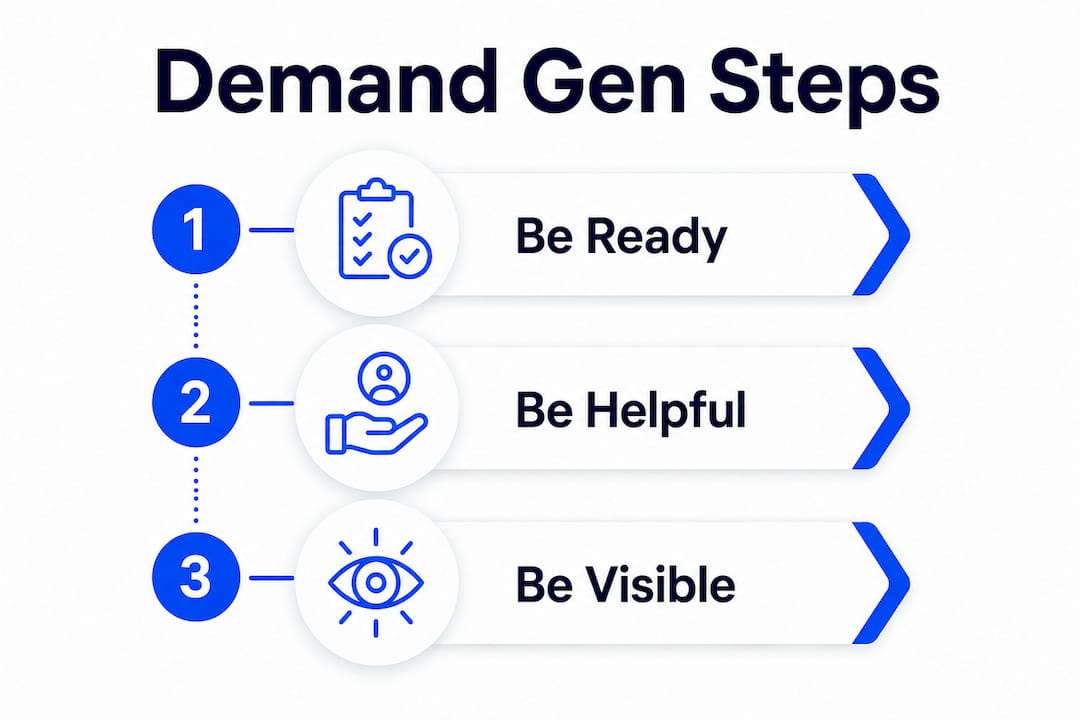
The answer is a three-step revenue engine: Be Ready, Be Helpful, Be Visible. That’s the blueprint. Not a funnel. Not a lead capture form. A continuous system that shapes buyer preferences before they ever raise their hand.
Here’s the real talk: B2B buying journeys are largely complete before a buyer contacts a vendor. That single fact rewrites the entire demand gen playbook. If most decisions are made before your first sales call, your job isn’t to capture demand at the last moment. It’s to shape it while buyers are still learning.
The shift that’s actually happening right now? Demand generation is moving from lead capture to a revenue engine culture focused on account-level pipeline contribution and MQL-to-SQL velocity. MQL volume as a success metric is dying. Pipeline contribution, deal velocity, and revenue influence are replacing it.
The 2026 demand gen blueprint in brief:
Pro Tip: Don’t try to implement all three steps at once. Audit where you’re weakest first. Most teams have decent content but terrible data hygiene. Fix the foundation before scaling the tactics.
The table below maps each step to its core focus, primary metric, and the biggest mistake teams make at that stage.
| Framework Step | Core Focus | Primary Metric | Common Mistake |
|---|---|---|---|
| Be Ready | Data hygiene, ICP fit, intent signals | Pipeline velocity, MQL-to-SQL speed | Scaling volume before cleaning data |
| Be Helpful | Open content, AI-optimized education, personalization | Account engagement depth, content influence | Gating everything, blocking AI crawlers |
| Be Visible | Demand coverage, AI visibility, channel presence | AI citation rate, channel reach, share of voice | Staying on owned channels only |
The teams winning in 2026 treat these three steps as a loop, not a sequence. You don’t finish “Be Ready” and move on. You keep refining it as AI enrichment updates your account priorities in real time.
The foundation isn’t glamorous. But without it, every tactic you layer on top just scales noise. Real talk: most demand gen programs fail not because of bad tactics but because of bad data feeding those tactics.

Data hygiene and ICP alignment come first. Your ideal customer profile needs to be a living document, not a slide from last year’s planning session. In 2026, intent data is a core trigger for coordinated sales and marketing actions, not a nice-to-have signal. That means your ICP definition has to be tight enough to make intent signals meaningful. If your ICP is too broad, every signal looks like a buying signal.
The shift from volume metrics to pipeline velocity changes how you measure readiness. Cost per lead is easy to game. Pipeline contribution, MQL-to-SQL speed, and revenue influence are harder to fake and far more useful. When marketing and sales align around these shared metrics, behavior changes. Teams stop chasing form fills and start focusing on accounts that actually convert.
Shared target account management is where alignment becomes real. Marketing and sales need to own the same target account list, updated continuously based on firmographic fit, buying signals, and real-time intent. Static spreadsheets reviewed annually are a liability in 2026. The best teams treat their target account list as a living system.
Readiness best practices for 2026:
Pro Tip: Run a sales process audit before you touch your demand gen tactics. You’ll find the real bottleneck faster than any dashboard will show you. Nine times out of ten, the problem isn’t the top of the funnel. It’s the handoff.
The teams that skip this step spend the rest of the year wondering why their pipeline looks full but revenue doesn’t move. Structure beats heroics every time.
Buyers don’t want to fill out a form to get your best thinking. They want answers, and they want them now, often from an AI assistant that’s already done the research for them. The content strategy that wins in 2026 treats content as a service, not a lead capture mechanism.
Open, authoritative content structured for AI search engines outperforms gated assets in 2026. AI systems crawl open content. Answer engines summarize it. Buyers trust brands that explain clearly and consistently. Gated PDFs block that flow entirely. When your best content is locked behind a form, you’re invisible to the 95% of your market that’s quietly researching but not ready to identify themselves yet.
Personalization in 2026 isn’t about inserting a first name into an email. It’s about delivering the right content format to the right account at the right stage of their research process. AI-powered enrichment tools now merge engagement data, firmographic signals, and intent patterns to tell you what a specific account cares about this week. That’s the input for your content sequencing, not a generic nurture track.
Tactical content formats that move accounts in 2026:
The micro-community angle deserves more attention than most teams give it. Brands using knowledge-sharing micro-community platforms achieved 25% higher marketing ROI according to Kantar LIFT data. Nearly 40% of consumers trust micro-community recommendations as much as personal ones. That’s peer-to-peer credibility that no paid ad can replicate.
Pro Tip: Before you create new content, run buyer interviews with five recent closed-won and five closed-lost accounts. Ask them what they were searching for, what content they found useful, and what made them trust you or not. The answers will reshape your entire content calendar.
The comparison below shows how content-as-a-service differs from traditional gated content in practice.
| Dimension | Traditional Gated Content | Content as a Service |
|---|---|---|
| Primary goal | Lead capture | Buyer education and trust |
| AI discoverability | Blocked | Open and crawlable |
| Buyer stage served | Late-stage, identified buyers | Early-stage, anonymous researchers |
| Format | PDFs, whitepapers behind forms | Guides, videos, tools, open articles |
| Sales alignment | Generates MQLs for follow-up | Builds context SDRs use in conversations |
| Measurement | Form fills, downloads | Account engagement, pipeline influence |
The handoff between marketing and sales gets sharper when content is built around real buyer questions. SDRs stop sending generic follow-ups and start referencing specific content the account engaged with. That’s when the conversation shifts from convincing to confirming.
Visibility in 2026 means something different than it did two years ago. It’s not just about ranking on Google. It’s about showing up in the answer your buyer’s AI assistant gives them when they ask a question you should own.

Demand coverage means being present across buyer-preferred channels rather than just the ones you own and control. Buyers form shortlists before they ever visit your website. They’re reading Reddit threads, watching YouTube explainers, asking Perplexity for vendor comparisons, and getting recommendations from AI assistants that have already synthesized the market for them. If you’re not in those conversations, you’re not on the shortlist.
The agentic AI shift is real and accelerating. AI assistants increasingly act on buyers’ behalf, requiring brands to prioritize AI visibility by surfacing content effectively in AI-driven buyer journeys. Kantar reports that 24% of AI users already use an AI shopping assistant, and 74% of AI assistant users regularly seek AI-driven recommendations. When the buyer’s first move is to ask an AI, your content needs to be the source that AI cites.
Generative Engine Optimization (GEO) is the new SEO. It’s about getting your brand cited and trusted by large language models. If the model doesn’t know you, it won’t recommend you. That means creating clear, structured, machine-readable content that answers the questions buyers ask AI tools directly. Think entity coverage, not just keyword coverage. Think structured answers, not just long-form prose.
Visibility tactics that matter in 2026:
The cold reality: Google AI Overviews are expected to appear on a substantial share of queries by Q3 2026. The businesses cited in those overviews will see click-through rates well above organic positions. The ones not cited lose traffic even if their organic rank doesn’t change.
The tactics that dominate 2026 aren’t new inventions. They’re evolutions of what’s always worked, rebuilt around AI, intent data, and account-level thinking. Here’s what’s actually moving pipeline.
Account-Based Marketing as revenue architecture. Top-performing teams treat ABM as a revenue strategy with dynamic target account lists updated continuously based on firmographic and intent data. ABM in 2026 isn’t a campaign type. It’s how pipeline gets created, jointly owned by sales, marketing, and customer success. The teams still running ABM as a set of LinkedIn ads to a static list will consistently lose to those running it as a shared commercial motion.
AI-powered lead and account scoring. Merging engagement, intent, and firmographic signals into a unified score replaces the old “clicks and downloads” model. Predictive scoring looks forward, estimating buying likelihood based on account context and timing. It tells you not just who’s interested but who’s ready.
Content marketing built for AI discovery. Open, ungated, structured content that answers real buyer questions. Not content that traps. Content that teaches. The goal is to win the learning phase so the buying phase becomes a confirmation, not a persuasion.
Social media and micro-community engagement. Organic reach on branded pages keeps declining. The ROI is shifting toward micro-communities, employee influencers, and authentic participation in niche spaces where buyers actually talk to each other.
Marketing automation with human oversight. Automation handles enrichment, scoring, and sequencing. Humans guide strategy and make final decisions. The “Sandwich Model” works: AI handles the heavy lifting in the middle while humans set direction and close the loop.
In-person events at human scale. Smaller, intimate events that create real connections between buyers and subject-matter experts accelerate trust faster than any digital channel. The companies seeing the fastest pipeline movement in 2026 are leaning into these, not away from them.
Video as a primary education format. Short explainers, buyer interview series, and behind-the-scenes content that shows how you think. Video builds familiarity before a sales conversation ever happens.
Customer advocacy and referral programs. Your best customers are your best demand gen channel. Structured advocacy programs that make it easy for happy customers to refer, review, and co-create content compound over time in ways paid media can’t.
Paid media with full-funnel thinking. The era of “brand or performance” is over. 2026 is about brand and performance together. If you’re not building a full-funnel engine where brand fuels sales and sales build brand, you’re leaving pipeline on the table.
Pro Tip: Don’t try to run all ten tactics simultaneously. Pick the three that match your current growth stage and go deep. Lean teams should prioritize high-value content, basic intent signals, and lightweight ABM. Growth-stage companies under pipeline pressure should add full-funnel measurement and AI-assisted scoring. Enterprise teams should layer in advanced personalization and regional events.
| Tactic | Best for | Key 2026 upgrade | Measurement |
|---|---|---|---|
| ABM | Mid-market and enterprise | Dynamic TAL with real-time intent | Pipeline from target accounts |
| Content marketing | All stages | Open, AI-structured, ungated | Account engagement, AI citations |
| AI-powered scoring | Growth and enterprise | Predictive, not retrospective | MQL-to-SQL velocity |
| In-person events | Enterprise, complex sales | Intimate, expert-led formats | Pipeline influenced per event |
| Customer advocacy | All stages | Structured review and referral programs | Referral pipeline, review velocity |
| Paid media | All stages | Full-funnel, brand plus performance | Revenue influence, not just CPL |
| Video | All stages | Short-form, question-answering format | Account engagement, watch depth |
The demand generation workflow that ties these tactics together matters as much as the tactics themselves. Isolated campaigns don’t build pipeline. Connected journeys do.
The technology shifts happening right now aren’t incremental. They’re structural. And the teams that treat them as “something to watch” instead of “something to act on” will feel it in their pipeline numbers by Q3.
Agentic AI is the biggest structural shift. The parent term “agentic AI” now pulls 101,000 searches a month, with “agentic AI tools” up 309% year over year. These systems don’t just respond to queries. They observe, learn, and take actions on behalf of users. When the buyer’s AI agent is doing the research, shortlisting vendors, and potentially initiating contact, the rules of discovery change completely. Your content needs to be machine-legible, not just human-readable.
AI has evolved from automation to decision support, enabling predictive scoring and continuous revenue engine models that require human oversight. The key word is “require.” Algorithms amplify good judgment. They don’t replace it. The teams that get this right pair AI’s analytical power with human context, questioning AI recommendations rather than just executing them.
First-party data is now the foundation, not a backup plan. Third-party cookies are fading. Privacy-first marketing forces discipline: collect what you need, explain why, and respect boundaries. First-party data becomes genuinely valuable when trust exists. A trust center is a conversion lever, not just a legal checkbox.
The table below summarizes the key technology and behavioral trends shaping demand gen in 2026.
| Trend | What’s changing | Impact on demand gen | Action to take |
|---|---|---|---|
| Agentic AI | AI agents act on buyers’ behalf | Brands must be machine-legible and AI-cited | Invest in GEO and structured content |
| Generative Engine Optimization | AI Overviews on 50%+ of queries by Q3 2026 | Organic traffic shifts to AI citations | Build entity coverage and open content |
| First-party data | Cookie deprecation accelerates | Owned data becomes primary signal source | Build consent-based data collection |
| AI-powered scoring | Predictive replaces retrospective scoring | Faster, more accurate account prioritization | Integrate intent, firmographic, and behavior data |
| Zero-click search | 68% of Google searches end without a click | Content works by building AI familiarity | Optimize for mentions, not just clicks |
| Micro-communities | Organic branded reach declining | Peer-to-peer trust outperforms broadcast | Participate authentically in niche communities |
| Voice commerce | AI assistants facilitate purchases directly | New discovery channel for local and SMB | Invest in AEO and structured data |
The role of AI in marketing strategies is no longer theoretical. It’s operational. The question isn’t whether to use it. It’s whether your team has the judgment to use it well.
Attribution models are also evolving. Multi-touch attribution is giving way to revenue influence models that credit the full account journey, not just the last click. The teams measuring pipeline contribution by channel, not just lead volume, will make smarter budget decisions and have better conversations with their CFO.
Cold email isn’t just declining. It’s approaching a threshold where the economics stop making sense for most B2B teams. Here’s the data, and here’s what to do about it.
Cold email reply and conversion rates are expected to decline significantly by late 2026. Compare that to industry average reply rates of 8–10% in 2018 and 2–4% for well-crafted sequences in 2024. The decline isn’t a blip. It’s a structural trend driven by three compounding forces.
First, AI-generated cold email volume has increased dramatically, training recipients to ignore unfamiliar senders. When everyone’s inbox is flooded with AI-written sequences, the cognitive response is to filter everything that doesn’t come from a known contact. Second, spam filter sophistication has improved significantly. Third, inbox management has become a survival skill, and buyers are more protective of their attention than ever.
The businesses still getting results from outreach in 2026 are doing something fundamentally different. They’re running highly targeted, relationship-seeded outreach where the first touchpoint isn’t a cold email. It’s a comment on a LinkedIn post, a shared connection, a piece of content the prospect already engaged with. The volume play is over.
What replaces cold email volume:
The cold outreach deliverability challenge is real, but it’s also a forcing function. Teams that adapt early build relationship-based pipeline that compounds. Teams that keep scaling volume will spend more and get less every quarter.
Real talk: The shift away from cold email volume isn’t a loss. It’s a clarification. You were never going to build a sustainable revenue engine on 1% reply rates. The teams that embrace relationship-seeded, intent-triggered outreach will build pipeline that’s faster to close and cheaper to acquire.
Demand gen and sales enablement aren’t separate functions in 2026. They’re two sides of the same revenue motion. When they’re misaligned, you get the classic symptom: marketing celebrates MQL volume while sales complains about lead quality. Sound familiar?
The fix starts with shared definitions and shared data. Marketing and sales need to agree on what a qualified account looks like before any campaign launches. Not just MQL criteria, but the full journey from MQL through MQA, SAL, SQL, Opportunity, and Closed Won. When both teams use the same definitions and see the same real-time buyer signals, deal cycles shorten and conversion rates improve.
Marketing’s job in this aligned model is to build context that sales activates. That means creating content that addresses real objections SDRs hear on calls, not just awareness content that looks good in a report. When an SDR can reference a specific piece of content a prospect engaged with, the conversation shifts from cold to warm immediately. That’s the handoff that actually works.
Sales enablement in 2026 also means equipping reps with AI-powered insights at the point of conversation. Which accounts are showing intent signals right now? What topics is this buying committee researching? What content have they consumed? When reps have this context before they pick up the phone, they stop sounding like they’re reading from a script and start sounding like they understand the buyer’s situation.
Pipeline optimization requires both teams to own the outcome together. Set SLAs for follow-up speed. High-intent accounts should get SDR contact within 24 hours of a signal. Define what happens when an account goes cold. Build feedback loops where sales tells marketing which content is actually useful in conversations and which isn’t.
The sales enablement practices that scale revenue treat the SDR as marketing’s most important customer. When marketing understands SDR workflows, content gets sharper. Messaging aligns with real objections. The result is a demand gen program that doesn’t just fill the top of the funnel. It accelerates everything below it.
Budget allocation in 2026 requires a different mental model than previous years. The old split between “brand” and “performance” is obsolete. The new model is full-funnel investment where brand fuels sales and sales build brand simultaneously.
The biggest budget mistake most B2B teams make is over-investing in late-stage demand capture while under-investing in early-stage demand creation. You’re fighting over the 5% of your market that’s actively buying right now, driving up CPL and CAC, while the other 95% forms opinions without you. Shifting even a portion of budget toward the 95% through open content, community presence, and AI visibility pays compounding dividends.
For lean teams with smaller budgets, the priority order is clear: high-value open content and SEO first, basic intent signal tools second, lightweight ABM third. These three investments build the foundation everything else runs on. Don’t buy expensive personalization technology before you have clean data and a working content engine.
Growth-stage companies under pipeline pressure should add full-funnel measurement tools and AI-assisted lead scoring to that foundation. The ability to see which accounts are in-market right now and route them to the right rep at the right moment is worth more than most paid media spend at this stage.
Enterprise teams with complex stacks should allocate toward ABM as a revenue strategy, advanced personalization infrastructure, high-value regional events, and AI visibility investment. The B2B sales tech trends driving revenue growth in 2026 reward teams that invest in integration, not just individual tools.
One budget principle that holds across all stages: measure pipeline contribution by channel, not just lead volume or CPL. When you know which channels actually influence closed revenue, budget decisions become much easier to defend and much harder to game.
You don’t need to transform everything at once. The teams that try to do everything simultaneously usually end up doing nothing well. Here’s a phased approach that builds momentum without overwhelming your team.
Start by auditing your current state honestly. How clean is your CRM data? How aligned are marketing and sales on ICP definitions and pipeline metrics? What content do you have, and is it open and AI-crawlable or locked behind forms? Run a sales process audit to find the real bottlenecks before you add new tactics on top of broken processes.
From that audit, prioritize three to four initiatives based on your growth stage and biggest gaps. Don’t try to run ten tactics in parallel. Pick the ones with the fastest, most measurable impact for your specific situation.
Select one ICP segment and one core offer. Map a set of top-of-funnel, middle-of-funnel, and bottom-of-funnel tactics aligned with your chosen priorities. For top of funnel, test a vertical-specific ungated guide, a paid search experiment, or a micro-community participation program. For middle of funnel, run a webinar series and a retargeting campaign. For bottom of funnel, focus on intent-triggered SDR outreach, ROI calculators, and proof-of-concept offers.
Measure everything against pipeline contribution, not activity volume. At the end of 90 days, you’ll have real data on what’s working for your specific market and ICP.
Double down on the tactics that generated pipeline. Cut the ones that didn’t, regardless of how much effort went into them. This is where most teams struggle. They keep running tactics that feel busy but don’t move revenue because stopping them feels like admitting failure. Structure beats heroics.
Add AI-powered scoring and enrichment at this stage if you haven’t already. By month six, you should have enough engagement data to make predictive scoring meaningful. Use it to update your target account list and sharpen SDR prioritization.
By Q4, you should be running a connected demand gen motion where content, intent signals, ABM, and sales enablement feed each other. Focus this phase on tightening the integration: faster signal routing, sharper content personalization, and better attribution reporting. Build the feedback loops that make the system smarter over time.
The lead generation guide from MQL to pipeline is a useful reference for mapping the specific handoffs and SLAs that make this integration work in practice.
Real talk: The roadmap above assumes you’re willing to make decisions based on data, not comfort. The biggest implementation risk isn’t technical. It’s organizational. Teams that can’t agree on shared metrics or shared definitions of success will stall at month three every time. Alignment isn’t a soft skill. It’s a revenue driver.
The most effective demand generation approach in 2026 combines a clean data foundation, open AI-optimized content, and demand coverage across buyer-preferred channels to build a continuous revenue engine rather than a lead capture funnel.
| Point | Details |
|---|---|
| Revenue engine over funnel | Demand gen now measures pipeline contribution and MQL-to-SQL velocity, not lead volume. |
| Buyer journeys start without you | B2B buying journeys are 70–83% complete before buyers contact vendors, so shape preferences early. |
| Cold email is nearly dead | Reply rates are expected to fall below 1% by late 2026; replace volume outreach with intent-triggered engagement. |
| AI visibility is a new channel | 74% of AI assistant users seek AI-driven recommendations, making GEO and open content non-optional. |
| Foundation before tactics | Clean data, ICP alignment, and shared metrics must come before any new tactic is layered on. |
Most demand gen programs look busy on dashboards and weak in outcomes. Leads flow in. MQLs pile up. Sales still complains. Revenue barely moves. That’s the leaky bucket problem, and it’s fixable.
Saleslabelconsulting works with RevOps leaders, Heads of Sales, and VPs of Sales to build demand generation systems that produce predictable pipeline, not just activity metrics. We audit what’s broken, align your teams around shared revenue goals, and build the workflows that make your tactics actually convert.
If you’re ready to stop guessing and start building a sales enablement system that ties demand gen directly to closed revenue, let’s talk. The framework exists. The tactics are proven. The only variable is whether you’re ready to implement them with discipline.
Explore our demand gen and sales enablement services and see exactly how we help B2B teams turn pipeline pressure into predictable growth.
Subscribe to our Insights: Expert productivity tips in your inbox
You'll receive 1-3 emails per month. Your data stays private, always.

CRO & Co-Founder with Sales Label Consulting

Watch our Sales Mates Podcast
July 21, 2026 - 9 min read
Read article Read articleJuly 20, 2026 - 8 min read
Read article Read articleJuly 19, 2026 - 9 min read
Read article Read article