
Predictable Sales Results Guide for Revenue Leaders
TL;DR:
- Predictable sales results depend on disciplined sales processes and accurate pipeline data.
- Effective forecasting blends multiple methods and maintains a regular review cadence to catch issues early.
Predictable sales results are defined as the ability to forecast revenue within 5–10% of actual outcomes through repeatable, disciplined sales processes. Systematic sales approaches consistently deliver this level of accuracy when teams commit to process integrity over heroics. For sales executives and RevOps leaders, predictability is not a vanity metric. It directly affects business valuation, budget allocation, and investor confidence. This guide breaks down the core methods, pipeline disciplines, and management practices that turn revenue forecasting from guesswork into a reliable operating system.
Sales forecasting is the engine of consistent revenue generation. Without a structured method, your pipeline becomes a collection of opinions rather than a reliable signal.
The five most widely used B2B forecasting techniques are:
No single method wins every situation. Stage-weighted works well for mid-market teams with moderate deal volume. Length-of-cycle suits enterprise teams with long, complex sales cycles. Historical analysis fits teams with two or more years of clean CRM records.
The real unlock comes from blending methods. When you run stage-weighted and run-rate trend models in parallel, divergence between them becomes a signal. A 15% divergence between methods indicates something in the pipeline needs investigation. That’s not a problem. That’s your early warning system working.

Pro Tip: Set a three-cadence forecasting rhythm: weekly deal reviews to catch slippage, monthly run-rate checks to validate trajectory, and quarterly trend analysis to recalibrate assumptions. This cadence alone reduces forecast surprises by forcing structured conversations before problems compound.
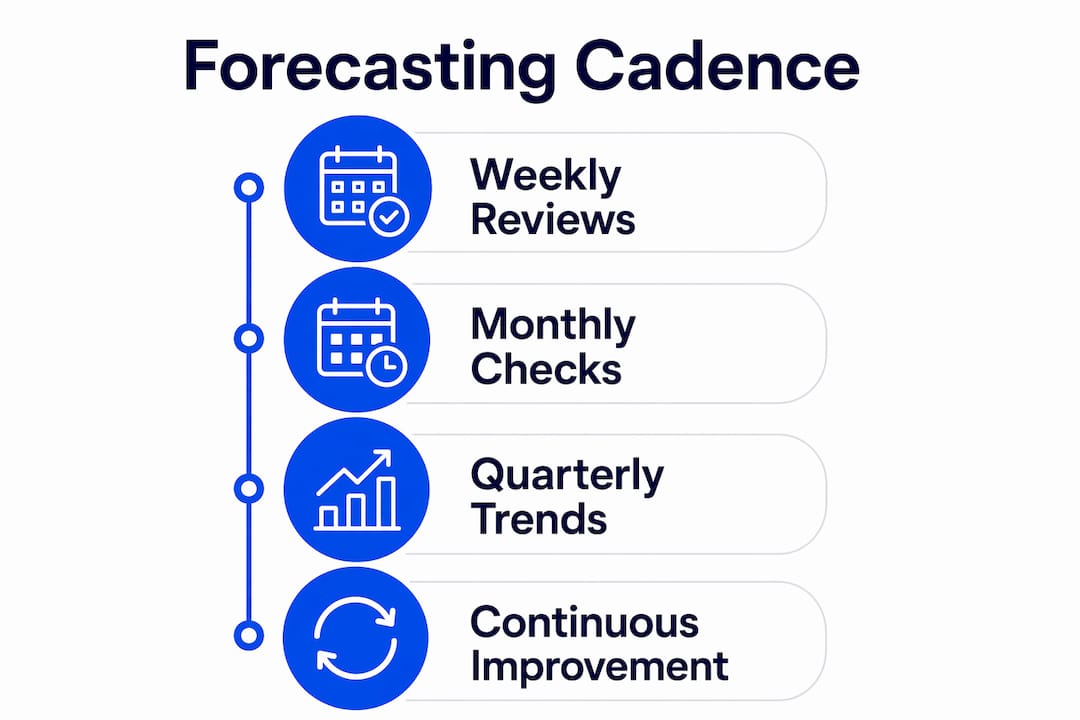
Forecasting cadence matters as much as method. Teams that review forecasts only at month-end react to problems instead of preventing them. Weekly deal reviews force reps to update CRM data and surface stalled opportunities before they contaminate the quarterly number.
| Forecasting method | Best for | Data requirement |
|---|---|---|
| Stage-weighted pipeline | Mid-market, moderate deal volume | Stage definitions in CRM |
| Length-of-cycle | Enterprise, long sales cycles | 12+ months of closed deal data |
| Historical analysis | Stable markets, consistent deal flow | 24+ months of clean records |
| AI/ML-enhanced | High-volume, complex pipelines | Large, structured datasets |
A clean pipeline is the foundation of a reliable forecast. Without it, even the best forecasting method produces noise.
The key pipeline health metrics every sales leader should track are:
Stage gate discipline is what separates a managed pipeline from a wishful one. Each stage should have objective exit criteria. A deal does not move to “Proposal” because the rep sent a document. It moves when the prospect has confirmed budget, identified a decision-maker, and agreed to a timeline. Qualification frameworks like BANT, MEDDIC, and SPICED exist precisely to enforce this discipline.
Pro Tip: Build a “pipeline health scorecard” reviewed in every Monday morning manager meeting. Score each rep’s pipeline on coverage, aging, and stage distribution. Make it visible. What gets measured gets managed.
Leading pipeline indicators like MQL volume, discovery call counts, and new opportunity creation tell you where revenue will be in 60–90 days. Lagging indicators like closed-won rate tell you where it was. You need both, but leading indicators give you time to act. A drop in discovery call volume this week is a revenue problem next quarter.
| Metric | Healthy range | Warning signal |
|---|---|---|
| Pipeline coverage ratio | 2–3x current quarter quota | Below 2x or above 4x |
| Stage conversion rate | Stable quarter over quarter | Drop of 10%+ in any stage |
| Deal aging | Within average cycle length | 30+ days beyond average |
| New opportunity creation | Consistent weekly volume | Two consecutive weeks of decline |
Frontline sales manager development is the highest-leverage investment for building a predictable sales system. Most organizations under-invest here, and it shows in their forecast variance.
The problem is structural. Most sales managers were promoted because they were great individual contributors. Closing deals and coaching reps to close deals are different skills. The transition requires deliberate training, not just a title change.
Effective forecast managers do three things consistently:
Under-investment in frontline manager development is a documented barrier to sales predictability. The fix is not a one-time training event. It’s a cultural shift where forecast discipline is a management expectation, not a quarterly exercise.
Investing in executive coaching best practices for your sales management layer pays compounding returns. A manager who can coach deals, read pipeline signals, and develop reps simultaneously multiplies the output of their entire team.
Pro Tip: Pair each manager with a “forecast accuracy scorecard” that tracks their team’s forecast-to-actual variance over rolling quarters. Make accuracy a performance metric for managers, not just for reps. When managers own the number, they manage it differently.
The sales team coaching tips that produce the most consistent results focus on deal qualification, not deal cheerleading. The manager’s job is to challenge assumptions, not validate optimism.
Structure beats heroics. A repeatable sales process is what allows a team of 10 reps to produce consistent results rather than relying on two or three top performers to carry the number.
Here’s how to build one:
| Process element | What it produces |
|---|---|
| Objective stage criteria | Consistent pipeline valuation |
| Qualification framework | Fewer late-stage surprises |
| Required documentation | Faster ramp for new reps |
| CRM as system of record | Accurate forecast data |
| Weekly process metrics | Early coaching triggers |
Sales enablement is the connective tissue between process design and execution. When reps understand why each step exists and how it connects to the forecast, compliance improves. When they see it as paperwork, it doesn’t. The investment in sales enablement step by step pays off in forecast consistency, not just rep productivity.
Accurate sales forecasts protect revenue and align organizational decisions on budgeting and quotas. That alignment is impossible without a standardized process feeding clean data into your forecasting model.
Predictable sales results require operational discipline, clean pipeline data, and managers who treat forecast accuracy as a core responsibility rather than a reporting exercise.
| Point | Details |
|---|---|
| Blend forecasting methods | Combine stage-weighted and run-rate models; a 15% divergence signals a pipeline issue to investigate. |
| Enforce pipeline health metrics | Track coverage ratios, deal aging, and stage conversion weekly to catch problems before they hit the forecast. |
| Develop frontline managers | Train managers to coach deals and enforce CRM hygiene, not just review numbers. |
| Standardize the sales process | Define objective stage criteria and require documentation at every stage to produce reliable forecast data. |
| Use leading indicators | Monitor MQL volume and discovery call rates to predict revenue 60–90 days out and act before it’s too late. |
Real talk: most sales teams don’t have a forecasting problem. They have a discipline problem that shows up in the forecast.
I’ve worked with RevOps leaders and VPs of Sales who invested heavily in forecasting tools and saw almost no improvement in accuracy. The tools weren’t the issue. The underlying data was dirty, the stage criteria were vague, and the managers were running pipeline reviews that felt more like therapy sessions than operational checkpoints.
Revenue predictability is a reflection of operational discipline and data integrity. That’s not a comfortable truth for teams that want a software fix. But it’s the truth that produces results.
The mindset shift I push for in every engagement is this: stop treating predictability as a target to hit and start treating it as a mirror. When your forecast misses, the question isn’t “what went wrong this quarter?” It’s “what does this miss tell us about our process?” Predictability means stable forecast accuracy and the ability to course-correct fast, not hitting the exact number every time.
The teams that get this right invest in their managers first. Not in new tools, not in new territories. In the people who sit between the data and the decisions. That’s where the leverage lives.
— Antony
Saleslabelconsulting works directly with RevOps leaders, Heads of Sales, and VPs of Sales to build the operational foundation that makes revenue predictable. The work is practical, not theoretical.
The sales enablement program instills process discipline across your entire sales team, from stage criteria to CRM hygiene to qualification standards. The sales audit service identifies exactly where your pipeline breaks down and why your forecasts deviate. Both services are built for tech and B2B sales organizations that need measurable results, not generic advice. If your forecast variance is too high or your pipeline health is inconsistent, that’s the starting point.
A predictable sales results guide is a framework that outlines the forecasting methods, pipeline disciplines, and process standards sales teams need to consistently hit revenue targets within a defined accuracy range.
Organizations using systematic sales approaches typically achieve forecast accuracy within 5–10% of actual revenue. AI-powered tools can improve that accuracy by 20–40% when data quality is high.
The recommended cadence is weekly deal reviews, monthly run-rate checks, and quarterly trend analysis. Weekly reviews catch slippage early and prevent late-quarter surprises.
A coverage ratio of 2–3x for the current quarter is the standard benchmark. Below 2x signals risk; above 4x often indicates poor qualification and inflated pipeline.
Frontline manager development is the highest-leverage investment for sales predictability because managers control CRM hygiene, deal coaching quality, and the rigor of pipeline reviews at the rep level.
Subscribe to our Insights: Expert productivity tips in your inbox
You'll receive 1-3 emails per month. Your data stays private, always.

CRO & Co-Founder with Sales Label Consulting

Watch our Sales Mates Podcast
July 16, 2026 - 9 min read
Read article Read article