
What Is a Sales Acceleration Strategy in 2026?
TL;DR:
- Sales acceleration involves removing structural friction to shorten sales cycles without rushing deals. It relies on process efficiency, technology enablement, and execution competency working together. The most effective tactics include qualified prospecting, warm introductions, and parallel stakeholder engagement.
A sales acceleration strategy is defined as the deliberate compression of your sales cycle by removing structural friction, enabling technology, and building execution competency across your team. This is not about selling faster. It’s about removing friction at every stage, from prospecting to closing, so ready-to-buy customers move through your pipeline without unnecessary delays. The three pillars are process efficiency, technology enablement, and execution competency. Neglect any one of them and the other two underperform. Saleslabelconsulting works with RevOps leaders, Heads of Sales, and VPs of Sales who need this system built correctly, not patched together.
A sales acceleration strategy rests on three integrated components. Pull one out and the whole structure weakens. Most teams focus on technology and ignore execution. That’s where deals stall.

Process efficiency means eliminating approval delays, redundant handoffs, and unclear stage criteria. If your reps spend time chasing internal sign-offs instead of advancing deals, your process is the bottleneck, not your team.
Technology enablement covers automation, analytics, and intent data. Automating low-value tasks like meeting scheduling, follow-up sequences, and CRM data entry frees reps to focus on conversations that move deals. Sales enablement trends in 2026 show that teams using intent-based signals to prioritize outreach consistently outperform those relying on volume alone.
Execution competency is the most neglected pillar. It includes consultative selling, multi-threading across buying committees, executive dialogue, and champion building. Over-automation without skill development leads directly to acceleration failures. Technology creates the opportunity. Execution closes it.
Pro Tip: Map your current sales cycle stage by stage and mark every step where a deal waits for something internal. Those waiting points are your first targets for process redesign.
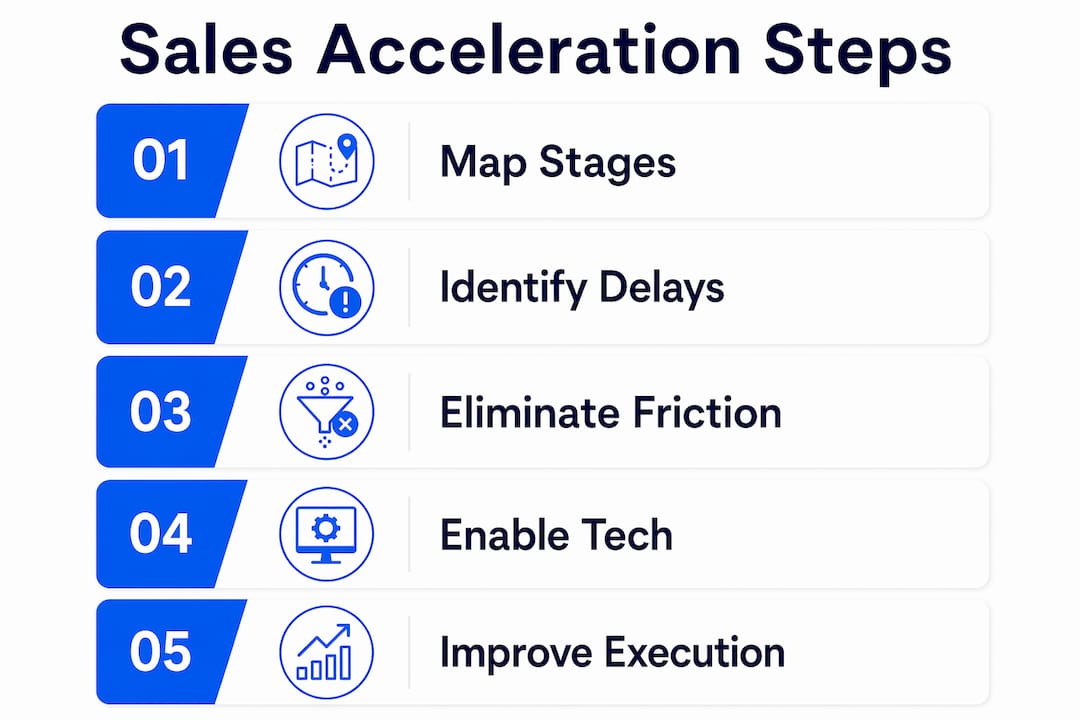
The most damaging misconception is that acceleration means selling faster. It does not. Acceleration is about removing structural friction that blocks customers who are already ready to buy. Rushing a deal that isn’t qualified wastes everyone’s time and inflates your cycle length with losses.
The second major pitfall is over-investing in automation while underinvesting in people. Firms that automate outreach sequences without building multi-threading and executive dialogue skills end up with higher volume and lower win rates. The technology surfaces opportunities. Your team still has to convert them.
“Pipeline acceleration is about removing waiting and delays to help customers move faster through their own decision-making process. It is a capability built via deliberate process and resource improvements, not rushing.” Pipeline Acceleration, 2026 Guide
Three more pitfalls that kill acceleration programs:
Real talk: most acceleration failures are not technology failures. They are qualification and execution failures dressed up as pipeline problems.
The highest-impact tactics in 2026 combine qualification discipline, relationship-based outreach, and pipeline velocity management. Here is what actually moves the needle.
Apply MEDDIC to every qualified opportunity. MEDDIC (Metrics, Economic Buyer, Decision Criteria, Decision Process, Identify Pain, Champion) forces your team to gather the information needed to advance a deal before investing resources. Teams using strict qualification frameworks like MEDDIC spend less time on deals they cannot win.
Prioritize warm, mutually consented introductions. Warm introductions improve reply rates from 2% to 40–50% compared to cold email. That is a 20x improvement in engagement. This single tactic changes pipeline economics more than any automation tool.
Implement parallel-pathing. Contact multiple stakeholders simultaneously rather than sequentially. In complex B2B deals, the economic buyer, the technical evaluator, and the end user all have influence. Waiting to meet them one at a time adds weeks to your cycle.
Use signal-based prospecting. Target accounts showing active intent: job postings for roles that indicate a buying need, technology changes, funding announcements, or content engagement. Reaching a buyer who is already in research mode shortens the cycle before the first call.
Manage pipeline velocity with a formula. The pipeline velocity formula is: (Opportunities × Win Rate × Deal Value) / Cycle Length. Reducing cycle length directly multiplies velocity. Companies that prioritize cycle compression outperform peers in uncertain markets.
| Tactic | Primary lever | Impact on cycle |
|---|---|---|
| MEDDIC qualification | Win rate | Removes unwinnable deals early |
| Warm introductions | Engagement rate | Lifts reply rates from 2% to 40–50% |
| Parallel-pathing | Cycle length | Eliminates sequential stakeholder delays |
| Signal-based prospecting | Lead quality | Targets buyers already in motion |
| Pipeline velocity tracking | All levers | Identifies the weakest link in real time |
Pro Tip: Run your pipeline velocity formula quarterly. If cycle length is your weakest variable, focus your next 90 days entirely on friction removal. If win rate is lowest, focus on qualification and champion building.
For a deeper look at compressing sales cycles in B2B environments, the tactics above combine into a repeatable system when sequenced correctly.
Implementation starts with measurement. You cannot fix what you haven’t mapped. Begin by tracking average cycle duration for each stage, then identify where deals sit longest without advancing. Those are your friction points.
Align sales and marketing before you change anything else. Misaligned messaging creates confusion for buyers and slows decisions. When marketing targets the same accounts with the same value proposition your reps use, buyers arrive at conversations already informed. That alone compresses early-stage cycle time.
Next, systematize your warm introduction workflow. Warm introductions with double opt-in create engagement rates that cold outreach cannot match. Build a process for identifying shared connections, requesting introductions, and tracking conversion rates from intro to first meeting.
Pro Tip: Don’t try to fix everything at once. Pick the one pipeline stage with the longest average duration and redesign it completely before moving to the next. Focused changes compound faster than broad ones.
The B2B buyer journey in 2026 has shifted toward self-directed research. Buyers arrive at conversations later and more informed. Your acceleration system needs to meet them where they are, not where your process assumes they are.
I’ve worked with enough sales organizations to say this plainly: the teams that accelerate successfully are not the ones with the best tools. They’re the ones with the clearest process and the most disciplined qualification.
Every VP of Sales I’ve spoken with who struggled with acceleration had the same root problem. They invested in technology first and process second. The CRM was configured. The sequences were running. But reps were still chasing deals that had no champion, no defined decision process, and no real urgency. Technology amplified the chaos instead of fixing it.
The mindset shift that actually works is moving from volume-based thinking to intent-based thinking. Stop measuring success by outreach volume. Start measuring it by the quality of conversations and the speed at which qualified deals advance. Intent-based, mutually consented engagement is the defining characteristic of high-performing sales teams in 2026.
Buyer behavior has changed. Buyers do more research before engaging. They involve more stakeholders. They take longer to commit. Your acceleration strategy has to account for that reality. Friction removal, not pressure, is what moves modern buyers forward.
— Antony
Saleslabelconsulting works directly with RevOps leaders, Heads of Sales, and VPs of Sales to build acceleration systems that produce predictable revenue, not one-quarter spikes.
The work covers three areas: sales enablement, sales audits, and demand generation. Each engagement starts with a diagnostic to identify where your pipeline loses velocity and why. From there, we build the process, train the team, and configure the technology to support execution, not replace it. If you’re ready to move from patched-together tactics to a system that compounds, the sales enablement framework at Saleslabelconsulting is the right starting point. You can also explore sales enablement best practices to see how process and execution come together at scale.
A sales acceleration strategy succeeds when process efficiency, technology enablement, and execution competency work together as one integrated system, not as separate initiatives.
| Point | Details |
|---|---|
| Three pillars must integrate | Process, technology, and execution competency each fail without the other two. |
| Warm introductions change economics | Reply rates jump from 2% to 40–50% with mutually consented introductions. |
| Qualification discipline is non-negotiable | MEDDIC and strict stage criteria remove low-probability deals before they drain capacity. |
| Measure pipeline velocity | Track (Opportunities × Win Rate × Deal Value) / Cycle Length to find your weakest lever. |
| Execution competency is most neglected | Multi-threading, champion building, and executive dialogue unlock what technology cannot. |
A sales acceleration strategy is a systematic approach to compressing the sales cycle by removing friction, enabling technology, and building team execution skills. Its goal is faster revenue without proportional increases in headcount or resources.
Sales acceleration focuses on removing delays and friction in the buying process, not increasing outreach volume. Acceleration requires combining process, technology, and skill development into one integrated system.
Pipeline velocity equals (Opportunities × Win Rate × Deal Value) divided by Cycle Length. Reducing cycle length is the fastest way to increase velocity without adding headcount.
Most failures trace back to over-automating outreach while neglecting execution skills like multi-threading, champion building, and handling executive buyers. Technology surfaces opportunities. Trained reps close them.
Warm, mutually consented introductions produce the highest leverage. They lift reply rates from 2% to 40–50%, which changes pipeline generation economics more than any other single tactic.
Subscribe to our Insights: Expert productivity tips in your inbox
You'll receive 1-3 emails per month. Your data stays private, always.

CRO & Co-Founder with Sales Label Consulting

Watch our Sales Mates Podcast
August 24, 2026 - 8 min read
Read article Read articleAugust 23, 2026 - 11 min read
Read article Read articleAugust 22, 2026 - 8 min read
Read article Read articleAugust 21, 2026 - 7 min read
Read article Read article