
B2B Marketing and Sales Funnel: A 2026 Guide
TL;DR:
- A B2B marketing and sales funnel is a structured framework that guides business buyers from awareness to retention, involving multiple stakeholders. Properly defining and aligning each stage improves pipeline accuracy and predictable revenue, especially in complex, long sales cycles. Regularly updating and simplifying the funnel ensures it reflects buyer psychology and supports effective coordination between marketing and sales teams.
A B2B marketing and sales funnel is defined as a structured framework that maps how business buyers move from first awareness of your brand through evaluation, purchase, and long-term retention. Unlike a loose collection of tactics, this framework gives revenue teams a shared model for predicting where prospects are, what they need next, and when to act. The B2B version of this funnel carries unique weight: sales cycles span 3–12 months and buying committees average 8–13 stakeholders. That complexity is exactly why understanding the funnel’s structure is the first step toward building a predictable revenue engine.
A B2B marketing and sales funnel is the strategic map of how business buyers move from discovering your brand to signing a contract and becoming loyal customers. The industry standard term for this model is the “revenue funnel,” and it covers both the marketing side (awareness, education, lead generation) and the sales side (qualification, evaluation, closing). You need both halves working together. Without that integration, leads fall through the cracks between teams.
The funnel exists because B2B buying is not a single decision made by one person. Buying committees include diverse roles such as champions, blockers, users, budget holders, and executive sponsors, each with different goals and timelines. Your funnel must serve all of them simultaneously. That’s what separates a well-designed B2B funnel from a simple sales tracker.
Think of the funnel as a diagnostic tool. When deals stall or conversion rates drop, the funnel tells you exactly where the breakdown is happening. That visibility is what makes it worth building correctly from day one.
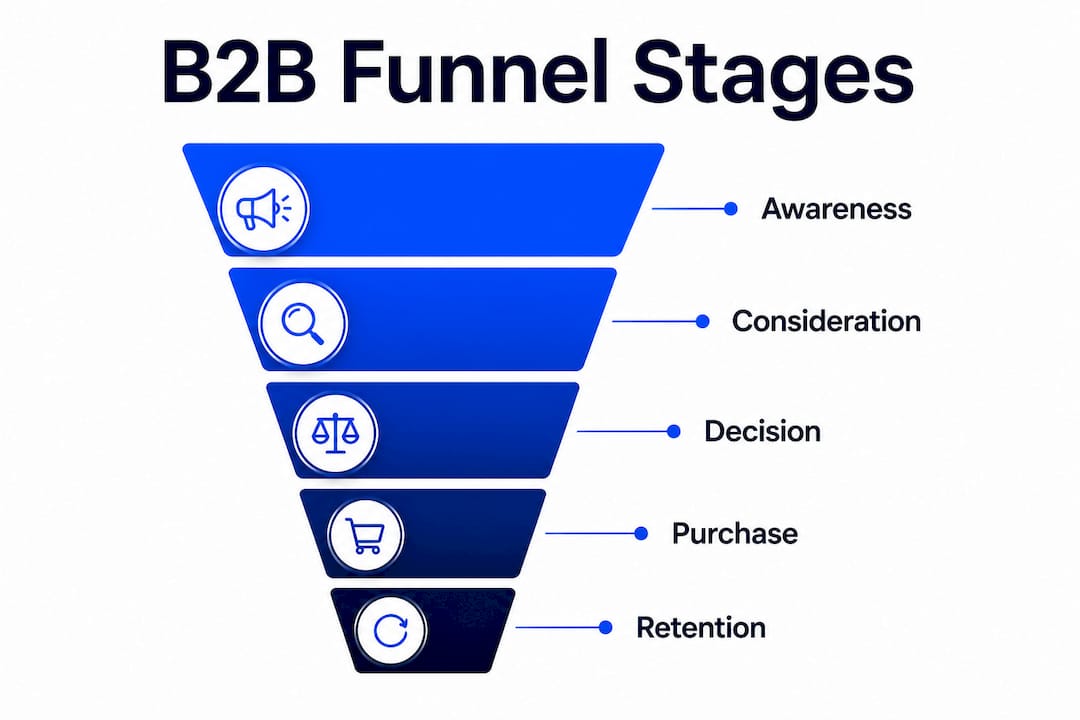
The typical B2B revenue funnel runs through six core stages. Each stage has a distinct job, and the handoff between marketing and sales happens at a defined point in the middle.
Awareness. The prospect recognizes a problem and discovers your brand through content, paid ads, events, or referrals. Marketing owns this stage entirely. The goal is reach and relevance, not conversion.
Interest and consideration. The prospect actively researches solutions. They consume blog posts, whitepapers, and case studies. Marketing nurtures them with targeted educational content designed to build trust over time.
Evaluation. The prospect compares vendors. This is where the marketing-to-sales handoff typically occurs. A prospect becomes a marketing-qualified lead (MQL) when they meet defined engagement thresholds, then a sales-qualified lead (SQL) after a discovery call confirms fit.
Decision. The buying committee reviews proposals, negotiates terms, and seeks internal approval. Sales owns this stage. The rep’s job is to reduce risk and build consensus across all stakeholders.
Purchase. The contract is signed. This is not the finish line. It’s the start of the retention phase.
Retention and advocacy. Customer success teams keep the account healthy. Satisfied customers become references, case studies, and sources of expansion revenue.
Pro Tip: Define precise entry and exit criteria for every stage before you build anything in your CRM. Vague stage boundaries produce unreliable pipeline data, and unreliable data produces bad forecasts.
Clear stage definitions also make funnel optimization possible. You can’t fix a conversion problem you can’t locate.
The difference is not just scale. It’s a fundamentally different buying psychology.

| Dimension | B2B funnel | B2C funnel |
|---|---|---|
| Decision-makers | 8–13 stakeholders | Usually 1 person |
| Sales cycle | 3–12 months | Minutes to days |
| Primary buyer motivation | ROI, risk mitigation, compliance | Convenience, emotion, price |
| Content focus | Education, validation, proof | Entertainment, urgency, aesthetics |
| Relationship depth | Long-term partnership | Often transactional |
B2B buyers operate in high-stakes environments. A wrong software purchase can cost a company millions and end careers. That’s why B2B funnels prioritize trust and education over speed and impulse. Your content must answer hard questions, not just generate clicks.
B2C funnels can afford to be emotional and fast. A consumer buying running shoes does not need a three-month evaluation process or a committee sign-off. B2B buyers do. This distinction shapes every content decision, every channel choice, and every sales motion you run.
The practical implication: if you apply B2C tactics to a B2B funnel, you will generate plenty of top-of-funnel noise and very few closed deals. The funnel design must match the buyer’s actual decision-making process.
Getting the funnel right requires matching your tactics to where the buyer actually is, not where you wish they were.
The MQL-to-SQL handoff is where most revenue teams lose money. Marketing passes leads too early; sales ignores them. Fix this by agreeing on a shared definition before the quarter starts. An MQL might be defined as a prospect who has downloaded two assets and visited your pricing page. An SQL requires a confirmed budget, authority, need, and timeline (the BANT framework). Qualifying B2B leads with clear criteria removes the guesswork from pipeline reviews.
Content is not one-size-fits-all. Match the format to the stage:
Effective lead nurturing means delivering the right content at the right moment, not blasting every prospect with the same email sequence.
Modern B2B marketing strategy connects your ideal customer profile (ICP), messaging, channels, and offer delivery into one revenue-focused system. The four main delivery motions are outbound (cold outreach), inbound (content-driven), product-led (free trial or freemium), and partner-led (channel resellers or integrations). Most B2B companies need at least two of these running simultaneously.
Pro Tip: Track engagement signals from multiple stakeholders visiting your key pages. When three or more people from the same account view your pricing page in one week, that’s buying momentum. Act on it before a competitor does.
Long cycles create drift. Deals go quiet, champions leave companies, and budgets get reallocated. The fix is a structured momentum plan for long cycles that includes scheduled touchpoints, mutual action plans, and executive-level engagement at key milestones. Structure beats heroics every time.
Real talk: most B2B revenue problems are not sales problems or marketing problems. They’re alignment problems.
The funnel and the pipeline are not the same thing. The funnel tracks buyer readiness; the pipeline tracks seller activities. Both are essential, and they must connect at the MQL-to-SQL handoff. When they don’t connect, marketing blames sales for ignoring leads, and sales blames marketing for sending junk. Neither team wins.
A unified marketing and sales funnel improves lead handoff coordination and boosts revenue predictability. The companies that get this right share three practices:
The revenue impact of alignment is well documented. Companies with tight marketing and sales coordination consistently outperform those running the two functions as separate departments. Saleslabelconsulting works directly with RevOps leaders, Heads of Sales, and VPs of Sales to build these shared systems. The goal is always the same: predictable revenue, not heroic quarter-end sprints.
A practical starting point is a step-by-step lead nurturing workflow that both teams co-own. When marketing builds the sequence and sales provides the messaging, the result is a nurture program that actually converts.
A B2B marketing and sales funnel works because it gives both marketing and sales a shared map of buyer readiness, stage criteria, and handoff points that drive predictable revenue.
| Point | Details |
|---|---|
| Define stage criteria first | Set precise entry and exit criteria for every funnel stage before configuring your CRM. |
| Keep stages to seven or fewer | More than 7 funnel stages causes CRM bloat and slows pipeline reviews without improving visibility. |
| Align MQL and SQL definitions | Shared lead definitions between marketing and sales eliminate the handoff failures that kill pipeline quality. |
| Match content to buyer stage | Awareness needs education; evaluation needs proof. Mismatched content stalls deals. |
| Track buying committee signals | Monitor multi-stakeholder engagement across your key pages to identify purchase intent early. |
Here’s what I’ve seen after working with dozens of B2B revenue teams: most companies build a funnel once, load it into their CRM, and never touch it again. The stages look clean on a slide deck. The pipeline report looks organized. But the data is garbage because nobody defined what “Proposal Sent” actually means, and three reps are using it differently.
The funnel is only useful when it reflects reality. Buyers don’t move in a straight line. They circle back. A prospect who went cold at the evaluation stage six months ago might re-enter at consideration after a budget cycle resets. Your funnel needs to accommodate that. Rigid, linear thinking about the buyer journey is one of the most common mistakes I see from otherwise sharp revenue teams.
The other mistake is over-engineering. I’ve seen funnels with 11 stages, each with sub-stages. Nobody uses them. The reps skip steps to close faster, the data becomes meaningless, and the VP of Sales is flying blind on forecast calls. Keep it to seven stages or fewer. Clarity beats completeness.
The best funnel I’ve ever seen was built by a Head of Sales who asked one question for every stage: “What does the buyer need to believe to move forward?” That question cuts through all the internal politics and process theater. Build your funnel around buyer psychology, not internal reporting convenience.
— Antony
Running a B2B funnel well requires more than a good framework. It requires the right processes, the right content, and a sales team that knows exactly what to do at each stage.
Saleslabelconsulting works with RevOps leaders, Heads of Sales, and VPs of Sales to build funnel systems that produce predictable results. From sales enablement step by step to full demand generation programs, the work connects your ICP, your messaging, and your sales motion into one operating system. If your pipeline feels unpredictable or your MQL-to-SQL conversion rate is disappointing, a sales enablement audit is the fastest way to find the gaps. The goal is a funnel your whole revenue team trusts.
A B2B marketing and sales funnel is a structured framework that maps the buyer’s journey from first awareness through purchase and retention, designed for complex sales involving multiple stakeholders and long decision cycles.
Keep your funnel to seven stages or fewer. More than seven stages creates CRM bloat and slows pipeline reviews without improving deal visibility or forecast accuracy.
A marketing-qualified lead (MQL) meets engagement thresholds set by marketing, such as content downloads or page visits. A sales-qualified lead (SQL) has been confirmed by sales as having budget, authority, need, and timeline.
The B2B sales cycle typically spans 3–12 months, depending on deal size and industry. Buying committees averaging 8–13 stakeholders extend the timeline because each role requires different information and approvals.
Aligned teams share lead definitions, feedback loops, and revenue metrics, which removes the handoff failures that cause qualified leads to go ignored and pipeline data to become unreliable.
Subscribe to our Insights: Expert productivity tips in your inbox
You'll receive 1-3 emails per month. Your data stays private, always.

CRO & Co-Founder with Sales Label Consulting

Watch our Sales Mates Podcast
September 20, 2026 - 13 min read
Read article Read articleSeptember 19, 2026 - 13 min read
Read article Read articleSeptember 18, 2026 - 10 min read
Read article Read articleSeptember 17, 2026 - 16 min read
Read article Read article