
Sales Process Compliance: A Practical EU Guide
TL;DR:
- Sales process compliance involves following legal, industry, and internal standards at every sales stage to ensure lawful and ethical revenue. Embedding compliance early and mapping checkpoints to CRM stages accelerates deal closure and improves pipeline accuracy. Regular audits, training, and coordination across sales, legal, and compliance teams are essential for maintaining a compliant and predictable sales process.
Sales process compliance is defined as the practice of adhering to legal frameworks, internal policies, and industry standards that govern how each stage of a sales process must be executed to produce lawful, ethical, and consistent revenue. For EU sales professionals, compliance officers, and business leaders, this means embedding GDPR requirements, FTC Telemarketing Sales Rule principles, and internal documentation standards directly into your sales workflow, not reviewing them after a deal closes. The cost of treating compliance as an afterthought is real. Compliance-related stalls cause 30–40% of fintech enterprise deals to fail after the demo stage. That number should reframe how you think about where compliance belongs in your process.
Sales process compliance is the structured practice of meeting all applicable legal, regulatory, and internal requirements at every stage of a B2B sales cycle. The industry term most practitioners use is “sales operations compliance,” which captures both the external legal dimension and the internal procedural one. Understanding sales process rules means knowing which obligations apply at prospecting, outreach, discovery, proposal, and close, and building those obligations into your CRM workflow rather than leaving them to legal review.

The importance of sales compliance goes beyond avoiding fines. Buyers in regulated industries, especially in finance, healthcare, and cybersecurity, now run compliance checks on vendors before procurement approval. A sales team that can demonstrate clean data handling, documented consent, and transparent commission structures moves through procurement faster than one that cannot. Regulatory compliance in B2B sales is evolving into a direct competitive advantage in these sectors.
Compliance also protects forecast accuracy. When reps skip compliance steps to push a deal forward, those deals often stall or collapse in legal review. That creates pipeline distortion that makes revenue forecasting unreliable. Structure beats heroics here. A compliant pipeline is a predictable pipeline.
Three external frameworks shape sales compliance for EU and internationally operating teams.
GDPR (General Data Protection Regulation) governs how you collect, store, and use prospect data across all EU member states. For sales teams, this means every outreach must rest on a documented lawful basis, either explicit consent or a completed Legitimate Interest Assessment. A Legitimate Interest Assessment requires you to show necessity, a clear business purpose, and a balance against the prospect’s privacy rights before you send a single email.
FTC Telemarketing Sales Rule applies to phone outreach and prohibits deceptive or abusive practices. The FTC carries civil penalties of up to $51,744 per violation for truthfulness failures in sales communications, including unsubstantiated ROI claims and misleading testimonials. EU teams engaging US prospects or operating US subsidiaries need this on their radar.
CCPA and CAN-SPAM equivalents extend similar data rights to California residents and govern commercial email. The practical requirements overlap significantly with GDPR, so a GDPR-compliant process usually covers most CCPA obligations.
Internal frameworks matter just as much. These include:
Scraped lists without documented lawful basis violate GDPR and CCPA frequently. Bulk cold email sequences built on purchased or scraped data represent the highest compliance risk profile in outbound sales today.
The real talk: compliance embedded in your workflow closes deals faster than compliance bolted on at the end. Compliance-related procurement stalls cause 30–40% of fintech enterprise deals to fail post-demo. The root cause is almost always the same. Reps discover compliance gaps during procurement review, not during discovery. By then, the buyer’s legal team is involved, timelines slip, and competitors who came prepared win.
Proactively addressing compliance during early discovery changes that dynamic. When a rep can confirm lawful data handling, reference a preapproved DPA, and speak to GDPR consent practices in the first two calls, procurement objections shrink. The buyer’s legal team has less to review. Deals close in weeks instead of months.
Pro Tip: Map your compliance checkpoints to your CRM stages. At the “Qualified” stage, confirm lawful basis for data. At “Proposal,” attach the DPA. At “Legal Review,” confirm suppression list status. Each checkpoint becomes an exit criterion, not an afterthought.
Pipeline quality improves too. Explicit exit criteria for moving deals between stages improve forecasting accuracy and confirm compliance requirements are met before a deal advances. When reps cannot specify what it takes to advance a stage, forecasting suffers and compliance adherence weakens simultaneously. These two problems share the same fix: defined stage gates with compliance checkpoints built in.
Compliance maturity also differentiates vendors in regulated industries. A fintech or cybersecurity buyer evaluating two vendors of similar capability will favor the one whose sales team demonstrates process discipline. That discipline signals what working with your company post-sale will feel like.
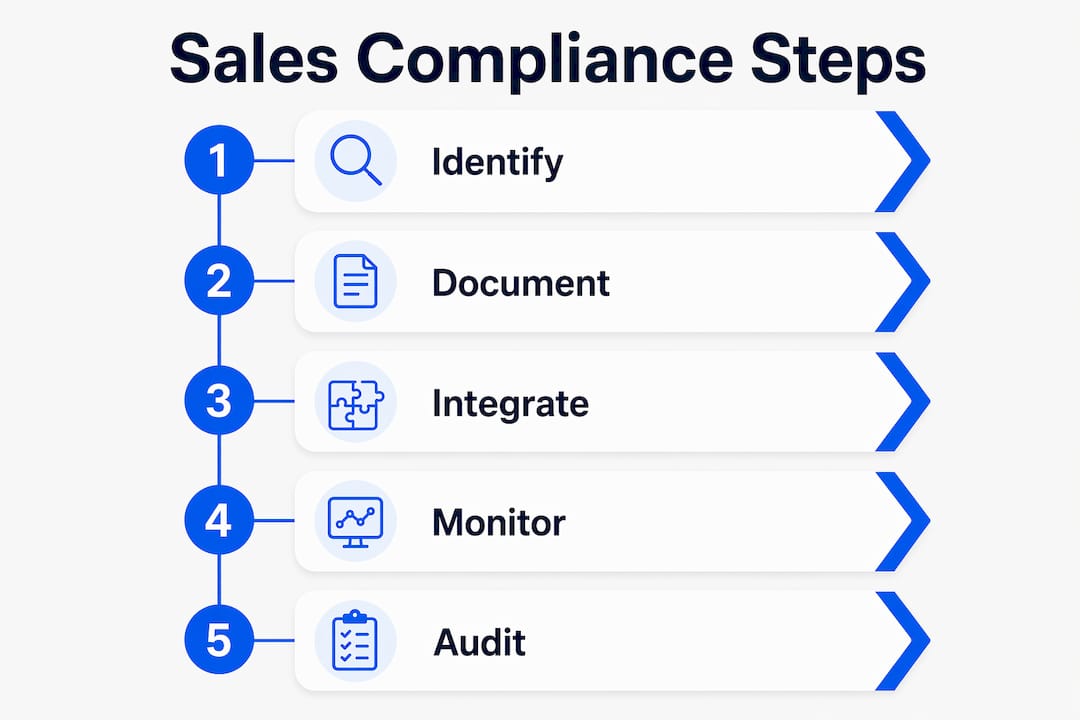
Consistent compliance requires process, not willpower. Here are the steps that work in practice.
Document your lawful basis for every prospect record. Under GDPR, you need either consent or a completed Legitimate Interest Assessment before outreach. Build this into your data acquisition step, not your legal review step. Compliance embedded at data acquisition prevents GDPR risks better than post-hoc legal reviews.
Maintain and enforce suppression lists. Every unsubscribe, opt-out, and do-not-contact request must be logged and honored across all channels within the legally required timeframe. Assign ownership of suppression list hygiene to a named person, not a team.
Preapprove your Data Processing Agreements. DPAs define data handling responsibilities between your company and the buyer. Without a preapproved DPA, legal review cycles run 2–4 weeks and routinely delay quarter-end closes. Get your DPA template approved by legal before your reps need it.
Run structured sales compliance training. Scheduled audits and rep training reduce legal penalties and internal friction. Training should cover GDPR basics, outreach rules, and how to handle compliance objections in discovery. Quarterly refreshers beat annual certifications.
Align incentive compensation with legal standards. Sales compensation compliance means your commission structures do not inadvertently reward behavior that creates legal risk. Clear, transparent commission structures build internal trust and support an ethical sales culture.
Build compliance exit criteria into your CRM stages. Each stage gate should require a compliance confirmation before a deal advances. This creates an audit trail and prevents reps from skipping steps under quota pressure.
Pro Tip: Use your sales process checklist as a compliance verification tool. A checklist that maps regulatory requirements to each stage gives reps a clear reference and gives managers an audit-ready record.
Common pitfalls to avoid: treating compliance as a legal department problem, using scraped lists without consent documentation, and skipping DPA preparation until the buyer’s legal team asks for it.
Ongoing compliance monitoring requires a system, not a spot check. Here is what an effective audit framework looks like for sales teams.
Coordination between sales, compliance, and legal teams is what makes audits useful rather than performative. Sales owns the CRM data. Compliance owns the framework. Legal owns the risk assessment. All three need a shared audit calendar and a shared definition of what “compliant” means at each stage.
You can also work with external specialists for compliance audits to get an independent view of gaps your internal team may have normalized. A fresh set of eyes on your sales data handling practices often surfaces risks that internal reviews miss.
Automation helps sustain compliance culture between audits. CRM workflows that trigger compliance reminders at stage transitions reduce reliance on rep memory. Periodic training keeps the team current as regulations evolve.
Sales process compliance is the single most effective way to protect pipeline quality, accelerate deal velocity, and reduce legal exposure across every stage of a B2B sales cycle.
| Point | Details |
|---|---|
| Define compliance at every stage | Map GDPR, FTC, and internal policy requirements to each CRM stage, not just to legal review. |
| Embed compliance at data acquisition | Document lawful basis before outreach to prevent GDPR violations and procurement stalls. |
| Use CRM exit criteria | Explicit stage gate requirements improve both forecast accuracy and audit readiness. |
| Train reps quarterly | Regular sales compliance training reduces legal penalties and builds ethical sales culture. |
| Audit across three functions | Effective audits require coordination between sales, compliance, and legal with a shared calendar. |
Here is what I have seen repeatedly working with EU sales teams: compliance gets treated as a legal department function until a deal collapses in procurement review. Then it becomes everyone’s problem. By that point, the quarter is at risk, the buyer is frustrated, and the rep is scrambling to find a preapproved DPA that does not exist yet.
The teams that get this right do one thing differently. They treat compliance as a sales workflow design problem, not a legal problem. They ask: “At what stage does this requirement need to be met, and who owns confirming it?” That question, asked early, changes everything.
I have also seen compliance become a genuine differentiator. In fintech and cybersecurity sales, buyers are increasingly sophisticated. They know what GDPR-compliant outreach looks like. When a rep demonstrates process discipline in the first two calls, it signals organizational maturity. That signal accelerates trust faster than any product demo.
The uncomfortable truth is that most sales teams do not have a compliance problem. They have a workflow design problem. Compliance requirements exist. The gap is that no one has mapped them to the sales process in a way reps can actually follow. Fix the workflow, and compliance follows naturally.
Balancing sales velocity with compliance rigor is not a trade-off. A compliant deal that closes is worth more than a fast deal that collapses in legal review. Structure beats heroics, every time.
— Antony
Sales compliance is not a one-time fix. It requires process design, audit readiness, and ongoing enablement built into how your team sells every day.
Saleslabelconsulting works with RevOps leaders, Heads of Sales, and VPs of Sales to design sales workflows that embed compliance at every stage, from data acquisition through contract close. Our sales enablement approach connects regulatory requirements to CRM stage gates, giving your team a process that is both audit-ready and built for predictable revenue. If your pipeline is stalling in legal review or your forecast accuracy is suffering, a sales process audit is the fastest way to find out why and fix it.
Sales process compliance is the practice of following all applicable laws, internal policies, and industry standards at every stage of a sales cycle. It covers data handling, outreach rules, contract requirements, and compensation practices.
Compliance-related procurement stalls cause 30–40% of fintech enterprise deals to fail after the demo stage. The cause is almost always a gap discovered late, such as a missing DPA or undocumented consent, that could have been addressed in early discovery.
GDPR requires sales teams to document a lawful basis, either consent or a Legitimate Interest Assessment, for every prospect record before outreach. It also mandates suppression list management, data retention limits, and timely responses to Subject Access Requests.
Monthly CRM stage audits, quarterly suppression list and training reviews, and annual compensation plan audits represent a practical audit cadence for most B2B sales teams operating under GDPR.
Scheduled compliance training keeps reps current on GDPR, FTC rules, and internal policies, reducing the likelihood of violations that carry civil penalties or trigger regulatory investigations. Quarterly training outperforms annual certification in sustaining compliant behavior.
Subscribe to our Insights: Expert productivity tips in your inbox
You'll receive 1-3 emails per month. Your data stays private, always.

CRO & Co-Founder with Sales Label Consulting

Watch our Sales Mates Podcast
August 27, 2026 - 14 min read
Read article Read articleAugust 26, 2026 - 9 min read
Read article Read articleAugust 25, 2026 - 8 min read
Read article Read articleAugust 24, 2026 - 8 min read
Read article Read article