
What Is a Sales Development Function? B2B Guide 2026
The sales development function is the specialized B2B team that sits between marketing and sales, responsible for identifying, qualifying, and engaging prospects before handing them off to Account Executives to close. It doesn’t close deals. That’s the point. Its entire job is to fill the top of the funnel with qualified, meeting-ready opportunities so your closers can do what they do best.
Real talk: most B2B sales organizations that struggle with pipeline predictability are running their Account Executives as both prospectors and closers. That’s a structural problem, not a people problem. The sales development function fixes it by creating a dedicated layer of outreach specialists, typically called Sales Development Representatives (SDRs) for inbound leads and Business Development Representatives (BDRs) for outbound prospecting.
Here’s what the function actually delivers:
The function focuses exclusively on top-of-funnel activities. Closing is someone else’s job.
Before the 2010s, most B2B sales teams ran a generalist model. Your senior Account Executive prospected, qualified, demoed, negotiated, and closed. All of it. The problem? Senior closers are expensive, and cold prospecting is time-consuming, repetitive work that pulls them away from the high-value activities they’re actually built for.
Sales development emerged in the 2010s alongside the explosive growth of B2B SaaS companies that needed to scale revenue fast without proportionally scaling headcount. The solution was specialization. By separating prospecting from closing, companies could hire lower-cost SDRs to handle the front-end work while Account Executives focused entirely on converting warm, qualified opportunities.
Technology made this possible at scale. CRM platforms like Salesforce, sales engagement tools, and data providers gave SDR teams the infrastructure to run high-volume, structured outreach without chaos. The function became a standard part of the modern B2B go-to-market motion, particularly in tech and SaaS, and has since spread across industries where complex sales cycles require deliberate qualification before a deal ever reaches a closer.
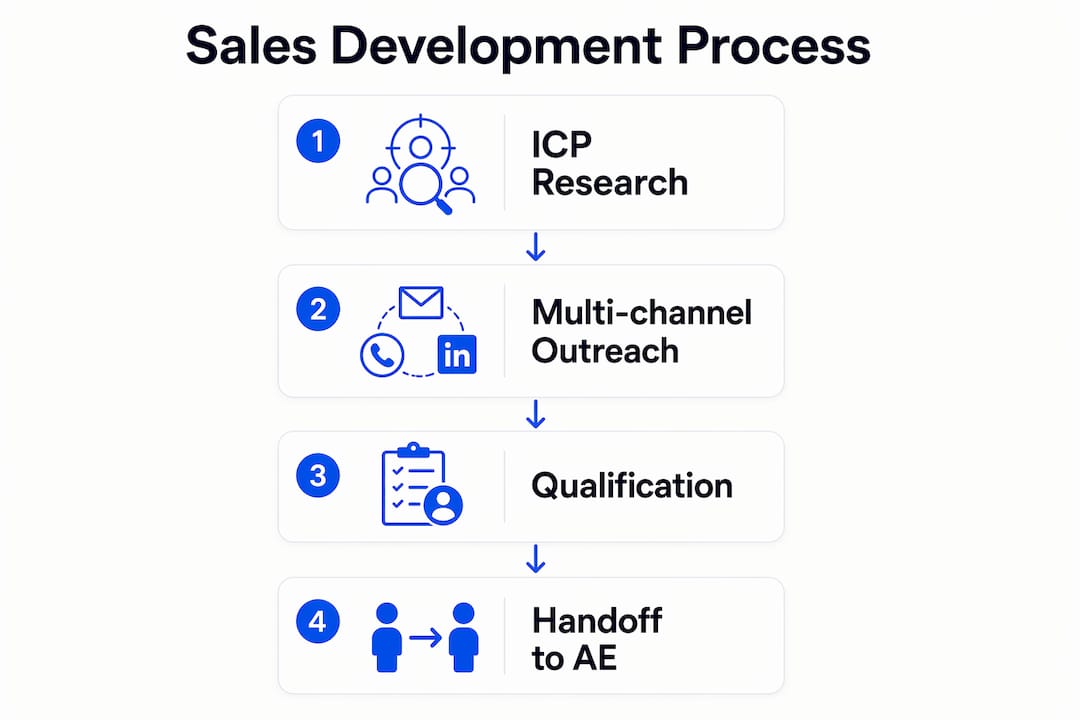
The sales development process runs in a clear sequence, even if the day-to-day feels scrappy. Here’s the flow:
Stage 1: ICP research and prospect identification
SDRs start with a defined ideal customer profile, typically built around company size, industry, tech stack, and buying signals. They use data tools to build target account lists and identify the right contacts within those accounts.

Stage 2: Multi-channel outreach
Outreach runs across phone, email, and LinkedIn, usually in a structured touch pattern or cadence. A typical sequence might include an initial email, a LinkedIn connection request, a follow-up call, and several more touchpoints over two to three weeks. The goal is a live conversation, not just a reply.
Stage 3: Qualification
Once connected, the SDR runs a discovery conversation to gather BANT qualification criteria: budget, authority, need, and timeline. A lead that meets the SQL definition moves forward. One that doesn’t gets disqualified or nurtured.
Stage 4: Handoff to Account Executive
The SDR schedules a meeting between the qualified prospect and the Account Executive, passes along all context gathered during qualification, and hands off ownership. From here, the AE runs the rest of the sales process.
| Stage | Key Activity | Output |
|---|---|---|
| ICP research | Build target account and contact lists | Prospect list |
| Outreach | Multi-channel cadence execution | Live connection |
| Qualification | BANT discovery conversation | SQL determination |
| Handoff | Meeting scheduled, context transferred | AE-owned opportunity |
Pro Tip: A weak handoff kills good qualification. SDRs should pass a written summary of every BANT detail to the AE before the meeting, not just a calendar invite.
Sales development handles two fundamentally different lead types, and mixing up how you treat them is one of the fastest ways to tank conversion rates.
Inbound leads come from marketing. A prospect downloads a white paper, requests a demo, or engages with a paid campaign, and that activity triggers a marketing qualified lead (MQL) that routes to an SDR. The SDR’s job is to quickly follow up, confirm genuine interest, and qualify the lead before it goes cold. Speed matters here. The longer an inbound lead sits uncontacted, the lower the conversion probability.
Outbound prospects are leads the SDR finds proactively by working a target account list built from the ICP. There’s no prior marketing interaction. The SDR identifies the right person, crafts a relevant message, and initiates contact cold. Volume and persistence drive results in outbound, because most prospects won’t respond to the first touch.
Understanding lead nurturing strategies matters here too, because not every inbound lead is ready to buy. Some need a nurture sequence before an SDR conversation makes sense.
Pro Tip: Don’t route every MQL straight to an SDR call. Set a minimum engagement threshold, like two or more content interactions, before triggering SDR outreach. It keeps SDR time focused on leads with real intent.
The SDR role is one of the most misunderstood in B2B sales. It’s not just dialing phones and sending templated emails. Done right, it’s a discipline that requires research, communication skills, and the ability to handle rejection without losing momentum.
A typical SDR day looks something like this: morning starts with reviewing new inbound MQLs and prioritizing follow-up. Mid-morning is for outbound prospecting, which means researching target accounts, personalizing outreach messages, and executing the day’s cadence steps. Afternoons often include qualification calls, CRM updates, and coordinating meeting logistics with Account Executives.

SDR roles don’t require formal degrees, but they demand specific skills: clear verbal and written communication, resilience under rejection, CRM proficiency (Salesforce and HubSpot are the most common platforms), and the ability to ask sharp discovery questions without sounding like a script.
Here’s what the SDR role covers day to day:
The SDR role also functions as a talent incubator for the broader sales org. SDRs who perform well develop deep product knowledge and customer insight, making them strong candidates for Account Executive roles. Many of the best AEs in B2B tech started as SDRs.
Pro Tip: If you’re managing SDRs, build a clear promotion path to AE. SDRs who see a defined career ladder stay longer and perform better than those who feel like they’re stuck in a dead-end role.
The connection between sales development and Account Executives is where pipeline quality gets made or lost. The handoff isn’t just a calendar invite. It’s a structured transfer of qualified context that sets the AE up to have a productive first conversation instead of re-qualifying from scratch.
A sales qualified lead (SQL) is the formal threshold that triggers the handoff. According to Wikipedia’s sales development entry, an SQL is a lead that meets the minimum criteria an SDR must gather before advancing it to a salesperson, most commonly covering budget, authority, need, and timeline. Once those boxes are checked and the prospect agrees to meet, the SDR schedules the discovery or demo call and passes ownership to the AE.
Here’s what a clean handoff process looks like:
| Handoff Element | Purpose |
|---|---|
| SQL criteria confirmation | Verifies the lead is worth AE time |
| Written qualification summary | Gives AE context without re-qualifying |
| Calendar booking | Removes friction from the next step |
| AE briefing | Aligns expectations before the call |
The real benefit to the pipeline is predictability. When sales development runs a consistent process, Account Executives receive a steady flow of warm, pre-qualified meetings instead of chasing cold leads. That frees AE capacity for what actually moves revenue: running great discovery calls, building relationships, and closing.
Here’s the honest truth about most sales development functions: they underperform not because of bad SDRs, but because of bad structure. The two most common failure modes are treating SDRs as appointment-setting machines with no real qualification criteria, and confusing lead generation with sales development.
Separating prospecting from closing can increase qualified opportunities per Account Executive by 3 to 5 times. That’s not a marginal efficiency gain. It’s a structural multiplier that changes what your AEs can realistically close in a quarter.
A few principles that separate high-performing sales development functions from average ones:
At Saleslabelconsulting, we see this pattern repeatedly in sales workflow audits: companies that invest in a well-defined sales development function with clear SQL criteria, structured handoffs, and coaching programs consistently outperform those running a generalist model where AEs do everything.
The pipeline impact of a well-run sales development function is direct and measurable. When SDRs consistently deliver pre-qualified SQLs to Account Executives, the AE’s time shifts from prospecting and cold outreach to running discovery calls and closing. That shift alone changes what’s possible in a given quarter.
Pipeline predictability is the most underrated benefit. When your sales development team runs a structured process with defined SQL criteria and consistent outreach cadences, you can forecast how many meetings will be booked, how many will convert to opportunities, and how many will close. That kind of visibility is what separates reactive sales organizations from ones that can actually plan growth. Understanding what drives B2B pipeline starts with getting this function right.
Sales development also protects revenue quality. Without a qualification layer, AEs spend time on deals that were never real. With a strong SDR function, only high-potential buyers reach the AE’s calendar. The result is a shorter average sales cycle, higher win rates, and better use of your most expensive sales resource.
For scaling companies, the function creates a repeatable growth engine. You can add SDR headcount, expand into new ICP segments, and increase outbound coverage without asking your AEs to do more. That’s how you build a high-performance sales team that scales without breaking.
If your pipeline feels unpredictable or your Account Executives are spending too much time prospecting instead of closing, the sales development function is where to start. Saleslabelconsulting works with RevOps leaders, Heads of Sales, and VPs of Sales to audit existing sales structures, define SQL criteria, and build the processes that make sales development actually work.
We’ve seen what happens when companies get this right. Pipeline capacity grows, AE productivity increases, and revenue becomes something you can plan around instead of hope for.
Explore our sales enablement framework to see how a structured sales development function fits into a predictable revenue architecture. Or if you want to know where your current setup is leaking, start with a sales audit and get a clear picture of what to fix first.
A well-structured sales development function, built around clear SQL criteria and specialist SDR roles, is the most direct path to predictable B2B pipeline growth.
| Point | Details |
|---|---|
| Core purpose of sales development | SDRs prospect, qualify, and book meetings so Account Executives focus entirely on closing. |
| Separation multiplies AE output | Separating prospecting from closing can increase qualified opportunities per AE by 3 to 5 times. |
| SQL criteria are non-optional | Budget, authority, need, and timeline must be defined before SDRs begin outreach. |
| Model fit depends on company stage | Inbound SDR models suit early-stage companies; outbound BDR teams drive scale after ICP is locked. |
| SDRs are a talent pipeline | High-performing SDRs advance into Account Executive roles, making the function a long-term investment. |
Subscribe to our Insights: Expert productivity tips in your inbox
You'll receive 1-3 emails per month. Your data stays private, always.

CRO & Co-Founder with Sales Label Consulting

Watch our Sales Mates Podcast
August 26, 2026 - 9 min read
Read article Read articleAugust 25, 2026 - 8 min read
Read article Read articleAugust 24, 2026 - 8 min read
Read article Read articleAugust 23, 2026 - 11 min read
Read article Read article