
Explaining sales objectives: A proven guide for B2B leaders
TL;DR:
- Effective sales objectives are SMART, fair, and aligned with business strategy to motivate teams.
- Combining bottom-up data with top-down goals creates realistic and ambitious targets.
- Regular reviews and clear communication help sustain performance and prevent target disengagement.
Most sales leaders assume that setting higher targets automatically drives better performance. It doesn’t. In fact, poorly calibrated sales objectives are one of the most common reasons B2B teams underperform, disengage, and churn. The real talk? Objectives that are unfair, unclear, or disconnected from business strategy don’t push people to work harder. They push people to give up. This guide breaks down what effective sales objectives actually look like, how to set them using real data, how to align them with your company’s strategy, and how to communicate them in a way that gets genuine buy-in from your team.
| Point | Details |
|---|---|
| Blend data and goals | Combine historical performance with top-down objectives for effective sales targets. |
| Fairness drives performance | A healthy sales organization sees 60-70% of reps meet objectives—adjust accordingly. |
| Alignment is crucial | Sales objectives should support and connect to wider business strategy for maximum impact. |
| Review and adapt | Regularly review objectives and attainment rates to maintain high motivation and results. |
A sales objective is a defined, time-bound goal that directs the efforts of your sales team toward specific business outcomes. It’s not just a number on a spreadsheet. It’s a commitment between leadership and the team about what success looks like and how it will be measured.
Sales objectives typically take several forms:
Each type serves a different purpose. Activity-based objectives are great for early-stage reps or new markets. Revenue-based objectives work best when your pipeline is mature and predictable. The mistake most leaders make is applying one type across the board regardless of context.
Effective objectives do three things well. They motivate your team by making progress visible. They focus effort on the actions that actually move the business forward. And they provide measurable checkpoints so you can course-correct before a quarter goes sideways.
For objectives to do all three, they need to be SMART: Specific, Measurable, Achievable, Relevant, and Time-based. But here’s the part most frameworks skip: they also need to be fair. Fairness isn’t soft. It’s strategic. An objective that ignores territory differences, seasonal patterns, or rep experience levels will destroy morale faster than a missed quarter.
“Set quotas bottom-up from historical data and territory potential, then layer in top-down company goals for fairness and alignment.”
Building high-performance sales teams starts with objectives that people actually believe in. If your reps think the number was pulled from thin air, you’ve already lost half the battle.
Pro Tip: Before finalizing any objective, ask yourself: “Can a rep in this territory realistically hit this target with strong effort?” If the honest answer is no, the objective needs to change, not the rep.
Common pitfalls include setting objectives based purely on last year’s revenue plus a growth percentage, ignoring market shifts, rep capacity, or competitive changes. Another trap is setting objectives in isolation without input from the people responsible for hitting them. Structure beats heroics every time.
With the qualities of strong objectives in mind, the real question is: How do you set targets that are both fair and stretching?
The answer lives in combining two perspectives: bottom-up and top-down.
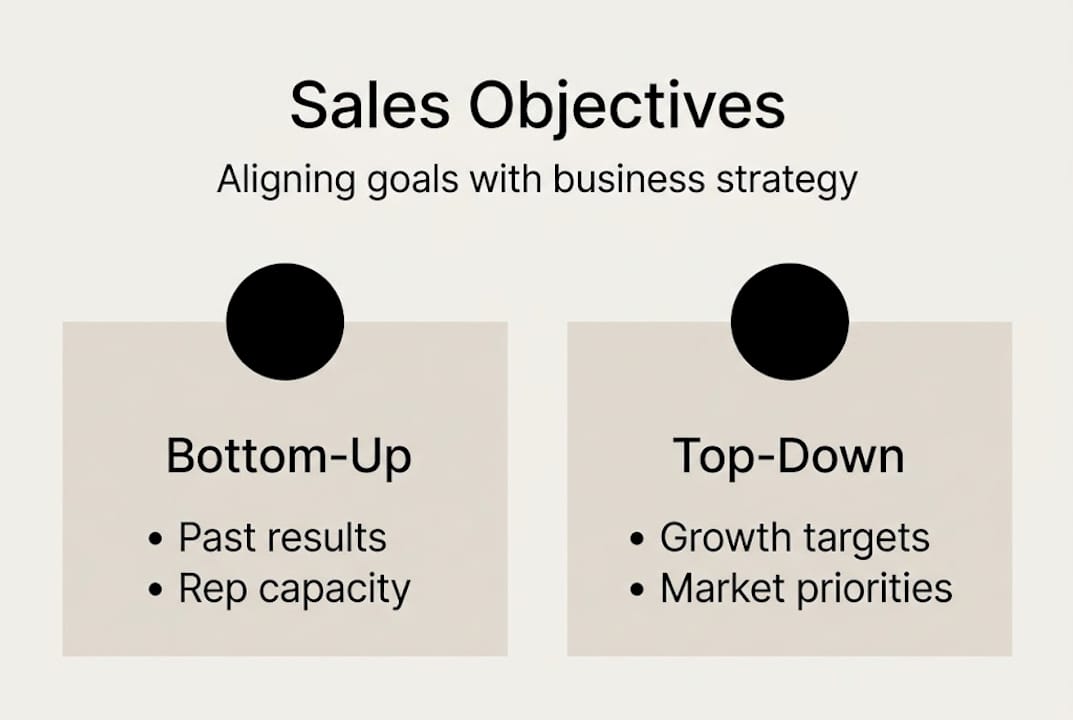
Bottom-up means starting with what you actually know. Historical win rates, average deal sizes, territory potential, rep capacity, and pipeline velocity. This grounds your objectives in reality.

Top-down means layering in what the business needs. Board targets, growth commitments, new product launches, or market expansion plans. This ensures your objectives serve the bigger picture.
Neither approach alone is enough. Bottom-up without top-down produces objectives that are comfortable but not ambitious. Top-down without bottom-up produces objectives that are ambitious but not achievable. The magic is in the blend.
Here’s a simple framework for calibration:
A useful health check: 60 to 70% of reps hitting quota is the signal of a well-calibrated objective. Below 60%? Your targets are likely too high or your enablement is broken. Above 90%? Targets are probably too low and you’re leaving growth on the table.
| Attainment rate | Signal | Action |
|---|---|---|
| Below 60% | Targets too high or enablement gap | Recalibrate or invest in training |
| 60 to 70% | Healthy range | Maintain and monitor |
| 70 to 90% | Strong performance | Consider modest stretch targets |
| Above 90% | Targets too low | Raise the bar next cycle |
A European B2B software team we worked with had 78% of their reps consistently missing quota. When we dug in, the problem wasn’t effort. It was that quotas had been set using global ARR growth rates without adjusting for regional market maturity. Once they recalibrated using local territory data, attainment jumped to 64% within two quarters, and rep turnover dropped significantly.
Review your sales commission models alongside objectives. If the comp plan doesn’t reward the behaviors your objectives are designed to drive, you’ll get misalignment fast. And build sales performance reviews into your cadence so you catch drift early.
Pro Tip: Don’t wait until year-end to realize your objectives were off. Set a 90-day review checkpoint into every objective cycle from day one.
Setting the right targets is step one. Ensuring they serve the company’s bigger picture is just as vital.
Sales objectives don’t exist in a vacuum. They’re the operational expression of your company’s strategic priorities. If the business is pushing into a new vertical, your objectives should reflect new account acquisition in that segment. If retention is the priority, cross-sell ratios and renewal rates should carry more weight.
The problem in most mid-to-large B2B organizations is that sales objectives get set in a silo. Finance sets revenue targets. Sales leadership translates them into quotas. And somewhere along the way, the connection to actual strategy gets lost.
Here’s what cross-functional alignment looks like in practice:
Key performance indicators that signal strategic alignment include: revenue from new accounts vs. existing, cross-sell and upsell ratios, market share by segment, and new product revenue as a percentage of total ARR.
Blending top-down company goals with bottom-up quota setting is the standard for high-functioning B2B sales organizations. It sounds obvious, but most teams still default to one or the other.
| Strategic priority | Relevant sales objective | KPI to track |
|---|---|---|
| Market expansion | New logo acquisition | New accounts per quarter |
| Product launch | New product revenue | % of ARR from new product |
| Retention focus | Renewal and expansion | Net revenue retention |
| Efficiency growth | Pipeline velocity | Average sales cycle length |
For European B2B firms specifically, sales-marketing alignment is often the biggest gap. Marketing generates leads for one segment while sales is incentivized to close in another. Fix that disconnect first.
Strong sales ops optimization also plays a critical role here. Your CRM data, forecasting models, and reporting cadences all need to reflect the same strategic priorities your objectives are designed to serve. If they don’t, you’re flying blind. Sound business budgeting practices at the organizational level also ensure that the resources needed to hit objectives are actually funded.
Even the best objectives fail without action. Here’s how to get your whole organization aligned and responsive.
Setting great objectives is only half the job. The other half is making sure every person on your team understands them, believes in them, and knows exactly what to do each day to hit them.
Here’s how to communicate objectives in a way that actually sticks:
Buy-in signals to watch for:
When objectives are failing, the signals show up fast. Low morale, pipeline sandbagging, and high early-stage churn in deals are all red flags. If less than 60% of reps are reaching goals, the objective itself is likely the problem, not just execution.
“The best sales leaders treat objectives as a living document, not a locked mandate. Adjust with evidence, not emotion.”
Build quarterly reviews into your operating rhythm. Use a feedback loop that includes rep input, manager observations, and CRM data. A strong sales training process helps reps close the gap between current performance and target. And don’t overlook sales territory optimization as a lever. Sometimes the objective is right but the territory design is what’s broken.
Having covered how to set and communicate objectives, let’s reconsider what the data and real-world experience really teach us.
Here’s the uncomfortable truth: most sales leaders know their objectives are too high. They set them that way anyway, hoping pressure will produce performance. It doesn’t. What it produces is burnout, sandbagging, and eventually attrition.
When reps consistently miss quota, they stop trying to hit it. They start managing their pipeline to look good on paper instead. The whole system becomes theater.
On the flip side, over 150% quota attainment consistently signals that objectives were set too low or are misaligned with actual market opportunity. Both extremes are expensive.
What actually works is a feedback-rich, data-driven cycle. Set objectives using real territory data. Review them quarterly. Adjust based on evidence. Give reps a voice in the process. This approach doesn’t feel as bold as aggressive top-down mandates, but it consistently outperforms them over a 12 to 24 month horizon.
Improving your sales operations infrastructure is what makes this possible at scale. Without clean data and solid processes, you’re guessing. And guessing with quotas is a fast way to lose your best people.
If you’re ready to move from theory to real results, Sales Label is here to help.
At Sales Label Consulting, we work directly with RevOps leaders, Heads of Sales, and VPs of Sales across Europe to build objective-setting frameworks that are grounded in data, aligned with strategy, and actually motivating for teams. We’ve seen what happens when quotas are set by gut feel, and we’ve helped organizations fix it.

Our step-by-step sales enablement approach gives you the structure to translate company goals into rep-level targets that stick. Use our sales performance review checklist to audit where your current objectives are breaking down. And if you’re ready for a full reset, explore how we approach sales department transformation for B2B organizations at every stage of growth.
Sales objectives are broad directional goals for the team, while sales quotas are specific, measurable targets assigned to individuals or groups, typically built using bottom-up historical data combined with top-down company goals.
If fewer than 60% or more than 90% of reps consistently hit their targets, your objectives need recalibration. The healthy attainment range sits between 60 and 70% of reps hitting quota each cycle.
Quarterly reviews are the standard. Markets shift, pipelines change, and team capacity fluctuates, so objectives that made sense in January may need adjustment by April. Monitor attainment closely and adjust with evidence.
Sales leaders, finance, marketing, and operations teams should all have a seat at the table. Each brings a different lens that prevents blind spots and ensures objectives are both ambitious and achievable.
Subscribe to our Insights: Expert productivity tips in your inbox
You'll receive 1-3 emails per month. Your data stays private, always.

CRO & Co-Founder with Sales Label Consulting

Watch our Sales Mates Podcast
October 22, 2026 - 9 min read
Read article Read articleOctober 21, 2026 - 9 min read
Read article Read articleOctober 20, 2026 - 9 min read
Read article Read articleOctober 19, 2026 - 10 min read
Read article Read article