
What Is Sales System Design (And What to Check First)
A sales system is a repeatable engine: data, playbooks, and automation working together to turn leads into predictable revenue. Sales system design is the discipline of building that engine on purpose, instead of letting it grow by accident. The system has two halves: a system of record that stores validated truth about every deal, and a system of engagement that governs how reps actually work those deals day to day.
Here’s the claim worth sitting with: a properly designed sales system converts predictable input (leads, activity) into predictable output (closed revenue). An undesigned one just produces noise.
Before you read another word, run this check:
If you answered “no” to any of those, your system has a foundation problem. Everything else in this article is downstream of fixing that first.
Sales system design succeeds when a validated CRM, clear exit criteria, and suggest-don’t-act automation work together to make revenue predictable rather than reactive.
| Point | Details |
|---|---|
| Fix data integrity first | Validate CRM writes and track field provenance before building dashboards on top of bad data. |
| Separate the two systems | Standardize the system of record; let the system of engagement flex by segment. |
| Use both metric types | Pair leading indicators like speed-to-contact with lagging ones like win rate for real coaching. |
| Pilot before rolling out | Test redesigns on one segment for about 60 days and measure the delta before scaling. |
| Get expert diagnostic support | Saleslabelconsulting runs 30/60/90 audit-to-pilot engagements to fix CRM data and process gaps. |
A sales process is the sequence of steps a rep follows to close a deal. A sales system is the infrastructure, technology, and rules that make that process repeatable across ten reps, or a hundred. Confuse the two and you’ll spend a year training people instead of building the machine that makes training unnecessary.
The system of record and the system of engagement do different jobs. Your CRM (the system of record) holds the authoritative version of every account, contact, and deal stage. Your playbooks, sequences, and cadences (the system of engagement) tell reps what to do next. Practitioners who’ve watched CRM implementations fail consistently point to the same root cause: teams try to force relationship-sensitive work into rigid automation meant for the system of record, and it backfires.
Why does this matter for growth? Because systems scale in ways ad-hoc processes never do.
Think of this as your audit checklist. Any gap here is a gap in revenue predictability.
At scale, you also need to think about partitioning and access controls, particularly if you’re running multiple business units or regions through one CRM instance. System-design guidance for CRM platforms stresses balancing personalization against centralized compliance controls, which is a fancy way of saying: don’t let every team build its own Frankenstein version of the CRM.
Pro Tip: Before adding a new automation, ask “does this suggest an action to a rep, or does it take an action on its own?” If it’s the latter and it touches customer-facing data, slow down. Suggest-don’t-act should be your default for anything relationship-sensitive.
Redesigning a sales system without a sequence is how consultants (and internal teams) waste six months reshuffling tools with no measurable outcome. Follow this order.
Skipping step 2 is a common failure point in system redesigns. Teams often jump straight to “let’s buy a new tool” without quantifying where deals actually die, then wonder why the new tool changes nothing.
Vanity metrics feel good in a slide deck and tell you nothing about whether your system is healthy. Metrics split cleanly into two categories: leading indicators, which predict future outcomes, and lagging indicators, which report what already happened.
Dashboards should be role-specific, not one-size-fits-all. A rep needs to see their own deal-health flags. A manager needs stage stagnation and velocity risk across the whole team. A VP needs trend lines against quota. Consistent pipeline inspection, reviewed weekly rather than only at quarter-end, is what turns dashboards into a coaching tool instead of a reporting chore.
| Signal | What It Means | Playbook Trigger |
|---|---|---|
| No recent activity | Deal is going cold | Alert routes to rep and manager, triggers re-engagement sequence |
| Stuck in one stage 2x average time | Stage exit criteria unmet | Manager reviews deal in weekly pipeline call |
| Lead score drops after enrichment | Data quality or fit issue | Route back to SDR for re-qualification, not auto-disqualify |
The most common trap we see at Saleslabelconsulting is automation that writes unvalidated data straight into the CRM, duplicate contacts, mismatched deal stages, enrichment fields that overwrite good data with bad. The fix is straightforward in concept and tedious in execution: add write validation and provenance tracking before you scale any automation further.
A realistic diagnostic-to-pilot engagement tends to follow this rhythm:
Pro Tip: Track your baseline for two weeks before changing anything. Teams that skip the baseline can’t tell whether the new system helped or whether the quarter was just better for reasons unrelated to the redesign.
The honest answer is both, applied to different layers of the system. Standardize the system of record: stage definitions, required fields, exit criteria, and data validation rules should be identical across every team and every rep. Inconsistent stage definitions are how forecasting turns into guesswork, because a “committed” deal means something different to every rep.
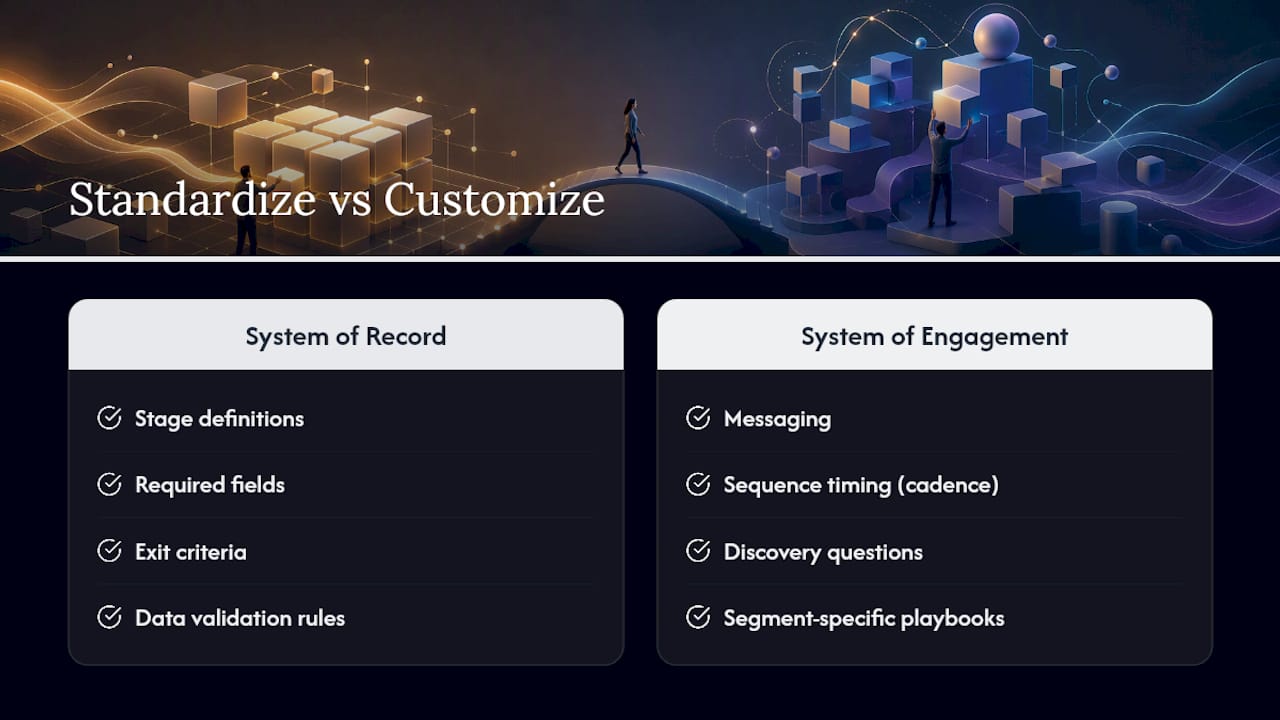
Customize the system of engagement. The cadence a rep uses to nurture an enterprise buyer over eight months looks nothing like the sequence for a self-serve SMB deal closing in eight days, and it shouldn’t. Forcing both segments through identical playbooks is a common reason automation gets ignored: reps see the mismatch and quietly go around the system.
The line to hold is this: never let customization creep into the data layer. If one team defines “qualified lead” differently than another, your pipeline reporting becomes fiction the moment you roll it up. Let regional or segment teams customize messaging, sequence timing, and even discovery questions. Don’t let them customize what counts as a validated stage exit, or a legitimate deal in the system of record. That single rule keeps your reporting honest while still giving reps enough flexibility to sell the way their market actually buys.
Segment-specific playbooks built on a shared data spine are usually the right compromise, not one universal script and not a free-for-all where every rep invents their own process.
The best-designed sales system fails if reps quietly revert to spreadsheets and personal notes three weeks after launch. Change management here isn’t a soft skill, it’s an engineering requirement, because a system nobody uses produces zero data, and a system with zero data can’t be measured or improved.

Start training before the system goes live, not after. Walk reps through the new stage definitions and exit criteria using their actual open deals, not hypothetical examples. Abstract training sessions produce confused questions in week one; hands-on sessions using real pipeline produce adoption in week one.
Give reps a reason that isn’t “compliance.” The pitch that works is: this system reduces the manual updating you hate doing, and the lead scoring flags the deals worth your time first. If the system only serves management’s reporting needs and adds work for reps, they will find a workaround, and they’ll find it fast.
Assign a single owner for the rollout, someone who fields questions, fixes broken workflows, and reports adoption gaps weekly for the first quarter. Momentum dies without a name attached to it. And build in a formal 90-day review; sales systems that never get revisited drift back toward the old habits they replaced, just with new tool names.
Most sales system advice fixates on tool selection: which CRM, which sequencing platform, which AI scoring vendor. That’s the wrong starting point, and it’s why so many redesigns produce a new stack with the same broken outcomes.
The conventional wisdom treats automation as an unqualified good, more automation equals more efficiency. It doesn’t work that way for relationship-sensitive sales motions. The suggest-don’t-act principle exists because autonomous writes to a shared CRM, made without human review, corrupt the one asset your whole team depends on: trustworthy data. Once reps stop trusting the CRM, they stop using it accurately, and your entire system of record degrades from the inside.
What should you prioritize first? Data integrity, not dashboards. A gorgeous dashboard built on unvalidated, duplicate-riddled data just displays confident-looking lies faster. Fix write validation and provenance before you touch reporting. Second: define exit criteria before you automate anything, because automating an undefined process just automates the chaos at higher speed.
Sales system design rewards patience in the boring layers so the exciting layers, AI scoring, dashboards, digital sales rooms, actually produce something real.
— Antony
Saleslabelconsulting exists for the exact gap this article just walked through: knowing what a validated system of record, clean exit criteria, and suggest-don’t-act automation should look like is one thing, building it inside a live sales team with a live pipeline is another. Our engagements match the job you actually need done, not a generic package.
A typical engagement includes a diagnostic audit of your current CRM data quality and stage definitions, a redesigned process with explicit exit criteria, and a pilot on one segment before anything rolls out company-wide, the same 30/60/90 rhythm outlined earlier in this article. Our sales enablement programs are built around this diagnostic-first approach because skipping the audit is how most redesigns waste a quarter.
If your CRM already feels more like a chore than a system of record, book a conversation with Saleslabelconsulting and start with the audit before you buy another tool.
Subscribe to our Insights: Expert productivity tips in your inbox
You'll receive 1-3 emails per month. Your data stays private, always.

CRO & Co-Founder with Sales Label Consulting

Watch our Sales Mates Podcast
September 23, 2026 - 8 min read
Read article Read articleSeptember 22, 2026 - 11 min read
Read article Read articleSeptember 21, 2026 - 8 min read
Read article Read articleSeptember 20, 2026 - 13 min read
Read article Read article