
Building the Right RevOps Org Structure for Your Growth Stage
Start with one generalist who owns the whole revenue engine. As you hire specialists, shift to a centralized model with shared services. Once your go-to-market gets complicated (multiple platforms, dozens of sellers, several channels) move to a hybrid, hub-and-spoke setup. The rule that matters more than any org chart: RevOps should report to the CRO or CEO, never buried inside Sales or Finance, or you lose the cross-functional authority that makes the role work.
Three factors decide your model:
Get the stage right and the rest of this playbook is just execution.
The right RevOps org structure matches company stage to operating model, and reporting into the CRO or CEO is what keeps that structure from collapsing under cross-functional pressure.
| Point | Details |
|---|---|
| Start with a generalist | Under roughly 50 employees, one RevOps generalist should own CRM, reporting, and process. |
| Match model to complexity | Move from centralized to hybrid hub-and-spoke as sellers, channels, and platforms multiply. |
| Protect the reporting line | RevOps should report to the CRO or CEO to avoid bias toward Sales convenience or Finance cost control. |
| Fix data before adding roles | Invest in data hygiene early since poor data quality compounds into every downstream metric. |
| Get expert help implementing | Saleslabelconsulting offers audits and 90-day playbooks to build the right structure for your stage. |
Structure decides who owns the data, who enforces service-level agreements, and who’s accountable for the forecast. Get that wrong and your whole GTM motion starts fragmenting, quietly, department by department.
We’ve watched this play out the same way at company after company: Sales trusts its own numbers, Marketing trusts different numbers, and by QBR time nobody agrees on pipeline coverage.
The data tax is real, and it compounds. Bad data doesn’t just annoy your analysts. It degrades every downstream metric, and the cost of fixing it later is always higher than the cost of building hygiene in early.
Common failure patterns we see on repeat:
RevOps typically organizes into three operating models: centralized, federated, and hybrid. Each fits a different stage of company complexity, and picking the wrong one early is one of the most expensive mistakes a scaling company makes.
Centralized means one RevOps team serves Sales, Marketing, and Customer Success from a shared function. It’s efficient and consistent, but it can get slow once demand outpaces the team’s bandwidth.
Federated means each department (Sales Ops, Marketing Ops, CS Ops) runs its own operations function independently. You get speed and deep functional context, but you also get the fragmentation problem described above: duplicated tools, conflicting definitions, no single source of truth.
Hybrid, or hub-and-spoke, keeps a central RevOps core that owns systems, data, and governance, while embedding specialists inside each function for speed. This is the most common pattern for companies scaling past their early growth phase, because it balances standardization with function-specific responsiveness.
Pro Tip: If you’re arguing about which model to pick, count your major platforms first. Three or more core systems (CRM, marketing automation, CPQ, a data warehouse) almost always means you need a hub-and-spoke structure, regardless of headcount.
Here’s how the roles break down once you’re past the solo-generalist stage. Each one needs a clear KPI set, or you’ll end up with people busy but not accountable.
At small scale, one person often wears three or four of these hats. The hiring signal to watch: when a role’s owner is spending more than half their week firefighting instead of improving the system, it’s time to split that role out.
Sequence matters as much as headcount. Hiring specialists before you have the volume to justify them creates fragile teams with nothing but overhead to show for it.
As a heuristic, expect roughly a single generalist under 50 employees, a team of 3 to 5 with light specialization between $10M and $50M in ARR, and full pods with embedded specialists above $50M ARR. Compensation ranges vary widely by market and role seniority. Check current market pay guides before setting bands rather than anchoring to outdated numbers.
RevOps should report to the CRO or CEO, not into Sales or Finance. Reporting into Sales tends to bias every decision toward sales convenience over cross-functional balance. Reporting into Finance tends to over-index on cost control at the expense of growth velocity. Either way, you lose the neutral authority that makes RevOps effective.
Set solid-line reporting into the RevOps leader for core team members, and dotted-line relationships into functional ops leaders (Sales Ops, Marketing Ops, CS Ops) so context doesn’t get lost.
Three rituals keep the structure honest:
Pro Tip: Practical governance rituals like these are what keep RevOps from getting re-siloed as the company grows. Skip the rituals, and even a perfect org chart collapses within two quarters.
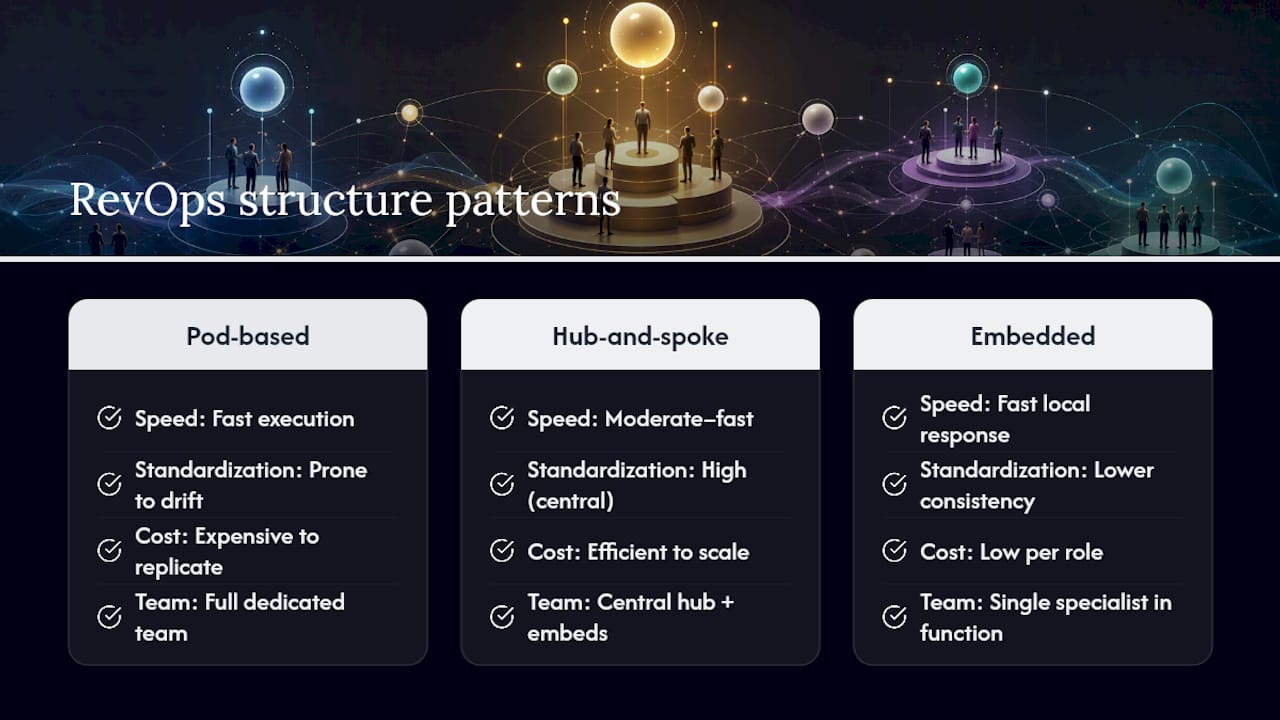
Three implementation patterns show up in practice, each with a real trade-off between speed and standardization.
Pod-based structures assign a full team (rep, analyst, enablement partner) to a segment or region. Fast and focused, but expensive to replicate and prone to drifting standards between pods.
Hub-and-spoke keeps a central team owning systems and governance, with specialists embedded in each function. Picture one systems owner, one analyst, and one enablement lead sitting in the RevOps hub, with a dotted line into each go-to-market function. This is the most common pattern for scaling companies, because it protects standardization without sacrificing too much speed.
Embedded specialists place a single RevOps person inside a function full time (a deal desk analyst sitting inside Sales, for instance) while still reporting into the RevOps leader.
Migrating between models works best with a checklist: define SLAs before you move anyone, assign a single owner for each workflow being transferred, and pilot one embedded role for a full quarter before rolling it out broadly.
A few non-negotiables, regardless of which model you pick:
Training breaks out into its own dedicated function once headcount passes roughly 250, because sustained enablement needs more than a slide deck and a Slack channel. Read the RevOps role across the revenue lifecycle for more on how enablement connects to the rest of the stack.
Here’s the order we’ve seen actually work when a company is either standing up RevOps for the first time or fixing one that’s drifted:
Assign a named owner to each item, not “the team.” Success metrics can be simple: forecast variance shrinking, SLA breaches dropping, one dashboard everyone actually trusts.
Pro Tip: The 90-day RevOps playbook works because it forces prioritization. Trying to fix everything in month one is how most restructures stall out before they start.
The pattern we see most often isn’t a bad org chart. It’s premature specialization: hiring a dedicated analyst before there’s a data owner to feed them clean numbers. The habit that fixes it is boring but effective: one weekly scoreboard, one escalation path, no exceptions.
— Antony
Saleslabelconsulting is the direct alternative to hiring a full internal RevOps team before you’re ready for one. Instead of guessing at org design or copying a chart from a company three stages ahead of yours, you get a structured audit of your current sales process, a stage-appropriate operating model, and a 90-day implementation plan built for your headcount and tool stack.

Engagements typically start with a sales process audit, move into enablement design, and end with clear SLAs and a CRM your team actually trusts. Clients walk away with tighter forecast accuracy, a cleaner data foundation, and a reporting line that protects RevOps from getting re-absorbed into Sales or Finance. If tool sprawl or integration debt is part of your problem, partners like Emergent IT often join these engagements for the systems side.
Start with a sales enablement engagement built for predictable revenue and get your structure mapped before your next hiring decision locks in the wrong model.
For deeper detail, see HubSpot Academy’s lesson on structuring RevOps teams and Salesforce’s guide to RevOps org charts, plus Saleslabelconsulting’s primer on revenue operations.
Subscribe to our Insights: Expert productivity tips in your inbox
You'll receive 1-3 emails per month. Your data stays private, always.

CRO & Co-Founder with Sales Label Consulting

Watch our Sales Mates Podcast
August 24, 2026 - 8 min read
Read article Read articleAugust 23, 2026 - 11 min read
Read article Read articleAugust 22, 2026 - 8 min read
Read article Read articleAugust 21, 2026 - 7 min read
Read article Read article