
Deal Desk Setup for Tech Sales: Speed and Margin
Here’s the verdict: pick one owner, publish your thresholds, build a single intake form, and commit to a 24-hour SLA for standard exceptions. That’s a functioning deal desk setup, and you can have it running this week, not next quarter.
Typically, 15 to 25% of deals need some kind of exception review. Do this in the next 72 hours:
A working deal desk setup pairs a single accountable owner with published thresholds, tiered SLAs, and CRM-logged approvals so exceptions get resolved fast without eroding margin.
| Point | Details |
|---|---|
| Assign one owner | Put a RevOps or Sales Ops lead in charge to keep pricing decisions neutral and quota pressure out of approvals. |
| Publish thresholds first | Define discount, ACV, and contract-complexity limits so reps self-triage before requesting review. |
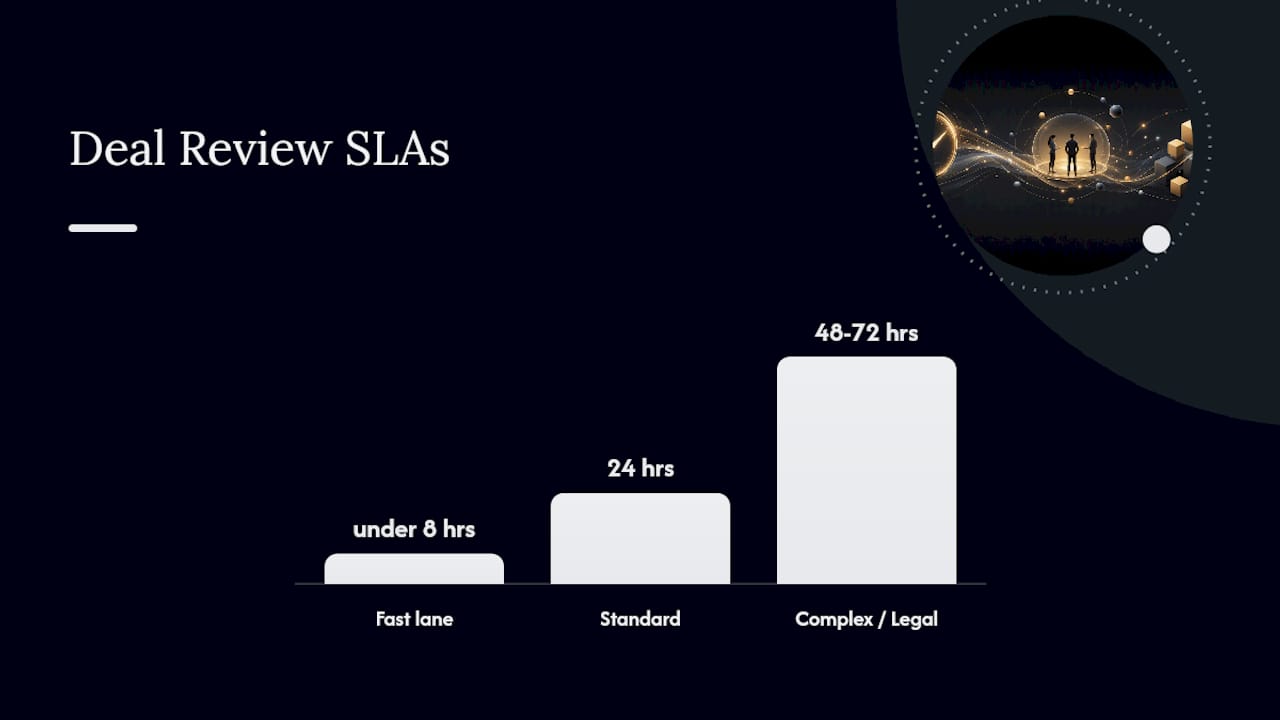
| Commit to tiered SLAs | Target 24 hours for standard exceptions and 48 to 72 hours for complex or legal reviews. |
| Log everything in the CRM | Record exact approved terms post-decision so there’s a single, auditable source of truth. |
| Get expert setup support | Sales Label Consulting builds the charter, approval matrix, and CRM workflow so the desk launches tested, not improvised. |
A deal desk is a cross-functional approval function that owns pricing exceptions, contract accuracy, and fast, auditable decisions on non-standard deals. It sits at the intersection of sales, finance, and legal, and it exists for one reason: to protect velocity and margin at the same time, instead of trading one for the other.
Structurally, it reviews, prices, and approves deals that fall outside standard terms, then feeds what it learns back into pricing policy. Its core jobs break down cleanly:
One clarification that saves teams a lot of pain: a deal desk is a process, not a headcount. Early-stage teams run this as a documented workflow owned by one person, not a department with a org chart.
Six steps, in order. Skip the order and you’ll build something that looks right and functions like a bottleneck.
Step 1: Define scope and thresholds. Decide what actually needs review, specific enough that reps can self-check without asking. Set thresholds by deal size, discount level, and contract complexity, such as deals over $50,000 ACV, discounts above 15%, custom payment terms, or non-standard legal clauses. Publish this in one reference document, not scattered across Slack pins and someone’s memory.
Step 2: Assign an owner and map approvers. Pick a deal desk owner, ideally from RevOps or Sales Ops rather than sales leadership itself. A desk run by RevOps preserves neutrality and keeps the process aligned to GTM efficiency instead of quota pressure on any given deal. Map who signs off at each tier: finance for margin exceptions, legal for contract deviations, product for custom feature commitments.
Step 3: Set SLAs and approval tiers. Tier your response times to match complexity. A workable structure:
Publish these SLAs somewhere visible, not buried in a wiki nobody opens.
Statistic Callout: A documented process with a single owner and a 24-hour approval SLA is enough for small teams to run an effective desk, no separate department required.
Step 4: Build the intake and approval workflow. One submission form. One set of required fields. One triage rule set that routes fast, simple requests to a quick lane and complex structuring work to a deeper review track. Pair it with a one-page approval matrix so nobody has to guess who signs what.
Step 5: Create pricing guardrails and a playbook. Build a discount matrix with pre-approved fallback positions, standard contract bundles, and a short list of non-standard terms that are already blessed. This is what lets reps move fast on their own instead of escalating everything.

Step 6: Integrate tooling and measure. Design CRM-first, and layer in CPQ or CLM once you can justify the investment. Track time-to-approval, win rate, and discount drift from day one, then tune thresholds based on what you see.
Pro Tip: Split your triage into two lanes on day one: a fast lane for simple, pre-approved exceptions and a deep-structuring lane for anything touching legal or multi-year pricing. Most teams that skip this end up routing everything through the same slow queue, which is the fastest way to make reps hate the desk.
The most common failure mode here isn’t a bad approval matrix. It’s over-scoping: letting the desk touch too many deals because nobody drew a firm line on what counts as “standard.”
Three artifacts get you moving without reinventing anything.
Submission form fields: deal link, ARR or TCV, requested concession, close date, justification, fallback position, and requested response-by date. Attach the CRM link directly. Free-text justification with no supporting numbers should bounce back automatically.
Approval matrix: rows keyed to discount bands and ACV tiers, columns showing required approver and SLA per cell.
| Discount / ACV Tier | Required Approver | Typical SLA |
|---|---|---|
| Under 15% discount, any size | Sales manager | Same day |
| 15 to 25% discount, under $50K ACV | Deal desk owner | 24 hours |
| 25%+ discount or $50K+ ACV | Deal desk + Finance | 48 hours |
| Custom legal terms | Deal desk + Legal | 48 to 72 hours |
SLA table: fast lane under 8 business hours, standard exceptions at 24 hours, complex or legal reviews at 48 to 72 hours, with automatic escalation pings if a tier’s clock runs out.
Store all three in your CRM or CLM alongside the playbook, and log every approved deal with the exact terms signed off, so there’s never a dispute about what was actually agreed to.
Start CRM-first. Centralizing intake in the CRM replaces scattered Slack and email requests with a single source of truth, so approvers can see deal history without chasing down five separate threads.
Pro Tip: Never let approvals live in email. There’s no audit trail, no timestamp anyone trusts, and no way to prove SLA compliance when a VP asks why a deal took nine days.
Track operational health and business impact separately, because they answer different questions.
Statistic Callout: A desk that touches the majority of deals is no longer functioning as an exception process. Keep the standard lane wide enough that the desk only sees genuine outliers.
Report a weekly scorecard to your CRO, CFO, and VP Sales. Use it to defend the desk’s existence with numbers, not vibes.
Pro Tip: Give reps a quick win first. A fast lane that clears simple exceptions in under a day builds trust fast. A desk that feels like a gate from day one gets routed around by week two.
The desks that earn trust are the ones that publish their SLAs and hit them consistently, turning the function into a partner reps actually want to use instead of a checkpoint they dread. The ones that fail almost always share the same three mistakes: scope creep that pulls in too many standard deals, SLAs nobody enforces, and approvals still happening in email where nothing is auditable.
Most teams either wing it with a shared spreadsheet or over-invest in tooling before they’ve proven the process. Neither gets you a working deal desk in under a month. Sales Label Consulting builds the charter, the approval matrix, and the CRM integration for you, so you launch a tested workflow instead of a draft nobody trusts yet.
Our engagements cover the full setup: writing the two-page charter with your leadership, mapping approvers and SLAs to your existing CRM and CPQ stack, delivering the submission form and playbook templates, and running the pilot with a governance scorecard your CRO will actually read. If your reps are still negotiating discounts over Slack, that’s the gap we close first.
Book a sales enablement diagnostic and we’ll map your current approval flow against a working deal desk model within the first session.
How long does a deal desk setup take to launch?
A lightweight version, with one owner, published thresholds, and a single intake form, can be running within a week. A CPQ-integrated version with full CLM automation typically takes several weeks longer, depending on your existing tech stack.
Does a small sales team need a full deal desk?
No. A documented process with one owner and a 24-hour SLA is enough for small teams. Build the department later, once deal volume justifies it.
What percentage of deals should go through deal desk review?
Most teams see 15 to 25% of deals needing exception review.
What’s the single biggest mistake teams make setting one up?
Letting approvals happen over email instead of the CRM. There’s no audit trail, no SLA enforcement, and no way to prove the desk is actually improving win rate or discount discipline.
For deeper background on intake design, review the ReWork deal desk basics guide for threshold examples and form fields. Pair it with Sales Label Consulting’s take on Sales Operations for how RevOps should own the process, and IT Sales Team Mastery for rollout and training tactics.
Subscribe to our Insights: Expert productivity tips in your inbox
You'll receive 1-3 emails per month. Your data stays private, always.

CRO & Co-Founder with Sales Label Consulting

Watch our Sales Mates Podcast
August 24, 2026 - 8 min read
Read article Read articleAugust 23, 2026 - 11 min read
Read article Read articleAugust 22, 2026 - 8 min read
Read article Read articleAugust 20, 2026 - 9 min read
Read article Read article