
Why B2B Sales Cycles Lengthen: A 2026 Guide
B2B sales cycles are longer today because of structural changes that aren’t reversing. The average B2B sales cycle has lengthened notably over recent years, driven by committee growth and procurement friction. That’s not a soft quarter or a bad patch. It’s a regime change.
The primary drivers are predictable once you see them clearly:
Here’s the honest read: some of these forces are outside your control. Buyer-side stages like procurement, legal, and finance review are where most of the lengthening happened. But rep-controlled stages, including outreach, discovery, demo, and follow-up, can get faster when you run the right process. Understanding which is which is the starting point for fixing your cycle.
Three structural forces account for almost all of the expansion. Committee growth. Procurement maturation. And self-directed buying, where buyers complete roughly 80% of their evaluation before contacting a vendor, then resurface with a compressed window and five vendors already shortlisted.

| Factor | Cycle Impact | Data Point |
|---|---|---|
| Larger buying committees | High | 11+ median stakeholders in 2024, up from 8 in 2018 |
| Security and compliance review | High | Enterprise deals averaging +18 days vs. 2022 for security due diligence |
| CFO budget gatekeeping | High | Deals above $25K now route through finance at most Series B+ companies |
| Free-trial fatigue | Medium | 14-day trials stretch to 45 days due to multi-stakeholder reviews |
| “No decision” outcomes | High | 56% of forecasted deals stall rather than close competitively |
| Single-threading | High | Multi-threaded deals close 30–40% faster on average |
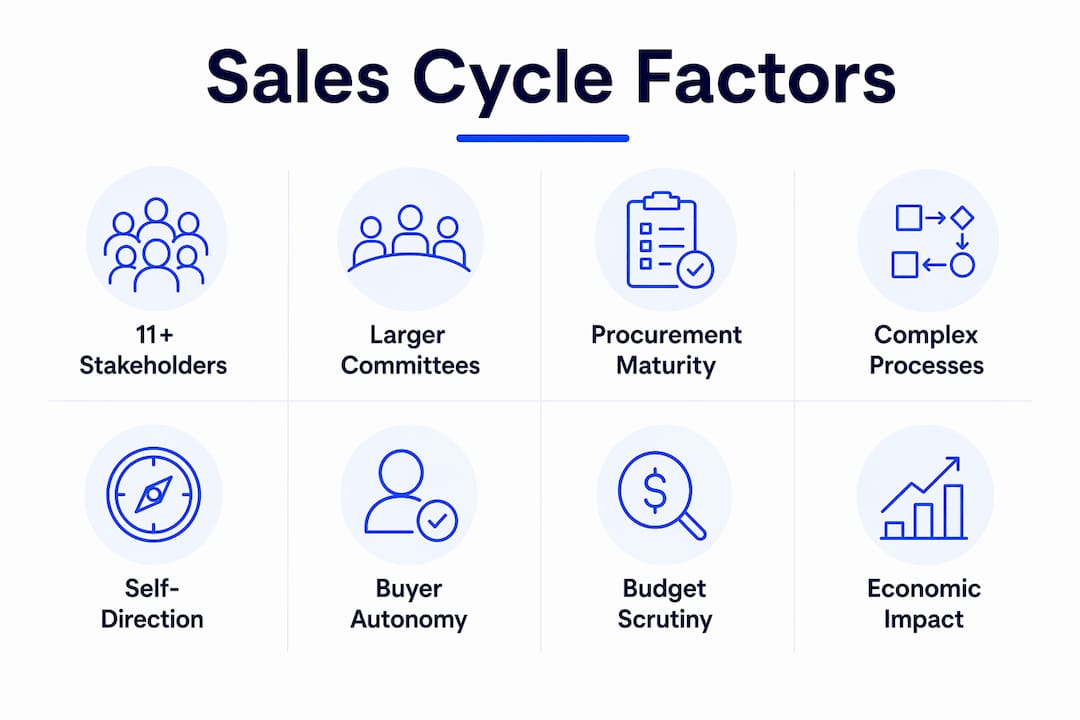
A few things worth calling out from that picture. Buying committees larger than 13 people tend to stall deals entirely because decision conflict outweighs coordination. Free-trial fatigue is structural, not behavioral: the user who starts the trial is rarely the sole decision-maker, so every handoff adds another week. And the CFO review that “just takes a few days” routinely runs 10–30 days at regulated buyers.
What you can do about it:
Pro Tip: Don’t wait for procurement to open the InfoSec questionnaire in week 10. Pre-fill it and send it proactively at proposal stage. That single move can cut 2–3 weeks off the back half of an enterprise deal.
Win rates decline significantly when deals extend beyond typical cycle lengths. That 26-point collapse isn’t because the buyer lost interest in the category. It’s because competing priorities accumulate, budget cycles shift, and champion momentum fades while the deal sits in limbo.
Pipeline forecasting breaks down fast when cycle variability is high. A team running on 3x pipeline coverage against a 90-day model is severely undercovered against a 135-day reality. The math is wrong twice: it overestimates how fast big deals close and underestimates how slow small deals move. Quota attainment suffers as a direct result. Many B2B sales teams fall short of quota, often due to inefficient cycles spent on deals unlikely to close.
The operational strain compounds. Reps spend 20–30 minutes per prospect manually logging calls and updating deal stages, and a full pipeline can cost a single rep 2+ hours daily in CRM maintenance alone. Add the meeting load, and pipeline reviews, forecast calls, and team syncs consume an average of 8–12 hours per week for a quota-carrying rep. That’s time not spent selling.
The impacts to watch:
Most deal stalls classified as active for long periods are effectively no-decision losses. Sales leaders should exclude these from the active forecast for accurate cycle measurement.
Disciplined qualification is the highest-leverage fix available to most sales teams. It doesn’t just improve pipeline quality. It compresses cycle duration by eliminating the deals that were never going to close and accelerating the ones that will.
Here’s the qualification sequence that actually moves the needle:
Lead quality and qualification are the foundational levers for sales efficiency, more so than any technology layer you add on top.
Misalignment between sales and marketing is a coordination failure, and it costs 15–25% of potential revenue. Marketing generates leads that sales doesn’t trust. Sales spends time prospecting because the inbound pipeline looks wrong. Budget gets wasted on both sides.
The fix is shared definitions and integrated processes, not more meetings. Here’s what alignment actually looks like in practice:
Pro Tip: The fastest way to expose alignment gaps is to run a joint pipeline review where marketing sees which of their leads actually closed and at what cycle length. That single session usually surfaces the ICP mismatch that’s been burning budget for months.
Cross-functional revenue operations alignment enables faster issue resolution and improves pipeline conversion velocity. If you want to go deeper on the mechanics, RevOps alignment is worth building into your operating model now, not after the next missed quarter.

You can also explore how sales and marketing alignment translates directly into revenue outcomes when the coordination is done right.
Budget scrutiny is now standard operating procedure, not a response to a bad macro quarter. CFO involvement in software purchases has increased roughly 40% in recent years. Deals that used to get approved at the VP level now require sign-off two levels up. The “do we really need this?” conversation happens on every deal, regardless of size.
Seventy-five percent (75%) of B2B buyers say they’re taking longer to make purchase decisions than before, and 78% say they’re more careful with spending than previously. Buyers are also cutting vendor stacks, not growing them. The post-2022 operating-leverage era made “consolidate first, add second” a standing procurement directive at most mid-market and enterprise buyers. Adding a new tool now means displacing at least one existing tool, which means your champion has to build an internal case for change, not just a case for your product.
Economic uncertainty also amplifies the “no decision” problem. Status quo is free, familiar, and low-risk. A new vendor is a change management project, a procurement workload, a budget reallocation, and a CFO conversation. In a cost-conscious market, the path of least resistance is to leave the current tool in place and revisit in six months. That revisit rarely happens on schedule.
The practical implication for your pipeline: deals without a quantified status-quo cost are the most vulnerable to no-decision outcomes. Build the ROI case from the first call, not the proposal stage.
The external forces get most of the attention, but internal dysfunction inside your own organization adds weeks to cycles just as reliably. Here’s where it concentrates.
Broken handoffs between sales and marketing create the first delay. Marketing-sourced leads auto-converted to opportunities and killed inside two weeks compress your median cycle in ways that hide real performance problems. Deals get lost because nobody owns the close date. Legal takes six weeks on contracts because there’s no expedited path. Discounts get offered without visibility because there’s no approval process.
Single-threaded selling is the most common rep-level mistake. Engaging only the champion in a multi-stakeholder deal means one person carries the entire internal case. When that champion gets pulled into another priority, the deal stalls. No backup. No momentum. Just a deal sitting in Stage 3 for three weeks with no activity.
Poor discovery discipline compounds the problem. Reps who don’t confirm budget and timeline in the first two calls end up doing multiple discovery calls that go nowhere. The proposal stage alone eats 30 days on average in software deals. Proposals sent within 24 hours of the demo close significantly faster. Every day of delay is a day the buyer’s attention shifts to something else.
Tool sprawl is the operational drag nobody talks about enough. The average B2B sales team uses around 10 different tools to manage prospects, sequences, calls, and reporting. Every context switch burns 10–15 minutes of focus time. 94% of organizations plan to consolidate their tech stacks in 2026 because tool sprawl is measurably slowing execution.
For a structured look at where your process is leaking time, a sales process audit surfaces the exact stages where deals stall and why.
Buyers don’t just evaluate your product. They evaluate continuously between meetings, using sources you don’t control, and form conclusions that harden before you ever get a chance to correct them. This is what’s sometimes called “confident misunderstanding”: a buyer who has spent two weeks researching independently doesn’t arrive at the next meeting with questions. They arrive with conclusions built from AI summaries, competitor comparison pages, and peer forums.
Late-joining stakeholders make this worse. A CFO who joins in week eight has no context from your discovery calls. They anchor their pricing expectations to a competitor’s published pricing page. A CISO reads a three-year-old forum thread about a data incident and never verifies whether it applies to your current product. When the buying committee convenes, the misalignments surface as conflict, and the deal stalls not because of competitive pressure but because the committee is arguing about different versions of your solution.
Research from Emblaze found that when sellers and buyers align on the problem definition, win rates improve by 38%. That alignment doesn’t happen automatically through more meetings. It requires governed, accurate explanation available throughout the evaluation, reaching every stakeholder, not just the champion.
The practical fix is infrastructure, not activity. Async content that addresses each stakeholder’s specific concerns, delivered individually rather than in one impossible joint meeting, keeps understanding accurate between touchpoints. A Loom video that runs 7 minutes per stakeholder concern, followed by 15-minute 1:1 calls, gets done in the same week as one joint meeting that never happens. And the rep comes out with better information because each stakeholder speaks freely.
Transparency in your own process matters just as much. When stage dates, close dates, and stakeholder records are wrong, you miss the signal that a deal has stalled. Deals that haven’t moved in two weeks without a clear reason should be escalated, not left to age in the forecast.
If your deals are taking longer than they should, the problem usually isn’t effort. It’s process. Saleslabelconsulting works with RevOps leaders, Heads of Sales, and VPs of Sales to diagnose exactly where cycles are leaking time and build the process fixes that stick.
Start with a sales enablement audit that maps your current cycle against the structural benchmarks and identifies the highest-leverage interventions for your specific deal motion. Real talk: most teams can cut 20–30 days off their cycle without adding headcount. They just need to fix the right things in the right order.
B2B sales cycles lengthen primarily because of structural forces: larger buying committees, procurement complexity, and budget scrutiny that won’t reverse, but rep-controlled stages can get faster with the right process discipline.
| Point | Details |
|---|---|
| Cycle length is up 37% since 2019 | The average B2B sales cycle hit 6.7 months in 2025, driven by committee growth and procurement friction. |
| Win rates collapse past 50 days | Win rates decline significantly when deals extend beyond typical cycle lengths; follow-up speed is the fastest fix. |
| Qualification is the top lever | Strict ICP alignment and early stakeholder mapping compress cycles more than any technology layer. |
| Alignment gaps cost 15–25% of revenue | Teams without RevOps discipline convert 50–55% of pipeline; aligned teams convert 65–75%. |
| Confident misunderstanding stalls deals | Buyers form hardened conclusions between meetings; governed async content prevents late-stage objections. |
Subscribe to our Insights: Expert productivity tips in your inbox
You'll receive 1-3 emails per month. Your data stays private, always.

CRO & Co-Founder with Sales Label Consulting

Watch our Sales Mates Podcast
August 24, 2026 - 8 min read
Read article Read articleAugust 23, 2026 - 11 min read
Read article Read articleAugust 22, 2026 - 8 min read
Read article Read articleAugust 21, 2026 - 7 min read
Read article Read article