
What Is Tech-Driven Selling? A 2026 Sales Guide
TL;DR:
- Tech-driven selling involves integrating AI, CRM platforms, and automation into sales workflows to boost productivity and pipeline predictability. It focuses on redesigning processes around technology tools that augment human efforts rather than replacing them, leading to increased deal closure rates and time savings. Successful implementation requires workflow mapping, seamless CRM integration, human oversight, and continuous refinement to prevent failure and maximize results.
Tech-driven selling is the strategic integration of AI, CRM platforms, and automation directly into sales workflows to increase rep productivity, close rates, and pipeline predictability. The industry term for this practice is “technology-enabled selling,” though sales professionals increasingly use “tech-driven selling” to describe the same discipline. Understanding both terms matters because the tools, frameworks, and results are identical regardless of what you call them. This guide breaks down what tech-driven selling actually looks like in practice, what the data says about its impact, and how you can implement it without the common pitfalls that waste budget and burn out your team.
Tech-driven selling is defined as the deliberate use of technology tools, including AI agents, CRM integrations, and data automation, to replace or augment manual sales tasks at every stage of the pipeline. This is not about buying software and hoping reps use it. It’s a workflow redesign philosophy.

The impact of technology on sales is no longer theoretical. AI-augmented sales teams close 31% more deals than traditional CRM-only teams. That 31% improvement is the equivalent of adding a third more sales capacity without a single new hire. For a VP of Sales managing a 10-person team, that math changes the entire headcount conversation.
The shift is also happening fast. 87% of sales organizations now use AI for prospecting, forecasting, or lead scoring. That means if your team is not actively building tech-enabled sales strategies, you are already operating behind the majority of your competitors.
What separates high-performing teams from the rest is not which tools they buy. It’s how deeply those tools are embedded into daily rep workflows. Structure beats heroics here. A rep with a well-designed AI-assisted workflow will consistently outperform a talented rep working off spreadsheets and gut instinct.
The performance data on digital selling techniques is clear and consistent across multiple research sources. Three specific outcomes stand out.
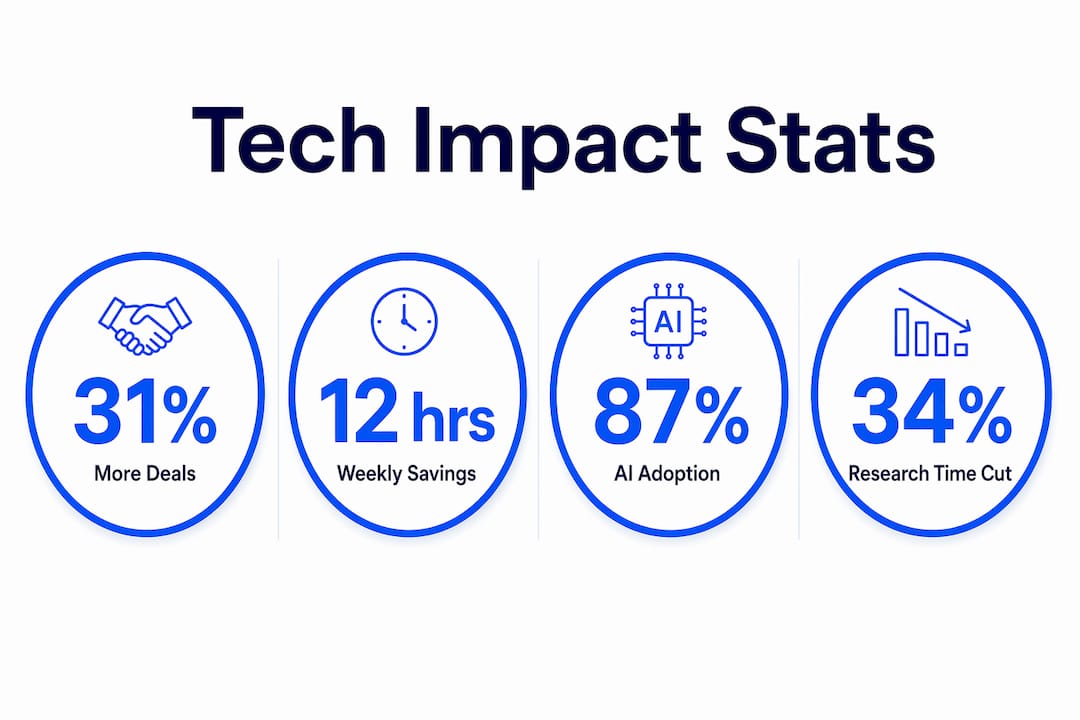
Time savings are substantial. Sales reps using AI tools save about 12 hours weekly, with 34% less time spent on research and 36% less time drafting emails. Those 12 hours per week represent roughly 600 hours per year per rep. Redirect that time toward discovery calls and closing conversations, and the ROI becomes obvious.
Speed to engagement is a competitive advantage. Sales teams responding within 48 hours to signal events book meetings at 4–6 times the rate of teams working from 90-day-old lists. Tech-driven selling makes that speed possible by automating signal monitoring and triggering outreach at the right moment. Without automation, most reps simply cannot move that fast at scale.
Buyer behavior demands it. Only 17% of the B2B buying journey involves direct interaction with a sales rep. That means buyers are forming opinions, comparing options, and narrowing their shortlist before you ever get a call. Tech-enabled sales strategies give you visibility into that invisible buying journey through intent data, CRM tracking, and automated touchpoints.
Here’s the real talk: the teams winning in 2026 are not the ones with the biggest budgets. They’re the ones who mapped their workflows, identified the highest-leverage AI touchpoints, and built systems that work while their reps sleep.
Pro Tip: Track your team’s time allocation for one week before buying any new tool. You’ll find the exact bottlenecks where AI can deliver the fastest ROI.
The core components of a tech-driven sales stack fall into five functional layers. Understanding these layers helps you avoid the “random tool” problem where teams accumulate software without a coherent architecture.
| Layer | Function | Example Use Case |
|---|---|---|
| Data | Enrichment, intent signals, contact accuracy | Pulling firmographic data and buying signals into CRM |
| Reasoning | AI analysis, lead scoring, forecasting | Scoring inbound leads by fit and intent automatically |
| Action | Automated outreach, follow-up sequences, scheduling | Sending personalized email sequences triggered by behavior |
| Orchestration | Workflow coordination across tools and teams | Connecting CRM, email, and LinkedIn touchpoints in one flow |
| Measurement | Performance tracking, attribution, pipeline analytics | Reporting on which sequences drive the most meetings booked |
AI agent stacks span all five of these layers to automate sales tasks with genuine autonomy. The most effective implementations do not treat these layers as separate tools. They connect them into a single, coherent workflow.
CRM integration is the critical factor most teams underestimate. Top-performing sales teams integrate AI tools directly into their CRM to avoid rep workflow toggling, achieving over 72% adoption rates. That number matters because adoption is where most tech investments die. A standalone AI tool that reps must open separately will be ignored within 60 days. An AI feature embedded inside Salesforce or HubSpot gets used because it’s already in the rep’s daily environment.
The AI role in sales is not to replace your reps. It’s to free their attention for the conversations that actually require human judgment, empathy, and relationship-building.
Pro Tip: Before evaluating any AI tool, ask the vendor one question: “Does this integrate natively with our CRM?” If the answer requires a Zapier workaround, keep looking.
Real talk: most tech-driven selling initiatives fail not because the technology is bad, but because the implementation ignores human behavior.
The biggest obstacle is what researchers call the technostress paradox. CRM systems initially cause technostress before full integration improves productivity. Reps feel overwhelmed by new tools, data entry requirements, and workflow changes. That stress leads to workarounds, incomplete data, and eventually, abandonment. The solution is not to slow down adoption. It’s to redesign workflows so the technology reduces cognitive load rather than adding to it.
Here are the four most common implementation mistakes and how to avoid them:
Pro Tip: Run a 30-day pilot with your top two reps before rolling out any new tool to the full team. Their feedback will surface integration gaps and workflow friction before they become org-wide problems.
Knowing how to implement tech-driven selling is where most guides stop being useful. Here’s a practical framework that works for teams of 5 or 50.
Map your current rep workflows in detail. Document every task a rep performs from prospecting through close. Identify which tasks are repetitive, data-dependent, or time-consuming. These are your AI leverage points. Mapping rep workflows and redesigning them around AI outputs consistently produces better outcomes than any other implementation approach.
Prioritize CRM-native AI features first. Before adding external tools, activate every AI feature already available in your existing CRM. Salesforce Einstein, HubSpot AI, and similar embedded features have the highest adoption rates because they require no behavior change from reps.
Build one AI-assisted workflow at a time. Start with the highest-volume, lowest-complexity task: typically prospect research or initial outreach sequencing. Get that working well before adding the next layer. Trying to automate everything at once creates chaos.
Define your human-in-the-loop checkpoints explicitly. Decide in advance which actions require human review before execution. Outbound emails to cold prospects can be automated. Responses to inbound enterprise inquiries should always go through a human first.
Measure adoption and output separately. Track whether reps are using the tools AND whether the tools are producing results. Low adoption with good results means you need better training. High adoption with poor results means the workflow design needs adjustment.
Run quarterly workflow reviews. The benefits of tech in sales compound over time only if you keep refining the system. Schedule 90-day reviews to identify new automation opportunities and retire tools that aren’t pulling their weight.
The sales enablement trends in 2026 confirm that the teams building repeatable, tech-enabled systems are the ones hitting quota consistently, not the ones relying on individual heroics.
Tech-driven selling succeeds when AI and automation are embedded into rep workflows by design, not bolted on as afterthoughts.
| Point | Details |
|---|---|
| Define before you deploy | Map rep workflows in detail before selecting any AI or automation tool. |
| CRM integration drives adoption | Tools embedded in existing CRM platforms achieve over 72% adoption vs. standalone alternatives. |
| Speed creates pipeline | Responding to signal events within 48 hours produces 4–6 times more booked meetings. |
| Human oversight is non-negotiable | Keep humans in the loop at high-stakes decision points to protect brand voice and deal quality. |
| Fix the process first | Automating a broken manual process only produces faster failures and wasted budget. |
I’ve worked with enough sales teams to say this plainly: most organizations buy technology to avoid fixing their sales process. They think a new AI tool will solve a pipeline problem that is actually a messaging problem, or a targeting problem, or a management problem.
The teams I’ve seen get the most out of tech-driven selling share one trait. They treat technology as a multiplier, not a solution. They already have a process that works at small scale. They use AI and automation to run that process faster and at higher volume. That’s it. There’s no magic.
CSOs must blend human expertise and digital tools to keep pace with evolving buyer expectations. I agree with that framing, but I’d push it further. The human expertise has to come first. You cannot automate your way to a value proposition. You cannot AI your way to genuine customer trust. What you can do is use technology to make sure your best human moments happen more often, with more of the right prospects, at the right time.
The other thing I’d warn against is chasing the newest tool. The AI sales tech market is moving fast, and there’s a new “must-have” platform every quarter. The teams that win are not the ones with the most tools. They’re the ones with the fewest tools that are deeply integrated and actually used. Fewer tools, better workflows, consistent execution. That’s the formula.
AI is not a replacement but a tool to free human attention for high-value conversations. After seeing this play out across dozens of sales organizations, I believe that completely.
— Antony
If you’re a Head of Sales, VP of Sales, or RevOps leader reading this and thinking “we need to get this right,” that’s exactly who Saleslabelconsulting works with. We specialize in sales enablement, sales audits, and demand generation for tech-focused sales teams. We don’t hand you a software list and call it consulting. We map your workflows, identify the gaps, and build the systems that produce predictable revenue.

Whether you’re starting from scratch or trying to fix an underperforming tech stack, our sales enablement framework gives you a clear, step-by-step path to results. We’ve helped teams like MergeRocks achieve a 60% increase in ARR by redesigning their sales process around the right technology. If your team is ready to stop guessing and start building, let’s talk.
Tech-driven selling is the practice of using AI, CRM tools, and automation to handle repetitive sales tasks so reps can focus on high-value conversations. It’s the integration of technology into every stage of the sales workflow, from prospecting to close.
AI tools save sales reps about 12 hours per week by reducing research time by 34% and email drafting time by 36%, according to Salesforce’s State of Sales report. That recovered time goes directly into revenue-generating activities.
The biggest risk is automating a broken process. Teams that deploy AI onto unproven manual workflows produce faster failures, not better results. Fix the workflow design before you automate it.
Your team is ready when you can document your current sales workflow in detail and identify at least three repetitive, high-volume tasks. If you can’t map the process, you’re not ready to automate it.
A CRM is one tool within a tech-driven sales system. Tech-driven selling describes the full architecture of AI, automation, data enrichment, and analytics that surrounds and enhances the CRM to drive measurable sales outcomes.
Subscribe to our Insights: Expert productivity tips in your inbox
You'll receive 1-3 emails per month. Your data stays private, always.

CRO & Co-Founder with Sales Label Consulting

Watch our Sales Mates Podcast
October 23, 2026 - 10 min read
Read article Read articleOctober 22, 2026 - 9 min read
Read article Read articleOctober 21, 2026 - 9 min read
Read article Read articleOctober 20, 2026 - 9 min read
Read article Read article