
Sales Training: Unlocking Revenue Growth in Tech
Sales leaders often face the challenge of balancing rapid market changes with the need for teams who consistently deliver results. For tech companies across Europe, sales training means much more than a quick update or one-time seminar. Continuous skills development helps sales organizations shift from basic product selling to understanding complex customer needs and thriving amid technological transformation. This article breaks down core concepts and misunderstandings about sales training, spotlighting strategies that lead to real, measurable improvement across tech-focused teams.
| Point | Details |
|---|---|
| Sales Training Is Continuous | Effective sales training is not a one-time event but a continuous journey that requires ongoing investment and adaptation to market dynamics. |
| Modern Approaches Emphasize Practical Skills | Contemporary training emphasizes immersive, scenario-based learning to enhance practical skills over traditional product knowledge. |
| Integration with Technology Is Essential | Successful sales enablement involves leveraging advanced technology for personalized, adaptive learning experiences that align with business objectives. |
| Common Pitfalls Must Be Addressed | Organizations should avoid inconsistent training and lack of performance tracking by implementing standardized protocols and regular skill assessments. |
Sales training is a strategic process designed to enhance a sales team’s capabilities, skills, and performance in today’s competitive business landscape. Specific skills development represents more than just product knowledge – it’s about understanding customer needs and adapting to evolving market dynamics.
At its core, sales training encompasses several critical dimensions:
Contrary to common misconceptions, sales training isn’t a one-time event but a continuous learning journey. Many organizations mistakenly view training as a brief intervention, when in reality, it requires ongoing investment and strategic implementation.
The primary objectives of comprehensive sales training include:
Effective sales training goes beyond traditional product demonstrations. It focuses on creating adaptive professionals who can navigate complex sales environments, understand nuanced customer requirements, and consistently deliver value.
Pro tip: Invest in continuous learning programs that blend theoretical knowledge with practical, scenario-based training to maximize your sales team’s potential.
Here’s a comparison of traditional vs. modern sales training approaches:
| Aspect | Traditional Training | Modern Training |
|---|---|---|
| Delivery Method | In-person lectures | Blended & digital formats |
| Focus Area | Product features | Customer needs/market shifts |
| Assessment | Periodic testing | Ongoing, real-time feedback |
| Duration | One-time sessions | Continuous development |
| Adaptability | Fixed content | Customizable learning paths |
Tech sales training has evolved dramatically, moving far beyond traditional product pitching to become a sophisticated learning ecosystem. Comprehensive training programs now focus on developing adaptive skills that address the complex technological sales landscape.
The primary types of sales training for tech teams include:
Modern tech sales training programs are strategically designed to address different career stages and skill levels. They typically incorporate multiple learning modalities to ensure comprehensive skill development:
Unlike traditional sales training, contemporary approaches emphasize practical skill mastery over generic sales knowledge. This means creating immersive learning experiences that mirror real-world technological sales challenges and provide immediate, actionable insights.
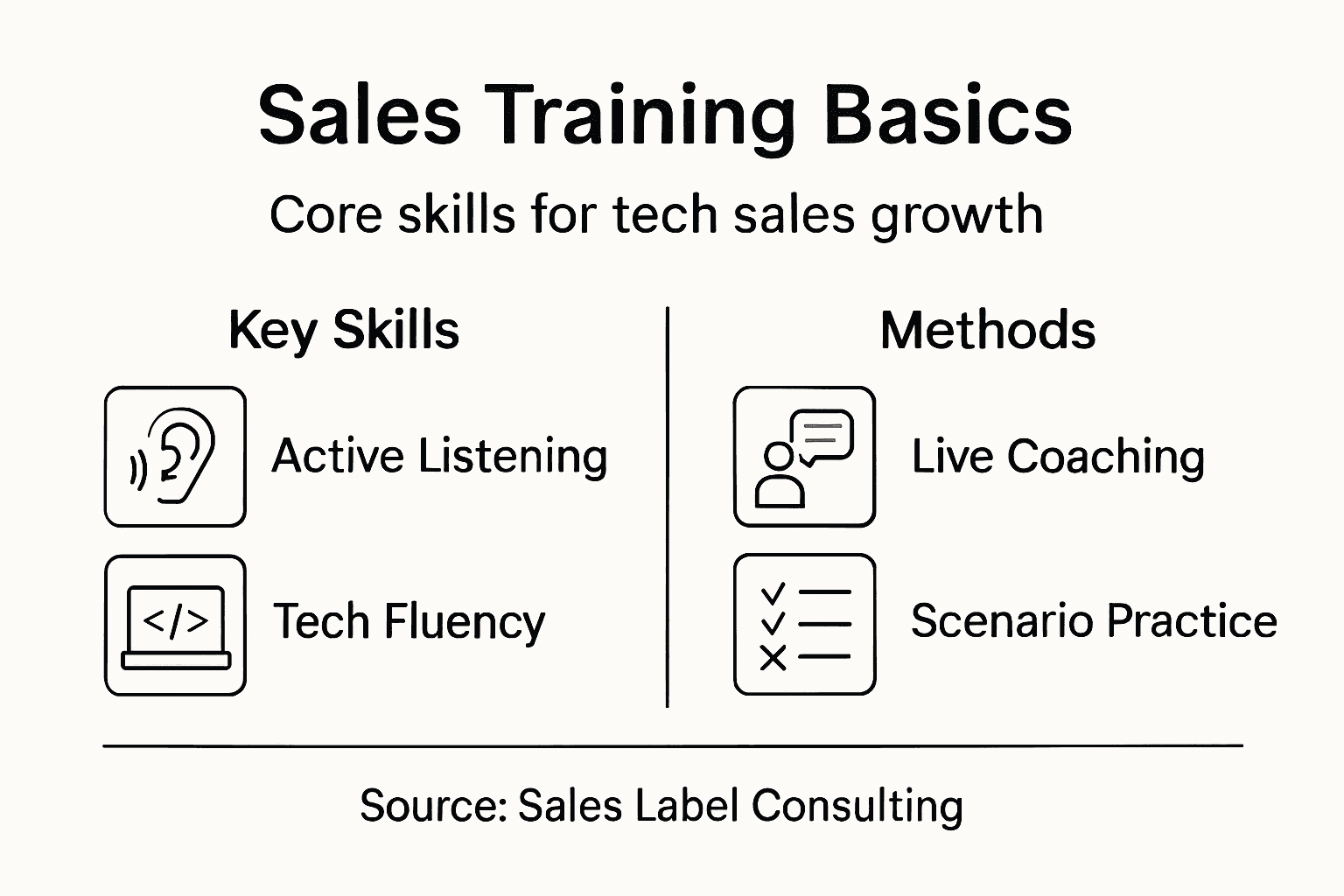
Pro tip: Implement a blended learning approach that combines digital resources, live coaching, and hands-on practice to accelerate your tech sales team’s professional development.
Sales training encompasses a comprehensive approach to developing professional capabilities that go far beyond basic product knowledge. Comprehensive skills development represents a strategic investment in transforming sales representatives into sophisticated business professionals.
The core skills typically covered in advanced sales training include:
Effective sales training methods typically focus on multiple skill domains:
Modern sales training goes beyond traditional lecture-based approaches. It incorporates interactive learning experiences that simulate real-world sales challenges, allowing representatives to develop muscle memory for complex sales interactions. This approach ensures that skills are not just learned but internalized and readily applicable in dynamic business environments.

Pro tip: Implement scenario-based training modules that provide immediate feedback and allow sales representatives to practice skills in controlled, realistic environments.
Sales enablement represents a sophisticated approach to aligning training, technology, and organizational strategy. Technology-driven sales integration transforms traditional sales approaches into dynamic, data-powered performance ecosystems.
The key components of integrated sales enablement include:
Successful integration requires a strategic approach across multiple domains:
Modern sales enablement goes beyond traditional training methods. It leverages artificial intelligence, data analytics, and immersive learning technologies to create personalized, adaptive learning experiences that directly align with organizational goals and individual performance needs.
Technology transforms sales training from a static process to a dynamic, interactive learning journey that evolves with market demands.
Pro tip: Create a cross-functional task force that includes sales, technology, and learning development professionals to design and implement a holistic sales enablement strategy.
Consistent sales team performance demands strategic alignment of individual skills with organizational objectives. Success hinges on creating a robust framework that addresses both technical competencies and interpersonal dynamics.
Common pitfalls that undermine sales training effectiveness include:
Strategies for driving consistent results require a comprehensive approach:
Sustainable sales performance emerges from a holistic approach that balances individual development with organizational goals.
Successful sales organizations recognize that consistency is not about creating uniform sales representatives, but about establishing a shared framework of skills, principles, and adaptive learning strategies that empower individual strengths.
Below is a summary of common sales training pitfalls and recommended solutions:
| Pitfall | Impact on Team Performance | Recommended Solution |
|---|---|---|
| Inconsistent training | Skills gaps persist | Use standardized onboarding |
| No performance tracking | Success is unmeasured | Add analytics to training |
| Generic content | Missed growth opportunities | Personalize learning plans |
| Lack of follow-up | Skills fade quickly | Schedule regular refreshers |
| Poor tech integration | Inefficient workflows | Align training with sales tools |
Pro tip: Develop a quarterly skills calibration process that identifies individual performance gaps and creates targeted development plans for each team member.
Navigating the complex world of tech sales demands more than just product knowledge. The article highlights the critical challenges of inconsistent training, lack of continuous development, and misaligned technology integration that slow revenue growth. Are you struggling to build a sales team that adapts to evolving customer needs while delivering predictable, error-free results? Effective sales training must blend skill mastery with advanced enablement strategies to empower your team and enhance customer satisfaction.
At Sales Label Consulting, we specialize in closing these gaps through tailored Sales Enablement solutions, comprehensive Sales Audit services, and dynamic Demand Generation strategies. We bring entrepreneurial tech experience that transforms traditional sales training into a continuous, data-driven learning journey ensuring your sales team remains agile and high performing.

Take action now to overcome the common pitfalls of tech sales training and drive consistent revenue growth. Visit Sales Label Consulting and discover how our expert consulting can empower your Head of Sales or VP of Sales to build a confident, results-driven sales organization. Start your transformation today and secure your competitive advantage.
Sales training in the tech industry is a strategic process designed to enhance the skills and performance of sales teams, focusing on understanding customer needs, mastering product and market knowledge, and adapting to technological changes.
Sales training improves team performance by developing essential skills like communication, negotiation, and relationship management, which are vital for navigating complex sales environments and achieving consistent results.
An effective sales training program typically includes skill enhancement, product knowledge, customer psychology training, technology enablement, and ongoing assessments to ensure comprehensive development of sales representatives.
Modern sales training differs from traditional methods by focusing on interactive learning experiences, ongoing feedback, and adaptability to individual learning styles, whereas traditional training often relies on one-time lectures and generalized content.
Subscribe to our Insights: Expert productivity tips in your inbox
You'll receive 1-3 emails per month. Your data stays private, always.

CRO & Co-Founder with Sales Label Consulting

Let's book a free consultation call
October 23, 2026 - 10 min read
Read article Read articleOctober 22, 2026 - 9 min read
Read article Read articleOctober 21, 2026 - 9 min read
Read article Read articleOctober 20, 2026 - 9 min read
Read article Read article