
Demand Generation Workflow: 2026 B2B Growth Guide
TL;DR:
- A demand generation workflow is an automated sequence of marketing and sales actions designed to create awareness and qualify prospects. Building the right foundation, including clear buyer personas, aligned goals, integrated technology, ungated content, and clean data, is essential for success. It involves stages of demand creation, capture, nurturing, and qualified lead handoff, supported by AI automation and continuous measurement.
A demand generation workflow is a structured, automated sequence of marketing and sales actions designed to create awareness, qualify prospects, and move them through the pipeline until they’re ready to buy. This is the engine behind predictable revenue, not a collection of disconnected campaigns. The workflow integrates CRM platforms like Salesforce or HubSpot, marketing automation tools, AI-powered orchestration, and content strategy into one coordinated system. Over 60% of software buyers choose a vendor they already know before the evaluation even starts. That single fact explains why your workflow must start with brand authority, not just lead capture. Done right, a demand generation workflow shortens sales cycles, improves lead quality, and aligns your marketing and sales teams around the same pipeline goals.
Before you build anything, you need the right foundation. Most teams skip this step and wonder why their campaigns underperform.
Here’s what you need in place before execution:
| Foundation Element | Why It Matters |
|---|---|
| ICP and intent data | Targets the right accounts before spend is wasted |
| Sales-marketing alignment | Prevents MQL disputes and pipeline leakage |
| Integrated tech stack | Enables attribution and automation at scale |
| Ungated content library | Builds brand trust before buyers enter evaluation |
| Clean CRM data | Powers accurate scoring and personalized outreach |
Get these five elements right and your workflow has a real chance. Skip any one of them and you’re building on sand.
The lead generation process breaks into four distinct stages. Each one feeds the next.

Step 1: Demand creation. This is where you build awareness before buyers are actively searching. Publish content that answers real questions your ICP is already asking. Use SEO to rank those answers. Show up consistently on LinkedIn and in industry communities. The goal is to be the brand buyers already know when they enter evaluation. Remember: demand gen shortens sales cycles by educating buyers before your sales team ever picks up the phone.
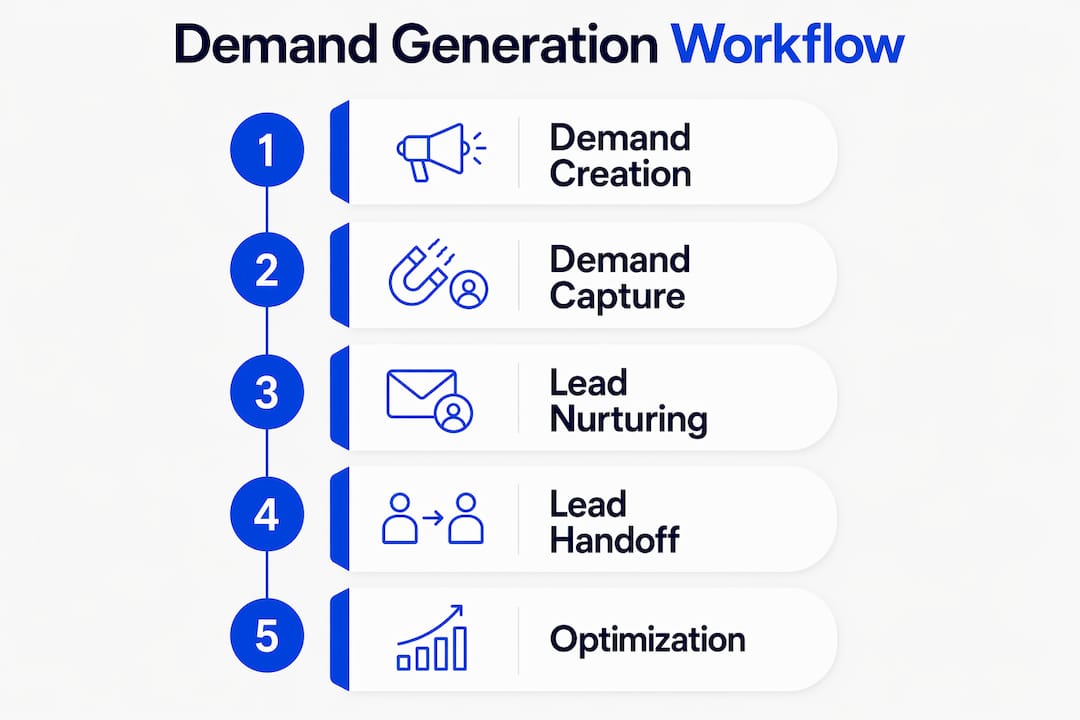
Step 2: Demand capture. Once buyers show intent, you need to catch them. This means paid search targeting high-intent keywords, retargeting campaigns for site visitors, and lead forms on your highest-traffic pages. Use intent data platforms to identify accounts actively researching your category. Successful demand generation blends content marketing, account-based marketing (ABM), paid ads, and personalized outreach with intent signals layered on top.
Step 3: Lead nurturing. The average B2B buying cycle runs 10.1 months. That means most leads are not ready to buy when they first engage. Build email sequences that deliver value at each stage of the buyer journey. Use retargeting to stay visible. Personalize content based on the prospect’s industry, role, and behavior. Automation handles the volume; your content handles the persuasion.
Step 4: Qualified lead handoff and optimization. Define your MQL threshold clearly: a specific lead score, a combination of engagement signals, or a direct demo request. When a lead hits that threshold, trigger an automated handoff to sales with full context attached. The sales rep should know what content the prospect consumed, what pages they visited, and what their company looks like. No cold handoffs.
Pro Tip: Use an AI-powered workflow to automate lead enrichment, qualification scoring, and the first outreach sequence. AI tools like Copy.ai or Clay can pull firmographic data, score leads, and trigger personalized emails without manual intervention. This is where you get scale without sacrificing consistency.
Real talk: most demand generation programs fail not because of bad strategy but because of execution gaps. Here’s where teams consistently go wrong.
Real talk: The teams that win in 2026 treat content as infrastructure, not as a campaign. They publish consistently, answer real buyer questions, and build a library that compounds over time. One viral post is not a demand generation strategy.
Pro Tip: Audit your current content library quarterly. Identify which pieces drive pipeline and which ones just generate traffic. Double down on what converts, and cut what doesn’t.
You can’t fix what you don’t measure. Data-driven attribution and pipeline metrics like cost per MQL and conversion rates are the core of any optimization loop. These numbers tell you where the workflow is working and where leads are leaking out.
| Metric | What It Tells You |
|---|---|
| Pipeline contribution | Which campaigns are actually generating revenue-stage opportunities |
| Cost per MQL | Whether your spend is efficient relative to lead quality |
| MQL to SQL conversion rate | How well marketing and sales definitions are aligned |
| Sales cycle length | Whether nurturing is accelerating or stalling buyer decisions |
| Digital self-serve conversion | How well your website converts without human intervention |
More than 50% of large B2B transactions now flow through digital self-serve channels. That means your website, your demo flow, and your pricing page are part of your demand generation workflow whether you treat them that way or not. Optimize the digital experience with the same rigor you apply to your email sequences.
Run A/B tests on subject lines, landing page copy, and CTA placement. Use closed-loop reporting to connect marketing touches to closed revenue. Pull insights from your sales team about the objections they hear most often, then address those objections in your content. This feedback loop is what separates teams that grow from teams that plateau.
Pro Tip: Set a monthly pipeline review that includes both marketing and sales leaders. Review the same data together. When both teams see the same numbers, alignment happens naturally and finger-pointing stops.
The long B2B sales cycle demands that you stay present with prospects across every stage. Peer validation, community presence, and customer success stories work as demand levers that paid ads simply can’t replicate at the same trust level.
A demand generation workflow succeeds when brand authority, automation, and sales-marketing alignment operate as one connected system rather than separate functions.
| Point | Details |
|---|---|
| Start with brand authority | Ungated, educational content builds trust before buyers enter evaluation. |
| Align on MQL definitions | Sales and marketing must agree on lead criteria before any automation runs. |
| Automate the full sequence | Connect CRM, marketing automation, and AI tools to eliminate manual errors. |
| Measure pipeline contribution | Track cost per MQL and conversion rates to identify and fix workflow gaps. |
| Optimize digital experience | Over 50% of large B2B deals close through self-serve channels, so your website is part of the workflow. |
I’ve worked with enough B2B sales and marketing teams to spot the pattern quickly. The conversation almost always starts with “we need more leads.” But when you dig into the data, the problem is rarely volume. It’s quality, timing, and trust.
Teams pour budget into paid acquisition, gate every asset, and wonder why their pipeline is full of leads that never convert. The real issue is that buyers don’t trust you yet. They haven’t seen enough of your thinking. They haven’t heard your name from a peer. They haven’t read anything from you that made them think, “these people actually get our problem.”
The shift I’ve seen work consistently is treating content as infrastructure, not as a campaign. That means publishing answers to real buyer questions every week, not just when there’s a product launch. It means showing up in the communities where your buyers already spend time. It means letting your best ideas live ungated so they can spread.
AI-powered workflow orchestration changes the execution side of this equation significantly. When you automate demand generation sequences connecting your CRM, marketing automation, and AI enrichment tools, you free your team to focus on strategy and content quality instead of manual tasks. That’s the competitive advantage most teams are still sleeping on.
The teams winning in 2026 are not the ones with the biggest ad budgets. They’re the ones with the clearest point of view, the most consistent content output, and the tightest sales-marketing alignment. Structure beats heroics every time.
— Antony
If you’ve read this far, you already know that a demand generation workflow is more than a marketing project. It’s a revenue architecture decision. The gap between knowing what to do and actually executing it cleanly is where most teams lose ground.
Saleslabelconsulting works directly with RevOps leaders, Heads of Sales, and VP-level teams to design and implement demand generation programs that produce predictable results. From sales enablement for predictable revenue to full pipeline audits, we bring the structure your team needs to stop guessing and start growing. If your current workflow isn’t generating the qualified pipeline you need, let’s talk about what’s actually blocking it.
A demand generation workflow is an integrated sequence of marketing and sales actions that creates brand awareness, nurtures prospects, and converts qualified leads into pipeline opportunities. It connects content strategy, automation, CRM, and sales handoff into one coordinated system.
Demand generation builds awareness and interest before a prospect is ready to engage, while the lead generation process captures and qualifies prospects who are already showing intent. Demand generation feeds lead generation; they are sequential, not interchangeable.
You need a CRM (Salesforce or HubSpot), a marketing automation platform (Marketo or Pardot), an intent data source (Bombora or G2), and an AI workflow tool for enrichment and sequencing. These systems must integrate to enable attribution and consistent execution.
The average B2B buying cycle is 10.1 months, so demand generation is a long-term investment. Most teams see measurable pipeline impact within three to six months when brand authority content and automation are running consistently.
Gated content reduces reach and signals distrust to buyers who can find the same information elsewhere. Leading B2B tech firms in 2026 prioritize ungated content that ranks in search and builds brand authority, which generates higher-quality pipeline than form-gated assets.
Subscribe to our Insights: Expert productivity tips in your inbox
You'll receive 1-3 emails per month. Your data stays private, always.

CRO & Co-Founder with Sales Label Consulting

Watch our Sales Mates Podcast
Available
June 18, 2026 - 9 min read
Read article Read articleJune 15, 2026 - 11 min read
Read article Read articleFix the System
Not Symptoms