
Sales Team Setup for Leaders: Stage First Plan at 8, 20, and 50 Reps
If you have fewer than 8 reps, keep them full-cycle. If you’re past 20, break into pods or a hybrid model. The single most important move right now is picking the structure that matches your headcount, not the one that looks impressive on an org chart, and locking in a 30-60-90 ramp gate before your next hire starts.
TL;DR:
- Sales team structures should match headcount growth, with full-cycle roles for up to 8 reps, and specialized or hybrid models for larger teams.
- Introducing roles like SDRs or specialized pods only makes sense once prospecting begins to significantly impact closing time or when managing multiple segments or verticals.
- Building a 30-60-90 onboarding plan, with clear milestones and a structured coaching cadence, reduces ramp time and improves retention for new sales hires.
- Measuring handoff success and maintaining clean CRM data are essential to prevent pipeline leakage and ensure accurate forecasting as teams scale.
- Leading indicators of a successful setup include faster ramp time, accurate pipeline coverage, and improving forecast accuracy within 3 to 6 months.
Every sales team setup boils down to one of three shapes, plus a mashup that most enterprise teams eventually land on. Get this decision wrong and you’ll spend a year untangling it. Get it right and everything downstream, hiring, comp, onboarding, gets easier.
Island (full-cycle). One rep owns the deal from first call to signed contract. It’s scrappy, fast to launch, and forgiving of a messy process because there’s no handoff to break. The trade-off: reps split focus between prospecting and closing, so neither gets done at elite level.
Assembly Line (specialized). SDRs prospect, AEs close, CSMs retain. Each rep gets sharper at their one job, and your pipeline math becomes predictable because you can isolate exactly where deals stall. The cost is coordination: every handoff is a place where context, and deals, can leak.
Pod. Small cross-functional units (often an AE, SDR, and sometimes a solutions engineer) own a segment or territory together. Pods work well when account-based selling or vertical specialization matters, but a single pod rarely justifies the overhead. Practitioners generally recommend running multiple pods before the model pays for itself.
Hybrid. A blend, usually Assembly Line for velocity deals and pods for enterprise accounts, layered under one RevOps backbone. Hybrid models are increasingly favored for multi-channel enterprise motions, especially once you’re selling to multiple buying committees at once.
Here’s how the signals typically break down:
Pro Tip: Don’t specialize before you have proof. Splitting SDR and AE roles when you have four reps just adds a handoff with nothing to hand off yet. Wait until prospecting visibly eats into closing time.
Sales team structure isn’t a static decision, it’s a series of structural moves triggered by headcount. Here’s the sequence that holds up across most B2B tech go-to-market motions.
At each threshold, the mistake isn’t picking the wrong model. It’s waiting too long to move off the old one, or moving before the volume justifies it.
Building a sales team is a sequencing problem before it’s a headcount problem. Hire in the wrong order and you’ll spend your first six months fixing a foundation instead of building on it.
Hiring order matters more than most leaders expect. Hire your first AE to prove the motion converts. Add an SDR once that AE’s calendar is prospecting-heavy rather than closing-heavy. Bring in a manager and early RevOps hire close together, since Sales Ops driving CRM hygiene and forecasting often outperforms a premature management hire in the 8 to 15 rep range.
Pro Tip: When you’re scoring candidates, weight coachability and process discipline above past quota attainment. A rep who followed someone else’s playbook at their last company tells you less than a rep who can visibly adapt to yours.
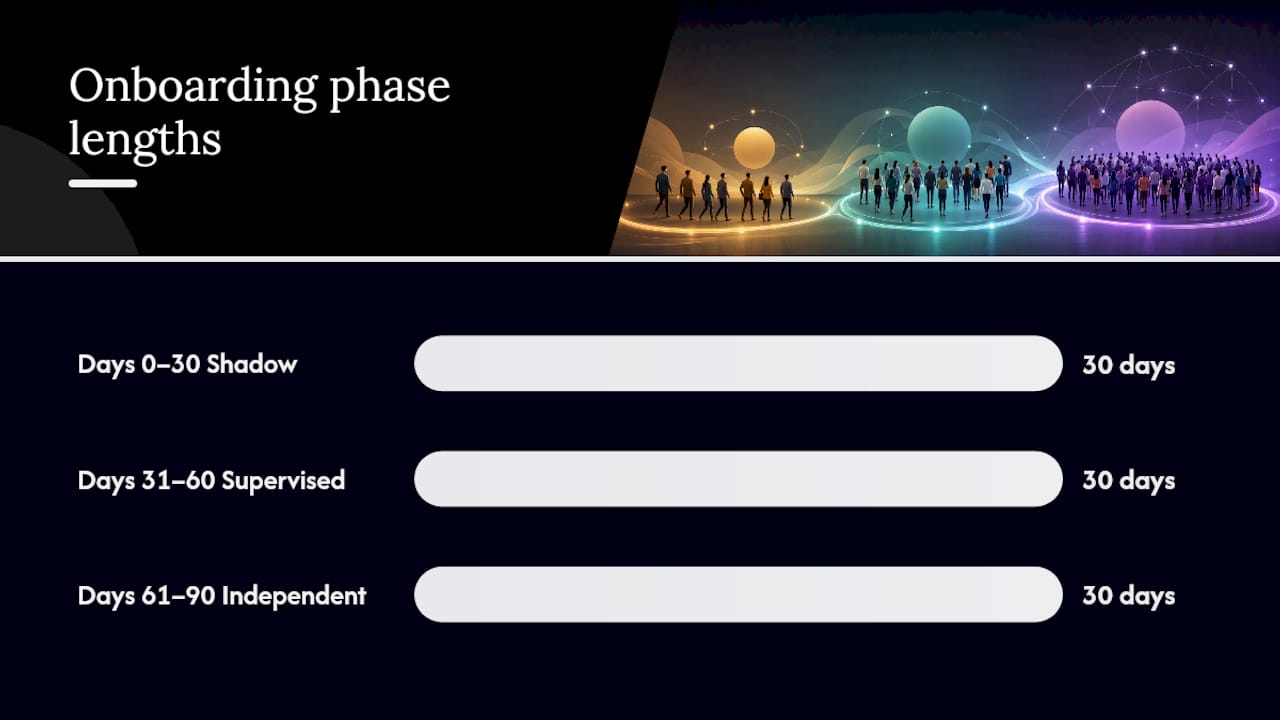
A reusable 30-60-90 framework with milestone gates is the single highest-leverage tool in your sales team setup, and it works the same whether you’re onboarding your third hire or your thirtieth. Structured onboarding with a weekly coaching cadence measurably reduces ramp time and improves retention.
Run a four-part weekly coaching cadence throughout: a recorded call review, a pipeline audit, a check on outreach sequences, and a peer-sharing session where reps compare what’s working. That last one is the cheapest coaching you’ll ever get.
If a rep misses the day-30 gate (can’t articulate ICP, can’t run a clean discovery call), extend shadowing rather than pushing them forward. If they miss day-90 coverage, it’s a direct conversation about fit, not another 30-day extension. Our onboarding frameworks for faster ramp go deeper on the exact milestone checklist.
Comp plans and KPI dashboards are the two levers that either reinforce your sales team setup or quietly sabotage it. Get the ratios wrong and you’ll pay for the wrong behavior.
For AEs, a 50/50 or 60/40 base-to-variable split is the common baseline, tightening toward more base for longer, more consultative sales cycles. SDRs typically skew more toward base (60/40 or 70/30) since their outcomes depend heavily on volume they can’t fully control. Set OTE (on-target earnings) benchmarks relative to your local market and deal size, not to whatever number a competitor is advertising to recruit.
Statistic Callout: Balanced measurement pairs activity metrics (calls, sequences, meetings booked) with outcome metrics (meeting-to-opportunity conversion, opportunity-to-close, ACV, cycle length). Track only outcomes and you’ll know something’s wrong without knowing why. Track only activity and you’ll reward busywork.
Specialization only works if the handoff between roles is documented, not assumed. Context loss at handoff is the leading cause of pipeline leakage once teams move to an Assembly Line structure.
A workable SDR to AE SLA checklist includes:
Measure handoff success with meeting-to-opportunity conversion rate and time-to-first-action after handoff as your two core SLA KPIs. If those numbers slip, three fixes usually work fast: mandatory call recordings for every SDR-booked meeting, joint attendance on first calls for the first two weeks of a new SDR/AE pairing, and a weekly SLA review where breaches get flagged out loud, not buried in a dashboard.
Pro Tip: If AEs keep complaining about meeting quality, don’t just retrain the SDR. Pull the call recordings first. Half the time the issue is a vague ICP definition, not a skills gap.
You don’t need a sprawling stack to run a clean sales team setup. You need a small one that doesn’t lie to you.
RevOps owns the connective tissue: data governance so fields don’t rot, territory design so accounts don’t overlap or get orphaned, routing rules so leads land with the right rep instantly, and a consistent forecasting methodology everyone actually uses. Integration matters more than any single tool: if your outreach platform, CRM, and call recording system don’t talk to each other, you lose the coaching-quality data that makes the whole system worth running. For teams selling complex technical products, our tech sales team playbook covers stack choices specific to enterprise GTM motions.
Structure beats heroics. Here’s what to actually do this month, in order.
At 90 to 180 days, three signals tell you if the structure is working: ramp time is shrinking hire over hire, pipeline coverage is hitting target without heroics, and forecast accuracy is improving month over month.
Pro Tip: Pick one metric you’ll review every single Monday, no exceptions. Teams that skip the weekly review lose the thread within a month, no matter how good the dashboard looks.
Culture in a sales org isn’t ping-pong tables. It’s whether reps trust the process enough to follow it when a deal gets hard.
The teams that stay motivated through a rough quarter share one trait: leadership treats pipeline problems as system problems first, not motivation problems. If three reps miss quota, that’s rarely a coincidence of effort, it’s usually a signal in the ICP, the comp plan, or the handoff process. Blaming hustle when the system is broken burns trust fast.
Recognition works best when it’s specific and public: calling out a well-run discovery call in a team channel does more for morale than a vague “great job, team” email. Peer accountability, the kind you build through the weekly coaching cadence’s peer-sharing session, tends to outperform top-down pep talks, because reps trust other reps’ read on what’s actually working.
Autonomy matters too, but it has to be earned through the ramp gates, not handed out on day one. A rep who’s proven they can run a clean process independently should get real latitude on how they work their pipeline. A rep still inside their 90-day ramp shouldn’t, and pretending otherwise just sets them up to fail quietly. The healthiest sales cultures are blunt about performance and generous with coaching, in that order.
Onboarding gets a rep to competent. Ongoing training is what gets them to excellent, and it’s the piece most teams drop once the new-hire excitement fades.
The mistake is treating training as a one-time event instead of a cadence. Run it in a fixed rhythm: monthly deep-dives on a specific skill (objection handling, discovery questioning, competitive positioning), quarterly certification on new product releases or messaging changes, and ongoing call review as a standing agenda item, not something that only happens when a deal goes wrong.
Peer-led sessions tend to land better than manager-led ones for skill-building, because reps trust “here’s exactly what I said” from a colleague more than a generic script from leadership. Record your best calls (with permission) and build a living library new hires can study during their first 30 days, and veterans can revisit when they’re stuck on a specific deal type.
Tie development directly to career pathing. Reps who can see a documented path from AE to senior AE to manager stay engaged longer than reps who are just told to “keep closing.” Vague growth promises are the fastest way to lose a rep who’s hitting quota to a competitor with a clearer plan.
Forecasting and quota setting live or die on the same input: clean historical data. If your CRM hygiene is shaky, no methodology will save your forecast accuracy.
Most B2B teams blend two approaches. Pipeline-based forecasting weights open opportunities by stage and historical close rates at that stage, giving you a rolling, deal-level view. Historical/quota-based forecasting sets targets off trailing performance (often trailing 3 to 4 quarters) adjusted for market conditions, new hire ramp, and known pipeline gaps. Relying on only one leaves blind spots: pipeline-based forecasts miss macro shifts, historical forecasts miss what’s actually sitting in the funnel right now.
Quota setting works best as a top-down and bottom-up reconciliation. Leadership sets a revenue target based on company growth needs; managers build it back up from realistic per-rep capacity, factoring in ramp time for new hires and territory quality. When those two numbers land far apart, that gap is useful information, not a problem to paper over with an arbitrary split.
Revisit quotas at least twice a year. A quota built on last year’s market conditions, before a pricing change or a new competitor entered the picture, sets reps up to miss through no fault of their own.
Territory design determines whether your reps are competing with each other for the same accounts or actually covering the market. Get it wrong and your best reps end up fighting over easy accounts while whole segments go untouched.
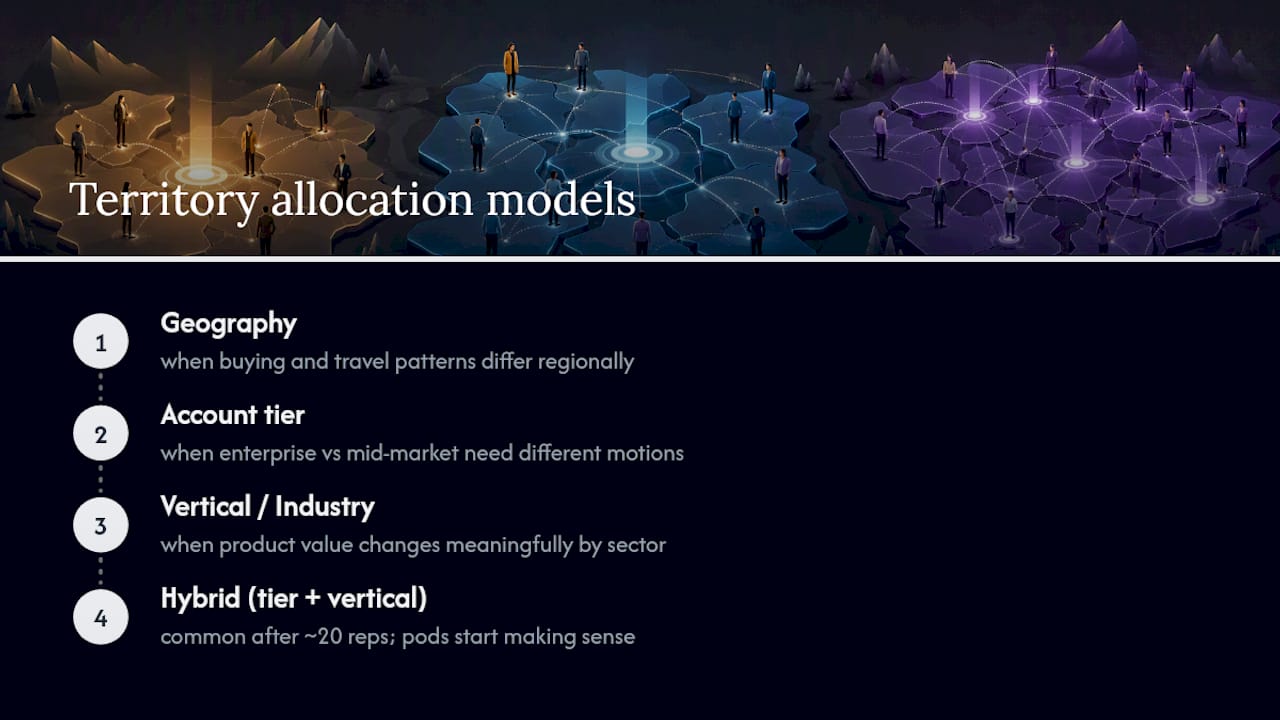
Three common allocation models: geography (works when buying behavior and travel patterns are regionally distinct), account size or tier (works when enterprise and mid-market deals need genuinely different sales motions), and vertical/industry (works when your product’s value proposition changes meaningfully by sector). Most growth-stage B2B tech companies land on a hybrid of tier and vertical once they pass the 20-rep mark, which is also roughly when pod structures start making sense for the same reason.
Whatever model you choose, balance territories on realistic opportunity, not just account count. A territory with 200 small accounts and one with 40 enterprise accounts can carry equal quota if the math is done honestly, but only if RevOps is tracking total addressable pipeline value per territory, not headcount of leads.
Revisit territory lines every time you add a meaningful batch of new accounts or reps. Stale territory maps are one of the quietest causes of rep attrition, because nothing demotivates a good rep faster than watching a colleague inherit a better patch of accounts by accident.
A sales team setup only works if the information flowing through it is trustworthy and timely, both inside the sales org and across the functions it touches.
Inside the team, the weekly coaching cadence (call review, pipeline audit, sequence check, peer sharing) doubles as your core communication rhythm. Layer a short daily standup for pipeline blockers on top of it for higher-velocity motions, but keep it under ten minutes, longer than that and it becomes theater instead of information transfer.
Cross-functionally, sales needs tight loops with marketing (lead quality feedback, campaign performance data), product (feature requests surfaced from lost deals, competitive gaps), and customer success (renewal risk signals that started as sales-cycle red flags). The failure mode here is almost always one-directional: sales reports up to leadership but never reports sideways to the teams that could actually fix the root cause of a recurring objection or a leaky segment.
Documented, async communication (a shared deal-review doc, a Slack channel with a clear escalation protocol) beats meeting-heavy coordination once you’re past roughly 15 to 20 people touching the revenue motion. Meetings don’t scale; written systems of record do.
Your CRM is the record of what happened. Sales engagement platforms and automation tools are what make more of the right things happen in the first place, and the two categories solve different problems.
A sales engagement platform sequences outreach across email, calls, and social touches, and gives reps a structured cadence instead of a personal guessing game about when to follow up. This matters most for Assembly Line and Hybrid models, where SDR volume depends on consistent, trackable sequencing rather than individual initiative. For teams weighing which automation approach fits which motion, resources like this look at applying different AI models to different tasks are useful when deciding between high-touch, personalized sequences and high-velocity, templated outreach.
Automation tools beyond engagement platforms, meeting schedulers, conversation intelligence that auto-tags call themes, and workflow triggers that update CRM fields without manual entry, exist to protect the coaching-quality data your RevOps team depends on. The trap is layering on tools that don’t integrate: a scheduler that doesn’t sync to the CRM, or a call intelligence tool whose insights never make it into pipeline reviews, just creates more places for data to go stale. If a channel spans sales and marketing, coordination frameworks built for multichannel orchestration can help keep messaging and timing aligned across both teams.
The same three mistakes show up across most engagements: hiring reps before structure exists, treating onboarding as a checklist instead of a coaching system, and pushing RevOps down the priority list until the CRM is too messy to trust.
Fixing the sequence, structure first, then hires, then systems, usually produces the same pattern: faster ramp on new hires, cleaner forecasting within a quarter or two, and pipeline that stops swinging wildly month to month. None of it is complicated. Most of it just requires doing things in the right order.
— Antony
That’s what a Sales Label Consulting engagement is built for: a structured audit plus a setup plan, not a generic template with your logo swapped in.
A typical sales audit and setup engagement covers org design mapped to your current headcount, a 30-60-90 ramp plan customized to your sales motion, a KPI and forecasting dashboard structure, and the enablement materials your managers need to run the weekly coaching cadence without building it from scratch. It’s built for VPs of Sales, Heads of Sales, and RevOps leaders at B2B tech companies who need the structure fixed before the next hiring wave, not after. Start with our sales enablement engagement page to see what’s included and book an initial conversation.
Match structure to headcount: full-cycle (Island) for 1 to 8 reps, specialized roles (Assembly Line) for roughly 9 to 20, and pods or hybrid models once you pass 20 reps and can run at least three pods.
It’s an onboarding framework where new hires shadow and study in the first 30 days, execute under supervision in days 31 to 60, and work independently with a pipeline coverage target by day 90.
Keep managers at roughly 6 to 8 direct reports; coaching quality and forecast accuracy both degrade once a manager runs more than that.
Definitions vary by source and there’s no single agreed-upon standard version, so treat any specific list as one framework among several rather than an industry-wide rule.
Hire an SDR once prospecting is measurably displacing your AEs’ closing time, not on a fixed headcount schedule, since teams that split too early just add a handoff with nothing yet to hand off.
Subscribe to our Insights: Expert productivity tips in your inbox
You'll receive 1-3 emails per month. Your data stays private, always.

CRO & Co-Founder with Sales Label Consulting

Watch our Sales Mates Podcast
September 15, 2026 - 10 min read
Read article Read articleSeptember 14, 2026 - 10 min read
Read article Read articleSeptember 13, 2026 - 8 min read
Read article Read articleSeptember 12, 2026 - 10 min read
Read article Read article