
Fix Lost Deals in One Week: Five Field Sales Handoff for B2B Tech
An effective sales handoff process runs on one rule: define exactly when a lead becomes “handed off,” then enforce an AE first-touch SLA (a few business hours is a reasonable default) with zero exceptions. Every handoff needs five required fields, an accepting owner, and a documented trigger. Below, you get the template, the SLA math, and a one-week audit to find where your process is actually leaking deals.
TL;DR:
- Failure to enforce a strict first-touch SLA within four business hours significantly reduces qualification chances, emphasizing the need for automated alerts when deadlines are missed.
- A sales handoff requires five fixed fields in the CRM, including discovery summary, stakeholder map, objections, competitor mentions, and next meeting details, to prevent information gaps.
- Automating required fields, routing, SLA clocks, and escalation alerts in the CRM is critical to maintaining consistent handoff quality at high deal volumes.
- Conducting a one-week audit of recent handoffs reveals common breakdowns, such as incomplete records or delayed first outreach, allowing targeted process improvements.
- Speed of initial outreach after handoff directly impacts deal progression, making rapid, personalized engagement essential for effective sales-to-sales or sales-to-CS transitions.
A sales handoff process is the defined sequence of steps, fields, and approvals that move a deal or account from one owner to another without losing context. Most teams run into trouble because they’re using the wrong model for the wrong situation. There isn’t one handoff. There are at least three, and mixing them up is how information gets lost.
SDR to AE handoff happens when a sales development rep books and qualifies a meeting, then passes the opportunity to an account executive to run the sales cycle. This is the highest-frequency handoff in most B2B tech orgs and the one most likely to fail silently, since documentation gaps rather than dropped balls are usually the real cause.
Marketing to sales handoff transfers a lead from demand generation to the sales team once it hits a defined qualification threshold. It depends entirely on shared definitions of MQL and SAL, because without agreement on what “qualified” means, sales will keep rejecting leads marketing thinks are ready.
Sales to CS or implementation handoff transfers a signed deal to the team responsible for onboarding and retention. This one carries the highest stakes financially, since a bad start here shows up later as churn.
Here’s how to pick a model based on scale:
A reproducible handoff playbook has six moving parts: trigger, record, intro, acceptance, SLA, and feedback. Skip any one of them and the process degrades into whatever the individual rep remembers to do that day.
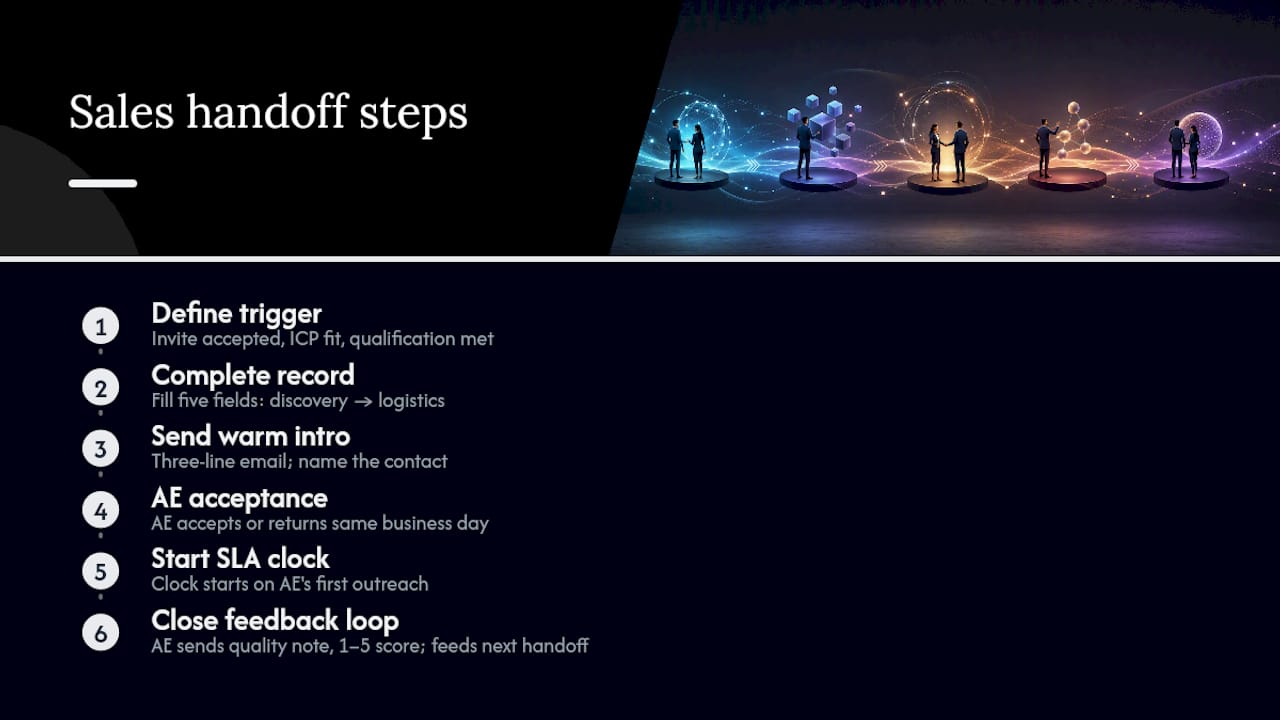
1. Define the trigger. A lead doesn’t get “handed off” just because a meeting got booked. Set minimum conditions: calendar invite accepted, ICP fit confirmed, a qualification threshold met (BANT, MEDDIC, or your own scoring), and evidence of meaningful contact, not just an email reply. Vague triggers are one of the most common reasons handoffs fail without anyone noticing.
2. Complete the handoff record. Before the meeting happens, the outgoing rep fills five fields (detailed in the next section) in a fixed order: discovery summary first, then stakeholders, objections, competitor mentions, and next-meeting logistics last. Order matters because the discovery summary frames everything after it.
3. Send the warm introduction. A three-line email works better than a five-paragraph one. State who you are, why you’re stepping in, and confirm the existing meeting time. Loop in the customer’s main contact by name, not “the team.”
4. AE acceptance. The AE reviews the handoff record and either accepts it or kicks it back with a specific gap flagged, within a set window (same business day). Accepting without reading is how bad handoffs propagate.
5. Start the SLA clock. The moment a handoff is marked complete, the AE’s first-touch clock starts. This isn’t the same as the meeting date. It’s the clock on the AE’s first personalized outreach.
6. Close the feedback loop. The AE sends a short quality note back to the SDR: what worked, what was missing, and a 1 to 5 completeness score.
Pro Tip: Build the trigger conditions directly into your CRM’s stage-change rules. If a rep can manually flip a deal to “handed off” without the five fields populated, they will, especially at the end of the month.
Escalation matters as much as the SLA itself, which you can reliably track using a marketing automation checklist tailored for SMBs. If an AE misses the first-touch window, the system should notify the AE’s manager automatically, not rely on the SDR to chase it down. That single change removes the most common excuse for late handoffs: nobody knew.
A working handoff document needs five required fields, no more. Piling on extra sections just gives reps a place to write nothing useful.
Optional fields worth adding once your base template is solid: budget signals, technical requirements, integration needs, and any artifacts shared (a proposal, a security questionnaire, a recording link).
The field that separates a mediocre handoff from a genuinely useful one is the gap and risk log. This is a running list of unresolved items, each with an owner and a target resolution date. The trick most teams miss:
Keep the original severity rating on a risk even after it’s resolved. If a “high” risk gets fixed, don’t erase that it was ever high. That history tells the next person (a CS manager, an AE inheriting the account later) how fragile the relationship really was, not just its current state.
A completeness score, one point per required field filled correctly, gives you a quick audit number and a lightweight way to hold reps accountable without a full compliance review. Full templates for this kind of handoff checklist and audit structure can save you from building one from scratch.
Speed to lead isn’t a nice-to-have metric. Leads contacted very quickly after handoff are significantly more likely to qualify than those contacted later, according to research cited in sales handoff process guidance. That statistic alone should settle most internal debates about SLA length.
Practical defaults that hold up in most B2B tech orgs:
First touch has a specific definition, and loosening it defeats the purpose. It means a reply in the existing thread, a personalized outreach referencing something from the handoff record, or a logged call attempt. It does not mean sending a calendar invite with no message, and it does not mean an automated sequence email firing on schedule.
When an SLA gets missed, the system, not a person, should catch it. Automated alerts to the AE’s manager after the window closes, paired with a visible dashboard of open handoffs, remove the ambiguity around who’s responsible for follow-up.
A handoff without feedback is a one-way transaction, and one-way transactions never improve. The AE should send the SDR (or the sales rep should send CS) a short note within 24 hours of the first real conversation: outcome, a 1 to 5 quality score, and one specific correction if something was missing. Industry practitioners frame this as a two-way contract between SDR and AE: without that feedback, SDRs have no way to know which qualification habits are actually working.
Track a small set of metrics consistently rather than a long dashboard nobody checks:
Pro Tip: Run a 30-minute SDR-AE calibration huddle every week. Review one handoff that went well and one that didn’t, out loud, together. Weekly calibration prevents the blame culture that shows up when handoff quality is only discussed after a deal falls apart.
Pair the weekly huddle with a monthly audit: pull a sample of handoffs, score them against your completeness checklist, and report the trend to leadership. If completeness scores are climbing but time-to-kickoff isn’t improving, the bottleneck has moved somewhere else, usually AE capacity or CRM routing.
Automation is what turns a documented process into a process that survives someone being busy or new. Required fields, deterministic routing, and SLA clocks close the gaps that manual handoffs always leave open eventually.
Implementation order matters. Start with required fields and validation, then add routing logic, then layer in SLA clocks and alerts last. Teams that build alerts before the underlying fields are reliable end up ignoring the alerts within a month. A structured CRM implementation roadmap helps sequence this without breaking active pipeline.
Pull your last 30 handoffs and ask three questions of each one: was the trigger actually met, were all five fields filled with real content, and did the AE make first touch inside your SLA window? Most teams find the failure clusters around one of these three, not spread evenly across all of them.
These are the same fixes we walk clients through at Sales Label Consulting when a lead qualification process is generating volume but not conversion. The pattern repeats often enough across B2B tech teams that it’s rarely a people problem. It’s a documentation and enforcement gap.
Most advice on this topic treats the handoff document as the whole solution. It isn’t. A perfect five-field template sitting in a CRM that nobody’s forced to complete accomplishes nothing. The enforcement mechanism, the SLA and the required-field gate, matters more than the elegance of the template itself.

The conventional wisdom also overrates length. Sales teams keep adding fields to handoff records hoping more detail means fewer dropped balls. In practice, a bloated template gets abandoned under deal-flow pressure, while a five-field record with a real completeness score gets used every time because it’s fast enough to actually fill out.
If you’re prioritizing one thing this quarter, make it the SLA and its escalation path, not a longer template. Speed to first touch has the clearest, most immediate impact on qualification rates, and it’s the easiest thing to measure without a big process overhaul. Fix that first. The template refinement can come after you’ve proven the discipline holds.
— Antony
Reading a checklist is one thing. Getting your CRM, your reps, and your SLA actually aligned is another. Consulting firms work directly with RevOps leaders, Heads of Sales, and VPs of Sales across B2B tech companies to design handoff systems that survive contact with real pipeline pressure, not just a slide deck.

We match the fix to the actual gap. If your handoff records exist but nobody fills them out consistently, that’s an enablement problem. If you don’t know where handoffs are actually breaking, that’s an audit problem, and a structured sales audit will show you the exact stage where deals lose momentum. Clients typically see faster time-to-kickoff and measurably higher handoff completeness scores once the SLA and required fields are enforced in the CRM rather than left to memory. Book a handoff audit to get a clear picture of where your process may be leaking revenue before it costs you another quarter.
Most frameworks describe prospecting, qualifying, needs analysis, presentation, handling objections, closing, and follow-up, though exact step counts vary by methodology.
This is a follow-up cadence, not a formal handoff standard: contact a prospect 2 hours, 2 days, and 2 weeks after initial contact to stay top of mind without over-messaging.
A common simplified version covers prospecting, qualifying, presenting, closing, and post-sale follow-up, with the sales handoff process typically occurring between qualifying and closing (SDR to AE) or after closing (sales to CS).
The account executive transfers a signed deal to the implementation or customer success team, ideally with the handoff document completed within 48 hours and a kickoff meeting scheduled within five business days of signature.
Four business hours is a workable default for most SDR-qualified handoffs, though high-priority inbound leads warrant a one-hour window given how sharply qualification rates drop with delay.
Subscribe to our Insights: Expert productivity tips in your inbox
You'll receive 1-3 emails per month. Your data stays private, always.

CRO & Co-Founder with Sales Label Consulting

Watch our Sales Mates Podcast
September 14, 2026 - 10 min read
Read article Read articleSeptember 13, 2026 - 8 min read
Read article Read articleSeptember 12, 2026 - 10 min read
Read article Read articleSeptember 11, 2026 - 11 min read
Read article Read article