
Account-Based Sales Development: The B2B Playbook
Account-based sales development (ABSD) concentrates your SDR capacity on a named list of high-fit accounts and the buying groups inside them, rather than chasing inbound leads or blasting volume-based sequences. The verdict: if your ACV exceeds $50K and your deals involve multiple stakeholders, ABSD will generate higher-quality pipeline than any traditional lead-handoff model. As Clay defines it, ABSD treats each target account as a market of one, requiring account-level research and multi-contact outreach before any qualification attempt.
Here’s how it differs from the old model in plain terms:
Pro Tip: *Before pitching ABSD to leadership, run a quick audit of your current pipeline.
Account-based sales development generates higher-quality pipeline than volume outbound when ACV exceeds $50K, buying groups include multiple stakeholders, and the program is built on account-level governance, shared ownership, and signal-driven outreach.
| Point | Details |
|---|---|
| Start with 25–50 Tier 1 accounts | A small, disciplined pilot list forces real personalization and produces measurable signal within 90 days. |
| Map 3+ stakeholders per account | Gartner puts B2B buying groups at 5–11 people; single-contact outreach is a structural failure mode, not bad luck. |
| Measure account coverage first | Target 2+ stakeholders engaged per account in the pilot phase before optimizing for meetings or pipeline. |
| Expect 2–3x meeting conversion | Signalon reports ABSD-sourced meetings convert at roughly 2–3x the rate of volume-based outbound when executed with discipline. |
| Saleslabelconsulting pilots this end-to-end | Fixed-scope ABSD pilot design, CRM reconfiguration, playbook build, and 90-day review — live and measurable before handoff. |
The architecture matters more than the tactics. Demandbase is clear that ABSD relies on account intelligence to determine who to target, when to reach out, and what messaging will land — and that account-level coordination between SDRs, marketing, and AEs is the structural requirement, not a nice-to-have.
Here are the five components your program must have before you run a single sequence:
1. Target account selection and governance
Build your Ideal Customer Profile (ICP) from closed-won data, not assumptions. Tier accounts into three groups: Tier 1 (highest fit, most research investment), Tier 2 (strong fit, moderate personalization), and Tier 3 (fit but lower priority, lighter touch). Define who owns account assignment, who can add or remove accounts, and how often the list is reviewed. Without governance, the list becomes a political document instead of a strategic one.
2. Account intelligence and stakeholder mapping
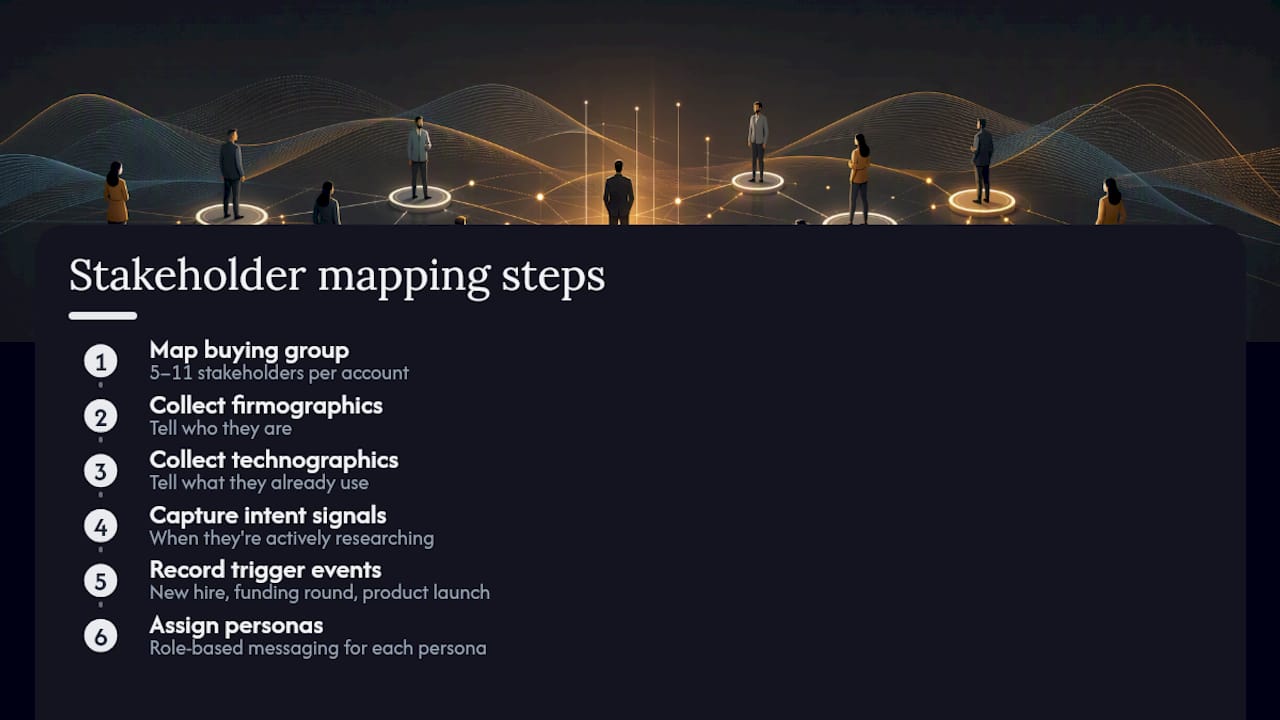
This is the fuel. Firmographics tell you who they are. Technographics tell you what they already use. Intent signals tell you when they’re actively researching. Trigger events — a new hire, a funding round, a product launch — tell you why now. Map every account to its buying group before outreach starts. Gartner guidance puts B2B buying groups at 5–11 stakeholders, which means single-contact outreach is a structural failure mode, not a bad-luck outcome.
3. Personalized multi-channel outreach and coordinated plays
SDRs and marketing run coordinated plays against the same accounts at the same time. An SDR sequence doesn’t run in isolation from a LinkedIn ad campaign or a targeted content push. The plays are designed together, timed together, and measured together. This is what Demandzen describes as the shift from a relay race to a unified revenue motion.

4. Operations and data model
Your CRM must be configured for account-level tracking, not just contact-level. That means contact-to-account mapping, account engagement scoring, and pipeline attribution at the account level. Without this, you can’t measure what’s working.

5. Enablement and content
Role-based messaging for each persona in the buying group. Deal rooms or shared workspaces for AE handoffs. Handoff dossiers that give AEs the full account picture — stakeholders engaged, content consumed, objections surfaced — so they don’t start from zero.
Pro Tip: Build your ICP from your top 10 closed-won accounts, not from a whiteboard session. Pull the firmographic and technographic data from those accounts and let the pattern tell you what “good” looks like.
Stat to know: Signalon reports that ABSD-sourced meetings convert to opportunities at roughly 2–3x the rate of volume-based outbound, with average deal sizes running 40–60% larger when the program is executed with discipline.
Structure beats heroics here. A 90-day pilot with clear success gates is how you earn the budget and headcount to scale. Here’s how to build it.
For building joint sales-marketing cadences that sustain this rhythm beyond the pilot, the governance model matters as much as the tactics.
| Phase | Duration | Key Milestone |
|---|---|---|
| Pilot design | Weeks 1–2 | 25–50 Tier 1 accounts selected, success gates defined |
| Roles and cadence | Weeks 2–3 | SDR, AE, marketing, RevOps owners assigned |
| Pilot execution | Days 1–90 | 45-day checkpoint; engagement and meeting targets reviewed |
| Scale decision | Day 90 | Pipeline per account vs. baseline; expand or reset |
The real talk: most teams over-invest in tools and under-invest in data quality. Get the foundations right before you automate anything. Signalon confirms that ABSD requires a connected tech stack with the CRM as the operational hub, sales engagement platforms for sequences, and data platforms for firmographic, technographic, and intent signals.
Core tool categories:
Integration priorities (do these first):
Pro Tip: Before buying an intent provider, check whether your CRM already captures behavioral signals you’re ignoring — website visits, content downloads, and email engagement from existing contacts. That’s free intent data.
For teams thinking about AI-enabled signal aggregation to speed qualification and personalization, the principle is the same: signals only matter if they reach the SDR at the moment of outreach.
As Signalon describes, ABSD treats each account as a market of one — which means your sequences need to reflect what you actually know about the account, not just the persona archetype.
Initial email (Tier 1):
Subject: [Trigger event] — quick thought for [First Name]
Hi [First Name],
Saw that [Company] recently [trigger event — e.g., expanded into a new market / hired a new VP of Sales]. Teams in that position often run into [specific challenge]. We’ve worked through that with a few [industry] companies and have a pattern that tends to compress the timeline.
Worth 20 minutes to compare notes?
[Your name]
Follow-up email (Day 8):
Subject: One thing that might be useful
Hi [First Name],
Sharing this because it’s directly relevant to what [Company] is working on: [link to resource or benchmark].
No ask — just thought it was worth your time. Happy to walk through how it applies to your situation if useful.
[Your name]
LinkedIn touch (Day 3):
Call script snippet:
Pro Tip: For Tier 1 accounts, spend 15 minutes on account research before writing a single word of outreach. Pull their recent press releases, LinkedIn activity, and job postings. The best personalization hook is almost always hiding in a job description.
Measuring dials and demos is the wrong game for ABSD. The metrics that matter are account-level, not activity-level. Here’s what to track and what targets to aim for.
What to watch beyond the table:
Benchmark to set expectations: Signalon’s data puts ABSD-sourced meeting-to-opportunity conversion at roughly 2–3x the rate of volume-based outbound. Use that as your directional pilot goal, not a guarantee.
For a deeper look at sales enablement metrics that connect SDR activity to revenue outcomes, the same account-level logic applies across the funnel.
Most ABSD pilots fail for predictable reasons. Here’s the honest list and what to do about each one.
Organizational anti-patterns:
Operational traps:
Measurement mistakes:
Red flags that should trigger a reset:
Pro Tip: The fastest way to diagnose a struggling ABSD pilot is to pull the last 10 sequences run against Tier 1 accounts and read the first email in each one. If they could have been sent to any company in the industry, the personalization isn’t there yet.
For a broader look at fixing classic sales mistakes that show up in ABSD adoption, the patterns are consistent across B2B tech teams.
Use this as your pre-mortem before the pilot and your handoff artifact to leadership. It’s built from the same framework Saleslabelconsulting uses in revenue architecture audits with B2B tech clients.
Pre-flight checks:
Pilot checklist:
Execution checklist:
Scale checklist:
Real talk from the field: One B2B SaaS team we’ve seen run this playbook started with 30 Tier 1 accounts, a single SDR, and a marketing manager who co-owned the account list. At the 90-day mark, 22 of those accounts had 3+ stakeholders engaged, and pipeline per account was running at more than double the non-target baseline. The program scaled to 150 accounts in the next quarter. The difference wasn’t the tools — it was the governance and the shared weekly review.
Monday.com’s target account selling framework supports the same conclusion: focusing resources on fewer, better-fit accounts and mapping buying groups early produces measurable win-rate and deal-size uplift. The checklist above is how you operationalize that principle.
ABSD produces outsized returns in a specific set of conditions. Get those conditions wrong and you’ll spend six months building a program that underperforms a well-run volume outbound motion.
ABSD works when:
ABSD underperforms when:
The decision rubric: If your top quartile of accounts by ACV represents a disproportionate share of revenue, and your deals consistently involve multiple stakeholders, run a 90-day pilot with 25–50 Tier 1 accounts. Set a single primary success metric — pipeline per account vs. your non-target baseline — and review it at 45 days. If the signal is positive, scale. If it’s flat, diagnose the personalization and data quality before expanding the list. Expect 6–9 months before ABSD pipeline meaningfully influences ARR at scale. That’s not a weakness of the model; it’s the compounding nature of account-level relationships.
For IT sales teams building SDR and AE alignment in complex B2B environments, the same rubric applies: the program’s durability depends on the governance model, not the sequencer.
Most ABSD programs stall because the architecture is designed in a workshop and never operationalized. Saleslabelconsulting works differently: we design the pilot, configure the data model, build the playbooks, and run the first 90-day review with your team — so the program is live and measurable before we hand it off.
What we deliver for ABSD engagements:
Engagements run as fixed-scope pilots, ops reconfiguration retainers, or enablement workshops — depending on where your team is in the journey. If you’re ready to move from volume outbound to a focused, account-level motion, start with our sales enablement framework to see how the pieces connect. Book a scoping call and we’ll tell you in 30 minutes whether ABSD is the right next move for your team.
These are the sources worth bookmarking if you’re building or scaling an ABSD program:
Subscribe to our Insights: Expert productivity tips in your inbox
You'll receive 1-3 emails per month. Your data stays private, always.

CRO & Co-Founder with Sales Label Consulting

Watch our Sales Mates Podcast
August 18, 2026 - 9 min read
Read article Read articleAugust 17, 2026 - 16 min read
Read article Read articleAugust 15, 2026 - 9 min read
Read article Read articleAugust 14, 2026 - 9 min read
Read article Read article