
GTM Audit: A Revenue Leader’s Guide for B2B Tech
A go-to-market (GTM) audit is a structured diagnostic of your entire revenue engine — people, process, technology, data, and pipeline — designed to surface where growth is leaking and what to fix first. Commission one when any of these three conditions are true:
If one of those fits, run an internal quick scan this week. If two or three fit, commission an external audit now.
A GTM audit is the fastest way to identify which part of your revenue engine is leaking — and to get a prioritized, 30-day plan to fix it before you hire, raise, or scale.
| Point | Details |
|---|---|
| Commission when targets slip | Run an external audit when you miss targets repeatedly, pipeline underdelivers, or a scale event is approaching. |
| Insist on a scored framework | A health score by GTM category lets you prioritize fixes by revenue impact, not by whoever shouts loudest. |
| Expect a 30-day turnaround | A focused audit delivers a scored report and 90-day plan in four weeks; quick wins surface in week one. |
| Track 30/90/180 milestones | Measure lead response, pipeline coverage, and forecast accuracy at 30 days; ARR per FTE at 180 days. |
| Saleslabelconsulting | Delivers a full GTM audit with CEO discussion, scored assessment, and a prioritized 90-day plan for B2B tech firms. |
A thorough GTM assessment touches every lever that connects market demand to closed revenue. Here’s what belongs in scope, and why each area matters:
Pro Tip: Attribution gaps tend to carry the highest leverage of any single finding. When you can’t link ad spend to closed revenue, you can’t scale what works — fixing attribution often frees significant budget immediately.
The primary outcomes are concrete and measurable. A well-run GTM implementation review identifies revenue leaks by name, prioritizes fixes by impact, and gives you a 90-day plan you can execute without waiting for a strategy offsite.
Specific KPIs you should expect to move:
A scored GTM assessment rolls individual category scores into an overall health score, so leadership can see revenue impact and implementation complexity side-by-side — which accelerates decision-making significantly.
| Audit Finding | Targeted KPI | Expected Direction |
|---|---|---|
| ICP mismatch in outbound | Win rate by segment | Increase |
| Slow lead response time | Speed-to-lead | Decrease (hours) |
| Attribution gap in demand gen | Cost per closed deal | Decrease |
| CRM data hygiene issues | Forecast accuracy | Increase |
| Misaligned compensation | ARR per FTE | Increase |
Deliverables from a full audit typically include a scored GTM health report, a prioritized 90-day growth plan, a KPI dashboard, and updated playbook recommendations. The sales audit explained framework from Saleslabelconsulting covers all of these in a structured five-step engagement.
A 30-day audit cadence is the standard for a focused GTM review. Here’s how it breaks down:
Before the audit kicks off, make sure your marketing analytics and website data are clean and accessible. Preparing these inputs ahead of time improves audit accuracy and reduces the time the implementation team spends on data cleanup rather than diagnosis.
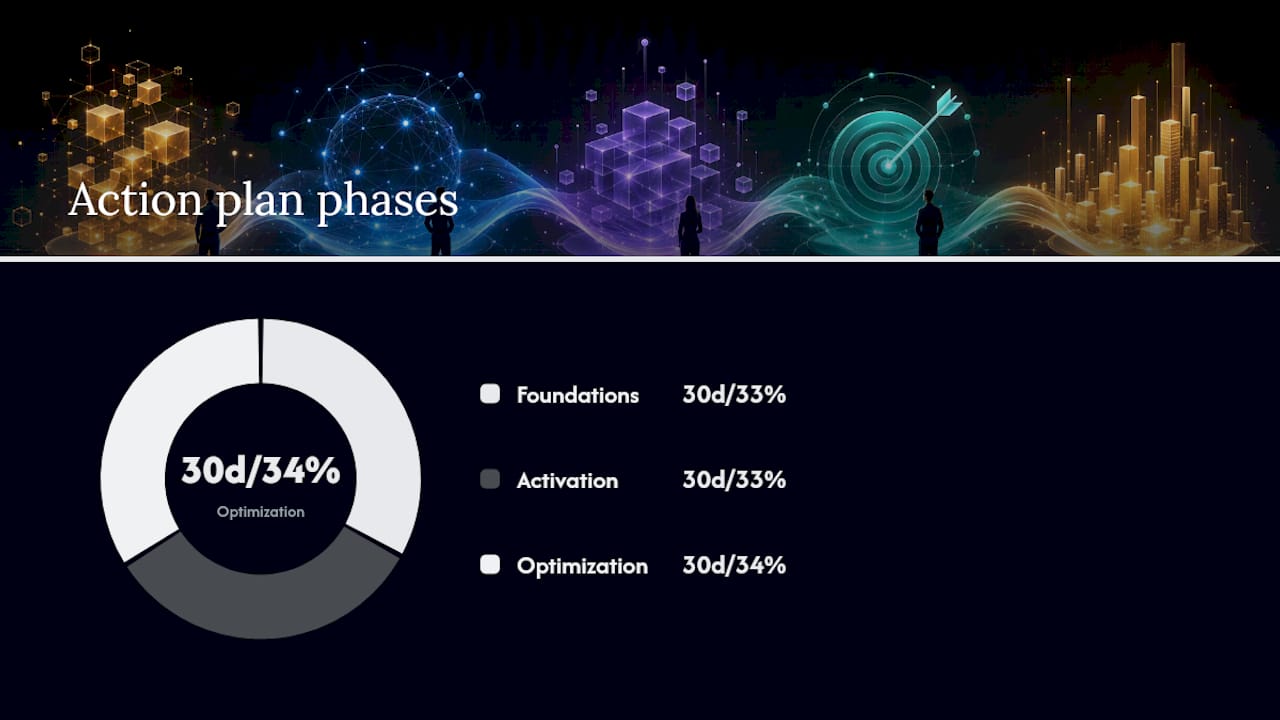
Engagement models vary by scope and depth. Here’s how the market typically breaks down for B2B tech and IT firms:
Main cost drivers: number of stakeholder interviews, depth of CRM and data analysis, whether implementation support is included, and the provider’s RevOps experience in your specific segment.
When evaluating proposals, check for: what’s explicitly included in scope, who owns the data after the engagement, what post-audit support looks like, and whether KPIs are tied to revenue outcomes rather than deliverable counts.
Evaluation criteria that actually matter:
Ten questions to ask any vendor:
Red flags to walk away from: no access to raw CRM data, vague deliverables (“a strategic roadmap”), no prioritized plan, KPIs tied to activity rather than revenue, and over-reliance on tool outputs without human diagnostic work.
Pro Tip: A good audit avoids the reflex to hire or buy. Before recommending headcount, a credible provider checks seller-to-pipeline ratios and quantifies whether the bottleneck is capacity, process, or data — because hiring into a broken process just scales the problem.
Use this checklist to scope an engagement or build an internal audit plan. The sales audit checklist from Saleslabelconsulting provides additional RFP-ready language for IT and B2B tech firms.
Audit activities to include in scope:
| Activity | Deliverable Format | Timing | Owner |
|---|---|---|---|
| CRM data export and hygiene | Scored data quality report | Week 1 | RevOps |
| Pipeline stage analysis | Conversion waterfall chart | Week 2 | RevOps + Sales Lead |
| Stakeholder interviews | Interview summary memo | Week 2–3 | Consultant |
| GTM category scoring | Scored health report | Week 3 | Consultant |
| 90-day prioritized plan | Action plan document | Week 4 | Consultant + CEO |
Internal prep steps before the kickoff:
Metrics to track by milestone:
Preparing your website analytics and tracking data before the audit starts shortens the diagnostic phase and gives the consulting team cleaner inputs from day one.
Real talk: most GTM audits fail not because the diagnosis is wrong, but because the output is a slide deck nobody acts on. The finding becomes a conversation piece at the next board meeting, and six months later the same revenue leaks are still open.
The audits that actually move ARR share one trait — they’re built around a prioritized, time-bound plan with named owners, not a list of observations. A scored health report is only useful if it tells you which three things to fix first and who’s accountable for each one. Without that, you’ve paid for a diagnosis and skipped the treatment.
The other pattern worth naming: leaders often commission an audit when they suspect a people problem, and the audit reveals a process or data problem. A credible GTM assessment checks seller-to-pipeline ratios and CRM data quality before recommending any headcount change. Hiring into a broken process scales the problem, not the revenue.
If your pipeline is underperforming and you need a clear answer — not a 60-slide deck — Saleslabelconsulting runs a focused GTM audit that delivers a scored health report and a prioritized 90-day plan within 30 days. No fluff, no vague “strategic recommendations.” You get a CEO-level discussion of findings, a structural analysis of your revenue system, and a concrete action plan with named owners.
Engagement options: a quick diagnostic to establish a baseline, a short 2–4 week audit for early-stage teams, a full-scope audit with implementation support for companies at $5M+ ARR, or an ongoing advisory retainer. Every engagement includes the sales enablement step-by-step framework so audit findings connect directly to execution. Review the full services overview or go straight to the audit engagement page to book a scoping call.
Subscribe to our Insights: Expert productivity tips in your inbox
You'll receive 1-3 emails per month. Your data stays private, always.

CRO & Co-Founder with Sales Label Consulting

Watch our Sales Mates Podcast
September 22, 2026 - 11 min read
Read article Read articleSeptember 21, 2026 - 8 min read
Read article Read articleSeptember 20, 2026 - 13 min read
Read article Read articleSeptember 19, 2026 - 13 min read
Read article Read article