
Sales Stage Exit Criteria: A RevOps Guide That Works
Sales stage exit criteria are the verifiable buyer outcomes that must be true before an opportunity advances to the next pipeline stage. Not a rep’s gut feeling. Not a completed activity like “sent proposal.” A fact you can point to, backed by evidence, that someone other than the rep can check.
Copy this checklist into your playbook or CRM field library today:
Pro Tip: Be strict about evidence at Proposal and Commit, where forecast dollars live. Give reps more judgment room at Discovery, where the goal is qualifying interest, not proving a signed contract exists.
Exit criteria work when they demand buyer-sourced evidence with a named owner and inspection method, not rep-reported activity.
| Point | Details |
|---|---|
| Define exit, not entry | Exit criteria require proof a deal is ready to advance, not just proof it belongs in the stage. |
| Ban activity-only gates | Replace “proposal sent” with buyer confirmation that they will evaluate it under stated criteria. |
| Tighten late-stage rigor | Require procurement contact, legal review status, and a mutual close plan before Commit. |
| Automate the enforcement | Use expiry dates and manager sign-off fields instead of manual pipeline scrubs. |
| Get a structured audit | Saleslabelconsulting builds enforceable exit criteria and CRM fields through its sales audit engagements. |
Entry criteria define who belongs in a stage. Exit criteria define what has to be true before that opportunity is allowed to leave it. That distinction sounds small. It isn’t. A deal can meet entry criteria for “Proposal” the moment a rep drafts one, but exit criteria for that same stage require the buyer to actually engage with it, evaluate it, and respond.
This is where most CRMs fall apart. Reps move deals forward based on effort, not buyer behavior, and RevOps ends up managing a forecast built on hope. Strong exit criteria make funnel conversion, stage aging, and forecast reporting more trustworthy because they replace “I feel good about this one” with a checkable fact.
Methodologies like MEDDICC exist for exactly this reason: they force reps to document Metrics, Economic Buyer, Decision Criteria, and so on, before a deal can be called qualified. You don’t need to adopt MEDDICC wholesale, but borrowing its discipline of buyer-sourced proof over rep opinion will fix half your pipeline hygiene problems on its own.
Here’s the part that should worry you if your stages are still activity-based: teams that skip explicit exit criteria, or stack too many stages without clear graduation rules, routinely see CRM compliance failures and forecast inflation concentrated in late stages — right where the dollars matter most.
Good stage design maps to buyer milestones, not seller tasks. If your stage names describe what the rep did, you’ve already built the wrong pipeline. Here’s a practical structure for a typical B2B motion, adapted to your product and sales cycle length.
Every stage needs the same five components: minimum buyer evidence, an owner, an inspection method, the CRM fields that capture it, and a rule for what happens when that evidence goes stale.
| Stage | Minimum Buyer Evidence | Owner | Inspection Method | Expiry/Downgrade Rule |
|---|---|---|---|---|
| Discovery | Business problem confirmed, stakeholder named, rough timeline discussed | Rep | Self-attest, manager spot-check monthly | Downgrade to lead if no follow-up in 21 days |
| Qualification | Budget range confirmed, decision process mapped, timeline set | Rep | Manager review at forecast call | Return to Discovery if budget/authority unconfirmed after 21 days |
| Evaluation/Demo | Technical stakeholder engaged, use case validated, next-step meeting booked by buyer | Rep + Solutions | Manager sign-off required | Downgrade if buyer cancels two consecutive meetings |
| Proposal | Buyer confirms they will evaluate the proposal under stated criteria | Rep | Mandatory manager inspection | Expire after 30 days with no buyer response |
| Negotiation | Procurement contact identified, legal review initiated, redlines exchanged | Rep + Deal Desk | Mandatory manager and deal desk sign-off | Rollback to Proposal if procurement goes silent 21+ days |
| Commit/Close | Mutual close plan signed, verbal or written commitment with date | Rep + Manager | Mandatory manager sign-off | Rollback to Negotiation if close date slips without new date |
| Post-Sale | Contract executed, kickoff scheduled, handoff to Customer Success confirmed | Rep + CS | Manager verification | Escalate if handoff exceeds 5 business days |
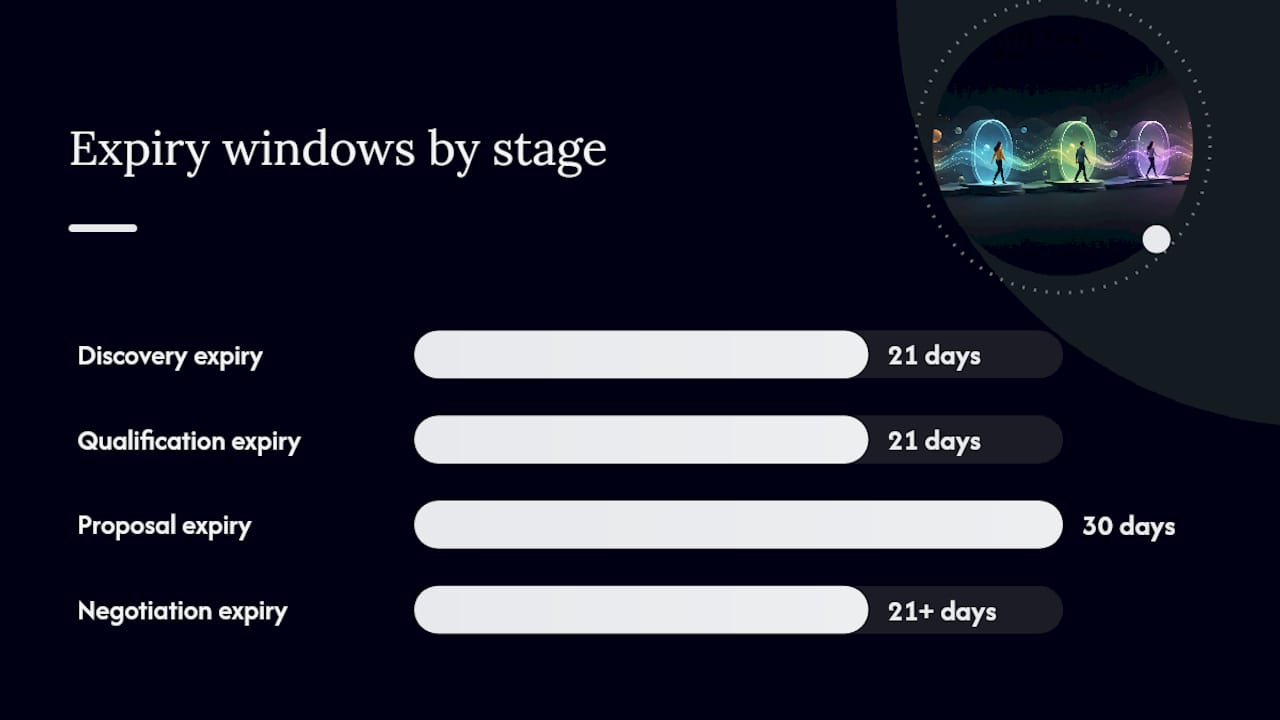
A few things about this list are worth calling out directly.
Discovery should stay loose. You’re qualifying interest, not building a legal case. Requiring too much proof here just trains reps to fudge the fields.
Qualification is where BANT or MEDDICC-style documentation earns its keep. Budget, authority, need, and timeline all need a real answer, not a placeholder.
Proposal is the stage most teams get wrong. Sending a document is an activity, and a proposal alone doesn’t prove buyer intent or a path to close. The exit criterion isn’t “proposal sent.” It’s “buyer has confirmed they will review it against specific criteria by a specific date.” That single change eliminates a huge share of the deals that die quietly in Proposal for six weeks.
Negotiation and Commit deserve your tightest controls. Without documented procurement contacts, legal review status, and a mutual close plan, deals linger at high-probability stages and inflate the forecast right when leadership is relying on it most.
Template snippet you can paste directly into a CRM field description: “Exit evidence: [buyer name] confirmed via email/call on [date] that [milestone]. Verified by [manager] on [date]. Expires [date] if no further buyer action.” That one line, repeated consistently, turns a vague pipeline into an auditable one.
For a deeper look at how to separate real opportunities from early-stage noise, see our guide on lead vs. prospect vs. sales opportunity definitions.
Most exit criteria fail not because the concept is wrong, but because the writing is lazy. “Prospect is engaged” isn’t a criterion. It’s a vibe. Here’s the process that produces criteria a manager can actually enforce.
Effective exit criteria follow something close to SMART principles: measurable, realistic, tied to a specific buyer action, and reviewed periodically rather than treated as permanent law. Demanding zero risk before a deal can advance isn’t rigor, it’s paralysis. The goal is measurable, realistic thresholds balanced against reasonable time constraints, not an impossible bar nobody clears.
Do: write criteria as buyer-confirmed facts (“Economic buyer verbally agreed to timeline on 3/12 call”).
Don’t: write criteria as rep activities (“Sent follow-up email,” “Had a good call”).

Pro Tip: When a rule feels too strict for a fast-moving deal, don’t loosen the criterion. Add a documented manager override instead. That preserves the standard while giving good judgment room to operate.
Exit criteria without measurement are just documentation. The point is to generate signals that tell RevOps whether the pipeline can be trusted.
Track these on a recurring basis:
Set a real threshold, not a vague one. A deal sitting in Proposal for more than 30 days with zero buyer response should trigger an automatic flag in your weekly pipeline review, not a shrug. Teams that skip this step tend to discover, three weeks before quarter close, that half their “committed” pipeline was never actually verified. That’s not a forecasting problem. It’s a governance problem that exit criteria are built to solve.
Managers should require documented evidence, not a verbal recap, before accepting any deal into the commit forecast. If a rep can’t produce it in under a minute during a pipeline review, the deal doesn’t belong at that stage yet.
The failure patterns repeat across almost every sales org we’ve reviewed:
Red flags to watch for in your next weekly forecast review: deals with no activity in 21+ days that are still “on track,” stages with zero rollback ever recorded, and reps who can’t answer “what does the buyer need to confirm before this advances?”
Quick remedies: compress redundant stages, require manager sign-off at Proposal and Commit specifically, and build automatic downgrade triggers tied to evidence expiry dates instead of relying on someone remembering to check.
Don’t rewrite your entire stage model in one sprint. Pilot it on one segment or product line for four to six weeks before expanding.
Ownership should be explicit from day one: RevOps designs the criteria and CRM fields, sales managers enforce them in weekly reviews, reps execute and log evidence, and one named person owns exceptions so edge cases don’t quietly erode the standard.
| Week | Milestone |
|---|---|
| 1–2 | Draft criteria per stage with sales leadership input |
| 3–4 | Build CRM fields, run pilot with one team or segment |
| 5 | Weekly manager inspection, collect friction points |
| — | Revise criteria based on pilot feedback |
| — | Full rollout with training and documented exceptions process |
Fields alone won’t fix pipeline hygiene, but the right fields make enforcement possible instead of aspirational.
Our sales audit engagements map each client’s stages to actual buyer milestones, then build the CRM fields and manager inspection rules that make those criteria enforceable, not aspirational.
The instinct to standardize everything is a trap. We’d rather see loose, judgment-friendly criteria at Discovery and near-forensic rigor at Proposal, Negotiation, and Commit, where forecast dollars actually live. The best inspection setups pair manager sign-off with buyer-sourced evidence, not just a completed field. Predictable revenue isn’t about controlling every stage equally. It’s about knowing exactly which stages deserve zero tolerance for guesswork.
Most sales teams have stage names but no real gates, which is exactly why forecasts slip and deals rot in “Proposal” for months without anyone flagging it. Saleslabelconsulting runs sales audits that map your actual buyer milestones to enforceable exit criteria and CRM fields, so managers stop debating deal health in every pipeline review and start inspecting it against a checklist.
The engagement typically pairs a pipeline audit with an implementation roadmap: we diagnose where your stages break down, then build the fields, inspection rules, and downgrade triggers that make exit criteria stick. If your forecast has been wrong more often than it’s been right, start with a sales audit and get a concrete plan for fixing it.
What’s the difference between entry criteria and exit criteria for a sales stage?
Entry criteria determine whether an opportunity belongs in a stage at all. Exit criteria determine whether it’s proven enough to leave that stage and move to the next one. A deal can meet entry criteria for Proposal the instant a document goes out, but it needs buyer confirmation before it satisfies the exit criteria to move to Negotiation.
How many pipeline stages should a B2B sales process have?
Five to seven stages tends to work best for most B2B motions. Beyond that, reps struggle to keep CRM data accurate, and the extra granularity rarely improves forecast quality.
What happens if a deal doesn’t meet exit criteria in time?
It should downgrade or roll back to the prior stage based on a predefined expiry rule, not sit indefinitely at an inflated probability. That rollback rule is what keeps your forecast honest.
Should managers approve every stage transition manually?
No. Reserve mandatory manager sign-off for the stages where forecast dollars are at risk, typically Proposal, Negotiation, and Commit. Earlier stages can run on rep self-attestation with periodic spot-checks.
How do exit criteria improve forecast accuracy?
They replace subjective stage movement with documented, buyer-sourced evidence, which reduces the number of deals inflating the forecast based on rep optimism rather than actual buyer commitment.
Subscribe to our Insights: Expert productivity tips in your inbox
You'll receive 1-3 emails per month. Your data stays private, always.

CRO & Co-Founder with Sales Label Consulting

Watch our Sales Mates Podcast
August 17, 2026 - 16 min read
Read article Read articleAugust 16, 2026 - 13 min read
Read article Read articleAugust 15, 2026 - 9 min read
Read article Read articleAugust 14, 2026 - 9 min read
Read article Read article