
What is sales alignment: A guide for tech sales leaders
TL;DR:
- Misaligned sales and marketing teams can cost B2B companies over 10% of annual revenue due to poor coordination and unclear processes. Achieving sales alignment involves shared definitions of success, unified buyer data, and joint accountability to ensure faster deals and accurate forecasts. Sustained success requires formal SLAs, integrated tech stacks, and continuous review to prevent operational silos and miscommunication.
Misaligned sales and marketing teams cost B2B companies 10% or more of annual revenue, and that number compounds quietly until someone finally asks why deals are stalling, forecasts are wrong, and the pipeline looks healthy but closes poorly. If you’re leading sales at a mid-sized tech company in Europe, you’ve probably felt that friction without having a clean name for it. This guide covers what is sales alignment, why it breaks down, and exactly what you can do to fix it operationally, not just culturally.
| Point | Details |
|---|---|
| Definition of sales alignment | Sales alignment means sales and marketing teams share the same success metrics, buyer insights, and responsibility across the sales funnel. |
| Revenue impact | Aligned teams grow revenue by about 20% annually while misaligned teams can decline by 4% or more. |
| Core components | Effective alignment relies on shared data, formalized SLAs, joint accountability, and integrated technology. |
| Common challenges | Terminology mismatches and lead qualification disagreements often cause misalignment and operational conflicts. |
| Sustaining alignment | Alignment requires ongoing execution, recurring reviews, and shared visibility into buyer conversations, not just meetings. |
Sales alignment isn’t a vibe or a team-building outcome. It’s a shared operating model where sales and adjacent revenue teams, marketing, customer success, and RevOps, work from shared definitions of success, shared buyer data, and shared accountability across the entire funnel.
That’s the sales alignment definition that actually holds up under pressure. Not “marketing and sales get along.” Not “we have a weekly sync.” It’s about whether both teams agree on what a good lead looks like, what stage a deal is in, and who owns what outcome.
The business case is hard to ignore. Aligned companies achieve roughly 20% annual revenue growth, while misaligned ones face about a 4% annual decline. That’s a 24-point swing based largely on operational discipline. Want to dig into the business case for sales alignment? It goes deeper than most teams expect.
What misalignment actually costs you:
The importance of sales alignment becomes obvious when you trace a deal backward. Where did it stall? Who had incomplete buyer context? Which team assumed the other had handled it? That’s the alignment gap showing up in real money.
Real alignment has three non-negotiable building blocks. Miss any one of them and you’re running on hope, not process.
1. Shared definitions of success
Both teams need to agree on revenue outcomes, not just activity metrics. If marketing is measured on MQLs and sales is measured on closed ARR, you’ve already created a structural misalignment. Winning looks like shared pipeline targets, conversion rates across funnel stages, and joint ownership of revenue outcomes. Not “we each hit our individual numbers.”
2. Shared buyer data
A unified CRM isn’t optional, it’s the connective tissue. When a sales rep opens a lead and has no visibility into what content that prospect engaged with, which emails they opened, or what pain points they’ve expressed, they’re going in blind. Shared buyer data means both teams work from the same profile of the same person in real time.

3. Shared accountability
This is where most companies flinch. Joint accountability across the funnel means marketing doesn’t wash its hands when a lead is passed, and sales doesn’t blame marketing when a quarter goes sideways. You set shared sales and marketing goals and both teams answer for the outcomes together.
Pro Tip: Don’t wait until alignment breaks to formalize it. Formalized SLAs for alignment define lead quality standards, response time expectations, and escalation paths before conflict starts. Write them down. Both teams sign off. Review them quarterly.
Here’s the uncomfortable truth most alignment conversations miss: alignment is an execution problem, not a collaboration attitude problem. More meetings will not fix a broken workflow. Shared visibility into buyer conversations will.
Most alignment failures don’t announce themselves. They show up as friction in the handoff, distrust between teams, and mysterious pipeline leakage.
The biggest culprits:
The fix isn’t a workshop. It’s a restructure of how teams address operational conflicts at the process level. Look at fixing sales and marketing conflicts as a systems problem, not a personality problem.
Pro Tip: Run a “lead journey audit” quarterly. Pick 20 recent closed-lost deals and trace them back to their first touch point. Map every handoff. You’ll find your alignment gaps faster than any survey will.
The enablement alignment strategies that actually work treat alignment as a continuous process, with regular check-ins, shared metrics, and real consequences when commitments aren’t met.
Here’s how to move from knowing what sales alignment is to actually building it. These aren’t theoretical. They’re what works.
1. Write a formal SLA between sales and marketing
Formalizing SLAs with defined lead quality criteria, response time targets, and handoff conditions turns alignment from a handshake into an enforceable process. Include what qualifies as a sales-ready lead, how quickly sales must follow up, and what happens when criteria aren’t met.
2. Consolidate your tech stack
Integrated CRM and marketing automation platforms that share real-time data are the foundation everything else sits on. If your sales team and marketing team are pulling reports from different systems, you don’t have alignment. You have two teams narrating two different movies. Your pipeline optimization techniques will never reach their ceiling without a single source of truth.
3. Adopt an account-based approach
Account-based marketing forces both teams to agree on target accounts, ideal customer profiles, and coordinated outreach. That shared targeting discipline is itself a form of alignment. It builds selling alignment practices into your day-to-day motion, not as a side project.
4. Run joint revenue reviews weekly
Not a status update, a diagnostic. Both teams look at the same pipeline data, review conversion rates at each stage, and flag where deals are stalling. If you want to know how to achieve sales alignment that holds, this cadence is where it lives.
| Alignment strategy | What it fixes | Time to impact |
|---|---|---|
| Formal SLA | Lead definition disputes | 2 to 4 weeks |
| Integrated CRM | Data silos and visibility gaps | 1 to 3 months |
| Account-based targeting | Misaligned outreach focus | 4 to 8 weeks |
| Weekly joint reviews | Forecast accuracy, deal stalls | Immediate |
| Shared incentive structure | Behavioral misalignment | 1 quarter |
If you want support building this from the ground up, consulting to improve alignment can compress the learning curve significantly. And a dedicated sales enablement for alignment program gives your teams the playbooks, training, and shared frameworks to sustain it.
Understanding the benefits of sales alignment gets clearer when you see the contrast between how most companies operate versus what integrated alignment actually looks like.
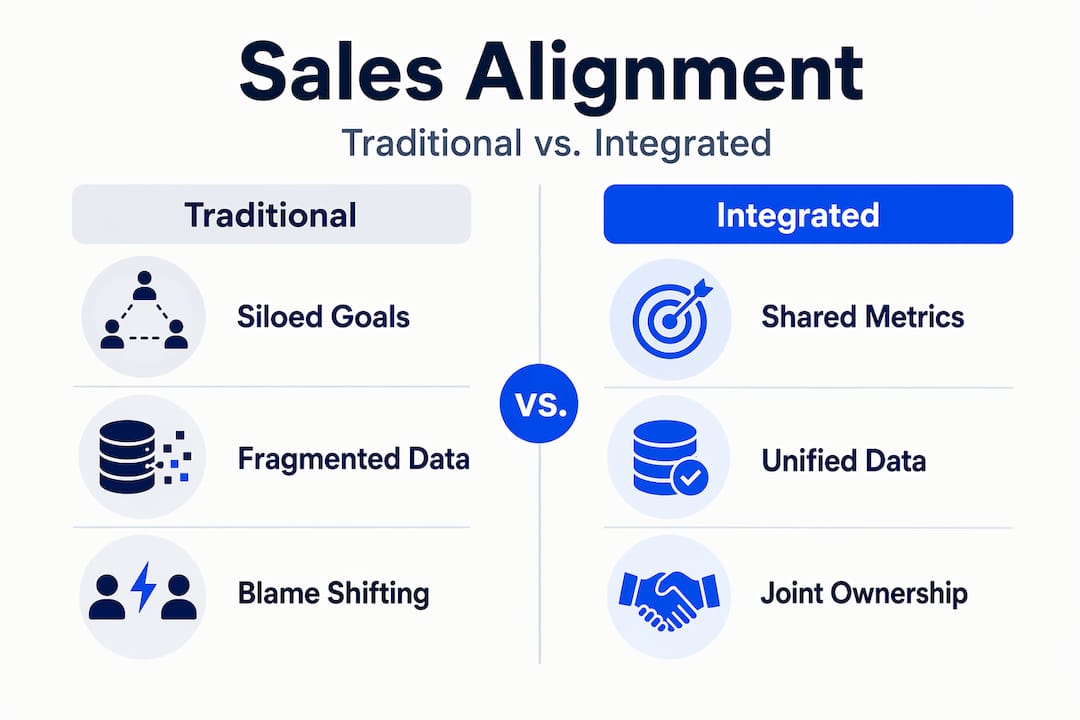
| Factor | Traditional approach | Integrated alignment |
|---|---|---|
| Lead qualification | Each team defines it separately | Joint ICP and MQL/SQL criteria |
| Data sharing | Separate systems, weekly reports | Unified CRM with real-time access |
| Accountability | Each team owns its own metrics | Shared pipeline and revenue targets |
| Handoffs | Manual, email-based, often late | Automated triggers with defined SLAs |
| Performance reviews | Siloed team meetings | Joint revenue reviews |
| Outcome | Lead waste, slow cycles, finger-pointing | Higher conversion, faster deals, accurate forecasts |
Companies using integrated revenue operations grow faster than those relying on siloed alignment efforts. That’s not surprising once you understand the mechanics.
What integrated alignment actually delivers:
If you want to build this into your team structure, start with RevOps and sales alignment as your operational backbone, then layer in sales operation best practices to keep it running.
Here’s the real talk most alignment articles won’t give you.
The majority of companies treat sales alignment as a relationship problem. So they fix it with meetings. Quarterly offsites. Shared Slack channels. “Better communication.” And six months later, the same friction is back because nothing structural changed.
Alignment fails when teams lack shared visibility into buyer conversations, not when they lack goodwill toward each other. Your sales reps can love your marketing team and still lose deals because they had no idea what the prospect read, saw, or said before the first call.
There’s another issue nobody talks about loudly: metric mismatches between enablement and leadership create hidden alignment crises even when meetings are happening regularly. Sales enablement reports content usage. Leadership tracks quota attainment. Neither metric tells you whether reps are using the right content at the right stage with the right buyers. That’s a systems design failure, not a communication failure.
What actually works is building alignment into your workflows. Shared dashboards that both teams are accountable to. Automated handoff triggers that remove the “did you follow up?” conversation. Revenue reviews where marketing and sales answer together for results. This is teamwork and operational alignment that holds under pressure.
Structure beats heroics. If your alignment depends on two exceptional managers who happen to get along, it will break the moment one of them leaves. Redefining alignment implementation means building systems that don’t rely on individual relationships to function.
The best sales alignment best practices aren’t clever tactics. They’re the discipline to make shared definitions, shared data, and shared accountability non-negotiable parts of how your revenue team operates.
Getting clear on what is sales alignment is the first step. Building it inside a growing tech company is the harder part. That’s where structured enablement makes the difference between good intentions and actual pipeline results.
At Sales Label Consulting, we work with RevOps leaders, Heads of Sales, and VPs at mid-sized tech companies to build the processes, playbooks, and shared metrics that make alignment stick. We’ve seen what breaks and what holds. Our sales enablement step-by-step guide gives you a proven path from misalignment to predictable revenue. If you want to measure what’s working, our sales enablement metrics for ROI framework shows you exactly where to look. Start with our sales enablement best practices to find your highest-leverage moves first.
Alignment ensures both teams share goals and buyer data, which reduces wasted effort and increases conversion rates across every funnel stage. Aligned companies achieve roughly 20% annual growth compared to the 4% decline misaligned companies face.
A sales-marketing SLA formalizes commitments around lead quality, response times, and handoff criteria so both teams are held to clear, measurable standards. Formalizing SLAs turns alignment from a handshake into a process with real accountability.
Sales distrust builds when handoffs are based on activity like email opens rather than genuine buying signals such as budget, urgency, and decision authority. Reps end up re-qualifying everything, which wastes time and breeds resentment.
A reliable CRM acts as the single source of truth, giving both sales and marketing real-time visibility into the same buyer data and eliminating the information gaps that cause handoff failures.
It’s ongoing. Alignment decays without recurring reviews against shared KPIs, because team priorities shift, tools change, and new people arrive with different assumptions about how things work.
Subscribe to our Insights: Expert productivity tips in your inbox
You'll receive 1-3 emails per month. Your data stays private, always.

CRO & Co-Founder with Sales Label Consulting

Watch our Sales Mates Podcast
October 15, 2026 - 9 min read
Read article Read articleOctober 14, 2026 - 7 min read
Read article Read articleOctober 13, 2026 - 10 min read
Read article Read articleOctober 12, 2026 - 11 min read
Read article Read article