
Sales quotas explained: Strategies for EU tech leaders
TL;DR:
- Sales quotas are measurable targets assigned to sales teams for specific periods, not arbitrary or aspirational goals. A hybrid approach that combines top-down business targets with bottom-up territory and performance validation ensures realistic and fair quota setting in EU tech firms. Effective management involves continuous monitoring, stress testing, and detailed documentation to align quotas with human factors and regulatory requirements.
Sales quotas are one of the most misunderstood levers in a technology company’s revenue engine. Too many sales leaders treat them as arbitrary numbers handed down from finance, or worse, as aspirational stretch goals with no connection to pipeline reality. The result? Disengaged reps, unpredictable revenue, and a cycle of constant renegotiation that drains everyone’s energy. This guide cuts through the noise. We’ll walk you through what sales quotas actually are, how to set them with rigor, how to validate and govern them over time, and what EU-specific regulatory realities you cannot afford to ignore in 2026.
| Point | Details |
|---|---|
| Quotas are measurable targets | Sales quotas are concrete targets for revenue or activities, not just broad goals or aspirations. |
| Hybrid setting works best | Leading EU tech firms blend top-down and bottom-up inputs to set high-impact, achievable quotas. |
| Benchmarks and stress tests matter | Quota validity comes from using pipeline coverage and attainment benchmarks, not just averages. |
| Fairness and compliance are musts | Design quotas to handle edge cases and ensure defensibility under EU pay transparency rules. |
| Quota management is ongoing | Effective quota management means regular monitoring, coaching, and well-documented in-year tweaks. |
Let’s start with basics, because a lot of the dysfunction we see in EU tech sales teams starts here. A sales quota is not a wish list. It’s not a stretch goal designed to “motivate” people toward something they’ll never reach. Sales quotas are measurable targets assigned to a salesperson or team for a defined time period, such as monthly, quarterly, or annually, and they’re built to be specific and trackable.
Here’s where most teams blur the lines:
The critical distinction? A quota is not the same as a stretch goal. Stretch goals are designed to be aspirational, often set at levels where hitting them would be exceptional. Quotas are designed to define expected performance. Conflating the two is a management mistake that erodes trust fast.
Real talk: If your reps don’t know exactly what counts toward their quota and when credit is applied, you don’t have a quota system. You have a source of conflict.
Pro Tip: Write your quota definition in plain language before you set any number. Define exactly what qualifies as a closed deal, which products are included, whether multi-year deals count at full value or year-one value, and when credit is recognized. Ambiguity at the definition stage shows up as disputes at quarter-end.
Clarity is not optional. It’s the foundation everything else rests on.
Now that we’ve defined what quotas are, let’s talk about how to actually set them without flying blind. The mistake most teams make is going pure top-down. Finance announces an ARR target, leadership divides it by headcount, and reps get a number with no context for why it was chosen or whether it’s achievable given their territory.
A practical hybrid approach for EU tech and SaaS teams starts top-down with the business target, validates that number bottom-up through territory capacity and historical performance, and then reconciles the gap before deployment. Here’s how this plays out in practice:
| Approach | Starting point | Strengths | Risks for EU tech teams |
|---|---|---|---|
| Top-down only | Board or finance target | Fast to deploy | Ignores territory variance and ramp reality |
| Bottom-up only | Rep and territory data | Highly contextual | May undershoot business needs |
| Hybrid | Both simultaneously | Balanced and defensible | Requires more data and process discipline |
The hybrid model takes more effort upfront. But it dramatically reduces renegotiation mid-year, which is where the real time gets lost. If you’re serious about building high-performing sales teams, this structured approach is non-negotiable.
Pro Tip: Before finalizing any quota, run your historical pipeline data through a simple coverage ratio check. If the average rep needs 3x pipeline coverage to hit quota, and their current pipeline is at 1.8x, you already know the number needs adjustment before the quarter even starts. Use your coaching for pipeline growth strategy to close the gap proactively.
Setting a quota using a hybrid model is a strong start. But how do you know the number you’ve landed on is actually valid? This is where stress testing becomes essential.

Quota validity can be confirmed using pipeline coverage ratios and by monitoring attainment distribution across your team, not just average attainment. These two tools together tell you whether your quota is realistic or just optimistic.
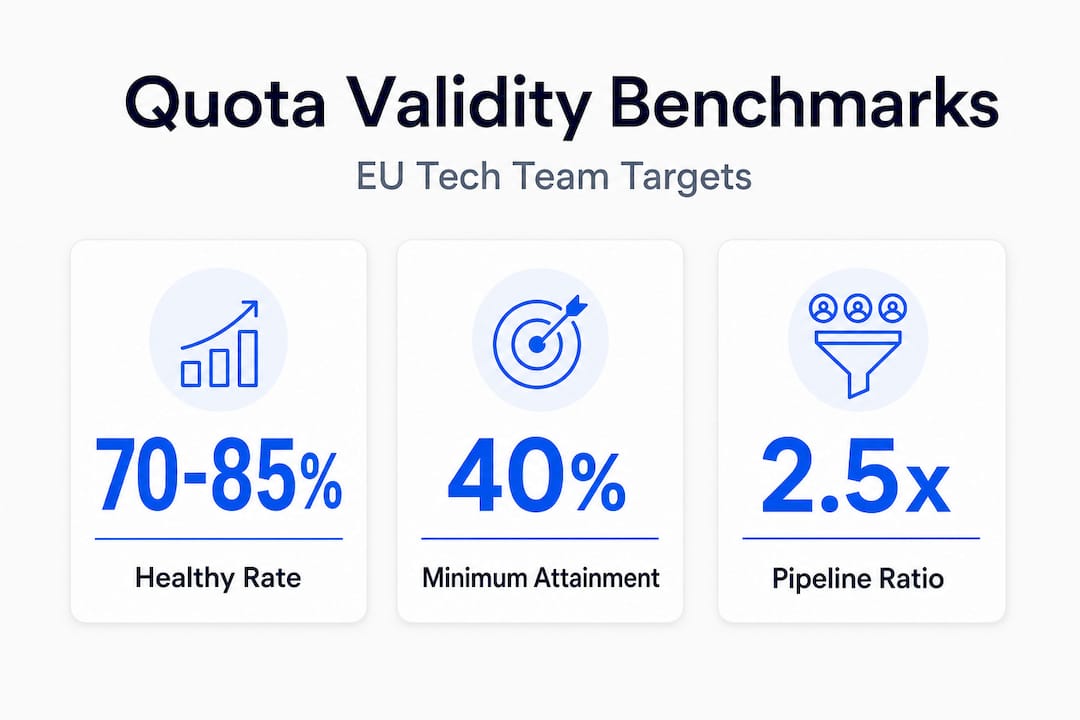
Pipeline coverage ratio is simple: take the total pipeline value across all reps and divide by the total quota for the period. A 3x coverage ratio is a commonly cited minimum for B2B tech. Below 2x, you’re in trouble. Above 4x, you may be setting quotas too low or counting unqualified deals.
Attainment distribution is even more telling. Instead of looking at whether the team hit 95% of plan on average, look at how individual attainment is spread. Ask:
If fewer than 40% of your reps are hitting quota, that’s not a performance problem. That’s a quota design problem.
Industry benchmarks for quota attainment in B2B suggest a healthy attainment rate is between 70% and 85%, while typical ranges show that only 43% to 57% of reps actually hit quota in a given quarter. That gap between “healthy target” and “typical reality” is a signal: most teams are running quotas that are too aggressive for real-world conditions.
Red flags to watch for in your own data:
The goal is for measuring pipeline health to become a regular habit, not a quarterly scramble. Treat these benchmarks as diagnostic tools, not report cards.
Here’s a truth that doesn’t get discussed enough: even a well-calibrated quota number can create serious problems if you haven’t addressed the edge cases. And in EU technology sales environments, edge cases are everywhere.
Quota design must handle real-world complexity including territory and account potential differences, ramp and tenure adjustments, mid-year changes, and the downstream mechanics of how deals get credited. If you don’t document the rules for these situations before deployment, you will be making judgment calls under pressure at the worst possible moment.
Common edge cases that need written policies before your plan launches:
EU compliance adds another critical layer. The EU Pay Transparency Directive expands its scope to include total remuneration and variable pay elements, meaning that differences in quota-linked compensation must be documented and explainable. If two reps in similar roles with similar tenure have materially different OTE outcomes driven by quota differences, your company needs to be able to show why that difference exists.
Real talk: “We just gave them different territories” is not sufficient documentation under the EU Pay Transparency Directive. You need to show the market potential data, the historical performance baseline, and the methodology used to assign quota. Build that file now, not when an audit request arrives.
For deeper guidance on structuring your variable comp mechanics correctly alongside quota design, the commission model strategies and onboarding and ramp frameworks on our site are worth reviewing before your next planning cycle.
This is the section most quota guides skip. They spend all their energy on how to set the number, and then assume deployment is the finish line. It isn’t. Quota effectiveness is determined by what you do after you deploy.
Effective quota management operates as a continuous governance loop: you gather data inputs, model scenarios, deploy, monitor KPIs in-period, and make adjustments with clear pre-established rules. That last part is critical. Adjustments made without written rules create fairness disputes and erode trust faster than a bad quota number ever could.
Here’s what your governance loop should look like in practice:
Leading indicators matter here as much as lagging ones. Pipeline coverage by rep, ramp trajectory, and activity or process KPIs, when monitored early, give you the ability to intervene with coaching before a rep misses quota rather than after. That’s the difference between proactive management and reactive damage control.
Pro Tip: Write your quota adjustment rules before you launch the plan. Define what triggers a mid-year quota adjustment, who approves it, and how it will be communicated. If reps learn that quotas can be renegotiated by complaining loudly enough, you’ll spend your entire year managing that dynamic instead of managing pipeline. Link your pipeline health indicators tracking directly to your adjustment criteria so decisions are data-driven, not political.
Here’s our honest take after working with EU tech sales teams across multiple stages: most quota guides treat quota-setting as a math problem. Get the formula right and the people will follow. That’s wrong.
The real failure mode we see most often is not a bad formula. It’s a failure to account for human context. When a rep in Berlin is carrying the same quota as a rep in Warsaw, despite wildly different market maturity and deal cycle lengths, it doesn’t matter how elegant your hybrid model is. The Warsaw rep feels set up to fail. And they’re right.
One-size-fits-all quotas are a morale drain disguised as operational efficiency. They push your best people to focus on the path of least resistance, not the highest-value opportunities. And they concentrate overachievement in your most favorable territories while creating chronic underperformance in harder ones.
We’ve also seen teams overcorrect in the opposite direction, building quotas so tailored and complex that no one can explain how they were derived. Reps who don’t understand their quota don’t trust it. And reps who don’t trust their quota don’t commit to it.
The real lesson from managing quota processes through rapid scale, for more on pipeline predictability: set rules before you set numbers. The governance framework, the adjustment criteria, the edge case policies, and the documentation standards should all exist before a single quota number is deployed. Numbers without structure are just pressure. Structure with numbers is a performance system.
Designing a quota system that actually holds up under real-world conditions, EU regulatory scrutiny, and the pressures of rapid scaling takes more than a spreadsheet. It takes experience with what breaks and why.
At Sales Label Consulting, we work directly with RevOps leaders, Heads of Sales, and VPs of Sales at EU technology companies to build quota systems that are calibrated, documented, and defensible. Whether you need a structured step-by-step enablement approach, want to align your team around scaling best practices, or need a comprehensive sales audit to find where your current process is leaking revenue, we bring the entrepreneurial tech experience to make it practical and fast. Let’s build a quota system your team can actually win with.
A sales quota is a measurable revenue target assigned to a salesperson or team for a set time period, such as monthly or quarterly, and it’s specific enough to be tracked and verified.
A healthy attainment rate ranges from 70% to 85%, though typical B2B data shows only 43% to 57% of reps actually hit their quota in a given quarter.
You can validate fairness by using pipeline coverage ratios and analyzing attainment distribution across your team rather than relying on a single average number.
The most common mistakes are relying purely on top-down targets and skipping the bottom-up validation step that the hybrid quota model requires for accuracy and fairness.
Because the EU Pay Transparency Directive requires companies to document and justify differences in variable pay tied to quota and territory mechanics, not just base salary.
Subscribe to our Insights: Expert productivity tips in your inbox
You'll receive 1-3 emails per month. Your data stays private, always.

CRO & Co-Founder with Sales Label Consulting

Watch our Sales Mates Podcast
September 14, 2026 - 10 min read
Read article Read articleSeptember 13, 2026 - 8 min read
Read article Read articleSeptember 12, 2026 - 10 min read
Read article Read articleSeptember 11, 2026 - 11 min read
Read article Read article