
Measure sales effectiveness to drive B2B revenue growth
TL;DR:
- Sales effectiveness links effort directly to revenue outcomes, emphasizing measurable, strategic metrics.
- Consistent measurement enhances forecasting, coaching, and decision-making, driving predictable revenue growth.
- Implementing focused frameworks like audits, playbooks, or dashboards accelerates data-driven sales improvement.
Most sales leaders we talk to believe their best reps are simply gifted. They’ve got the charisma, the instincts, the relationships. And sure, talent matters. But here’s the real talk: charisma doesn’t scale. Intuition doesn’t compound. If you want predictable revenue and a team that consistently hits quota, you need measurement baked into the DNA of your sales operation. This article breaks down what sales effectiveness actually means, which metrics matter most, how to integrate measurement into your strategy, and what practical frameworks European B2B sales teams can start using right now.
| Point | Details |
|---|---|
| Measurement fuels growth | Tracking sales effectiveness uncovers opportunities for revenue and performance improvements. |
| Metrics reveal strengths | Smartly chosen metrics help sales leaders identify what works and where to optimize. |
| Frameworks drive action | Practical frameworks turn measurements into clear strategies for sustainable sales success. |
| Culture shift needed | Sales measurement is most powerful when it becomes a leadership priority and cultural norm. |
Sales effectiveness is the degree to which your sales team converts effort into revenue outcomes. It’s not just about how hard your reps work. It’s about whether the right activities, with the right prospects, at the right time, are producing results that actually move your business forward.
Here’s where most organizations go wrong. They confuse activity with output. A rep who makes 80 calls a week might look impressive in a CRM report, but if those calls produce zero qualified pipeline, you’ve got a motion problem, not a hustle problem. Sales effectiveness is about connecting effort to outcomes in a measurable, repeatable way.
Why does this matter so much right now? Because the days of riding market momentum or betting on a few star sellers are over for most B2B companies in Europe. Boards want predictable ARR (Annual Recurring Revenue). Investors want margin expansion. CFOs want to see EBITDA (Earnings Before Interest, Taxes, Depreciation, and Amortization) improving year over year. And the only way to reliably deliver on those expectations is through a data-informed sales function.
Understanding sales performance metrics is the first step toward building that kind of function. It gives you a shared language across leadership, RevOps, and the sales floor.
15-25% EBITDA growth is achievable for consulting firms and B2B tech companies that commit to effective sales metrics and structured performance assessment.
Let’s be real about the common misconceptions that get in the way:
These misconceptions are expensive. When sales leaders operate on assumptions instead of data, they make the wrong investments, coach on the wrong behaviors, and miss the revenue targets they could have hit. The foundation of everything that follows in this article is this: measurement is not a reporting task. It’s a strategic discipline.
With this foundational understanding, we can address exactly how measurement plays a strategic role across your entire revenue operation.
Now that the importance is clear, let’s look at which metrics actually move the needle. Not every number in your CRM is worth obsessing over. The goal is to identify the indicators that connect directly to revenue outcomes and business health.
Here are the most valuable key sales metrics for B2B sales teams:
Here’s a practical comparison of what happens when teams track these metrics consistently versus those that don’t:
| Metric | Teams with regular tracking | Teams without tracking |
|---|---|---|
| Win rate | 28-35% average | 18-22% average |
| Sales cycle length | Shorter by 15-20% | Unpredictable, often extended |
| Quota attainment | 75-85% of reps hitting target | 50-60% of reps hitting target |
| Revenue predictability | High confidence in forecasts | Frequent forecast misses |
| Coaching effectiveness | Data-driven, targeted | Anecdotal, reactive |
The data tells a clear story. Sales enablement metrics consistently boost ROI for tech firms by giving managers the visibility they need to coach with precision rather than guessing what’s holding reps back.
Looking at sales metrics examples from high-performing tech teams shows that the most successful organizations typically track five to seven core metrics, not twenty. They review them weekly in pipeline reviews and use them to make actual decisions about resource allocation, coaching priorities, and campaign targeting.
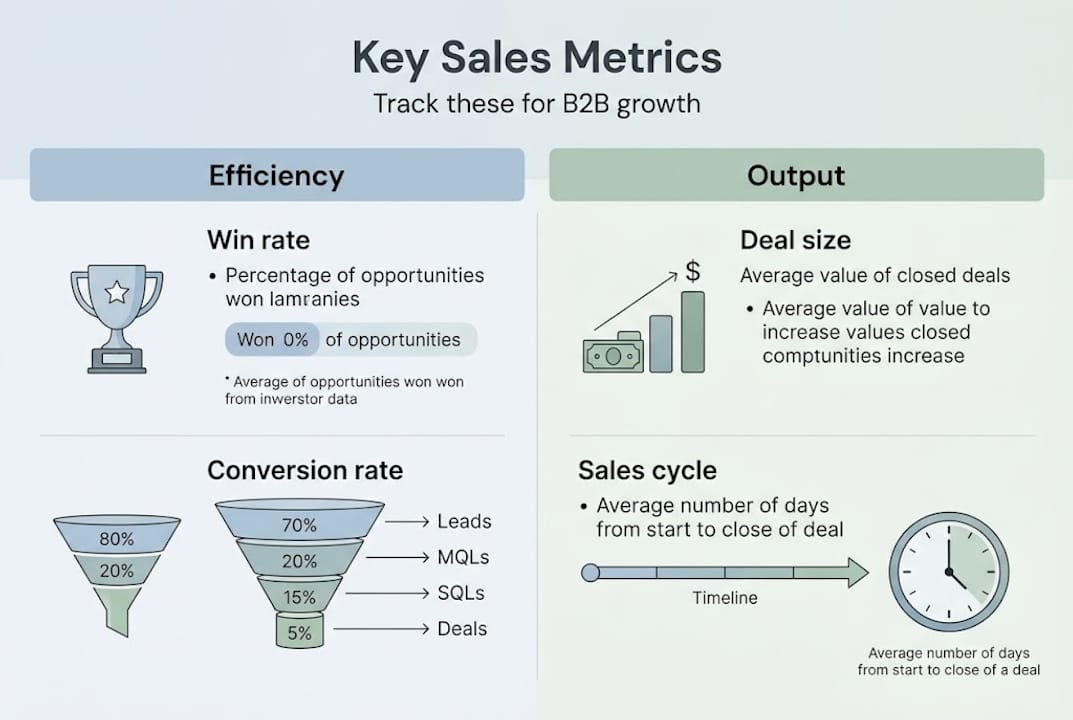
One practical area where metrics create massive leverage is in the sales review process. When reviews are structured around objective data rather than manager perception, reps trust the feedback more and act on it faster.
Pro Tip: Don’t choose metrics based on what your competitors are tracking or what looks impressive in a board slide. Choose metrics that answer the specific strategic questions your business is facing right now. If your challenge is slow pipeline velocity, focus on cycle length and stage conversion. If your challenge is poor margin, focus on average deal size and discount rate.
Understanding what to measure is only half the battle. The real transformation happens when measurement changes how your team operates day to day. Let’s look at how to integrate measurement into strategy and coaching in a way that actually sticks.
Here’s a sequential approach for building a measurement-driven sales operation:
Analyzing sales performance with this kind of structured cadence reveals patterns that would be invisible to even the most experienced sales leader operating on intuition alone. You start seeing things like: deals that go to legal review are 40% less likely to close. Or: reps who do three or more discovery calls have a win rate 12 points higher than those who do one.
Those insights don’t come from gut feel. They come from data.
Measuring sales outcomes through structured processes like sales audits helps consulting firms and B2B tech companies unlock reliable, predictable revenue rather than riding waves of inconsistent performance.

A common pitfall is what we call “metric overload.” Leadership gets excited about measurement and suddenly the team is tracking 25 KPIs (Key Performance Indicators). Reps spend more time updating dashboards than selling. Managers spend more time in reporting meetings than coaching. That’s the opposite of what you want.
Use the sales audit checklist to identify the five to seven metrics that matter most for your current growth stage, and ruthlessly ignore the rest. Focus creates momentum.
Pro Tip: If a metric doesn’t lead to a specific action when it changes, it’s probably not worth tracking. Every metric on your dashboard should have a corresponding “If this drops, we do X” response plan.
To put these strategies into practice, let’s explore real frameworks and tools that European B2B sales teams can deploy without needing a full RevOps team or a massive tech stack investment.
There are three primary frameworks worth knowing:
1. The manual audit framework. This is the scrappy starting point. Pull your CRM data monthly, run it through a structured spreadsheet template, and review with your sales leadership team. It’s low tech but highly effective for organizations that are just beginning to build a measurement culture. It forces conversation and ownership without requiring software investment.
2. The enablement playbook framework. This goes one step further. You define your sales process stages, assign specific metrics to each stage, and build enablement content that addresses the gaps your metrics reveal. If your conversion from demo to proposal is consistently low, your playbook gets a new module on demo-to-proposal follow-up. The playbook becomes a living document, updated by data. Sales enablement step by step improves revenue predictability by creating a structured, measurable process that every rep follows and every manager can evaluate.
3. The automated dashboard framework. This is the most scalable option. Tools like Salesforce, HubSpot, or Clari can automate data collection and visualization, giving you real-time visibility into pipeline health, rep performance, and forecast accuracy. This framework requires more investment upfront but pays back quickly in time saved and decisions improved.
| Framework | Cost | Time to implement | Best for |
|---|---|---|---|
| Manual audit | Low | 1-2 weeks | Early-stage measurement programs |
| Enablement playbook | Medium | 4-8 weeks | Teams with defined sales processes |
| Automated dashboard | Higher | 8-16 weeks | Scaling teams with CRM discipline |
Here are practical tips for launching a measurement initiative when you’re working with limited time and resources:
One underrated consideration when building your measurement program is how sales commission models interact with the metrics you track. If you’re measuring win rate but commission is purely volume-based, you’re sending mixed signals. Align your incentives with the behaviors you’re trying to reinforce through your metrics.
Pro Tip: Start with one framework. Master it. Then expand. Trying to build manual audits, a playbook, and an automated dashboard simultaneously usually leads to none of them getting done well. Structure beats heroics.
Here’s an uncomfortable truth that most consultants won’t say out loud. Most sales organizations that “track metrics” aren’t actually using them. They collect data. They build dashboards. They present numbers in QBRs (Quarterly Business Reviews). And then they make decisions based on the same instincts they’ve always relied on.
That’s not measurement. That’s theater.
The real problem isn’t a lack of data. It’s a lack of culture. Measurement only works when leadership treats data as a genuine input to decisions, not a post-hoc justification for decisions already made. We’ve seen this pattern repeatedly across European B2B tech companies: the CRO (Chief Revenue Officer) says “we’re data-driven,” but when the numbers contradict their preferred strategy, the numbers get ignored.
There’s a massive difference between tracking data and acting on explaining sales metrics in a way that changes behavior. One is reporting. The other is leadership.
Changing this requires explicit commitment from the top. The VP of Sales has to model data-driven decision-making in every pipeline review, every strategy session, every rep conversation. When leadership asks “what does the data say?” before offering an opinion, the culture shifts. It takes three to six months of consistent behavior, but it sticks.
Measurement is not a tool for catching people out. It’s a tool for removing ambiguity so that everyone, from SDRs to the board, can have honest conversations about what’s working and what needs to change.
The frameworks and metrics in this article give you a strong starting point. But knowing what to measure is different from building a measurement system that actually drives change inside your organization.
At Sales Label Consulting, we specialize in turning measurement from a concept into a competitive advantage. Whether you need a structured step-by-step sales enablement program, a hands-on sales audit checklist to identify your biggest gaps, or a complete sales performance review checklist to bring structure to your team’s evaluation process, we’ve built tools and consulting engagements specifically for European B2B sales leaders who want predictable, scalable results. Let’s move from insight to action.
Key metrics include conversion rate, win rate, quota attainment, sales cycle length, and average deal size. These five give you a complete picture of pipeline health, team performance, and revenue predictability, as supported by tech firm ROI data from enablement-focused organizations.
Sales effectiveness should be reviewed at least quarterly, with monthly check-ins for fast-moving environments. Teams following a predictable revenue framework typically build weekly metric reviews into their pipeline management cadence for maximum responsiveness.
Measurement provides objective data that reveals gaps and opportunities invisible to even experienced leaders. 15-25% EBITDA growth outcomes consistently favor teams that use structured metrics over those relying solely on experience-based judgment.
Manual audits, enablement playbooks, and automated dashboard tools are the three most practical starting points. A structured sales audit process is particularly effective for getting fast visibility into your current state with minimal technology investment.
Subscribe to our Insights: Expert productivity tips in your inbox
You'll receive 1-3 emails per month. Your data stays private, always.

CRO & Co-Founder with Sales Label Consulting

Watch our Sales Mates Podcast
October 11, 2026 - 7 min read
Read article Read articleOctober 10, 2026 - 8 min read
Read article Read articleOctober 9, 2026 - 7 min read
Read article Read articleOctober 8, 2026 - 10 min read
Read article Read article