
Optimize sales territory management for revenue growth
TL;DR:
- Effective sales territory management is an ongoing process that aligns with how businesses sell, not just geography.
- Using hybrid territory structures tailored to market dynamics and customer needs enhances sales efficiency and growth.
- Regular monitoring and adjustments through KPIs and team feedback prevent imbalances and maximize revenue.
Sales territory management is one of the most underestimated levers in a B2B tech company’s revenue engine. Most teams treat it as a one-time map exercise, then wonder why pipeline coverage is uneven and top reps are burning out while others coast. The reality is that territory structure can be geographic, named-account, industry/vertical, customer segment, product/solution, partner/channel, or hybrid, and the key is aligning that structure to how your business actually sells. Get this right, and you unlock predictable growth. Get it wrong, and you’re leaving ARR on the table every quarter.
| Point | Details |
|---|---|
| Territory isn’t just geography | Effective sales territories account for accounts, industries, segments, and more—not just maps. |
| Management is ongoing | Real success comes from continuous monitoring, adapting, and balancing territories as your business evolves. |
| Hybrid models drive results | Mixing territory dimensions lets EU tech firms better address market complexity and grow revenue. |
| Align structure to sales motion | The best territory design is always tailored to how your business actually sells, not what looks simplest. |
| Review and realign regularly | Regular territory reviews and adjustments help maintain performance and avoid costly imbalances. |
With this foundation, let’s clarify exactly what sales territory management means and why it’s transformative for EU tech firms.
Sales territory management is not a one-time carve-up of a map. It’s an ongoing, proactive process of designing, allocating, monitoring, and refining how your sales team covers the market. Think of it as the operating system underneath your entire go-to-market motion. When it runs well, everything else accelerates. When it’s outdated or ignored, even your best reps can’t save the numbers.
Here’s the real talk: geography is just one dimension. Modern territory structures can be built around many different factors, and the smartest EU tech companies are already mixing them:
The problem with defaulting to pure geographic splits in the EU is obvious once you see it. A rep covering “DACH” might be handling a 50-person SaaS startup in Munich and a 10,000-person enterprise in Frankfurt simultaneously. Those two deals require completely different skills, cycles, and stakeholders. Lumping them together because they share a country code isn’t a strategy. It’s a legacy habit.
Effective organizing sales operations starts with asking: how does our business actually sell? What does our ideal customer look like? What does the buying journey require? The answers to those questions should drive your territory model, not a map.
“Territory structure can be geographic, named-account, industry/vertical, customer segment, product/solution, partner/channel, or hybrid; the key is aligning the structure to how the business actually sells.” Territory & Quota Planning
Now that we’ve defined it, here are the essential components that make territory management work in practice.
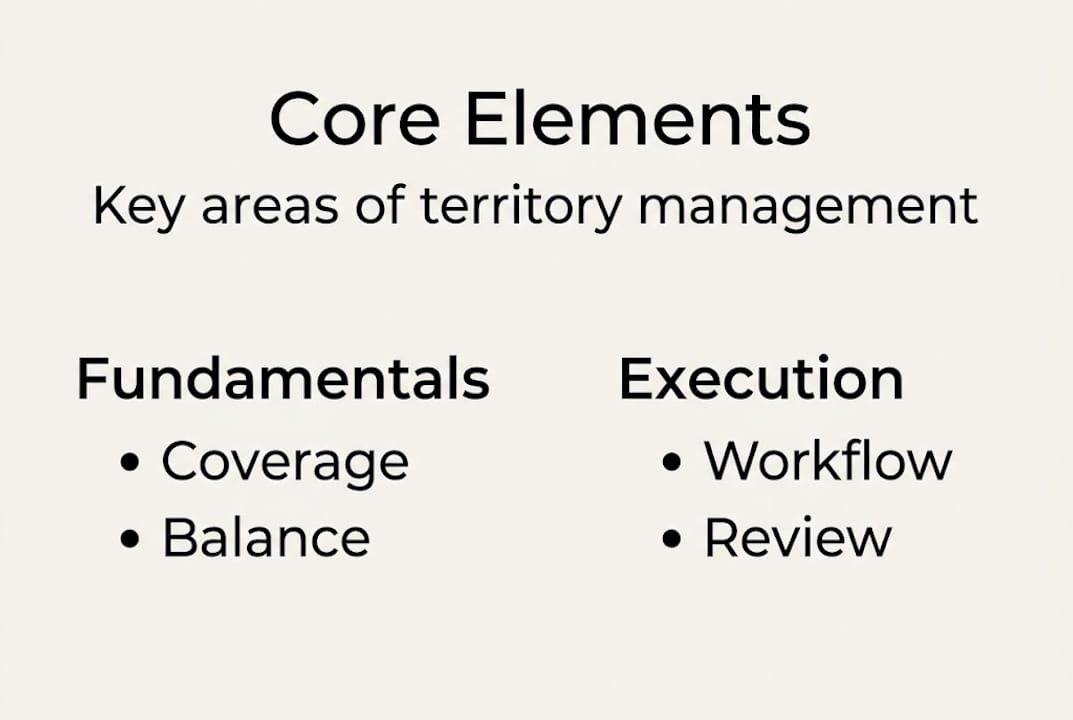
“Territory planning” and “territory management” are often discussed together: planning is the design and allocation step, while management covers ongoing governance, including changes, onboarding into new assignments, performance monitoring, and rebalancing over time. Both matter. Skipping either one creates gaps that cost you revenue.
Here are the five core elements you need to execute well:
Each of these steps connects directly to revenue outcomes. Poor allocation creates imbalance where one rep is overwhelmed and another is underloaded. Skipping onboarding slows ramp time. Ignoring monitoring means problems compound silently until they show up as a missed annual target.
For teams looking to streamline this process, optimizing territory workflow is a practical starting point to reduce friction across each of these steps.
Pro Tip: Run a quarterly “territory health check” using a simple scorecard. Ask reps to flag coverage gaps, capacity issues, or accounts that feel misaligned. Combine that qualitative feedback with your CRM data to spot realignment opportunities before they become revenue problems.
But which structure fits your organization? Let’s break down the main territory frameworks and how to select or combine them for EU tech sales realities.

There’s no single right answer. The best structure depends on your GTM motion, product complexity, customer base, and team size. Here’s a comparison to help you think it through:
| Structure | Strengths | Best use case | Pitfalls |
|---|---|---|---|
| Geographic | Simple to manage, clear ownership | Early-stage teams, regional focus | Ignores buying patterns, uneven density |
| Industry/vertical | Deep expertise, faster trust-building | Complex B2B, niche verticals | Requires specialist reps, harder to scale |
| Named account | High focus, strong relationship depth | Enterprise, strategic accounts | Risk of over-coverage on small accounts |
| Customer segment | Aligns to buyer journey, clear ICP | Multi-segment businesses | Segment overlap can create confusion |
| Product/solution | Enables deep product knowledge | Multi-product companies | Coordination challenges across teams |
| Partner/channel | Scales reach without headcount | Indirect sales motions | Harder to control pipeline quality |
| Hybrid | Flexible, matches real buying behavior | Most scaling EU tech firms | Requires strong ops and clear rules |
For most EU tech firms operating across multiple countries with diverse customer profiles, a hybrid approach is not just an option. It’s often the only model that actually works. Examples include mixing dimensions such as geography plus industry plus named accounts, rather than relying on maps alone.
Consider a SaaS company selling to financial services firms across the Nordics and Benelux. A pure geographic split would give you a “Nordics rep” and a “Benelux rep.” But if your fintech buyers in Stockholm and Amsterdam have more in common with each other than with a logistics company in the same country, a vertical-first model with geographic overlays makes far more sense.
Getting your RevOps sales team structure aligned with your territory model is equally critical. RevOps needs to operationalize whatever territory design you choose, so the two must be built together, not in silos.
Some companies also explore hybrid territory approaches when scaling across markets, combining internal coverage with specialized external resources to extend reach without overloading the core team.
Key considerations when choosing your structure:
Even the best-designed frameworks can fail. Here’s how to avoid classic errors and drive consistent wins.
We’ve seen this pattern repeatedly: a company invests in a territory redesign, rolls it out with good intentions, and then six months later the problems are back. Usually, it’s not the model that failed. It’s the execution. Here are the most common pitfalls:
The fix isn’t complicated, but it does require discipline. Here’s what works:
Pro Tip: Involve your reps in the territory redesign process. Not just as feedback recipients, but as active contributors. Reps who co-design their territories are far more likely to own the outcomes. Buy-in is not a soft concept. It’s a revenue driver.
The number one strategy? Align structure to how the business actually sells. As the principle goes, “the key is aligning the structure to how the business actually sells”, not to what’s easiest to administer. Easy doesn’t equal effective.
For practical examples of how structure translates to results, explore sales strategy examples that show how leading teams have redesigned their coverage models to hit growth targets.
Real talk: Territory management done right is a competitive advantage. Most of your competitors are still drawing maps. You can be building a revenue system.
Top tech companies treat territory management as an ongoing loop, not a set-and-forget. Here’s how to keep it dynamic.
Ongoing governance includes changes, onboarding into new assignments, performance monitoring, and rebalancing over time. That’s not a quarterly task. It’s a continuous operating rhythm. The companies that get this right don’t just have better territory models. They have more predictable revenue.
Here are the KPIs that matter most for monitoring territory health:
| KPI | What it signals | Adjustment trigger |
|---|---|---|
| Quota attainment by territory | Overall territory productivity | Below 70% for two quarters |
| Coverage gap rate | Accounts not actively worked | Over 30% of ICP accounts untouched |
| Lead response time | Speed of follow-up within territory | Over 24 hours average |
| Pipeline balance | Even distribution across reps | One rep holds over 40% of total pipeline |
| Win rate by territory | Quality of territory-to-rep fit | Win rate drops 15%+ vs. prior period |
| Ramp time for new assignments | Onboarding effectiveness | Over 90 days to first close |
Use this table as a living dashboard. When a trigger fires, that’s your signal to investigate, not wait for the next planning cycle.
Here’s a practical review process you can implement now:
For companies navigating rapid growth or market shifts, sustainable growth adjustments offer a useful framework for making territory changes without disrupting momentum.
Change communication matters as much as the change itself. When you rebalance territories, tell your team why. Show the data. Explain the logic. Reps who understand the reasoning adapt faster and perform better. Some organizations also look at outsourced business processes to handle territory administration, freeing up RevOps bandwidth for higher-value analysis and strategy work.
So what’s holding most teams back? Here’s a candid perspective from the field.
We’ve worked with enough EU tech companies to see a clear pattern. Territory management gets deprioritized because it feels like an internal ops problem, not a revenue problem. Leaders focus on hiring more reps, launching new campaigns, or refreshing the pitch deck. Meanwhile, the underlying territory model is quietly undermining all of it.
Traditional models focus heavily on geography because it’s visible and easy to explain. “You own Germany, she owns France.” Simple. But simplicity isn’t the same as effectiveness. When your territory model doesn’t reflect actual buying behavior, you’re asking your reps to fight the market structure every single day. That’s exhausting, and it shows up in attrition, missed quota, and inconsistent pipeline.
The visionary tech leaders we see driving real growth are doing something different. They’re treating territory design as a strategic asset. They’re asking hard questions: Does this territory structure reflect our ICP? Does it leverage our reps’ actual strengths? Does it scale with our growth plan? These leaders are evolving sales team management from a headcount game into a systems game.
Here’s our honest take: the next revenue breakthrough for most EU tech firms won’t come from another SDR hire or a new sales tool. It will come from fixing the foundational structure that determines how every rep spends their time and which accounts they prioritize. Structure beats heroics. Every time.
If you’re ready to turn these best practices into measurable results, here’s where to go next.
Territory management is one of those areas where the gap between knowing and doing is significant. You can read every framework and still struggle to apply it inside a real organization with real constraints. That’s exactly where we come in.

At Sales Label Consulting, we help RevOps leaders, Heads of Sales, and VPs of Sales build territory models that actually match how their business sells. From predictable revenue enablement to a structured 5-step sales audit that surfaces territory imbalances and coverage gaps, we bring the experience and the frameworks to move fast. If your territory model is overdue for a redesign, or you’re not sure where the gaps are, let’s talk. The upside is real, and it’s closer than you think.
Territory planning is designing and allocating sales areas, while territory management involves ongoing monitoring, changes, and performance oversight across those areas over time.
Yes. Territories can be structured by industry, product, customer segment, named accounts, or a hybrid combination, not just by location.
Hybrid structures help EU tech firms address complex, cross-border clients by mixing dimensions like geography and industry rather than relying on simple map-based splits.
Territories should be reviewed at least annually, with ongoing governance covering changes and rebalancing triggered by significant sales, market, or personnel shifts.
Key KPIs include quota attainment by territory, coverage gap rate, lead response time, pipeline balance across reps, and win rate trends compared to prior periods.
Subscribe to our Insights: Expert productivity tips in your inbox
You'll receive 1-3 emails per month. Your data stays private, always.

CRO & Co-Founder with Sales Label Consulting

Watch our Sales Mates Podcast
Available
April 28, 2026 - 10 min read
Read article Read articleApril 28, 2026 - 10 min read
Read article Read articleApril 28, 2026 - 10 min read
Read article Read articleApril 27, 2026 - 9 min read
Read article Read articleDrop us a line to talk
about your project